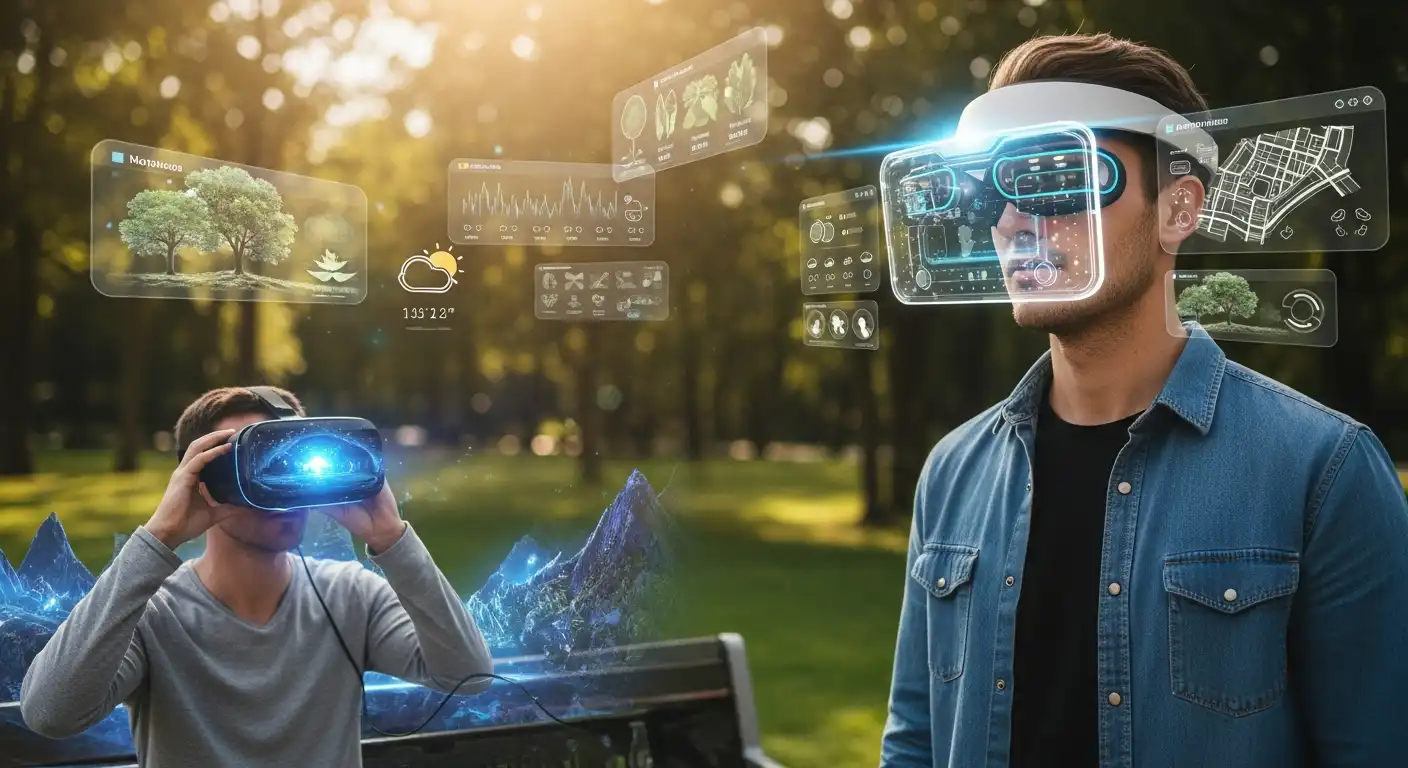
For decades, we consumed stories from a safe distance. We sat on our couches and stared at flat, rectangular screens, watching other people live their lives, fight their battles, and explore new worlds. This flat-screen model worked well, but it always kept us on the outside looking in. Today, in 2026, the screen is finally dissolving. We have entered the era of the immersive content market, where we do not just watch the story—we step directly inside it. Virtual reality is no longer a niche toy for gamers. It is the new foundation of global entertainment, education, and social connection, fundamentally changing how we experience digital reality.
Step Inside the Story
Traditional media required us to imagine what it felt like to stand in a specific place. If you watched a documentary about the deep ocean or a film about a historical battle, you only saw what the camera director chose to show you. Virtual reality completely breaks this limitation. When you put on a modern, lightweight VR headset, you are no longer a passive viewer. You are an active participant. You can look up at the towering canopy of a rainforest, turn around to see a creature sneaking up behind you, or look down at the dizzying heights of a mountain peak. The story happens all around you, and this presence creates an emotional connection that flat screens can never replicate.
The Rebirth of Live Entertainment
We used to spend fortunes on concert tickets, plane travel, and hotels just to see our favorite artists perform live. If you lived in a remote town or could not afford the ticket, you simply missed out on the experience. Virtual reality is democratizing live entertainment. Today, musicians, theaters, and sports leagues broadcast their events in high-definition, 3D spatial audio directly to the VR market. You can purchase a virtual ticket and stand right on the stage next to the lead guitarist, or sit in the front-row seat of a championship football match. You feel the energy of the crowd and the scale of the stadium, all from your own living room.
Classroom Without Walls
Our education systems relied on textbooks and flat diagrams for centuries. We forced students to memorize dry facts about the solar system or the human body. Virtual reality turns learning into an active adventure. Instead of reading about ancient Rome, students can put on their headsets and walk through the bustling streets of the Colosseum. Instead of staring at a drawing of a cell, they can shrink down and float through the bloodstream, watching how white blood cells fight off an infection. When we make education a physical experience, children learn faster and retain knowledge for much longer. We stop telling them about the world and start showing it to them.
The New Creative Tools for Artists
We once designed digital art using keyboards, mice, and flat monitors. It was a clumsy way to build three-dimensional shapes. Virtual reality gives creators a brand-new canvas. Sculptors, painters, and architects now design inside the 3D space itself. They use their hands to mold digital clay, paint with glowing light in mid-air, and walk through their architectural designs before workers lay a single physical brick. This frictionless creative process accelerates innovation and enables wild, beautiful designs that were previously impossible to create on a flat screen.
Building the Virtual Workplace
The physical office is becoming optional for millions of people. But flat video calls often feel cold, exhausting, and disconnected. We miss the informal chats by the coffee machine and the collaborative energy of a shared whiteboard. Virtual reality is rebuilding the office in the digital space. Teams from different continents can meet in a virtual room, sit around a shared table, and brainstorm ideas on a 3D board. You can see your colleague’s gestures, hear their voice change as they move around the room, and instantly share physical models of a product. We get the collaboration of a real office without the stress of a daily commute.
The Hidden Danger of Virtual Isolation
We must look honestly at the risks of this immersive future. When the digital world becomes more colorful, more exciting, and more perfect than reality, some people will choose never to leave. We risk creating a generation of isolated individuals who trade real-world friendships, outdoor exercise, and community connections for a comfortable digital illusion. We need to maintain a healthy balance. We must design our virtual spaces to be tools that enhance our physical lives, not escape hatches that allow us to run away from them. The real world must always remain our primary home.
Protecting Your Biological Data in VR
A VR headset is not just a screen; it is a massive data-harvesting machine. To track your movements and make the virtual world look stable, the headset must constantly scan your eyes, measure your heart rate, and track your physical gestures. This means tech companies now collect our most private biological data. They know exactly what excites us, what scares us, and where we look when we want to buy something. We must demand strict privacy laws. Your biological data belongs to you, and no company should ever be allowed to sell your physical reactions to advertisers.
Conclusion
We are watching the death of the flat screen. The immersive content market is growing into a massive, global force that will reshape how we play, learn, work, and connect. By breaking down the physical barriers of distance and scale, virtual reality gives us the power to experience the impossible. But as we build these magnificent digital worlds, we must remain anchored in our physical reality. We must protect our privacy, value our physical connections, and ensure that technology always expands our human experience rather than limiting us to a headset. The future is no longer flat; it is wide open and incredibly real.