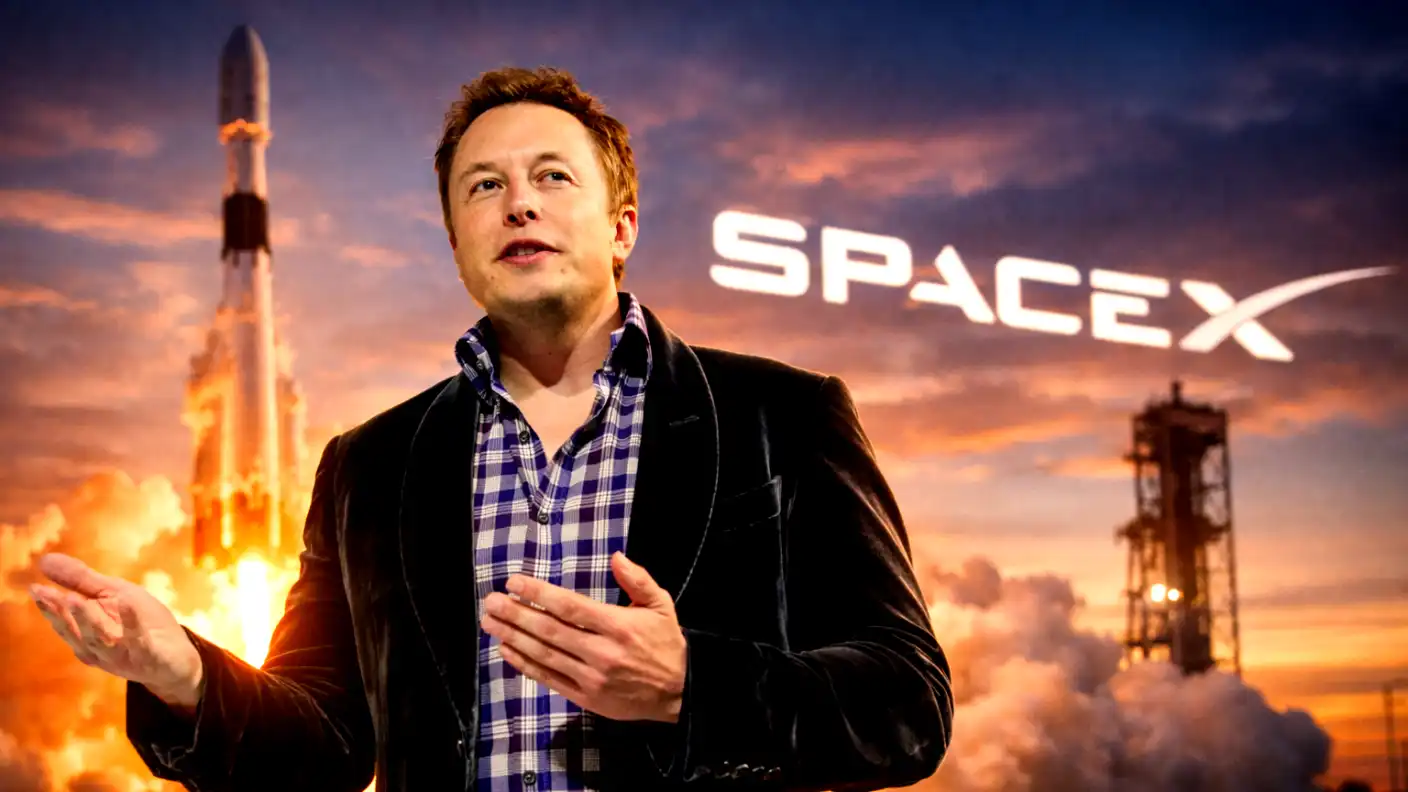
Wall Street equity research desks and institutional investors are assigning significantly higher probability odds to a potential corporate merger or parent holding company consolidation between electric vehicle giant Tesla and aerospace leader SpaceX. The surging market speculation follows public comments from Chief Executive Officer Elon Musk highlighting the accelerating technical, material, and operational overlaps across his technology enterprise empire. Financial analysts across top investment banks are describing a strategic consolidation as an increasingly logical, if not inevitable, evolution for the multi-billion-dollar corporate ecosystem.
A consolidated corporate entity uniting Tesla and SpaceX would create an unprecedented industrial technology conglomerate with a combined valuation well above $1 trillion. SpaceX recently achieved a private market valuation exceeding $210 billion in secondary tender offers, while Tesla maintains a public market capitalization hovering near $800 billion. Combining Tesla’s high-volume automated manufacturing, battery cell production, and public market capital access with SpaceX’s Starlink satellite broadband monopoly and reusable rocket launch capabilities would form an unmatched cross-industry industrial titan.
Financial statements confirm that the two balance sheets are already deeply intertwined. In its second-quarter earnings report, Tesla recognized a massive $1.005 billion pre-tax unrealized paper gain on its balance sheet holdings of private SpaceX equity. The paper investment gain proved crucial to Tesla’s reported financial results, accounting for nearly two-thirds of the automaker’s $1.11 billion in total quarterly GAAP net income. As cross-company technology transfers accelerate across material science, satellite communications, and artificial intelligence, Wall Street analysts argue that formal corporate unification represents the most efficient framework to streamline governance and unlock massive operational synergies.
TechGolly provides a detailed analysis of the rising Tesla and SpaceX merger odds, evaluating holding company corporate structures, shared material science engineering, Starlink vehicle connectivity, xAI compute integration, regulatory approval hurdles, and long-term Wall Street valuation models.
Unpacking the Mechanics of an “X Holdings” Parent Company Architecture
To understand how a potential transaction between Tesla and SpaceX would execute, financial analysts and corporate governance experts point to a parent holding company framework often referred to as “X Holdings.” Under this corporate architecture, an overarching parent entity would acquire or hold controlling equity stakes in Tesla, SpaceX, xAI, Neuralink, and The Boring Company.
Constructing a single parent holding company solves several complex financial and governance challenges for Musk and institutional shareholders. Rather than executing a direct cash acquisition that would drain corporate reserves, an X Holdings framework would utilize stock-for-stock equity swaps. Public Tesla shareholders and private SpaceX equity holders would exchange their existing shares for common stock in the new parent entity, creating a liquid, mega-cap industrial stock traded on major stock exchanges.
For Musk, a consolidated holding structure directly resolves a long-standing corporate governance goal: securing stable voting control over his artificial intelligence and robotics initiatives. Musk has repeatedly stated that he requires at least 25% voting power across his AI enterprises to prevent hostile corporate takeovers or activist investor interventions that could misalign advanced technology deployment. Consolidating his voting stakes across Tesla, SpaceX, and xAI under a unified parent company guarantees the voting leverage needed to direct long-term technology roadmaps.
From a financial market perspective, a parent holding company structure mirrors successful historical corporate precedents, such as Google’s reorganization into Alphabet or Warren Buffett’s multi-industry conglomerate structure at Berkshire Hathaway. Operating under an overarching corporate umbrella allows individual operating divisions—such as space launch, automotive assembly, satellite internet, and humanoid robotics—to preserve operational agility while benefiting from shared capital allocation, centralized legal defense, and unified corporate balance sheet strength.
The $1.005 Billion SpaceX Balance Sheet Anchor
A critical, overlooked detail confirming the deep financial relationship between Tesla and SpaceX is the $1.005 billion paper gain recognized on Tesla’s second-quarter income statement.
Years prior to the current merger discussions, Tesla acquired a strategic private equity position in SpaceX. As SpaceX’s private valuation climbed from $50 billion to over $210 billion driven by the rapid commercial expansion of Starlink and Starship development milestones, the value of Tesla’s private equity holding expanded proportionally.
During the second quarter, accounting standards required Tesla to mark its private equity holding to fair market value, yielding a $1.005 billion pre-tax unrealized gain. Because elevated research and development expenses on artificial intelligence and humanoid robotics compressed Tesla’s core automotive operating income to $398 million, the paper gain on SpaceX stock provided the vast majority of Tesla’s $1.11 billion in reported GAAP net income.
This accounting relationship demonstrates that Tesla’s financial reporting is already directly influenced by SpaceX’s corporate valuation. Formalizing a corporate merger or equity alignment eliminates accounting friction, allowing public equity investors to participate directly in SpaceX’s high-margin satellite launch and space logistics cash flows.
Technical and Material Synergies: From Starship Steel to Cybertruck Gigacastings
While financial engineering provides the corporate rationale, deep technical and material science collaboration provides the physical foundation for a Tesla and SpaceX merger.
The physical overlap between space launch engineering and automotive manufacturing has accelerated rapidly over recent years. A primary example of shared material science is the development of custom stainless steel alloys. SpaceX materials engineers spent years developing specialized cold-rolled 300-series stainless steel alloys designed to withstand the extreme thermal and structural stresses experienced by the Starship rocket during atmospheric re-entry.
Tesla’s engineering team directly adopted this exact proprietary stainless steel alloy to construct the structural exoskeleton of the Tesla Cybertruck. By sharing metallurgy research across corporate boundaries, Tesla eliminated millions of dollars in material development expenses, while SpaceX gained a high-volume industrial consumer that lowered raw stainless steel procurement costs through bulk purchasing.
Advanced manufacturing techniques represent a secondary area of deep cross-pollination. Tesla revolutionized automotive manufacturing by deploying massive “Gigapress” aluminum die-casting machines capable of casting entire front and rear vehicle underbodies in a single mechanical stamp. SpaceX manufacturing teams adapted these large-scale metal casting and automated friction-stir welding techniques to streamline Starship propellant tank assembly lines in Boca Chica, Texas.
Furthermore, the two enterprises share specialized engineering talent. Top-tier mechanical, aerospace, and software engineers routinely rotate between SpaceX facilities in Hawthorne, California, and Tesla campuses in Austin and Fremont. Shared engineering groups collaborate on thermal heat shield coatings, high-voltage electrical architecture, custom battery management systems, and high-reliability electric motor winding techniques.
Starlink Direct-to-Cell Integration and Vehicle Telemetry
The commercial integration of SpaceX’s Starlink satellite broadband network into Tesla’s global electric vehicle fleet represents one of the most immediate, high-value consumer synergies resulting from a merger.
SpaceX has constructed the world’s largest low-Earth-orbit satellite constellation, deploying over 6,000 active Starlink satellites that provide high-speed, low-latency internet coverage globally. SpaceX is expanding its Direct-to-Cell satellite capability, allowing standard cellular chips and vehicle antennas to connect directly to Starlink satellites without requiring expensive satellite dish hardware.
Integrating Starlink Direct-to-Cell technology natively into millions of Tesla passenger cars, Cybertrucks, Tesla Semis, and upcoming Cybercabs eliminates cellular coverage dead zones worldwide. Electric vehicles operating in remote desert highways, mountain passes, or rural agricultural corridors maintain continuous, uninterruptible connectivity to satellite networks.
Continuous global connectivity delivers major operational benefits for Tesla’s autonomous driving ecosystem:
First, real-time vehicle telemetry streaming. Tesla’s engineering team can stream high-definition camera video and sensor telemetry from active vehicles anywhere on Earth, enriching the real-world dataset used to train autonomous driving models.
Second, guaranteed over-the-air software updates. Tesla can push critical security patches, navigation map updates, and Full Self-Driving software builds to customer vehicles regardless of local cellular tower availability.
Third, reliable commercial robotaxi operations. Uninterruptible satellite connectivity ensures that autonomous Cybercabs operating in remote or suburban service areas maintain continuous communication with remote fleet management centers, satisfying strict state safety regulations.
The AI Compute Convergence: xAI, Optimus, and Autonomous Intelligence
The central force unifying Tesla and SpaceX into a single technological ecosystem is artificial intelligence. Elon Musk’s artificial intelligence research firm, xAI, functions as the digital cognitive engine driving physical hardware automation across both companies.
At xAI’s Colossus supercomputer facility in Memphis, Tennessee, engineering teams constructed a high-density liquid-cooled cluster housing 200,000 Nvidia graphics processing units. The Colossus supercomputer provides the massive pre-training compute capacity required to build advanced foundation reasoning models, specifically the Grok model series.
The digital intelligence trained on the Colossus supercluster is deployed directly into physical hardware systems operating across Tesla and SpaceX:
At Tesla, xAI’s computing cluster trains end-to-end vision neural networks powering Full Self-Driving and provides the artificial intelligence world models needed to operate the Optimus humanoid robot. Training an autonomous humanoid robot to navigate unstructured industrial environments, manipulate tools, and lift heavy factory parts requires processing petabytes of real-world physics data on massive GPU clusters.
At SpaceX, Grok artificial intelligence models process real-time telemetry from active Falcon 9 and Starship launch sequences, optimize orbital routing for thousands of Starlink satellites, and execute automated collision avoidance maneuvers in real time.
By creating a closed-loop physical artificial intelligence ecosystem, Musk establishes a unique competitive flywheel: SpaceX rockets and Tesla vehicles gather physical world data, xAI supercomputers process the data to train frontier models, and the resulting intelligence executes physical tasks across space rockets, electric cars, and humanoid factory workers.
Navigating Legal, Fiduciary, and Regulatory Approval Hurdles
While the commercial and engineering logic supporting a Tesla and SpaceX merger is compelling, executing a formal transaction requires navigating complex legal, regulatory, and corporate governance challenges.
A primary hurdle involves the fiduciary duties owed by Tesla’s board of directors to public minority shareholders. Because Tesla is a publicly traded corporation while SpaceX is a private enterprise dominated by internal insiders, any merger or stock-for-stock acquisition will face intense judicial scrutiny in Delaware or Texas corporate chancery courts.
Independent directors on Tesla’s board must ensure that the transaction valuation accurately reflects the fair market value of both companies, establishing special independent board committees and hiring independent financial advisers to issue formal fairness opinions. If public shareholders perceive that public Tesla capital is being used to subsidize private aerospace ventures without fair financial compensation, activist shareholders will file corporate breach of fiduciary duty lawsuits.
Federal regulatory agencies will also subject the transaction to exhaustive antitrust and national security reviews. The Federal Trade Commission and the Securities and Exchange Commission will evaluate whether combining dominant market positions in electric vehicles, satellite internet, space launch, and artificial intelligence creates anti-competitive market concentration.
Furthermore, because SpaceX executes highly classified defense launch contracts for the United States Department of Defense and intelligence agencies, the Committee on Foreign Investment in the United States and military security agencies must approve the corporate ownership structure, ensuring that foreign equity holders in public Tesla stock cannot access classified defense technology or restricted aerospace intellectual property.
Wall Street Valuation Re-Ratings and Long-Term Market Scenarios
Despite complex regulatory hurdles, Wall Street equity research desks maintain an overwhelmingly positive outlook regarding the long-term market valuation of a combined Tesla and SpaceX conglomerate.
Financial modeling published by top investment banks indicates that an integrated X Holdings parent company could achieve an initial public market valuation between $1.5 trillion and $2.0 trillion, with long-term bull-case projections targeting $3.0 trillion by 2030.
Consolidating the two companies fundamentally alters the risk profile for equity investors, creating an industrial giant with highly diversified, non-correlated revenue streams:
First, high-volume consumer automotive and retail energy storage revenues generated by Tesla’s Model 3, Model Y, Megapack, and solar operations.
Second, high-margin subscription recurring revenues generated by SpaceX’s Starlink satellite broadband network, which is expanding into maritime, aviation, and defense markets.
Third, high-margin, long-term government defense launch contracts secured by SpaceX’s Falcon 9 and Starship launch platforms.
Fourth, high-upside software recurring revenues generated by Full Self-Driving subscriptions, autonomous Cybercab ride-hailing networks, and Optimus humanoid robot commercial leases.
By blending mature, cash-generative commercial operations with high-growth aerospace monopolies and frontier artificial intelligence capabilities, a combined Tesla-SpaceX entity offers institutional investors an irreplaceable core holding for long-term capital appreciation.
Key Takeaways for Tech Executives, Investors, and Automotive Leaders
The rising odds of a Tesla and SpaceX merger offer vital strategic lessons for corporate decision-makers, technology architects, automotive executives, and global institutional investors.
First, physical technology convergence is the defining industrial trend of the 21st century. The historical boundaries separating automotive manufacturing, aerospace engineering, satellite telecommunications, and software artificial intelligence have dissolved. Companies that master multi-disciplinary hardware and software integration will dominate global markets.
Second, corporate balance sheets are increasingly interconnected through technology assets. Tesla’s $1.005 billion paper gain on SpaceX equity demonstrates how strategic cross-investments and shared intellectual property build balance sheet resilience during cyclical industrial downturns.
Third, vertical integration delivers insurmountable competitive advantages. Controlling the end-to-end physical technology stack—from raw stainless steel alloys and custom microprocessors to satellite networks and autonomous software—allows integrated conglomerates to innovate faster and operate at lower unit costs than fragmented competitors.
Finally, the global technology race requires immense physical and financial scale. As artificial intelligence and industrial automation scale toward multi-trillion-dollar commercial markets, visionary corporate leaders who combine capital, hardware manufacturing, and frontier digital intelligence will lead the global economy into the future.