Key Points:
- Kioxia’s market capitalization reached 44 trillion yen, surpassing Toyota to become Japan’s most valuable company.
- The historic turnaround comes just 18 months after Kioxia’s December 2024 IPO valued it at $5.2 billion.
- The company survived years of severe memory slumps, delayed listings, and a blocked Western Digital merger in 2023.
- Unstoppable demand for high-density enterprise SSDs in AI data centers drives the firm’s record profitability.
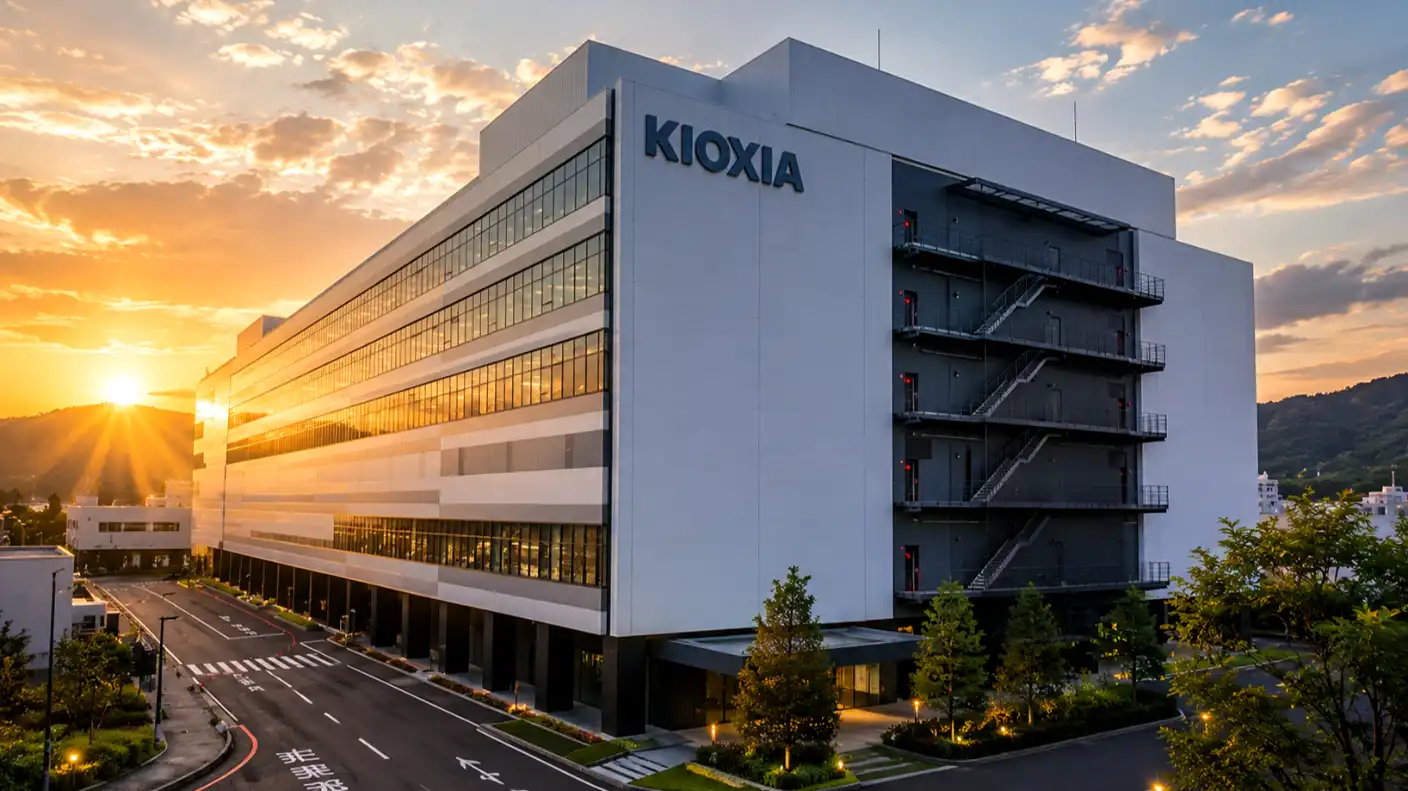
Kioxia Caps Years of severe financial market turmoil and strategic corporate uncertainty to officially crown itself as Japan’s most valuable listed company. The memory chipmaker’s total market capitalization soared past 44 trillion yen (approximately $274 billion) on Friday, edging past automotive titan Toyota Motor Corp. to secure the historic top spot. For a company that spun off from an embattled parent, narrowly survived a brutal semiconductor downturn, and repeatedly delayed its initial public offering, this dramatic climb represents an unprecedented corporate turnaround. The milestone proves that global capital markets now prize high-performance data storage as the most vital commodity of the digital era.
To understand the magnitude of this triumph, one must look back at the company’s highly unstable origins. In 2018, Toshiba Corporation, which pioneered NAND flash memory technology in 1987, faced catastrophic financial losses from its nuclear power division. To avoid bankruptcy, Toshiba sold its crown-jewel memory-chip business to a Bain Capital-led private equity consortium for 2 trillion yen ($18 billion). Rebranded as Kioxia in 2019, the newly independent chipmaker struggled immediately to find its footing, caught between falling consumer electronics demand and a global pandemic that disrupted manufacturing.
During its years as a private entity, the company sought to consolidate its market position by merging with its longtime joint-venture partner, U.S.-based Western Digital. However, the proposed multi-billion-dollar merger faced immense regulatory and corporate hurdles. In October 2023, South Korea’s SK Hynix, which held an indirect stake in Kioxia through the Bain Capital consortium, officially blocked the merger on antitrust grounds, fearing that the combined entity would severely undermine its market competitiveness. This high-profile rejection left Kioxia isolated, forced to navigate a punishing semiconductor downturn entirely on its own.
The year 2023 proved to be the most financially painful period in the company’s history. A severe global oversupply of memory chips, combined with a sharp slowdown in smartphone and personal computer sales, triggered historic losses. The company had to slash production and repeatedly delay its planned initial public offering as its valuation targets collapsed. After years of waiting, the firm finally debuted on the Tokyo Stock Exchange in December 2024 at a highly discounted valuation of just 780 billion yen ($5.2 billion). Very few Wall Street investors at the time anticipated that this cheap, struggling manufacturer would eventually dominate the national market.
Since that quiet December 2024 market debut, the company has executed a stunning, parabolic upward trajectory. Its stock price has surged by more than 3,500% from its initial offering price, pushing its market capitalization above Toyota’s valuation of 43.8 trillion yen. This rapid repricing reflects an extraordinary turnaround in the company’s underlying profitability. After posting massive losses in 2023, the chipmaker reported a record quarterly operating profit of 596.8 billion yen for the quarter ending in March. Furthermore, the company has guided for a massive operating profit of approximately 1.3 trillion yen (around $8.2 billion) for the June quarter alone.
The primary catalyst driving this sudden financial windfall is the unstoppable global supercycle in generative artificial intelligence. While early investors focused almost exclusively on graphics processing units (GPUs) to train large language models, deploying AI at scale requires immense amounts of high-speed, high-density storage. Generative AI systems must constantly read and write massive datasets, making traditional hard drives obsolete. This technological shift has triggered an unprecedented surge in demand for the enterprise-grade solid-state drives (SSDs) that Kioxia manufactures at its advanced, joint-venture production plants in Yokkaichi and Kitakami.
The company’s manufacturing footprint gives it a unique, highly defensible advantage over global competitors. Together with Western Digital, Kioxia cooperates with the Yokkaichi plant in Mie Prefecture and the newly expanded Kitakami facility in Iwate Prefecture. These state-of-the-art gigafabs produce the cutting-edge “BiCS FLASH” three-dimensional memory architecture, which stacks memory cells vertically to maximize storage capacity. By running these highly automated facilities at maximum capacity, the company can deliver the massive volumes of high-performance flash memory required by U.S. and Asian cloud-computing giants.
Kioxia’s ascent to the top of Japan’s corporate hierarchy signals a permanent transition for the nation’s equity markets. For more than three decades, global investors viewed Japan primarily as a cyclical, manufacturing-driven market dominated by automakers like Toyota and industrial heavyweights. The rise of Kioxia, alongside tech-focused conglomerates like SoftBank Group, proves that Japan has successfully re-established itself as a critical, high-growth hub for the global artificial intelligence infrastructure. This structural shift is attracting billions of dollars of foreign institutional capital back to the Tokyo Stock Exchange.
Ultimately, Kioxia’s extraordinary journey from the brink of financial collapse to becoming Japan’s most valuable company serves as a powerful lesson in corporate resilience. By surviving years of market downturns, blocked mergers, and failed listings, the company maintained its technical edge and prepared itself to capture the massive opportunities of the AI era. As global demand for advanced, high-density storage continues to outpace industry supply, the newly crowned market leader is exceptionally well-positioned to fund its future research and consolidate its dominance in the global semiconductor supply chain.