The global artificial intelligence boom is colliding with the hard, physical realities of the electrical grid. As tech giants build massive data centers to run complex, real-time AI models, they are consuming electricity at a rate that has caught utility companies completely off guard. These high-density computing hubs require continuous, around-the-clock power to prevent expensive server downtime, creating an urgent need for reliable, zero-emission baseload electricity.
While solar arrays and wind turbines make up over 90% of new global power capacity, their natural, weather-dependent intermittency leaves grids highly vulnerable during periods of low output. This has turned geothermal energy into the ultimate dark horse of the clean energy transition.
However, building traditional geothermal power plants is an incredibly slow and expensive process, often taking several years to assemble massive custom turbines on-site.
To solve this physical hardware bottleneck, Los Angeles-based startup Critical Energy has announced a breakthrough. Founded by Spencer Jackson, a former SpaceX rocket engineer, the company has raised $22 million in seed funding to mass-produce modular geothermal turbines in factories, allowing developers to bring geothermal data center power online in weeks instead of years.
The Crisis of AI Grid Interconnection and the Search for Baseload Power
The rapid expansion of generative artificial intelligence has fundamentally altered the global energy landscape. After nearly two decades of flat electricity sales, power demand in the United States is projected to grow by as much as 20% over the next decade. This sudden surge is driven primarily by hyperscale data centers, which operate as massive energy sinks, requiring up to 150 kilowatts of power per server rack.
To power these facilities sustainably, technology companies have committed to strict net-zero carbon goals. However, meeting these goals is proving incredibly difficult. While solar and wind are cheap and abundant, they cannot provide the constant, 24/7 power that AI data centers require.
This has kept fossil fuels entrenched in the energy mix, accounting for roughly 82% of all U.S. energy use. To escape this fossil fuel trap, developers are searching for a clean, stable baseload power source.
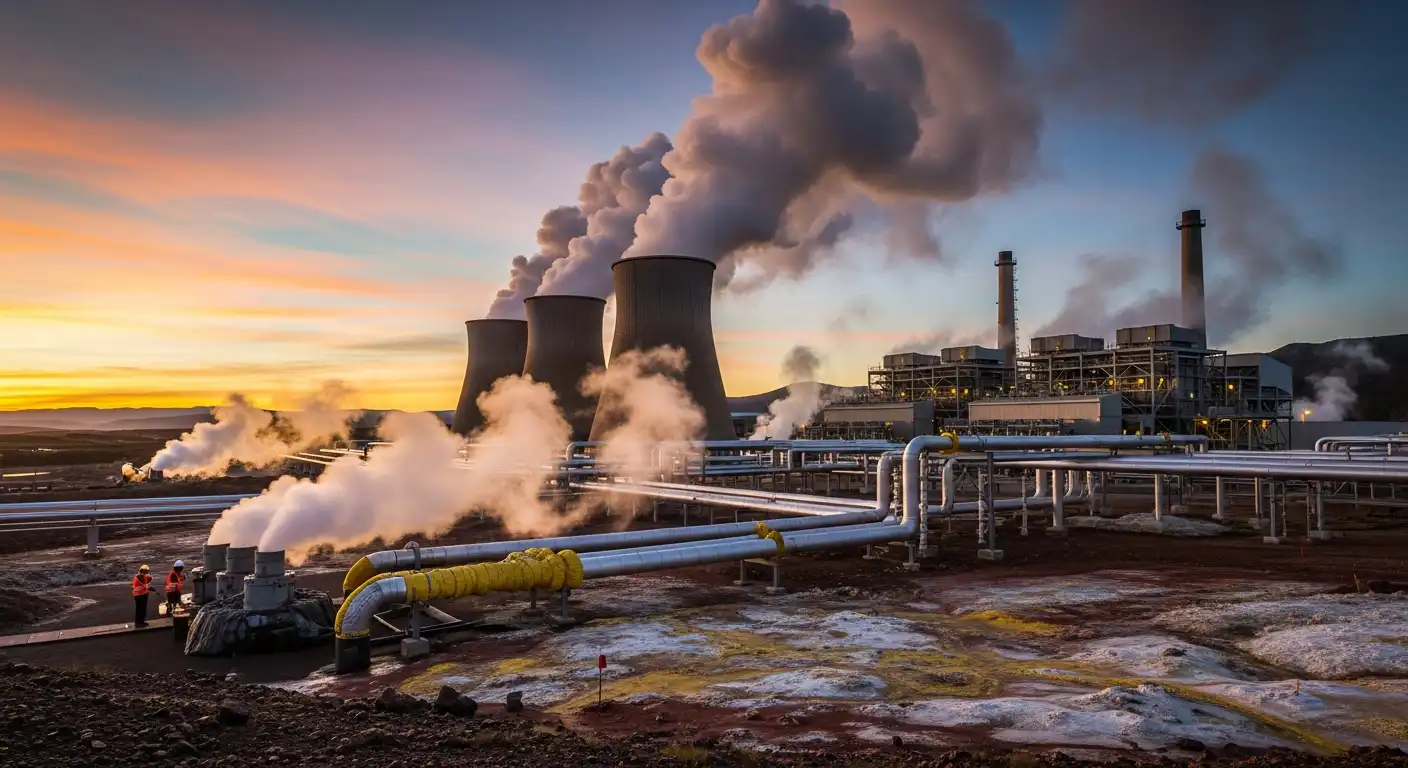
Geothermal energy, which draws constant heat from the Earth’s core, represents an ideal solution. But traditional geothermal projects take years to construct due to a major supply chain bottleneck: a severe global shortage of large-scale, custom-designed steam turbines.
Key Components of Next-Generation Geothermal Infrastructure
To transform deep geothermal heat into rapidly deployable, grid-scale electricity, developers rely on several critical technical components:
- Modular Geothermal Turbines: Container-sized, closed-loop turbines manufactured in automated factories rather than custom-assembled on-site over several months.
- Enhanced Geothermal Systems (EGS): Using advanced horizontal drilling and multi-stage hydraulic fracturing to engineer geothermal reservoirs in hot, dry, and impermeable underground rock.
- Factory-Line Mass Production: Applying highly standardized automotive and aerospace manufacturing principles to clean energy hardware to drive down costs.
- Behind-the-Meter Power Islands: Microgrid configurations that connect geothermal power plants directly to adjacent data center campuses, completely bypassing the public grid.
- Closed-Loop Thermodynamic Cycles: Using low-boiling-point working fluids to generate high-efficiency electricity from moderate-temperature subterranean heat.
Critical Energy’s Rocket-Engine Blueprint for Geothermal Power
The technical inspiration behind Critical Energy comes directly from the advanced aerospace programs of SpaceX. The startup’s founder and CEO, Spencer Jackson, spent seven years as an engineering leader at Elon Musk’s rocket company, where he designed structural components for Falcon Heavy, engineered thermal protection shields for Starship, and developed high-performance turbomachinery for the state-of-the-art Raptor rocket engine.
Jackson realized that the primary bottleneck in the geothermal sector was not the drilling process, but the surface hardware. He noticed that while advanced drilling startups were successfully reaching deep underground heat, they had to wait years to secure and assemble the massive, custom-built turbines needed to turn that heat into electricity.
To solve this, Jackson founded Critical Energy in 2024, aiming to do to geothermal power plants what Henry Ford did to the car.
Instead of treating a power plant as a custom, bespoke civil engineering project, Critical Energy designs and manufactures standardized, modular geothermal turbines. These units are built entirely in-house inside the company’s Los Angeles facility and are packaged inside standard, 40-foot shipping containers.
A fully functional, 5-megawatt power plant consists of just four of these containers. The company can ship these modular units anywhere in the world and assemble them on-site like giant Lego bricks in just a few weeks. This factory-built approach slashes construction costs, bypasses the global turbine supply chain crunch, and allows developers to bring zero-emission power online on unprecedented timelines.
The $22 Million Seed Funding and Strategic Backers
The startup’s bold vision has attracted significant attention from some of the most prominent climate and technology investors in Silicon Valley. Critical Energy announced that it has successfully raised $22 million in seed funding. The oversubscribed round was led by Susa Ventures and Upfront Ventures, with participation from MaC Venture Capital, Susquehanna Sustainable Investments, Humba Ventures, Scribble Ventures, and Underground Ventures.
Additionally, the company secured an undisclosed venture debt facility from Silicon Valley Bank to provide further financial cushion as it ramps up its operations. The newly raised funds are earmarked to build Critical Energy’s very first 2.5-megawatt commercial demonstration project.
By proving the viability of its factory-built, closed-loop thermodynamic turbines in a real-world setting, the company aims to quickly scale up its manufacturing capacity, transitioning from small-scale pilots to mass-producing gigawatts of modular power annually.
Geothermal vs. Nuclear: The Race to Power the AI Boom
As the power crisis intensifies, tech giants like Microsoft, Google, and Meta are exploring a wide variety of clean energy options, including advanced nuclear fission and next-generation nuclear fusion. However, these nuclear technologies face severe, long-term development timelines, with most startups targeting the early 2030s for their first commercial deployments.
Spencer Jackson believes that geothermal is positioned to beat these nuclear technologies to the market by a wide margin. He explained that within the next four to five years, geothermal startups will be delivering multiple gigawatts of clean, dispatchable power annually, establishing themselves as the dominant clean energy providers long before the first commercial fusion reactor comes online.
The commercial potential for geothermal in the tech sector is truly staggering:
- Meeting 64% of Hyperscale Demand: A recent report by the Rhodium Group concluded that behind-the-meter enhanced geothermal energy could meet up to 64% of the projected growth in electricity demand at U.S. hyperscale data centers by 2030, representing a massive market opportunity.
- 100% Demand Coverage in Major Hubs: If developers choose to locate their data centers based on energy access rather than traditional fiber networks, advanced geothermal could meet 100% of anticipated data center demand growth in 13 of the 15 largest technology markets in the United States.
- Weather-Independent 90% Capacity: Because geothermal draws energy directly from the Earth’s core, it operates with a high capacity factor of roughly 90%, running 24 hours a day, 7 days a week, regardless of weather conditions, making it far more reliable than wind and solar.
This exceptional reliability, combined with a tiny physical land footprint and minimal water usage, makes advanced geothermal the perfect fit for the stringent operational demands of AI hyperscalers.
The Strategic Expansion of Enhanced Geothermal Systems (EGS)
The rapid rise of companies like Critical Energy is happening alongside a broader technological revolution in how we access the Earth’s heat, known as Enhanced Geothermal Systems (EGS).
Historically, geothermal power was a niche energy source, limited to rare geographic regions like California, Kenya, and Iceland, where shallow volcanic activity created natural, highly permeable hydrothermal reservoirs.
Enhanced Geothermal Systems completely rewrite this geological constraint. By applying advanced horizontal drilling and multi-stage hydraulic fracturing techniques pioneered by the shale oil and gas industry, EGS developers can drill miles into hot, dry rock anywhere on Earth, inject cold water at high pressure to engineer their own underground heat reservoirs, and pump the superheated water back to the surface to generate power.
This technological breakthrough has unlocked a massive, multi-trillion-dollar investment opportunity. Startups like Fervo Energy—which recently went public in a historic $1.9 billion IPO—and Sage Geosystems are already building commercial-scale EGS projects in the western United States, backed by long-term power purchase agreements with Google and Meta.
By designing modular, container-sized turbines specifically tailored for these EGS projects, Critical Energy is solving the final, critical piece of the geothermal puzzle, allowing developers to quickly convert deep subterranean heat into clean, on-site electricity.
Conclusion
The successful funding round of Critical Energy represents a major turning point in the global search for reliable, zero-emission baseload power. By leveraging his SpaceX background to design modular, container-sized geothermal turbines, Spencer Jackson is successfully transforming power plants from slow, bespoke construction projects into standardized products built on factory assembly lines. This innovative approach directly addresses the primary bottleneck facing the clean energy transition, allowing developers to bring geothermal data center power online in weeks instead of years. As tech giants scramble to secure electricity to power the AI boom, and as advanced nuclear technologies remain years away from commercial viability, factory-built geothermal systems are emerging as the most practical, scalable solution to the world’s energy crisis. By turning deep underground heat into highly efficient, rapidly deployable electricity, Critical Energy is helping to build an abundant, low-cost, and 100% clean energy future, proving that the real-world execution of clean technology is the ultimate key to global sustainability.