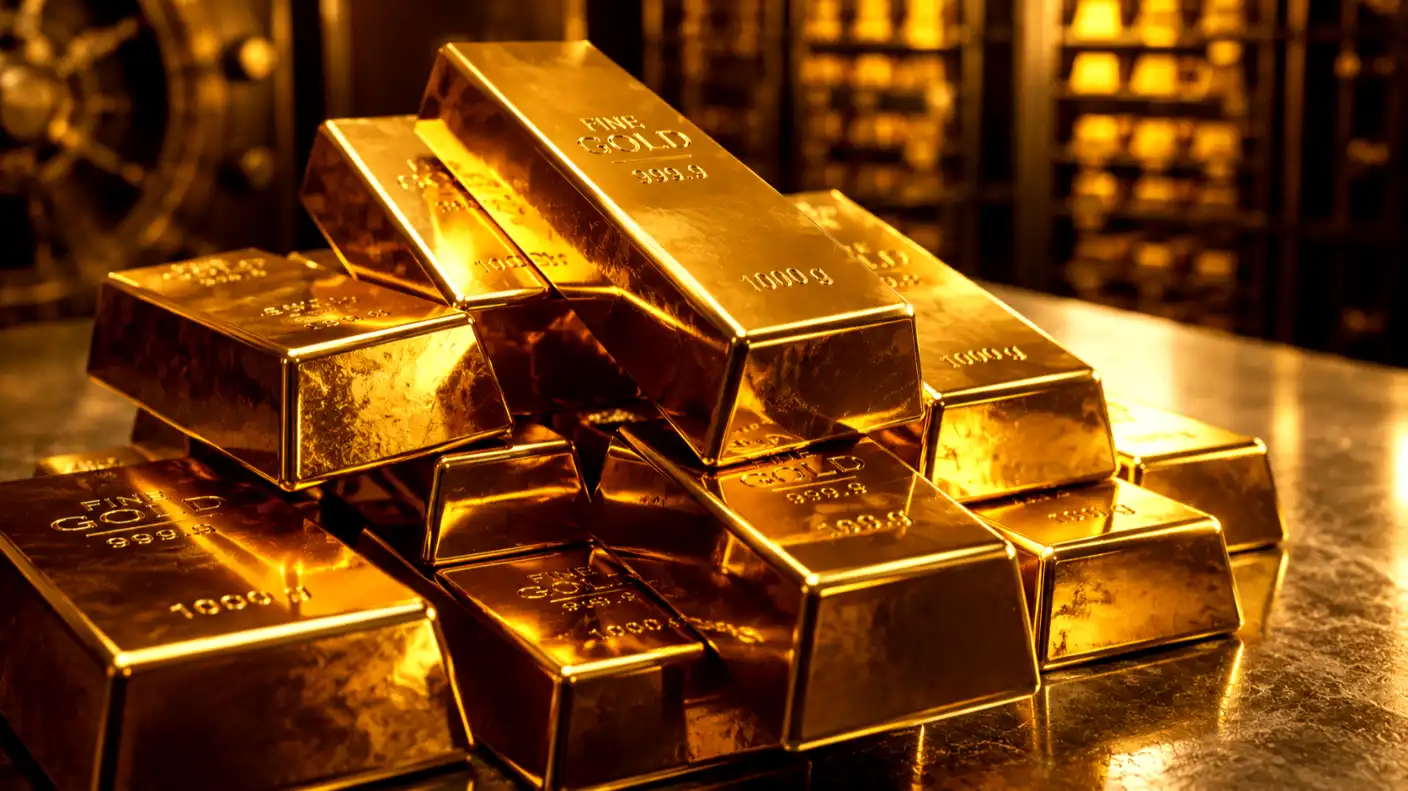
The global commodities market experienced a sharp recalibration on Monday as investors balanced two opposing forces: a significant geopolitical breakthrough in Western Europe and a stark, hawkish shift in American monetary policy. Gold prices found immediate support, reversing a portion of their recent losses, as high-level diplomatic negotiations between the United States and Iran in Switzerland yielded tangible progress toward a long-term peace agreement. This diplomatic success immediately cooled global energy markets, lowering oil prices and temporarily easing fears of a massive, long-term supply shock. However, the broader rally in precious metals ran into a wall of resistance. Investors continue to digest a highly aggressive policy stance from the Federal Reserve, which has signaled that interest rates in the world’s largest economy could remain elevated for a prolonged period.
For market participants, this dual dynamic creates a highly complex trading environment. On one hand, the easing of geopolitical tensions in the Middle East reduces the immediate demand for safe-haven assets like gold and silver. On the other hand, the corresponding drop in oil prices reduces overall inflation expectations. This drop removes a key justification for the Federal Reserve to continue raising interest rates to cool the economy. Because non-yielding precious metals perform poorly when interest rates are high, any factor that slows down the central bank’s tightening cycle provides an underlying safety net for bullion.
A Tense Diplomatic Breakthrough at the Lake Lucerne Summit
The primary driver of market sentiment early in the week was the conclusion of intense, all-night diplomatic negotiations at the Burgenstock luxury resort, overlooking Lake Lucerne in Switzerland. The talks, which brought together high-ranking officials from Washington and Tehran under the mediation of Pakistan and Qatar, initially faced a highly turbulent start. Before the sessions got underway, the Iranian government briefly announced that it had once again restricted maritime traffic through the strategic Strait of Hormuz. This move prompted U.S. President Donald Trump to issue direct warnings of military retaliation if the blockage continued or if Iranian-backed groups persisted in their operations. Despite this rocky opening, the mediators managed to keep both delegations at the table.
The presence of top-tier leaders, including U.S. Vice President JD Vance and Iranian Foreign Minister Abbas Araghchi, underscored the high stakes of the summit. Rather than collapsing under the weight of early threats, the discussions stretched into the early hours of Monday morning, culminating in a joint statement from Pakistan and Qatar that surprised many market analysts with its optimistic tone. The successful opening round of negotiations has established a concrete framework that could fundamentally alter the geopolitical and economic landscape of the Middle East.
The Burgenstock Negotiations and the 60-Day Peace Roadmap
The central achievement of the Swiss summit is a formal agreement on a comprehensive 60-day roadmap designed to lead to a permanent, legally binding peace treaty. Pakistan’s Prime Minister Shehbaz Sharif and Chief of Army Staff Field Marshal Asim Munir, working alongside Qatari foreign ministry officials, helped broker a structure where both sides committed to ongoing, structured diplomacy. The roadmap establishes a High-Level Committee to provide political oversight, ensuring that chief negotiators report regularly on their progress. Specialized working groups will simultaneously tackle the most contentious technical details, including the monitoring of nuclear facilities and the gradual dismantling of international sanctions.
Iranian Foreign Minister Abbas Araghchi announced that the initial phase of the agreement had already yielded substantial economic relief for Tehran. According to early details of the memorandum, the United States has agreed to waive sanctions on Iranian oil and petrochemical exports. Furthermore, some of Iran’s frozen financial assets in foreign banks, including those held in Qatar, are being unfrozen to help fund a major domestic reconstruction and development plan. While technical discussions are scheduled to continue in Switzerland for the remainder of the week, the formal creation of this diplomatic path has given financial markets a strong signal that both nations want to avoid an open, destructive war.
Stabilizing the Strait of Hormuz and Easing Global Energy Bottlenecks
Beyond the long-term diplomatic roadmap, the negotiators addressed immediate operational risks in the Middle East. To prevent accidental clashes or intentional disruptions in one of the world’s most critical maritime trade routes, the United States and Iran agreed to set up a direct communication line. This dedicated link aims to de-conflict shipping traffic through the Strait of Hormuz, allowing commercial oil tankers to resume normal operations. Shipping volumes through the waterway have already begun to pick up, providing relief to global energy supply chains that had been under severe strain for months.
The peace framework also includes a specialized “de-confliction cell” to monitor and enforce the cessation of military operations in Lebanon. This cell, which will include representatives from the Lebanese government, aims to ensure that hostilities between regional factions do not spill over and derail the broader U.S.-Iran peace process. The impact on energy prices was immediate. Brent crude futures, which had opened trading higher at $82.30 a barrel due to early-morning tensions, reversed course sharply. Brent dropped by $1.53, or 1.90%, to trade at $79.04 a barrel. This drop in energy costs is a critical piece of the macroeconomic puzzle, as it directly reduces the threat of energy-driven inflation.
Federal Reserve Hawkish Realities Cap Gold Price Potential
While the diplomatic breakthrough in Switzerland provided an optimistic backdrop, gold’s upward momentum ran headfirst into a wall of aggressive monetary policy. Investors are still actively processing the outcome of the Federal Reserve’s latest policy meeting, where central bankers took a surprisingly hawkish tone. Despite signs that global supply chains are normalizing and that energy prices are falling, American policymakers remain highly concerned about persistent core inflation. Consequently, the Fed has made it clear that it is in no rush to lower borrowing costs, and the prospect of further interest rate hikes remains firmly on the table.
The persistence of high interest rates represents a major hurdle for gold and other precious metals. Because gold does not pay a yield or dividend, the opportunity cost of holding the metal increases when yields on cash and government bonds are high. When investors can earn a safe, guaranteed return of over 3.5% on short-term U.S. debt, their appetite for non-yielding bullion naturally declines. This structural headwind has kept gold prices from staging a full, unchecked rally, even as geopolitical risks fluctuate.
The Kevin Warsh Era and the Threat of “Higher-for-Longer” Rates
The Federal Reserve’s newly reinforced hawkish posture is closely tied to its leadership transition under Chairman Kevin Warsh. During his first official policy meetings, Warsh adopted a very firm stance on price stability, refusing to give any early indications that the central bank is preparing to ease its monetary squeeze. The Fed board recently decided to hold its benchmark policy rate steady in the 3.50% to 3.75% range. However, the updated economic projections published by the committee revealed a much more aggressive internal consensus than the market had anticipated.
Specifically, nine out of nineteen Federal Reserve policymakers now believe that the central bank will need to implement at least one more rate hike before the end of the year to ensure inflation returns to its long-term 2% target. This shift has forced market participants to drastically adjust their expectations. According to fed funds futures, traders have completely priced out any potential rate cuts for the remainder of the year. Instead, the CME FedWatch Tool now shows a substantial 70% chance that the Fed will enact another rate increase by its September meeting. With a robust labor market supporting the U.S. economy—highlighted by a recent non-farm payrolls report that added 285,000 jobs—the central bank has ample economic breathing room to keep interest rates high without risking an immediate recession.
Inflation Trajectories and the Upcoming Personal Consumption Expenditures Release
The next critical test for the gold market will be the release of the U.S. Personal Consumption Expenditures (PCE) price index later this week. As the Federal Reserve’s preferred inflation gauge, the PCE data carries immense weight in shaping monetary policy expectations. Economists are widely expecting the upcoming report to show a slight acceleration in core inflation, driven by stubborn housing costs and service-sector price pressures. If the PCE index prints a higher-than-expected figure, it will confirm the Fed’s hawkish fears and likely cement expectations for a September rate hike.
Such an outcome would trigger a surge in the U.S. Dollar Index, which is already trading near a firm 13-month high. A stronger dollar makes commodities priced in greenbacks, such as gold and copper, significantly more expensive for foreign buyers, leading to natural downward pressure on prices. Conversely, if the PCE report reveals that inflation is cooling faster than anticipated—perhaps aided by the recent decline in global oil prices—gold could experience a significant relief rally. Under this scenario, the market would begin to trim its rate-hike bets, lowering bond yields and reviving the appeal of gold as an alternative asset.
Detailed Technical Breakdown: Precious and Industrial Metals Performance
Against this complex macroeconomic backdrop, the actual trading performance across the metals complex on Monday showed mixed, highly volatile results. Investors are adjusting their portfolios to account for a lower risk premium in energy, a stronger dollar, and persistent interest rate pressures. This has led to sharp intraday price swings as traders react to every update coming out of the technical-level talks in Switzerland.
Gold Rebounds From Multi-Session Losses to Reclaim Key Levels
Gold entered Monday’s session on the heels of a difficult period. The precious metal had slipped 1.4% during the previous week, marking three straight sessions of consecutive losses as the Federal Reserve’s hawkish tone pressured the market. The asset had also been trading below its 200-day moving average, a technical development that senior market analysts warned could signal a transition into a broader bear market. Some analysts even warned that a sustained drop below the critical $4,000 per ounce psychological level remained a distinct possibility if the Fed followed through on its rate-hike threats.
However, the progress in the Swiss peace talks provided a much-needed technical floor. Spot gold managed to rebound from its more than one-week low of $4,119.78, climbing up to $4,194.99 per ounce. U.S. gold futures for August delivery showed a corresponding advance, climbing up to $4,223.42 per ounce before settling slightly lower around the $4,222.9 mark. Despite this rebound, major financial institutions have begun to adjust their long-term forecasts to reflect the reality of higher interest rates. Goldman Sachs, for example, revised its year-end gold price target downward to $4,900 per ounce, down from an earlier projection of $5,400, specifically citing the lack of expected U.S. rate cuts.
Industrial Metals and Other Precious Assets Under Supply Shifts
The positive sentiment generated by the U.S.-Iran diplomatic progress extended to other precious and industrial metals, though performance remained highly fragmented. Silver prices experienced a solid recovery, rising 2.2% to trade near $66.36 per ounce after suffering a painful 4.6% decline during the previous week’s trading. Active silver futures settled around $66.465 per ounce, representing a modest daily gain of 0.22% as industrial demand expectations began to stabilize alongside the reopening of key maritime trade routes.
Platinum prices staged one of the most dramatic moves of the session. The metal gained a massive 11% to reach $1,683.39 per ounce, driven by a sudden wave of short-covering from institutional traders. On the futures front, the active platinum contract settled at $1,681.7 per ounce, down 1.50% on the day as high intraday volatility led to rapid profit-taking. Meanwhile, palladium futures traded down 0.51% to settle at $1,282.5 per ounce, reflecting ongoing concerns that a higher-for-longer interest rate environment will eventually slow global automotive manufacturing, reducing the long-term demand for catalytic converters.
In the industrial metals sector, copper prices showed signs of stabilization. Benchmark copper futures on the London Metal Exchange edged up by 0.9% to reach $13,719.70 per metric ton. In the United States, copper futures traded up 0.6% to settle at $6.37 per pound. Because copper is highly sensitive to global economic health, the prospect of a peaceful resolution to the Middle East conflict and the lifting of trade blockades provided immediate support to the red metal, offsetting some of the negative pressure from the strong U.S. dollar.
The coming weeks will likely see continued volatility across the entire commodities spectrum. As technical negotiators in Switzerland work through the details of the nuclear and sanctions frameworks, any signs of diplomatic friction will immediately show up in the price of oil and gold. Simultaneously, the global market remains deeply beholden to the Federal Reserve’s economic data dependency. If upcoming U.S. inflation figures remain hot, the pressure on gold will mount, setting up a classic battle between geopolitical risk premiums and macroeconomic realities.