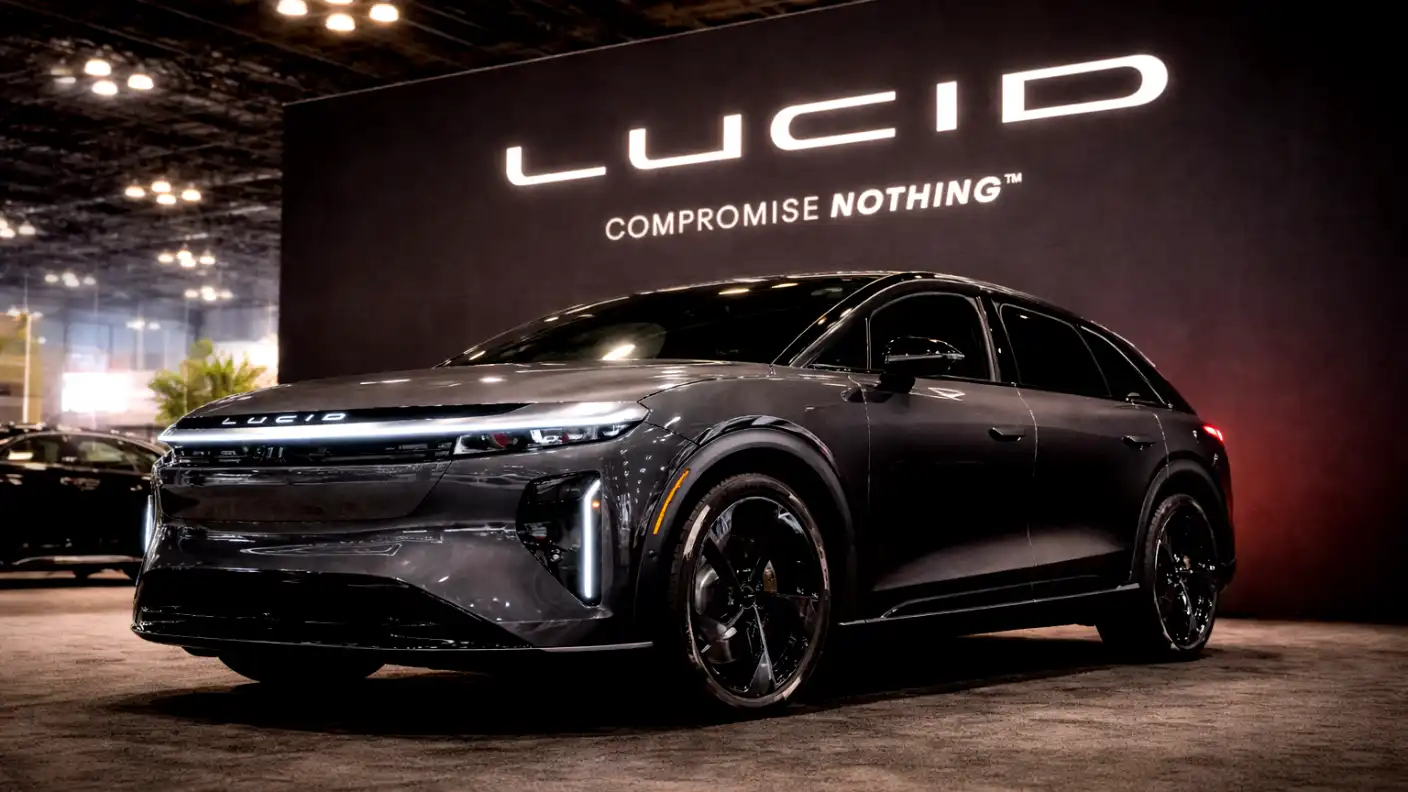
Electric vehicle manufacturer Lucid Group has entered a period of rapid restructuring as it attempts to survive a cooling market and persistent operational setbacks. On June 22, 2026, the California-based luxury automaker announced plans to lay off approximately 18% of its U.S. workforce. This decision represents the company’s second massive workforce reduction in just four months, highlighting the intense financial pressure facing pure-play electric vehicle startups in North America.
This latest round of job cuts will impact roughly 1,500 employees, affecting full-time workers, independent contractors, and hourly production staff. The announcement follows a 12% global staff reduction executed in February 2026, which already trimmed hundreds of roles from the company’s payroll. With these combined cuts, the luxury automaker has reduced its total headcount by roughly 2,500 positions since the start of the year.
The aggressive downsizing reflects a broader strategy by Lucid’s newly appointed chief executive, Silvio Napoli, who took the helm of the company on June 1, 2026. Napoli is attempting to streamline the company’s bloated corporate structure, reduce operational overhead, and align production output with actual market demand. As major automotive legacy brands and pure-play EV competitors adjust their own targets, Lucid is racing to achieve profitability before its remaining cash reserves run dry.
Inside the Restructuring Strategy
The formal restructuring plan aims to quickly lower the company’s cost structure as it navigates a transition year. According to regulatory disclosures filed with the Securities and Exchange Commission, Lucid expects the job cuts to yield approximately $158 million in annualized cost savings. These savings are crucial for a company that has consistently struggled with high cash burn since its public listing.
To achieve these savings, the manufacturer expects to incur approximately $32 million in cash charges. The majority of these costs will cover severance packages, extended healthcare benefits, and job transition assistance for the departing workers. Lucid plans to complete the bulk of this organizational restructuring by the end of the third quarter of 2026.
The decision to cut nearly a fifth of its domestic workforce represents a significant pivot from the aggressive expansion strategy the company pursued over the last few years. By the end of 2025, Lucid had expanded its global workforce to a record high of approximately 9,000 employees. Now, the combination of high interest rates, changing consumer preferences, and manufacturing bottlenecks has forced management to aggressively reverse course.
Leadership Shuffles and the Elimination of the COO Role
The workforce reduction coincides with an unprecedented shakeup in Lucid’s executive suite. The company’s new leader, Silvio Napoli, possesses an unconventional background for an automotive executive. Napoli spent the majority of his career at the Swiss escalator and elevator giant Schindler Group, where he served as both chief executive and chairman. He inherits a corporate culture that has experienced severe management instability, with more than ten top executives departing the company over the last 24 months.
Perhaps the most surprising casualty of this corporate restructuring is Marc Winterhoff. Winterhoff served as Lucid’s interim chief executive for more than a year during the search for a permanent leader. While the company originally announced that Winterhoff would transition to the role of chief operating officer after Napoli’s arrival on June 1, the new management team decided to eliminate the chief operating officer position. As a result, Winterhoff has left the company, receiving a severance package that includes security-related support and the right to retain his company-provided vehicle.
This executive turnover extends far beyond the COO role. Founder and longtime chief executive Peter Rawlinson abruptly resigned in February 2025, leaving a massive leadership void. Shortly thereafter, chief engineer Eric Bach left the company in late 2025 under highly contentious circumstances, subsequently filing a lawsuit for wrongful termination. More recently, Emad Dlala, a longtime executive who had only recently received a promotion, resigned from his post, leaving Napoli with a severely depleted team of industry veterans.
Production Bottlenecks and Factory Slowdowns
To align its balance sheet with current economic realities, Lucid is scaling back its manufacturing footprints and revising its short-term production strategies.
Discontinuing the Second Shift at Casa Grande
As part of the restructuring plan, Lucid has officially ended the second production shift at its advanced AMP-1 manufacturing facility in Casa Grande, Arizona. The company had introduced this second shift late last year in anticipation of scaling up production for its new models. However, slowing sales and high inventory levels forced the company to scrap the shift. This change directly impacts hourly manufacturing workers, contractors, and assembly technicians, marking the first time that production-line employees have been hit hard by Lucid’s cost-cutting measures.
The Gravity SUV Defect and Revenue Impairment
The decision to scale back production follows a painful manufacturing defect that severely disrupted the company’s financial planning. In February 2026, Lucid identified a major second-row seat defect in its highly anticipated Gravity SUV. The company had to halt all shipments of the vehicle to resolve the safety issue. This halt caused more than $200 million in revenue impairment during the first quarter of 2026, dealing a severe blow to the company’s cash flow. Because of this disruption, the manufacturer officially suspended its full-year 2026 production guidance, which had originally targeted between 25,000 and 27,000 vehicles.
Severe Contraction in the European Operations
While the U.S. layoffs have dominated domestic news, Lucid is also facing a severe crisis in its international expansion efforts. The company’s European division has struggled to find a foothold in the competitive European luxury EV market. Internal sources indicate that the company has been selling an average of only 1.5 vehicles per day across the entire European continent. To stop these mounting financial losses, the company is actively weighing a massive reduction of up to 40% in its European workforce, which continues to operate at a steep loss.
Collapsing Recruitment and the Saudi Pivot
The rapid downsizing has also led to a near-total freeze on new hiring in the United States. Corporate job boards show that open positions at Lucid have collapsed from nearly 800 positions a year ago to only about 180 today, representing a staggering 76% decline in recruitment activity. However, this freeze does not apply globally. Even as domestic roles disappear, the company expects to continue adding manufacturing workers in Saudi Arabia. Saudi Arabia’s Public Investment Fund remains Lucid’s majority shareholder, and the kingdom is heavily financing the construction and expansion of local assembly plants to establish Saudi Arabia as a regional automotive hub.
The Hard Realities of the Cooling Global EV Market
Lucid’s current struggles are not unique; they reflect a wider cooling of the global electric vehicle market. Over the last year, several major traditional automakers, including Ford and General Motors, have dialed back their electrification plans, delayed new model launches, and removed electric vehicles from their near-term product offerings. Consumers have increasingly gravitated toward more affordable hybrid options, driven away from premium electric vehicles by high interest rates, limited public charging infrastructure, and high retail prices.
For a pure-play EV company like Lucid, which operates exclusively in the premium segment, this market shift is highly dangerous. The company’s flagship vehicle, the Lucid Air sedan, has struggled to reach mass-market volumes due to its high price tag. To counter this, the company has pinned its long-term survival on the release of a lower-cost, mid-size vehicle platform.
Specifically, the company is working toward the release of its first mass-market model, the Lucid Cosmos SUV. Scheduled to launch in the second half of this year, the Cosmos is designed to start at under $50,000, bringing Lucid’s advanced battery technology to a much wider consumer base. Additionally, the company is attempting to enter the autonomous driving space. Lucid recently announced strategic partnerships with Uber and self-driving startup Nuro to develop a premium robotaxi service, which is scheduled to begin testing in San Francisco later this year.
Financial Stability and Long-term Cash Runway
The ultimate question surrounding Lucid is whether the company can survive long enough to bring these lower-cost models to market. The company’s financial performance has been deeply concerning to Wall Street analysts. In its financial disclosures for the full year 2025, Lucid reported $1.35 billion in sales against a massive net loss of $2.7 billion. The company burned through a negative free cash flow of $3.8 billion over the course of the year, including a cash burn of $1.24 billion in the fourth quarter alone.
The company’s primary financial lifeline remains the Saudi Public Investment Fund. The fund recently increased its delayed-draw credit facility for Lucid, providing an additional $2 billion to help keep the company afloat. As of the end of the last quarter, Lucid reported a total liquidity cushion of approximately $4.6 billion.
Chief Financial Officer Taoufiq Boussaid has stated that this liquidity is sufficient to fund the company’s operations into the first half of 2027. This timeline gives the company a narrow window of roughly 15 months to successfully launch the Cosmos SUV, resolve its manufacturing challenges, and prove that its business model can achieve positive gross margins. The $158 million in annualized savings generated by the current layoffs and shift closures will play a vital role in extending that cash runway as far as possible.
The upcoming months will test the leadership of Silvio Napoli. If the new chief executive can successfully steer the company through its current restructuring, resolve the Gravity SUV defects, and launch the Cosmos platform on time, Lucid may yet secure its place in the future of the automotive industry. However, if the market cooling continues to deepen, even the deep pockets of the Saudi Public Investment Fund may not be enough to shield the company from the realities of a highly competitive and capital-intensive market.