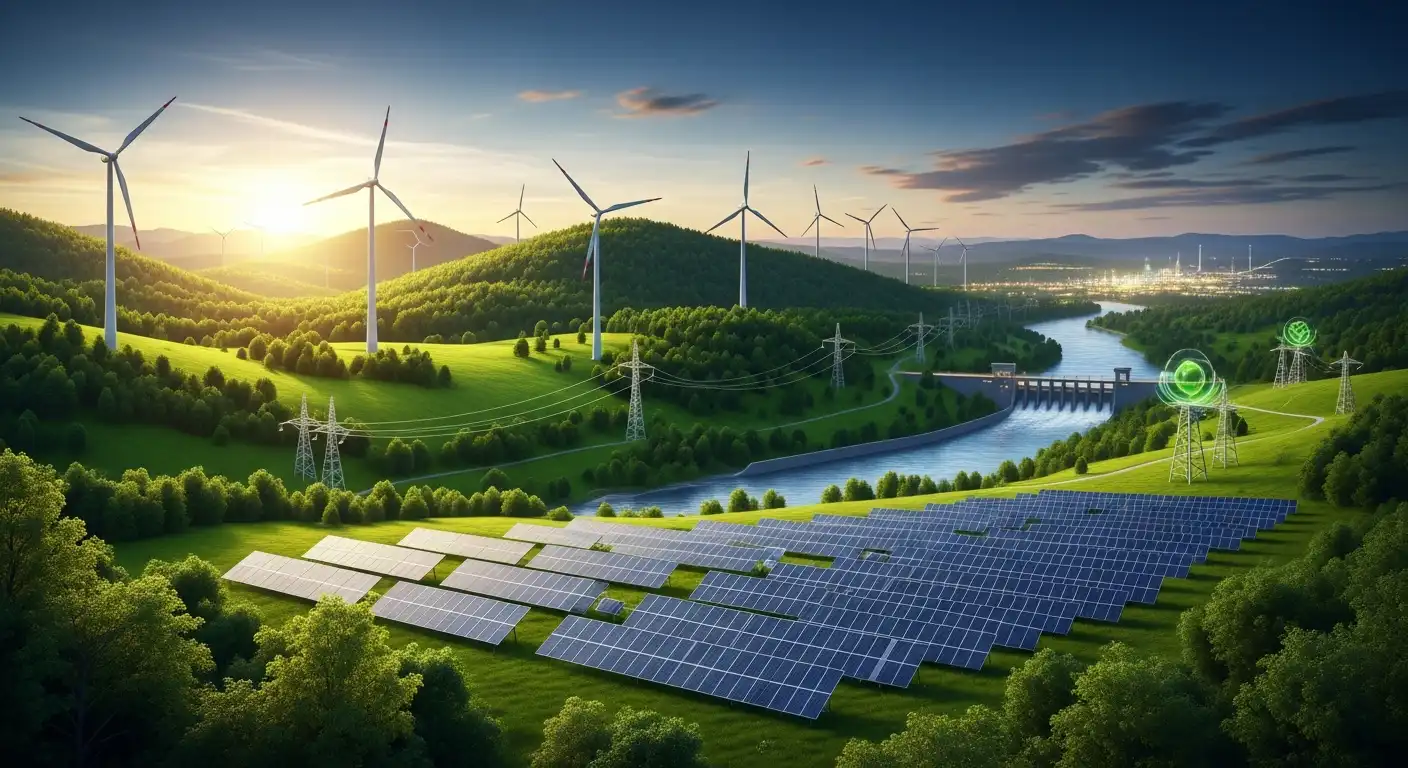
The global energy transition is moving into a complex phase focused on deep infrastructure modernization, grid resilience, and regulatory overhaul. As countries scramble to secure their local energy lines while meeting ambitious climate targets, the focus of economic planning is shifting from simply building wind turbines and solar panels to establishing highly integrated, intelligent power networks.
In late June 2026, the Chinese government announced a massive investment program designed to consolidate its position as the global capital of clean technology. Wang Hongzhi, head of the National Energy Administration (NEA), revealed during a press conference in Beijing that China’s total investment in key energy projects and emerging energy-related business models is projected to exceed 20 trillion yuan (approximately $2.93 trillion) during the 15th Five-Year Plan period, which covers the years 2026 to 2030.
This multi-trillion-dollar spending program follows the release of a major policy blueprint, the “15th Five-Year Plan for Building a New Energy System,” which was jointly issued by the National Development and Reform Commission (NDRC) and the NEA. By committing such an extraordinary volume of capital, China aims to transition from a fossil-dependent manufacturing giant into an electro-state powered primarily by domestic renewables, nuclear power, and artificial intelligence, providing a clear roadmap for global energy development.
Decoding the Twenty Trillion Yuan Investment Blueprint
The scale of China’s planned energy spending is unprecedented, representing a massive shift in how capital is allocated across the national economy. Rather than funding speculative real estate projects or traditional heavy industry, the central government is directing its financial resources to build out the physical and digital foundations of the next-generation energy grid.
Mass Funding for Key Energy Projects and Grid Modernization
The primary destination for this 20-trillion-yuan capital commitment is the physical modernization of the national electricity grid. Over the past decade, China has built some of the largest solar and wind farms in the world in its remote western deserts. However, transmitting that electricity to high-demand manufacturing hubs along the eastern coast has presented a major engineering challenge.
To solve this bottleneck, Wang Hongzhi announced that grid investments during the 15th Five-Year Plan period will grow by 30% compared to the previous five-year cycle. State Grid, which serves roughly 80% of the country, is leading this expansion by upgrading its ultra-high-voltage (UHV) direct-current transmission lines.
By building these high-capacity energy highways, the utility can transmit clean electricity across thousands of miles with minimal energy loss. This ensures that the green power generated in Ordos and Xinjiang can reliably run factories and homes in Shanghai and Shenzhen, resolving a major bottleneck that previously limited the efficiency of the country’s clean-tech investments.
Expanding Charging Infrastructure to Forty Million Stations
The second major destination for the 15th Five-Year Plan’s funding is the rapid, nationwide expansion of the country’s electric vehicle infrastructure. As the domestic automotive market transitions to electric models, the demand for fast, convenient public charging has surged.
To support this transition, Wang stated that the country aims to build 40 million basic charging facilities across the nation by 2030. This represents a massive expansion of the world’s largest charging network, designed to eliminate “range anxiety” and encourage consumers to adopt electric cars.
By integrating these charging stations directly into local power distribution grids, the government also hopes to utilize vehicle-to-grid (V2L) technologies. This will allow electric vehicles to act as decentralized battery storage packs, feeding electricity back into the grid during peak demand hours and helping to stabilize local power systems.
Reaching the Four Billion Kilowatt Power Capacity Milestone
The massive capital spending is backed by extraordinary growth in China’s physical power generation capacity, which has recently surpassed several historic milestones.
Dominating Global Installed Power Capacity
According to official data released by the National Energy Administration, China’s total installed power generation capacity reached 4.01 billion kilowatts by the end of May 2026. This figure puts China firmly at the top of the world, reflecting a rate of construction that has outpaced any other economy in history.
The NEA projects that this capacity will expand further, reaching an estimated 5.4 billion kilowatts by 2030. This rapid growth is being driven entirely by clean energy sources.
While the country continues to operate a significant baseline of coal-fired power plants to maintain grid stability during peak hours, the vast majority of its newly constructed capacity consists of solar arrays, wind turbines, nuclear reactors, and pumped-hydro storage facilities. This massive capacity cushion ensures that China can successfully meet its growing industrial electricity demands without relying on imported fossil fuels.
New Energy Becomes the Dominant Generation Source
The newly issued energy plan outlines a historic transition in the structure of the national power grid. By 2030, the share of new energy installed capacity—which consists primarily of solar photovoltaic and wind power—is projected to exceed 50% of the country’s total capacity.
This means that for the first time, clean, renewable energy will become the dominant source of power generation capacity in China, permanently displacing coal as the primary driver of the national grid.
To manage a system dominated by intermittent wind and solar power, the 15th Five-Year Plan requires developers to build complementary support and storage systems alongside new projects, ensuring that the grid remains safe, resilient, and fully operational even when the sun is not shining or the wind stops blowing.
The Structural Shift from Energy Control to Carbon Control
The most significant policy innovation in the 15th Five-Year Plan is a fundamental restructuring of how China regulates its emissions. This shift has major implications for global environmental practices.
Implementing the Dual Control of Carbon Emissions
Historically, China’s climate policy focused on “energy control,” which measured how much fuel an enterprise or region burned. While this system encouraged energy efficiency, it did not directly penalize carbon emissions, allowing some heavy polluters to meet their targets by shifting to other types of fossil fuels.
The new plan officially anchors the transition to a “dual control of carbon” system. This regulatory change shifts the focus of state assessments from total energy consumption intensity to absolute carbon emission intensity and total carbon volume.
And this distinction is highly relevant: energy controls measure how much fuel gets burned, while carbon controls measure the actual volume of greenhouse gases that reach the atmosphere. By transitioning to absolute carbon caps, the government is establishing a highly transparent, binding regulatory framework that will force local officials and corporate executives to actively manage and reduce their absolute emissions.
The Target of Fifty Percent Non-Fossil Power Generation by 2030
To support this new carbon-control framework, the energy plan outlines a target to generate 50% of China’s electricity needs from diversified non-fossil sources by 2030. This diversified clean energy mix includes nuclear power, hydropower, wind, and solar.
At the same time, the country’s total annual energy production capacity will rise to an equivalent of 5.8 billion tons of standard coal equivalent by 2030, up from 5.13 billion tonnes in 2025. This massive increase in clean energy generation will allow China to satisfy its growing electricity demands without increasing its greenhouse gas emissions, keeping the country on track to reach its peak emissions as scheduled.
By proving that a major industrial economy can generate half of its electricity from non-fossil sources, China is establishing a highly practical template for other manufacturing nations to follow.
Two-Way Empowerment: Artificial Intelligence Meets Clean Energy
One of the most innovative concepts in the newly unveiled energy plan is the “two-way empowerment” strategy, which seeks to integrate the artificial intelligence revolution with the clean energy transition.
Powering the AI Boom with Green Data Centers
China’s massive domestic artificial intelligence push has led to an exponential increase in the country’s electricity consumption. The advanced compute servers and cooling systems required to run large language models consume vast quantities of energy, putting immense pressure on local grids.
The new energy plan addresses this challenge by mandating the construction of green data centers. Under the new rules, major tech hubs and computing clusters must be located close to regions with abundant renewable energy resources, such as the wind and solar farms of Inner Mongolia and Xinjiang.
By powering these massive data centers with clean, local energy, China can support its AI ambitions without increasing its fossil fuel consumption, turning the green transition into a primary driver of the digital economy.
Embedding AI to Build a Smart and Resilient Grid
At the same time, the plan calls for using artificial intelligence to modernize and manage the national electricity grid. An energy system dominated by millions of decentralized solar arrays, wind turbines, electric vehicles, and battery storage systems is far too complex for traditional, manual management.
By integrating AI directly into the grid’s control systems, utility operators can use machine learning models to predict weather-related solar and wind drops, manage power loads dynamically, and optimize the flow of electricity across thousands of miles. This intelligent, automated management system will help prevent blackouts, improve grid efficiency, and ensure that clean energy is delivered exactly when and where it is needed most, demonstrating how advanced software can build a more resilient and sustainable physical world.
Establishing a Modern Infrastructure
The joint announcement by the National Energy Administration and the National Development and Reform Commission is a landmark event that signals a new, highly sophisticated phase of the global energy transition. By committing more than 20 trillion yuan ($2.93 trillion) to build a new energy system, China is proving that it is ready to transition from a simple manufacturer of clean-tech components into a fully integrated, clean-energy-powered industrial giant.
While the country must continue to manage the complex, real-world tensions between carbon-reduction goals and short-term grid security, its aggressive focus on grid modernization, EV charging infrastructure, and carbon controls provides a clear, reliable blueprint for the future.
As the 15th Five-Year Plan begins, the strategic decisions outlined in this blueprint will not only reshape China’s own economic landscape but will also continue to drive down global technology costs, shape international climate policies, and prove to the world that the future of economic growth is fundamentally tied to the future of clean energy.