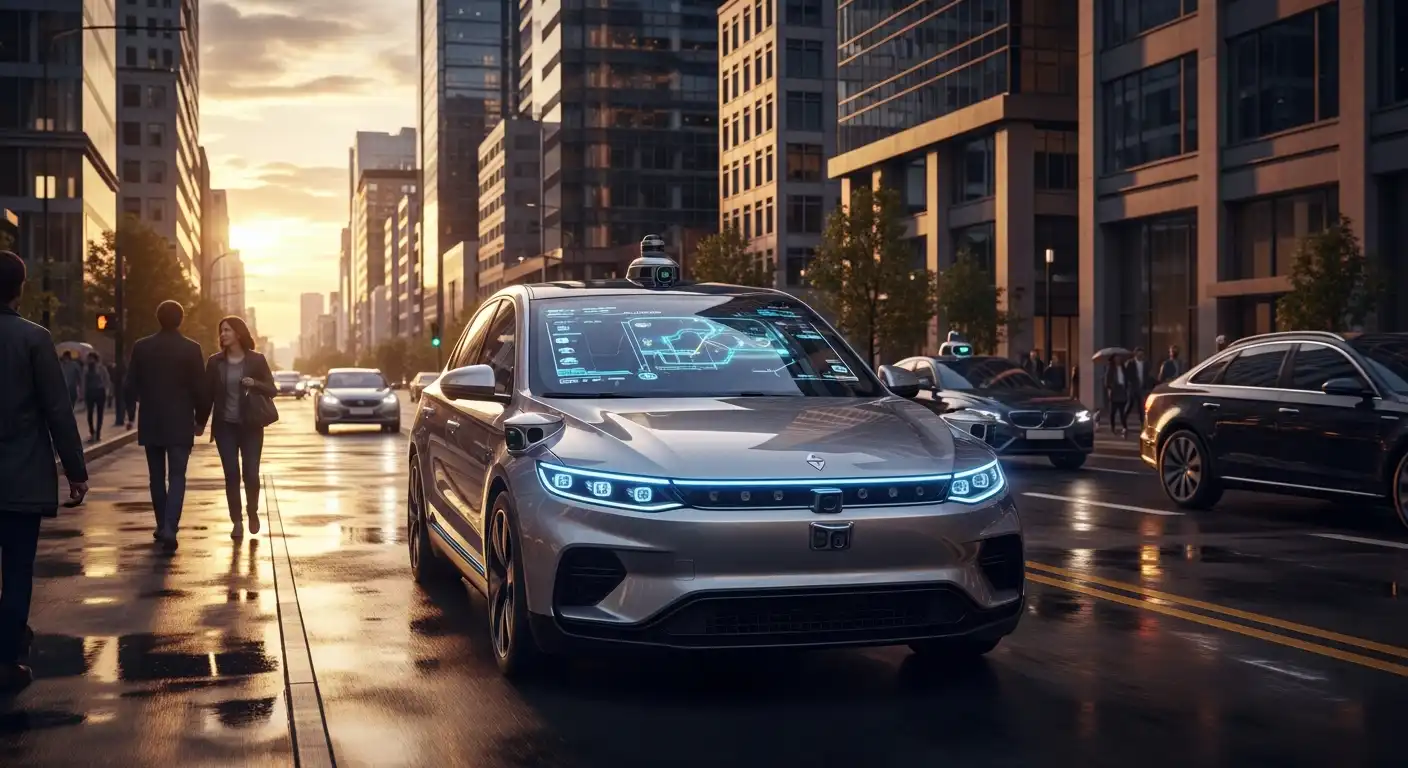
The global automotive and technology industries are undergoing a rapid convergence. No longer are cars evaluated simply by their mechanical performance, engine horsepower, or fuel efficiency. Instead, the modern automobile has transformed into a highly sophisticated, software-defined computer on wheels. To capture a larger share of this lucrative and fast-growing smart vehicle market, the world’s leading semiconductor manufacturers are locked in a fierce, high-stakes battle to supply the advanced chips and artificial intelligence systems that will power the vehicles of tomorrow.
This competitive tech race was highly visible at the Fourth China International Supply Chain Expo (CISCE) in Beijing. Running at the China International Exhibition Center in the city’s Shunyi District, the five-day event served as a massive platform for global technology giants to showcase their latest innovations. Recognizing the transformative impact of artificial intelligence on global logistics, manufacturing, and transport, the expo organizers introduced a dedicated, first-of-its-kind artificial intelligence exhibition zone.
This new pavilion covered the entire AI industrial chain, tracking the technology’s evolution from data collection and raw computing power to algorithms and real-world, turnkey solutions. Within this high-tech playground, vehicle AI solutions emerged as the primary attraction. Major American chipmakers—including Nvidia, Intel, and Qualcomm—revealed advanced vehicle control units, custom processor modules, and software integrations designed specifically to accelerate the development of autonomous driving and in-car intelligence, proving that the future of the automotive industry is being built on silicon.
The Strategic Convergence of US Chipmakers and Chinese Auto Giants
The high presence of American technology companies at the Beijing expo highlights a powerful, counterintuitive reality. Despite ongoing geopolitical tensions, trade disputes, and official rhetoric regarding economic “decoupling” or “de-risking” between Washington and Beijing, the commercial ties between the two technology superpowers remain remarkably deep.
US Technology Giants Top Foreign Exhibitors List Again
For the fourth consecutive year, companies from the United States topped the list of foreign exhibitors at the China International Supply Chain Expo. This sustained participation demonstrates that American technology giants view the Chinese market as an indispensable pillar of their global growth strategies.
With China currently operating the largest and most competitive electric vehicle (EV) and smart-car market in the world, American chipmakers cannot afford to isolate themselves from this ecosystem.
By participating heavily in the expo, these companies are actively working to embed their custom silicon and software architectures deep within the product development pipelines of China’s most prominent automotive brands, ensuring they remain the default technology providers for the next generation of global transport.
Nvidia’s Massive Partner Ecosystem on Full Display
Nvidia, the global leader in artificial intelligence and graphics processors, used the expo to showcase the sheer scale of its influence in the Chinese tech sector. The silicon giant dedicated its massive booth to presenting 39 live demonstrations, highlighting its deep partnerships with more than 110 Chinese technology companies, automotive manufacturers, and software developers.
These demonstrations showed how Nvidia’s advanced DRIVE platform is being used to power autonomous driving systems, simulated training environments, and on-board digital cockpits for Chinese EV makers.
By building this massive, highly collaborative ecosystem, Nvidia has made its hardware and software practically indispensable to China’s smart-car developers. This high level of integration protects the company’s market share, making it exceptionally difficult for local competitors to displace Nvidia’s technology even as the geopolitical environment remains highly volatile.
Edge AI Redefines the Smart Car Experience
The primary technological theme of the smart vehicle zone was the rapid transition to Edge AI. In traditional connected vehicles, complex computing tasks—such as voice recognition, route optimization, and environmental sensing—are sent to distant cloud servers to be processed.
While this cloud-centric model is cheap to implement, it introduces significant data transfer latency and is highly vulnerable to network dropouts. Edge AI solves this limitation by processing data directly on the vehicle’s local hardware, enabling instant, split-second decision-making that is critical for safety-sensitive driving operations.
Qualcomm Powers the ArcFox EV with Snapdragon Ride Flex
Qualcomm, a veteran participant attending the expo for the fourth consecutive year, demonstrated its commitment to the smart-car sector by displaying a high-tech ArcFox electric vehicle at its booth. The vehicle served as a live, physical demonstration of Qualcomm’s Snapdragon Ride Flex system-on-a-chip (SoC).
The Snapdragon Ride Flex is a landmark innovation in automotive silicon, designed to combine multiple, historically separate vehicle domains into a single, high-performance chip. Traditionally, a vehicle required separate, dedicated microcontrollers to run its digital instrument cluster, manage its central infotainment touchscreen, and operate its advanced driver-assistance systems (ADAS).
The Ride Flex SoC integrates all of these diverse computing tasks onto a single piece of silicon. This consolidation reduces the physical complexity of the vehicle’s electrical wiring, lowers overall manufacturing costs for automakers, and improves system reliability. By displaying this technology inside a production-ready Chinese electric vehicle, Qualcomm proved that its hardware is ready to act as the central nervous system for the next generation of affordable, highly integrated smart cars.
Intel Unveils the “Third Domain” of Vehicle Computing
Not to be outdone by its rivals, Intel used the Beijing expo to showcase a highly innovative approach to in-car computing. At its booth, a Chang’an Automobile equipped with a newly developed, physical AI computing module drew significant attention from industry experts and visiting engineers.
The module is built on Intel’s advanced Core Ultra processor, which features a dedicated neural processing unit (NPU) designed specifically to handle complex machine learning tasks at low power.
Gao Yu, the general manager of Intel’s PRC Technical Enablement Group, explained that the new computing module adds a completely separate, third computing layer to the vehicle’s architecture.
Historically, modern smart cars have been divided into two primary computing domains: the infotainment domain, which handles music, navigation, and cabin climate, and the autonomous driving domain, which manages lane-keep assist, adaptive cruise control, and collision avoidance.
Intel’s module introduces a “third domain” that operates independently of these existing systems, providing a dedicated, secure, and highly insulated computing layer to run advanced, on-board artificial intelligence applications.
Delivering One Hundred TOPS of On-Device Edge Power
This newly introduced third domain possesses significant computing power, allowing it to perform highly complex calculations directly on the vehicle’s local hardware. Gao Yu revealed that the Core Ultra-powered module delivers approximately 100 TOPS (trillions of operations per second) of edge computing power.
This substantial local processing capacity allows the vehicle to run advanced AI applications without needing any connection to external cloud servers.
For instance, the module can run local, real-time safety alert algorithms that continuously monitor driver behavior and road conditions, predicting potential hazards and issuing split-second warnings even when the vehicle is traveling through remote areas with zero cellular reception.
The on-board system also powers a highly natural, responsive voice interaction assistant that can understand complex, contextual commands and adjust vehicle settings in real time, providing a seamless, private, and highly reliable user experience that does not rely on foreign or external data centers.
The Plug-and-Play Lifeline for Older Vehicles
One of the most disruptive aspects of Intel’s new computing module is its physical design. Traditional automotive technology upgrades are incredibly difficult to execute, often requiring car owners to completely replace their vehicles or pay thousands of dollars for complex, dealer-installed hardware retrofits.
Intel’s AI computing module solves this upgrade barrier by utilizing a simple, plug-and-play design. The entire device requires only two physical cables to operate—one for power and one for the internet.
This extreme simplicity allows car owners to mount the module in almost any vehicle, instantly upgrading older, legacy cars with advanced edge AI capabilities, real-time safety alerts, and natural voice assistants without needing to purchase an expensive new vehicle.
This practical, low-cost upgrade path has proved highly popular with automotive fleet operators and car manufacturers alike, helping Intel secure more than 130 active edge AI design engagements with global partners as of mid-2026.
Navigating Geopolitical Complexities and Global Interdependence
The heavy participation of prominent American technology giants like Nvidia, Intel, and Qualcomm at the Beijing expo occurs at a time of significant geopolitical complexity. As governments debate national security policies and implement technology export controls, the business leaders operating in these sectors are delivering a clear message of economic pragmatism.
The Core Reality of Economic Synergy and Interdependence
James Zimmerman, the chairperson of the American Chamber of Commerce in China, addressed this commercial reality during his discussions at the expo. Zimmerman emphasized that the Chinese and United States economies are deeply integrated and highly interdependent, noting that attempting to forcefully separate these two massive systems is simply not practical for either country.
Zimmerman pointed out that the theme of the expo—”Connecting the World for a Shared Future”—reflects exactly what is needed between the United States and China moving forward: openness, connectivity, and synergy.
The automotive and semiconductor industries are global by nature, relying on a complex, highly distributed supply chain where raw materials are mined in one continent, processed in another, designed into advanced chips in Silicon Valley, and finally assembled into smart vehicles in China.
By working together to build open, collaborative supply chains, both nations can lower technology costs, accelerate the development of advanced safety systems, and ensure that the global transition to smart, clean transportation remains stable, resilient, and highly productive.
The Broader Scale and Impact of the Supply Chain Expo
The Fourth China International Supply Chain Expo has demonstrated its standing as the world’s premier platform for global supply chain cooperation. As the first national-level exhibition dedicated exclusively to supply chains, the expo focuses on presenting entire, integrated value chains rather than simple, isolated products.
The scale of the 2026 event is substantial, bringing together 676 companies, industry organizations, and specialized enterprises from 85 countries, regions, and international organizations.
The proportion of foreign exhibitors reached a high of 36.5%, with more than 65% of the participants representing Fortune Global 500 companies and leading global industry players. When including the upstream and downstream partners brought by the exhibitors, the actual participant count exceeded 1,200, turning the Beijing venue into a bustling global technology hub.
The physical layout of the expo was divided into six core supply chain zones, designed to vertically showcase advanced concepts, products, and technologies across strategically important industries:
- Smart Vehicles: Showcasing electric vehicles, autonomous driving systems, connected mobility solutions, and advanced automotive silicon.
- Digital Technology: Featuring artificial intelligence, edge-to-cloud ecosystems, blockchain traceability, and advanced supply chain software.
- Advanced Manufacturing: Highlighting Industry 4.0 solutions, industrial robotics, automated assembly lines, and smart factories.
- Clean Energy: Presenting renewable energy technologies, advanced battery storage systems, and sustainable grid solutions.
- Healthy Living: Displaying healthcare products, advanced medical devices, and wellness technologies.
- Green Agriculture: Showcasing sustainable farming practices, agricultural technology, and secure food supply chains.
By integrating these diverse industries under a single, cohesive theme, the expo has successfully demonstrated that the modern global economy is a highly interconnected web of technology and physical resources. The addition of the first-ever dedicated AI zone has been a major highlight, proving to the international business community that the ongoing digital and intelligent transformation of supply chains is no longer a future trend, but a present operational reality that is actively rewriting the rules of global industry.
Driving the Automated Future
The Fourth China International Supply Chain Expo has proven that the future of the automotive industry is being built on a foundation of open collaboration and advanced silicon. By showcasing high-performance vehicle AI solutions, US-China tech partnerships, and innovative edge computing modules, global chipmakers have demonstrated that they view China’s vast car market as an indispensable arena for technological innovation.
While geopolitical complexities and regulatory challenges will continue to require careful management, the massive scale, high foreign participation, and cooperative spirit seen at the Beijing expo show that commercial integration remains incredibly robust.
As Intel scales its “third domain” computing modules, Qualcomm rolls out its integrated Ride Flex systems, and Nvidia expands its massive partner ecosystem, these technology pioneers are proving to the world that the transition to smart, autonomous transport cannot be achieved in isolation.
By linking resources, engineering talent, and manufacturing scale across borders, the global technology supply chain is not just building smarter cars; it is establishing a more open, connected, and resilient digital world for decades to come.