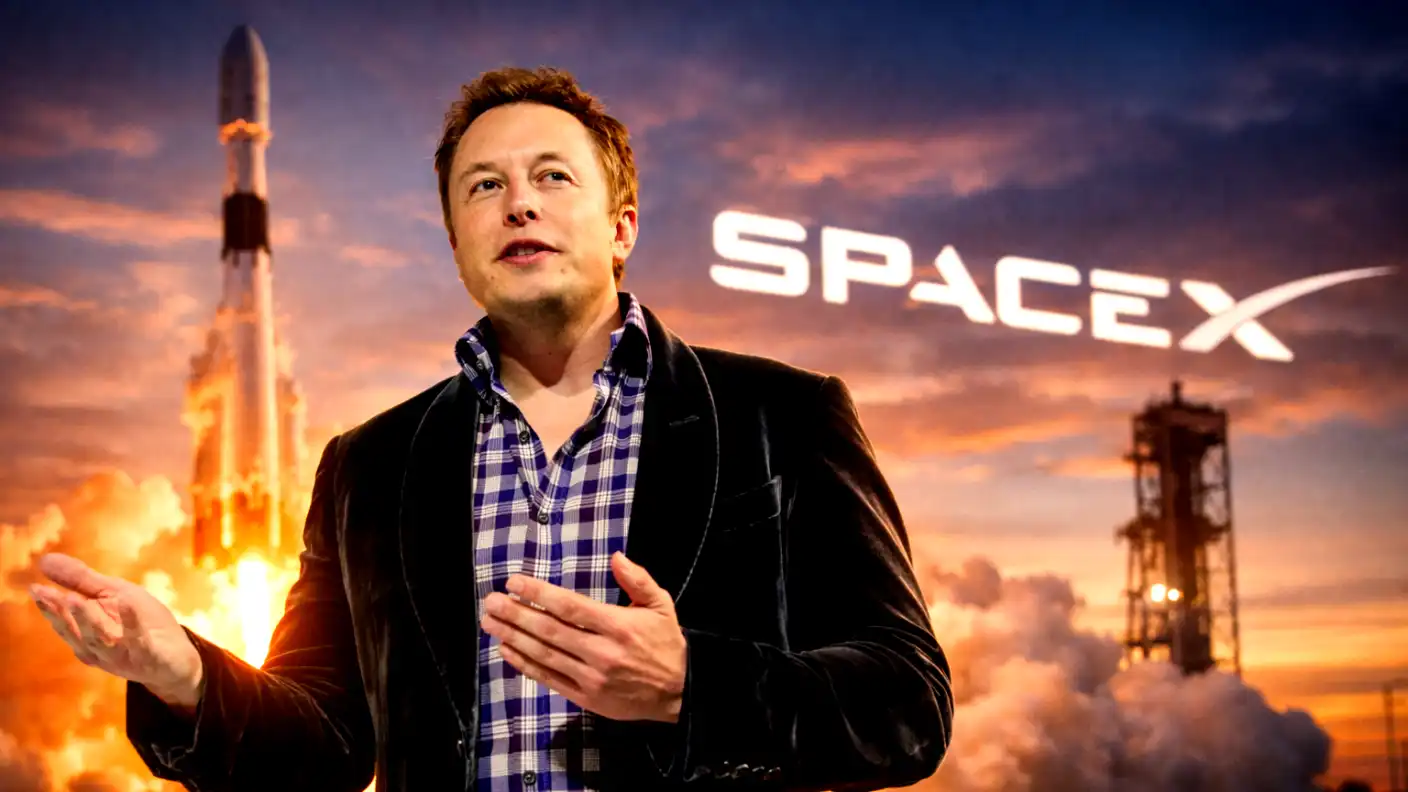
The transition of SpaceX from a scrappy aerospace startup into a massive global conglomerate reached a historic milestone in mid-2026. On June 12, 2026, the company founded by Elon Musk in 2002 officially went public. Under the ticker symbol SPCX on the Nasdaq exchange, the initial public offering raised a historic $75 billion, valuing the company at $1.77 trillion. By the end of its first day of trading, the stock climbed to $161 per share, representing a 19% gain and pushing the company’s valuation to over $2.1 trillion.
This blockbuster public debut did more than just crown Elon Musk as the world’s first paper trillionaire. It gave SpaceX a powerful financial currency to fund its next stage of evolution. No longer is SpaceX merely a rocket company that carries satellites and astronauts into orbit. The company is actively executing a strategy to dominate the global telecommunications, consumer hardware, and artificial intelligence infrastructure markets.
A recent report by the Wall Street Journal has thrust these ambitions into the spotlight, revealing that SpaceX may be testing a secret handheld artificial intelligence device. While Elon Musk quickly moved to deny the specific details of the report, the structural pieces of his business empire suggest that a major consumer telecom push is not only possible but highly probable. This deep-dive analysis explores the financial metrics of the historic SPCX debut, the details of the rumored AI handset, the company’s expanding terrestrial mobile plans, and how the convergence of Starlink, xAI, and space computing is reshaping the global telecom industry.
Deconstructing the Blockbuster SpaceX IPO
To understand the scale of SpaceX’s telecom ambitions, one must first look at the sheer financial power generated by its recent public listing. The SPCX offering represents the largest and most highly anticipated initial public offering in Wall Street history, easily eclipsing all previous records.
The Financial Mechanics of the SPCX Launch
During the roadshow and subscription period, underwriters priced the 555 million Class A shares at $135 each. When trading commenced on June 12, intense demand from both institutional and retail investors immediately drove the price up to an opening level of $150. By the close of the first day, the stock settled at $161 per share.
Underwriters quickly exercised their greenshoe option to sell an additional 15% of the offering, raising the total funds generated by the IPO to $86 billion. This massive cash injection is being utilized to fund the company’s capital-intensive projects, including the Starship deep-space rocket system and the buildout of orbital AI computing infrastructure. Crucially, post-IPO, Elon Musk retains absolute voting control of the company, holding between 82% and 85% of the total voting power.
Post-IPO Spending: Cursor and Bond Sales
Only days after entering the public markets, SpaceX began aggressively deploying its capital. The company announced a blockbuster $60 billion all-stock acquisition of Cursor, an advanced artificial intelligence coding startup founded in 2022. The deal, expected to close in the third quarter of 2026, will allow SpaceX engineers to write and execute autonomous code in plain English, drastically accelerating software deployment across the Starlink satellite network.
To complement this acquisition and bolster its cash reserves, SpaceX also executed a massive $25 billion bond sale. This combined $85 billion capital deployment in a single week signals that SpaceX is positioning itself to build out a global consumer tech and telecom empire at an unprecedented speed.
The Secret Handheld AI Device Rumor
Against the backdrop of this financial surge, the Wall Street Journal reported that SpaceX had demonstrated a prototype of a handheld consumer AI device to select investors and stakeholders ahead of the IPO. The leak immediately ignited speculation across the technology sector.
Proposed Hardware Specifications
According to the leaked details, the prototype device features a sleek, minimalist design that is physically slimmer than Apple’s flagship iPhone. The hardware is reportedly built around Qualcomm’s high-performance Snapdragon system-on-chip processors, designed specifically to run on-device machine learning tasks.
More importantly, the device does not run on Google’s Android or Apple’s iOS. Instead, it is designed to operate on a custom, proprietary SpaceX operating system. The core selling point of the hardware is its deep integration with xAI, the artificial intelligence company founded by Elon Musk that SpaceX absorbed in a quiet corporate reorganization. The handset would feature a dedicated, low-latency interface to run Grok, the flagship conversational AI chatbot.
Bypassing Apple and Google’s Gatekeeping
While building a consumer hardware device is notoriously difficult, the strategic rationale for SpaceX is clear. Currently, if SpaceX wants to distribute xAI’s Grok assistant to mobile users, it must do so through the Apple App Store or Google Play Store. This model forces SpaceX to surrender a 30% cut of its monthly subscription revenues to Apple and Google.
Also, it places SpaceX at the mercy of platform-specific app store regulations and privacy policies. Over the past few years, Elon Musk has repeatedly clashed with Apple and Google over their digital monopolies, even suggesting that he would build an “alternative phone” if the gatekeeping became intolerable. By creating a dedicated hardware platform that runs on a custom operating system, SpaceX could completely bypass this app tax, establishing a direct billing relationship with millions of consumers.
Elon Musk’s Rapid Denial
Within hours of the report’s publication, Elon Musk took to his social media platform X to flatly deny the claims, calling the report “utterly false.” Historically, Musk has expressed a deep dislike for the smartphone manufacturing business, famously stating that “the idea of making a phone makes me want to die.”
However, industry analysts remain skeptical of the flat denial. Musk has a long history of publicly denying reports that later turn out to be true, such as when he denied that Tesla had canceled its inexpensive Model 2 vehicle, only to announce a pivot to an autonomous robotaxi platform weeks later. Whether the device is currently a prototype or a long-term concept, the core components required to build an AI-native consumer device are already in SpaceX’s possession.
Terrestrial Mobile Expansion and the Charter Communications Talks
Even if a physical SpaceX smartphone is years away, the company is making undeniable moves to enter the retail telecommunications market directly on Earth. These efforts represent a massive threat to legacy cellular carriers.
Last week, SpaceX Chief Operating Officer Gwynne Shotwell reportedly briefed a select group of institutional investors on a plan to expand the company’s business into retail mobile phone service. According to sources familiar with the presentation, SpaceX is actively developing a terrestrial mobile service plan that would offer consumers standard cellular calling, texting, and high-speed data.
To facilitate this terrestrial expansion, Bloomberg reported that SpaceX is in active discussions with Charter Communications. Under the proposed partnership, SpaceX would utilize Charter’s extensive fiber and ground-based Wi-Fi infrastructure to route its mobile traffic when users are in densely populated areas.
When users travel outside of Charter’s terrestrial footprint, the service would seamlessly transition to Starlink’s orbital network. This hybrid network would allow SpaceX to offer comprehensive, nationwide mobile coverage with virtually zero dead zones, positioning it as a direct competitor to traditional telecom giants like AT&T, Verizon, and T-Mobile.
Starlink’s Direct to Cell Breakthrough
The foundation for this hybrid mobile strategy is Starlink’s “Direct to Cell” satellite technology, which has transitioned from an experimental program into an active commercial service.
Unlike traditional satellite communication, which requires a heavy, specialized dish like the Starlink terminal, Direct to Cell allows standard, unmodified LTE smartphones to connect directly to satellites in low-Earth orbit. The satellites essentially function as cell towers in space, utilizing mid-band PCS spectrum to transmit voice and data signals directly to existing consumer devices.
SpaceX has achieved this technological feat through a high-profile partnership with T-Mobile. In active testing, standard smartphones have successfully sent text messages, placed voice calls, and even transmitted basic web data directly through the Starlink constellation.
This technology is a game-changer for emergency services, maritime operators, and rural populations. Globally, roughly 15% of the Earth’s landmass lacks terrestrial cellular coverage. By bridging this gap from orbit, Starlink is creating a baseline level of global connectivity that traditional cellular networks cannot match. This capability provides SpaceX with an unmatched starting point: any mobile service or consumer hardware it launches will have global, unhackable coverage from day one.
The Strategic Synergy of Starlink, xAI, and Space Computing
The long-term vision driving SpaceX’s telecom strategy is the convergence of high-speed satellite connectivity, advanced artificial intelligence, and space-based edge computing.
By owning both the physical launch vehicles (Falcon 9 and Starship) and the satellite internet constellation (Starlink), SpaceX can launch hardware into orbit at a fraction of the cost of any competitor. This launch advantage allows the company to deploy advanced computing nodes directly into space.
SpaceX is actively planning to deploy “space-based data centers” — orbital satellites equipped with liquid-cooled AI processors. These space-based servers will run xAI’s Grok models directly in orbit, processing data closer to the source of satellite imagery and communication.
This architecture reduces the reliance on ground stations, minimizes latency, and provides a highly secure, unhackable computing environment. If a consumer uses a future SpaceX mobile service or AI device, their queries could be processed by a supercomputer orbiting 500 kilometers above their head, bypassing traditional terrestrial internet routing entirely.
Conclusion: The Future of SpaceX’s Telecom Strategy
The public listing of SpaceX under the ticker SPCX has marked the end of the company’s era as a simple rocket manufacturer. With an implied valuation of over $2.1 trillion and a fresh war chest of $86 billion in IPO capital, the company is building the physical and digital infrastructure of the future.
While the rumors of a secret, ultra-slim AI handset have faced a swift denial from Elon Musk, the strategic, technological, and financial incentives to build such a device are too powerful to ignore. The combination of Starlink’s Direct to Cell satellite network, xAI’s advanced machine learning models, Gwynne Shotwell’s retail telecom plans, and the potential partnership with Charter Communications highlights a clear trajectory: SpaceX is preparing to launch a direct assault on the global telecommunications industry.
As the company transitions into the public markets and begins integrating its recent $60 billion acquisition of Cursor, the next few years will determine whether SpaceX can successfully commercialize these ambitious telecom dreams. If successful, the company will not only dominate the space economy but will also establish itself as the central pillar of the global digital landscape, rewriting the rules of connectivity, hardware, and artificial intelligence for decades to come.