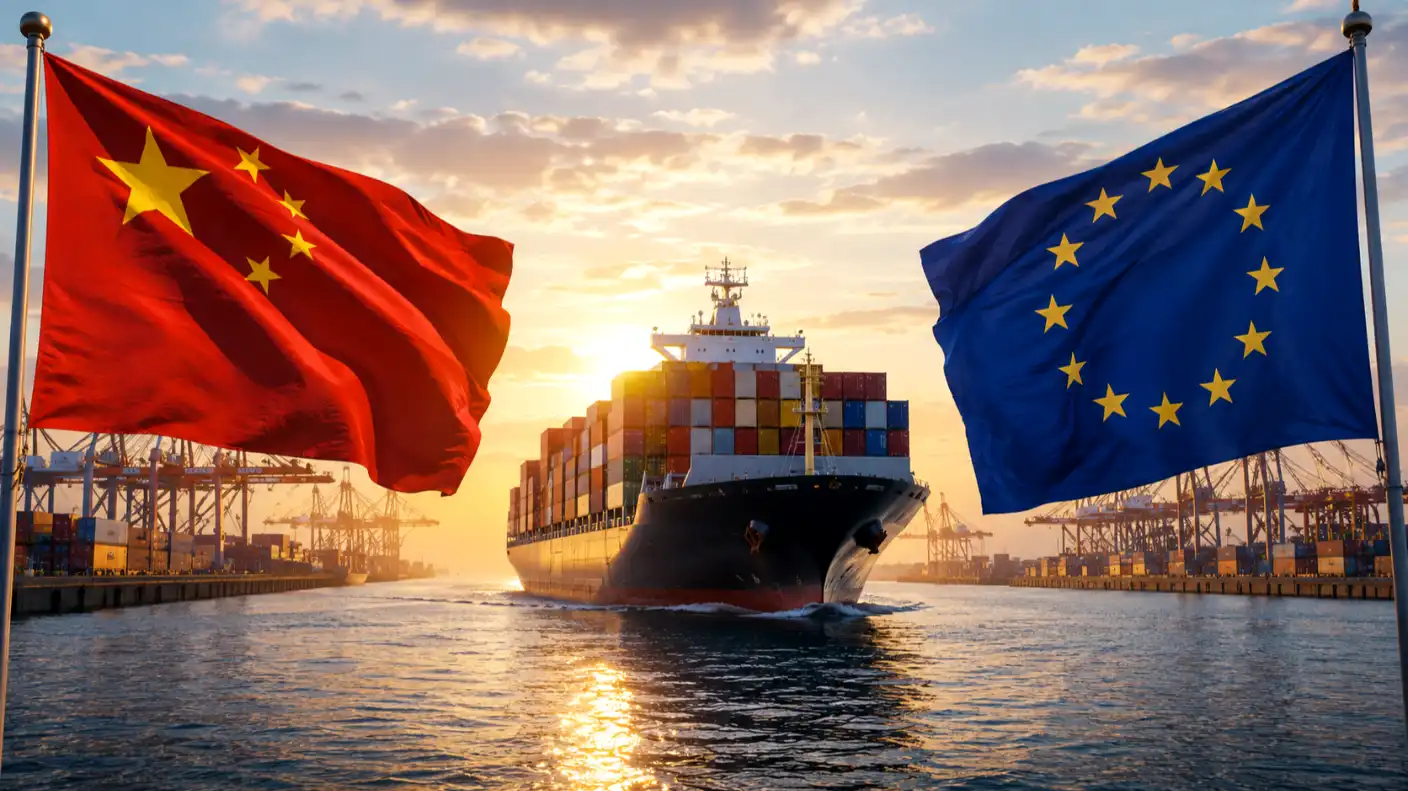
The complex economic relationship between China and the European Union has reached a critical bottleneck. As industrial overproduction, domestic market slowdowns, and intense geopolitical friction collide, Brussels and Beijing are locked in a high-stakes trade dispute. The European Union is preparing to deploy an array of protective trade measures to shield its domestic manufacturing from a massive wave of imports.
In a major bid to de-escalate these tensions, Chinese Foreign Minister Wang Yi concluded a landmark six-day tour of the Nordic nations in early July 2026. Visiting Denmark, Sweden, Finland, and Norway, the top diplomat attempted to find political openings and soften the stance of some of the bloc’s most security-conscious governments.
This rare Nordic tour was part of a larger diplomatic effort to defuse a looming trade war. Just a week prior, on June 29, Chinese Commerce Minister Wang Wentao met with European Union Trade Commissioner Maroš Šefčovič in Brussels.
The two sides agreed to launch a conditional three-month negotiation window, setting a strict deadline in October to achieve concrete progress toward balancing their trade relationship.
With the European Union’s annual trade deficit with China reaching an eye-watering €360 billion—equivalent to approximately $412 billion—the stakes could not be higher. To avert punitive tariffs and market restrictions, Beijing is offering unexpected structural concessions, testing whether economic diplomacy can overcome the structural forces of deglobalization.
The Anatomy of China Shock 2.0
The fundamental driver of the current trade dispute is a massive industrial imbalance that European policymakers are calling “China Shock 2.0.” Following years of intensive state subsidies and state-driven industrial planning, China has built an overwhelming production capacity in clean technology and advanced manufacturing.
This capacity is most pronounced in critical sectors such as electric vehicles, lithium-ion batteries, solar panels, wind turbine components, industrial machinery, and processed chemicals.
Because domestic consumer demand in China remains weak and a depreciated yuan has made Chinese exports exceptionally cheap abroad, manufacturers are dumping their excess capacity onto international markets.
The scale of this export surge is historic. Data compiled by Eurostat reveals that Chinese exports to the European Union now outweigh imports from the bloc by €1 billion per day.
For European industrial leaders, this imbalance represents a clear threat of deindustrialization. Unable to compete with heavily subsidized Chinese products that enter European ports at prices below local production costs, domestic companies in energy-intensive and mid-technology sectors are losing market share rapidly.
While Europe has historically positioned itself as a champion of open markets and free trade, the current rate of export growth has forced the 27-member union to shift its policy toward defensive economic security.
A Rare Geopolitical Charm Offensive in the Nordic Nations
Against this backdrop of rising economic friction, Foreign Minister Wang Yi’s tour of the Nordic region from July 2 to July 8 represented a highly calculated diplomatic maneuver. The whistle-stop tour marked the first visit by a Chinese foreign minister to Sweden in 22 years and the first to Denmark in 15 years.
By targeting Copenhagen, Stockholm, Helsinki, and Oslo, Beijing chose to focus its diplomatic energy on a region that is traditionally considered highly skeptical of Chinese influence.
The Nordic nations are all NATO members, and their security policies are closely aligned with the transatlantic framework. Following years of rising concerns over industrial espionage, national security, and China’s expanding interests in the Arctic, these countries have been among the strongest advocates of “de-risking”—the policy of reducing critical dependence on Chinese supply chains.
At the same time, these nations are global leaders in green technology, circular economics, and maritime transport, making them highly receptive to practical, eco-focused cooperation.
Wang Yi’s strategy involved using these shared environmental goals to build political goodwill. Throughout his meetings with leaders like Swedish Prime Minister Ulf Kristersson, Danish King Frederik X, and Finnish President Alexander Stubb, the veteran diplomat pushed for upgraded green cooperation agreements.
By negotiating new joint work programs in low-carbon transition, green shipping, and biopharmaceuticals, Beijing sought to prove its value as a pragmatic partner.
The goal was clear: to persuade these influential Nordic governments to resist broad, restrictive trade measures from Brussels, hoping that economic cooperation in green technology could soften the bloc’s defensive stance.
Beijing’s Surprise Offer to Cut the Gaping Trade Surplus
While Wang Yi handled the political charm offensive in northern Europe, the technical negotiations in Brussels yielded a rare sign of Chinese flexibility. During his marathon talks with European trade officials, Chinese Commerce Minister Wang Wentao signaled that Beijing is willing to explore structural concessions to narrow the trade gap.
In a departure from previous meetings where Chinese officials played down the significance of the trade surplus, Wang Wentao indicated that China is open to several corrective actions:
- European Purchase Agreements: Beijing is willing to consider formal purchase agreements designed to increase the volume of European goods imported into the Chinese market.
- Lowering Tariffs: The discussions touched on the possibility of lowering existing Chinese tariffs on specific European imports, particularly in high-value sectors.
- Voluntary Export Restrictions: Most surprisingly, Chinese negotiators signaled an openness to voluntary limits on the export volume of heavily subsidized products to Europe.
Publicly, Beijing has continued to maintain that the trade imbalance is simply the result of natural market forces and competitive advantages. Furthermore, Chinese officials have consistently argued that if European nations wish to rebalance trade, they should ease export restrictions on high-value products to China, particularly the advanced semiconductor manufacturing equipment produced by the Dutch firm ASML.
Yet, the private concessions offered in Brussels indicate that Beijing now recognizes its daily billion-euro trade surplus has become a serious political liability that could trigger highly destructive retaliatory measures if left unaddressed.
The EU’s Toughening Stance and New Trade Arsenals
The European Union’s willingness to engage in three months of talks does not represent a softening of its position. Behind the diplomatic handshakes, Brussels is systematically building a new arsenal of trade defense instruments designed to counter industrial overcapacity.
The centerpiece of this strategy is a cross-sector safeguard known as the “overcapacity instrument.”
Unlike traditional anti-dumping duties that take months to investigate and apply to specific products, the overcapacity instrument is designed to act as a broad, rapid-response shield.
The tool would utilize a two-tiered system of tariff-rate quotas. Under this structure, a predetermined, sustainable quantity of Chinese imports in critical sectors would be allowed to enter European ports at a low tariff rate.
However, once that volume threshold is crossed, any additional imports would immediately face punitive, protective tariffs. This system would allow Europe to maintain standard trade ties with China while preventing sudden, destabilizing export surges from wiping out strategic domestic sectors like automotive manufacturing, solar fabrication, and chemical production.
By establishing a strict October deadline for the trade talks, Brussels is keeping the pressure on Beijing. European trade officials have made it clear that if China’s commitments to reduce the trade deficit do not produce tangible, verifiable results within the three-month window, the European Commission will move forward with the deployment of these protective trade instruments.
This firm stance reflects a growing political consensus within the European Council that preparation must replace hesitation, and that Europe cannot afford to delay its trade defense policies while domestic industries face structural collapse.
The Geopolitical Friction: NATO, the Arctic, and Transatlantic Turmoil
The trade negotiations are further complicated by deep geopolitical disagreements that trade concessions alone cannot easily resolve. Throughout his tour, Wang Yi faced continuous questions from Nordic hosts regarding China’s close diplomatic, economic, and strategic partnership with Moscow.
For the Nordic nations, Russia’s military actions in Ukraine represent an existential security threat, and Beijing’s continued support for the Russian economy has severely damaged its standing in northern Europe.
Additionally, China’s self-proclaimed status as a “near-Arctic state” and its growing maritime assertiveness have raised alarms in Oslo and Copenhagen, both of which govern vast territories in the Arctic region.
As the Arctic ice melts, opening new global shipping routes, the Nordic capitals are highly sensitive to any Chinese attempt to establish a strategic or military footprint in the high north.
These security concerns were discussed extensively during the overlapping NATO summit in Turkey, where Nordic leaders reaffirmed their commitment to reducing strategic dependence on non-allied nations.
At the same time, Beijing is closely watching the political instability across the Atlantic. With potential shifts in United States foreign and trade policies on the horizon, Chinese strategists see a window of opportunity to drive a wedge between Europe and Washington.
By presenting itself as a stable, pragmatic partner committed to global trade and the green transition, Beijing hopes to convince European leaders that a full economic alignment with Washington’s aggressive decoupling strategy is a high-risk path that would harm Europe’s own economic interests.
The Hard Path to October and Beyond
The conditional truce agreed to in Brussels has temporarily averted a destructive trade war, but the road to a sustainable resolution remains incredibly challenging. China’s surprise offer to purchase more European goods and potentially limit its export volume is a significant diplomatic concession, but translating these promises into verifiable, structural changes is a massive task.
For Europe, the focus has shifted from simple dialogue to concrete outcomes.
If Beijing can deliver real, measurable reductions in the trade deficit before the October deadline, the two sides may establish a more balanced, sustainable framework for economic cooperation.
If the talks fail, the deployment of Europe’s new trade defense instruments will likely trigger a cycle of retaliatory measures, restructuring global supply chains and accelerating the division of the global economy into competing trade blocs.
The coming months will test whether economic diplomacy can survive in an era defined by national security, systemic overcapacity, and intense geopolitical rivalry.