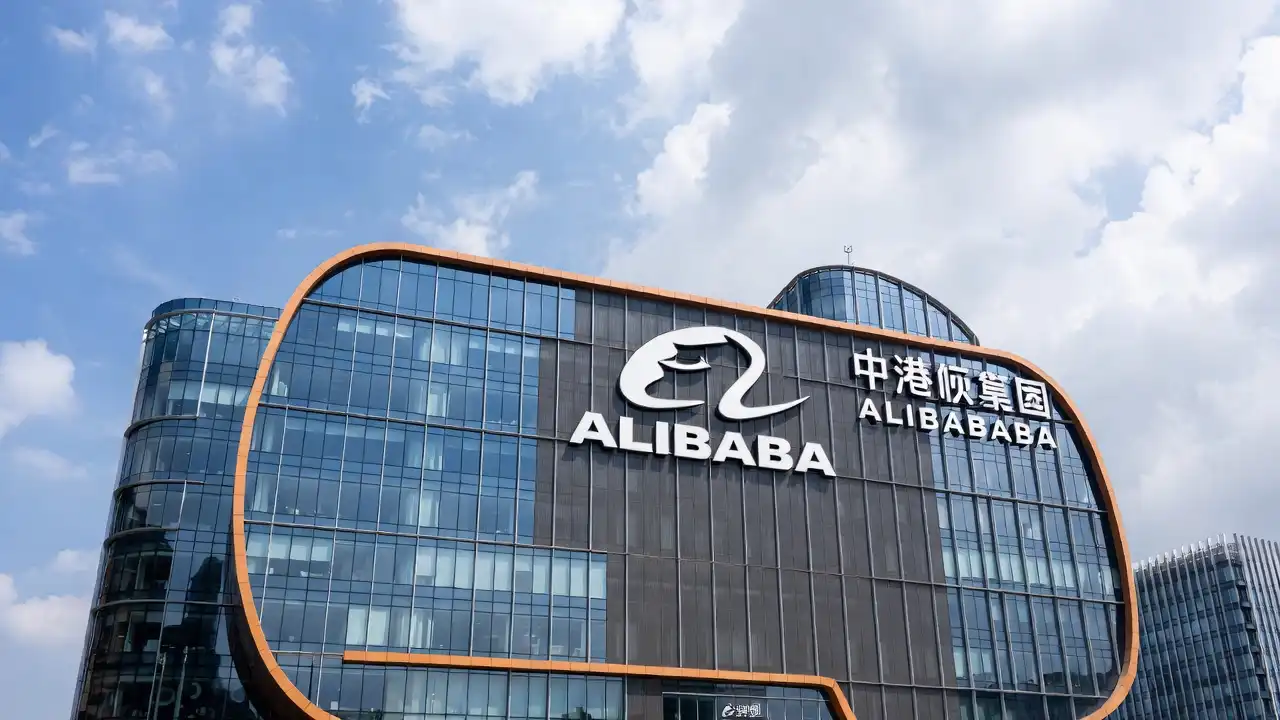
The global technology sector is witnessing a significant shift in capital allocation as investors look past high-flying semiconductor hardware stocks in search of deeply undervalued software and internet platforms. This trend was illustrated recently when shares of Alibaba Group Holding Limited delivered a powerful breakout, surging as much as 12.2% in Hong Kong trading to reach HK$107.5 per share.
This jump represents the e-commerce giant’s largest single-day financial gain since late September 2025. It also triggered a parallel rally in its U.S.-listed depositary receipts, which rose nearly 13% in pre-market and early trading sessions.
The immediate catalyst for this dramatic turn in sentiment was a pre-earnings analyst briefing held by Alibaba’s corporate management team. According to detailed reports from domestic media outlets, management shared that losses within its highly competitive instant-commerce and quick-delivery business narrowed significantly during the June quarter, while overall group profitability held steady.
This financial progress alleviated a primary concern for Wall Street: whether the company’s costly battle for local services market share would continue to drag down its overall profit margins.
The rally sparked a broader, positive chain reaction across regional capital markets. Powered by Alibaba’s double-digit breakout, the Hang Seng TECH Index jumped roughly 5%, while the benchmark Hang Seng Index advanced by 2.38% to reclaim the psychologically important 24,000-point level.
With peer internet megacaps like Tencent Holdings and JD.com rising by nearly 4% in tandem, the session demonstrated that investors are growing increasingly optimistic ahead of Alibaba’s formal earnings release scheduled for August 28.
The movement indicates that despite lingering geopolitical headwinds, the underlying cash-generating power of China’s premier consumer and technology ecosystem is once again taking center stage.
Decoding the Pre-Earnings Briefing and Market Reactions
To appreciate why the narrowing of local service losses triggered such a massive wave of buying, one must analyze the brutal competitive landscape of the Chinese on-demand delivery market. Over the past several years, instant retail—often referred to as quick commerce—has evolved into one of the most fiercely contested battlegrounds in the global digital economy.
The Economics of Taobao Quick Commerce
Alibaba’s dedicated delivery networks, Taobao Flash Delivery and Ele.me, compete directly against well-funded offerings from regional rivals, including JD Instant Delivery and Meituan Flash Delivery. The core issue with this business model is its high operational complexity and thin margins.
Maintaining a dense, highly responsive network of gig-economy delivery riders requires constant capital output. Additionally, to attract and retain consumers in a crowded market, platforms have historically had to offer heavy, margin-eroding user subsidies on everyday goods, food deliveries, and household items.
For several quarters, Wall Street analysts warned that this instant-commerce price war could become a permanent drag on Alibaba’s bottom line. The fear was that the company would find itself trapped in an endless cycle of capital-burning subsidies, eroding the massive cash flows generated by its highly profitable core e-commerce divisions, Taobao and Tmall.
The pre-earnings briefing directly addressed this concern. By revealing that losses in the instant retail segment narrowed meaningfully during the June quarter while overall group profitability remained stable, Alibaba proved that its operational optimization efforts are beginning to bear fruit.
The company is successfully managing to reduce its subsidy dependence and optimize its fulfillment routes without sacrificing market share, removing a major structural overhang that has depressed the company’s valuation for months.
The Great Capital Rotation: Out of Semiconductors, Into Chinese Internet
The timing of Alibaba’s rally also points to a broader macroeconomic shift occurring across Asian equity markets. For the first half of the year, international capital was heavily concentrated in the hardware manufacturers driving the global artificial intelligence infrastructure buildout.
Investors poured billions of dollars into semiconductor foundries and chip designers in South Korea and Taiwan, pushing valuations to highly stretched levels.
Recently, however, signs of exhaustion have emerged in this crowded AI hardware trade. Following a wave of earnings updates from major global chipmakers, investors began taking profits on expensive semiconductor positions.
This capital flight was reflected on the same day as Alibaba’s rally, when South Korea’s chip-heavy KOSPI index tumbled by as much as 5.3%, led by sharp declines in local hardware giants.
Instead of exiting the technology sector entirely, institutional fund managers rotated this freed-up capital into undervalued Chinese internet giants that had lagged the wider market. These companies possess massive user bases, generate predictable cash flows, and trade at deeply discounted valuations.
Alibaba, whose stock had fallen out of favor due to past regulatory crackdowns and consumer spending slowdowns, emerged as the primary beneficiary of this rotation trade. The sudden influx of capital highlights a growing market consensus that the valuation gap between Western tech giants and Chinese megacaps has grown too wide to ignore, particularly as the latter show signs of operational recovery.
The Strategic Consolidation of Alibaba’s AI and Cloud Portfolio
While e-commerce and local delivery operations remain the largest drivers of short-term revenue, Alibaba’s long-term enterprise valuation is increasingly tied to its cloud computing and artificial intelligence capabilities. In the weeks leading up to the analyst briefing, the company made several quiet but highly significant adjustments to its enterprise technology roadmap.
AI Consolidation and the Unified DingTalk Integration
A key structural development involves the systematic consolidation of Alibaba’s enterprise artificial intelligence product line. According to internal software reports, the company is folding three of its separate enterprise productivity and developer tools—QoderWork, Wukong, and MuleRun—into a single, unified artificial intelligence productivity platform.
This consolidated platform will be led directly by Chen Yusen, the Chief Executive Officer of DingTalk, Alibaba’s popular enterprise communication and collaboration suite.
This consolidation is a highly pragmatic business move. Rather than maintaining fragmented, competing AI tools across different business units, Alibaba is integrating its advanced artificial intelligence capabilities directly into its most popular enterprise software channel.
DingTalk serves as the daily operating system for millions of businesses, schools, and government organizations across China. By embedding its proprietary Qwen large language models directly into this existing ecosystem, Alibaba can offer a seamless, out-of-the-box AI productivity suite that can be quickly monetized through high-margin software-as-a-service models.
This software push is supported by broader positive developments within the domestic Chinese AI sector. For instance, recent reports that other major domestic AI developers are designing custom chips to power their systems highlight a broader trend toward technological self-sufficiency.
For Alibaba, this environment of rapid domestic innovation is driving accelerated revenue growth in its cloud division. Alibaba Cloud’s revenue growth reportedly accelerated in the first quarter of fiscal 2027, demonstrating that the company’s massive, multi-year investments in AI training and cloud infrastructure are finally translating into predictable commercial traction.
Navigating the Geopolitical and Regulatory Storm
The stock’s sudden 12.2% surge is even more remarkable when viewed against the severe regulatory and geopolitical headwinds that Alibaba had to navigate in the weeks preceding the rally. In the month leading up to the pre-earnings briefing, the stock had shed roughly 27% of its value, driven down by a series of legal disputes and international policy pressures.
Aggressive Share Buybacks and Undervalued DCF Metrics
To defend its stock price and signal confidence to the market, Alibaba’s corporate management team has been executing an aggressive share buyback program. On July 6 alone, the company repurchased approximately 4.11 million shares on the open market, representing a capital outlay of roughly $50 million.
This continuous buyback activity underscores the company’s solid balance sheet and highlights management’s belief that the stock is trading far below its intrinsic value.
Financial valuation models support this corporate stance. According to independent discounted cash flow (DCF) analyses and earnings multiple checks, Alibaba screens as materially undervalued.
The stock’s five-year decline of nearly 49% reflects a dramatic reset in investor sentiment and high geopolitical risk premiums, rather than a fundamental decay of the underlying business.
The company’s core platforms continue to generate billions of dollars in free cash flow, providing a massive cushion that allows the firm to fund buybacks, invest in artificial intelligence, and settle legal disputes simultaneously.
These financial buffers have been essential for weathering a series of rapid geopolitical setbacks. In June, the company was added to the U.S. Pentagon’s list of “Chinese military companies” under Section 1260H.
While Alibaba quickly secured a temporary, court-ordered reprieve that blocked certain lobbying restrictions, the designation itself remains a persistent legal overhang.
Additionally, the company had to digest a costly $600 million class-action legal settlement and navigate U.S. legislative threats targeting Chinese AI model training.
The company also faced public relations pressure in late June when the U.S. artificial intelligence developer Anthropic accused Alibaba of using thousands of fraudulent accounts to “illicitly” access its Claude AI models, an allegation that had caused Alibaba’s shares to drop 4.8% on June 25.
The fact that the pre-earnings briefing was able to completely reverse this downward momentum proves that when investors are presented with concrete signs of operational recovery, fundamental financial metrics can easily overcome geopolitical noise.
Future Outlook and the August 28 Earnings Milestone
As the market digests this dramatic rally, all eyes are now focused on the formal earnings report scheduled for August 28. This report will serve as the ultimate test of whether the pre-earnings optimism is justified, or if the stock’s double-digit surge was merely a temporary relief rally in a dominant, long-term bearish trend.
To sustain this positive momentum, Alibaba’s formal financial disclosures must confirm several key operational assumptions:
- Sustained Instant-Commerce Margin Improvement: Investors will expect hard data proving that the narrowing of delivery losses is part of a permanent, structural shift toward profitability rather than a temporary, seasonal fluctuation.
- Accelerated Cloud Revenue Growth: The report must provide concrete evidence that the integration of generative AI models has driven sustained, high-margin revenue expansion within Alibaba Cloud, verifying the company’s position as a premier enterprise software provider.
- Core E-Commerce Stability: The core Taobao and Tmall divisions must demonstrate resilient merchandise volume growth, proving that the company is successfully defending its market share against rising low-cost competitors.
From a technical analysis perspective, the stock sits at a highly interesting crossroads. While the daily chart has been structurally bearish for months, the stock’s recent stabilization and subsequent breakout above key short-term moving averages suggest that the selling pressure may have finally hit exhaustion.
However, long-term technical analysts caution that until Alibaba decisively reclaims and holds its key daily 20-day exponential moving average of around $107.42, the stock remains vulnerable to macro-driven pullbacks.
Ultimately, the upcoming earnings release will determine whether Alibaba can transform this tactical bounce into a sustained, long-term trend reversal. If the company can successfully pair its e-commerce market dominance with accelerated AI monetization, it may finally break free from its multi-year valuation slump and reclaim its position as one of the world’s most valuable technology enterprises.