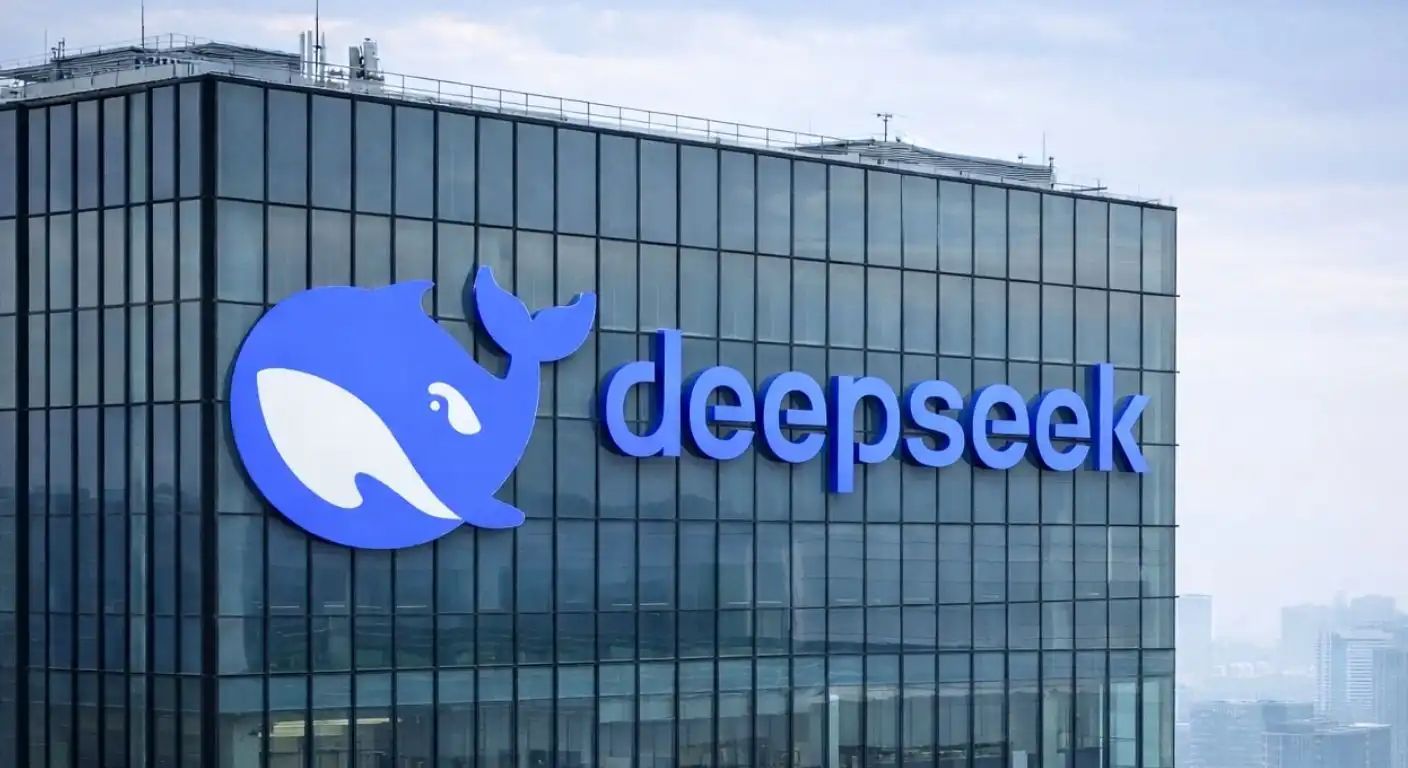
In a surprising strategic move that has caught global financial markets and Silicon Valley venture capital firms off guard, high-profile artificial intelligence laboratory DeepSeek informed prospective investors that it is placing an indefinite pause on its external fundraising plans. Despite receiving unsolicited funding offers from top-tier international venture funds and sovereign wealth entities that valued the Chinese startup between $10 billion and $15 billion, DeepSeek chose to reject external equity capital. The decision highlights the company’s commitment to maintaining research independence and relying entirely on the cash reserves of its parent company.
DeepSeek occupies a unique structural position in the global artificial intelligence ecosystem. Unlike Western AI laboratories that rely on multi-billion-dollar venture capital rounds or cloud conglomerate investments, DeepSeek is fully owned and funded by High-Flyer Asset Management. High-Flyer operates as one of China’s premier quantitative hedge funds, managing tens of billions of yuan in algorithmic capital and generating hundreds of millions of dollars in annual trading profits. This hedge fund backing provides DeepSeek with a permanent financial war chest, allowing its research team to pursue fundamental research without venture capital demands for rapid revenue monetization.
The decision to pause fundraising arrives shortly after DeepSeek sent shockwaves through the global technology sector with the release of its open-weights reasoning model, DeepSeek-R1, and its foundation model, DeepSeek-V3. By achieving reasoning and computer programming performance comparable to top proprietary Western models at a fraction of the traditional pre-training compute cost, DeepSeek ignited an industry-wide debate regarding artificial intelligence capital efficiency. Pausing external investment allows the firm to preserve its open-source research culture, avoid international regulatory complications, and focus exclusively on algorithmic breakthroughs.
TechGolly provides a detailed analysis of DeepSeek’s funding pause, evaluating hedge fund capital backing, algorithmic cost reductions, Mixture-of-Experts neural architectures, open-source democratization, semiconductor export sanctions, and the broader impact on global technology valuations.
Unpacking the Rationale Behind the DeepSeek Funding Pause
To understand why DeepSeek turned down billions of dollars in prospective venture capital, technology analysts must examine the corporate vision established by founder Liang Wenfeng. A computer science graduate and quantitative trading pioneer, Liang founded High-Flyer Asset Management before establishing DeepSeek as a dedicated artificial intelligence research initiative. From its inception, DeepSeek was envisioned not as a commercial software enterprise seeking an initial public offering, but as a long-term research institute dedicated to solving fundamental problems in artificial general intelligence.
Accepting external venture capital introduces significant operational trade-offs for artificial intelligence startups. Venture capital funds typically operate under strict 7-to-10-year fund lifespans, requiring portfolio companies to prioritize rapid top-line sales growth, lock down intellectual property behind proprietary paywalls, and execute high-valuation public listings or corporate sales. For a research lab dedicated to releasing open-weights software models under permissive open-source licenses, commercial sales pressures create direct ideological friction.
Furthermore, accepting foreign capital introduces severe geopolitical and regulatory complications. In the current international trade environment, an artificial intelligence startup accepting equity investments from North American, European, or Middle Eastern venture capital firms faces intense scrutiny from regulatory agencies, including the Committee on Foreign Investment in the United States. Foreign equity stakes can trigger mandatory regulatory reporting, limit commercial licensing options, and invite heightened export control scrutiny from federal trade authorities.
By remaining 100% self-funded through High-Flyer’s quantitative trading revenues, DeepSeek preserves total corporate sovereignty. The laboratory maintains complete freedom to release model weights publicly, distribute technical research papers detailing its training methodologies, and optimize its software code without answering to external board members, activist shareholders, or foreign regulatory bodies.
The High-Flyer Quant Edge: Financial Engineering Meets Neural Networks
The relationship between High-Flyer Asset Management and DeepSeek extends far beyond simple financial sponsorship. Quantitative financial trading and deep learning research rely on identical mathematical foundations: high-throughput statistical modeling, high-frequency data processing, and hardware-level software optimization.
Years before launching DeepSeek, High-Flyer constructed its own high-performance computing data centers to execute complex algorithmic trading strategies across domestic equity futures markets. Recognizing early that hardware scale would dictate future artificial intelligence capabilities, High-Flyer acquired a dense computing cluster of roughly 10,000 Nvidia H800 graphics processing units before Western trade authorities tightened semiconductor export restrictions.
This pre-existing high-performance computing cluster provided DeepSeek with immediate, low-cost training capacity. While competing artificial intelligence startups spent their early funding rounds purchasing expensive cloud computing credits from third-party hosting providers at high retail margins, DeepSeek executed its model training runs on self-owned, co-located hardware infrastructure operated at cost.
Furthermore, High-Flyer’s quantitative engineering culture instilled a strict discipline of computational frugality. Quantitative traders operate in an environment where microsecond latencies and memory bandwidth bottlenecks determine profitability. DeepSeek’s engineering team applied this exact low-level optimization mindset to neural network design, focusing on extracting maximum token throughput from every single watt of electrical power and gigabyte of GPU memory.
The Technical Breakthrough: High Reasoning at a Fraction of the Compute Cost
The primary reason global venture capital firms rushed to offer multi-billion-dollar valuations to DeepSeek is the company’s extraordinary engineering efficiency. In an industry where major frontier laboratories spend between $100 million and $300 million to pre-train a single top-tier model, DeepSeek achieved comparable benchmark results for less than $6 million in raw training compute.
The technical foundation supporting this cost revolution is DeepSeek’s advanced implementation of a Mixture-of-Experts (MoE) architecture. In a traditional dense neural network, every single parameter across the entire model must process every token of text, requiring massive computational matrix operations for every generated word.
In contrast, DeepSeek-V3 and DeepSeek-R1 utilize an MoE design featuring 671 billion total parameters, but activate only 37 billion parameters per individual token. An automated routing mechanism dynamically evaluates incoming prompts, directing specific mathematical calculations to specialized sub-networks within the model. This sparse activation method reduces active floating-point operations by over 80%, allowing the model to deliver deep reasoning capability while drastically cutting server power draw and memory bandwidth consumption.
DeepSeek also introduced Multi-Head Latent Attention (MLA), a specialized architectural innovation that compresses the key-value (KV) memory cache during model inference. Managing the key-value cache is one of the primary memory bottlenecks limiting server capacity during high-volume API requests.
By compressing the key-value cache into a low-dimensional latent space, MLA reduces memory footprint requirements by up to 90%. This allows cloud servers to host far more concurrent user sessions on a single GPU node, lowering ongoing API token serving costs to a tiny fraction of industry averages.
Furthermore, DeepSeek executed its training runs using FP8 (8-bit floating-point) mixed-precision math throughout the pre-training phase. While traditional AI training relies on heavier FP16 or BF16 mathematical precision, engineering FP8 execution kernels allowed DeepSeek to double arithmetic processing speeds and cut memory storage requirements in half without sacrificing model convergence stability or benchmark accuracy.
Open-Source Democratization versus Proprietary Cloud Lock-In
DeepSeek’s commitment to releasing open-weights software under permissive licenses has altered the strategic balance of power in the global software industry.
Historically, the highest levels of artificial intelligence reasoning were locked behind closed, proprietary cloud APIs operated by a small handful of mega-cap Western technology corporations. Enterprise organizations seeking to integrate advanced reasoning tools were forced to pay high per-token API fees and transmit sensitive corporate data to external cloud data centers.
Releasing models like DeepSeek-R1 with open weights allows enterprise technology departments, academic institutions, and independent software developers to download the model parameters directly. Corporations can host the model on private, air-gapped data center servers or private cloud instances, guaranteeing 100% data sovereignty and complete privacy for proprietary corporate records.
Furthermore, DeepSeek demonstrated that large reasoning models can be successfully distilled into compact 1.5-billion, 7-billion, 8-billion, and 14-billion parameter student models. These distilled student models retain the step-by-step reasoning capabilities of the massive teacher model while remaining small enough to run locally on standard consumer hardware, smartphones, and low-cost enterprise servers.
This open-source democratization has forced commercial cloud providers to lower their API token prices aggressively, accelerating the commoditization of raw language generation and shifting commercial value toward specialized enterprise data integration.
Re-Evaluating Silicon Valley’s 200 Billion Dollar AI Capex Supercycle
The technical achievements of DeepSeek triggered an immediate re-evaluation across Wall Street regarding the massive capital expenditure budgets allocated by Western technology giants. Dubbed by financial analysts as the “DeepSeek shock,” the revelation that high-level reasoning models could be trained for under $6 million raised fundamental questions regarding Big Tech’s $200 billion annual infrastructure buildout.
For the past three years, Western technology conglomerates operated under an assumption of raw hardware scaling: assuming that achieving higher intelligence required building exponentially larger data centers, buying hundreds of thousands of additional GPUs, and consuming gigawatts of electrical power. Valuation multiples for semiconductor designers, server manufacturers, and power utilities surged based on expectations of endless hardware demand.
DeepSeek proved that algorithmic innovation, custom compiler optimization, and mathematical efficiency can substitute for raw hardware spending. Demonstrating that a small, highly optimized research team can match the capabilities of multi-billion-dollar computing clusters caused an immediate market re-pricing across technology equities.
Financial analysts emphasize that while hardware scaling remains important for frontier research, the economic return on investment for data center infrastructure is facing intense scrutiny. Technology executives can no longer justify multi-billion-dollar capital outlays without demonstrating clear algorithmic efficiency gains and tangible corporate revenue returns.
This structural shift benefits enterprise software buyers. As artificial intelligence laboratories focus on model compression, token efficiency, and algorithmic optimization, the total cost of deploying intelligent software applications will continue to decline rapidly, accelerating enterprise technology adoption worldwide.
Navigating US Export Sanctions and Domestic Chip Sourcing
A critical dimension of DeepSeek’s operational story is its execution under strict international trade restrictions. The United States Department of Commerce has progressively expanded export controls targeting advanced semiconductors, restricting the sale of cutting-edge graphics processing units to Chinese entities.
DeepSeek’s technical breakthroughs demonstrate how necessity drives software innovation. Prevented from acquiring unlimited numbers of next-generation Western AI chips, DeepSeek’s engineering team focused on extracting maximum performance from its existing inventory of 10,000 Nvidia H800 processors.
By writing custom CUDA execution kernels, optimizing memory bandwidth allocation, and pioneering parallel processing communication protocols, DeepSeek achieved hardware utilization rates exceeding 90% during full-scale training runs, compared to typical industry utilization averages of 50% to 60%.
Looking toward future model generations, DeepSeek is actively adapting its software codebase to support domestic Chinese semiconductor architectures, including Huawei Ascend processors and local specialized accelerator chips. Rebuilding AI training frameworks to run efficiently on heterogeneous domestic silicon ensures that DeepSeek’s long-term research roadmap remains resilient against future international trade restrictions.
Strategic Outlook for Global Artificial Intelligence Competition
DeepSeek’s decision to maintain financial independence through hedge fund backing marks a defining moment in the evolution of the global artificial intelligence market.
As the industry matures through the late 2020s, global artificial intelligence development is bifurcating into two distinct operational paradigms:
On one side stand proprietary, closed-source cloud providers backed by Western tech conglomerates, offering high-security, full-stack enterprise cloud ecosystems supported by massive capital expenditure budgets.
On the other side stand open-source research laboratories—led by independent entities like DeepSeek, Meta’s Llama group, and global academic collectives—delivering transparent, high-efficiency open-weights models that democratize access to advanced intelligence.
DeepSeek’s self-funded independence guarantees that it will remain a disruptive force across international technology markets. By rejecting multi-billion-dollar venture capital valuations, the laboratory preserves its agility, maintains its open-source research mission, and continues pushing the boundaries of algorithmic efficiency.
For the broader global economy, the rise of low-cost, open-weights artificial intelligence models ensures that advanced cognitive automation will not remain the exclusive monopoly of a few mega-cap corporations, establishing a highly competitive, highly accessible digital foundation for future technological innovation.
Key Takeaways for Tech Executives, Founders, and Investors
The strategic decisions and technical breakthroughs executed by DeepSeek deliver vital insights for corporate executives, software developers, technology founders, and institutional investors.
First, business model independence enables strategic focus. By relying on internal quant hedge fund profits rather than external venture capital, DeepSeek preserves total research freedom, avoids commercial sales pressures, and maintains a pure focus on fundamental technological breakthroughs.
Second, algorithmic efficiency overrides raw capital expenditure. Software engineering teams and technology leaders must prioritize low-level code optimization, sparse neural architectures, and memory bandwidth efficiency, recognizing that smart software design can deliver 90% cost savings over brute-force hardware scaling.
Third, open-source models offer permanent enterprise advantages. Corporate technology officers should evaluate open-weights models like DeepSeek-R1 for private cloud deployments, capturing complete data privacy, zero vendor lock-in, and significant operational cost reductions.
Finally, the artificial intelligence revolution is entering an era of radical accessibility. As high-level reasoning capabilities become compressed into compact, low-cost neural networks, organizations that master local model deployment and domain-specific data integration will build lasting competitive advantages in the modern digital economy.