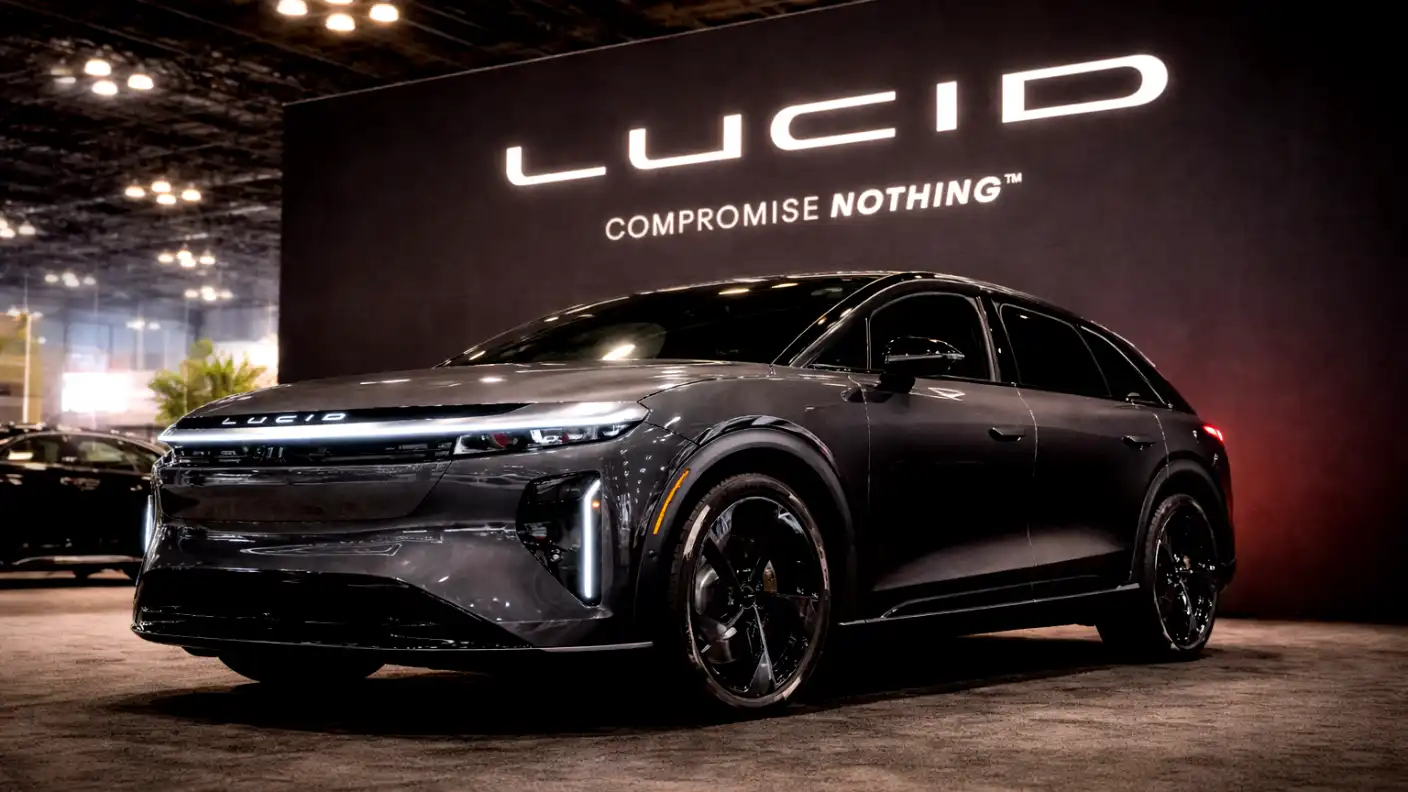
The luxury electric vehicle market is currently undergoing a brutal, highly disciplined financial correction. After years of chasing aggressive production targets and hyper-growth narratives, automotive startups are hitting a wall of high interest rates and cooling consumer demand. Lucid Group, the maker of the high-end Air sedan, has officially launched a sweeping business reset aimed at restoring investor confidence. The company confirmed on Tuesday, August 4, 2026, that it is implementing a comprehensive restructuring plan designed to generate $1.4 billion in annual cash savings by the end of next year.
This strategic pivot signals an end to the “growth at any cost” era for the California-based manufacturer. Like many of its peers in the electric vehicle space, Lucid relied on massive cash infusions from institutional backers and its primary shareholder, the Saudi Public Investment Fund, to subsidize the immense costs of scaling its manufacturing lines. However, as capital costs remain elevated and the global EV market experiences a significant, structural slowdown, the company’s leadership team has shifted its focus toward capital efficiency, supply chain optimization, and reaching the elusive goal of quarterly profitability.
The restructuring program involves several difficult, highly visible corporate actions, including a 15 percent reduction in its global workforce, a significant downsizing of its research and development budget for non-essential software programs, and a pause on several high-cost factory expansion projects. By slashing these expenditures, the company is attempting to lengthen its financial runway, ensuring that it possesses the cash reserves necessary to continue scaling its next-generation platform, the Gravity SUV, without requiring a dilutive, multi-billion-dollar emergency equity raise.
Dismantling the Overextended Growth Model
Lucid’s business reset is a clear response to the broader, systemic cooling of the electric vehicle market. Throughout 2024 and 2025, the company prioritized building massive, ultra-modern manufacturing capacity in Casa Grande, Arizona, and Saudi Arabia, anticipating that consumer adoption of luxury electric vehicles would grow in a linear, predictable fashion. That forecast proved to be highly optimistic. While the brand enjoys a dedicated, high-end following, the broader demand for luxury EVs has softened significantly as potential buyers grapple with high monthly financing costs and an increasingly crowded list of premium competitors from traditional legacy automakers.
The company’s leadership team now acknowledges that its previous growth model was built on an assumption of cheap capital and unlimited market expansion—two factors that simply no longer exist in the current economic climate. The restructuring plan aims to bring the company’s spending in line with its actual sales volume, rather than its theoretical maximum capacity. This involves a fundamental, painful re-engineering of the entire corporate cost base, forcing the executive team to prioritize only the most commercially viable product programs while abandoning the peripheral, long-shot bets that characterized its earlier, more speculative years.
The 15 Percent Workforce Reduction and Operational Streamlining
The most painful component of the business reset is a 15 percent reduction in the company’s global headcount. The layoffs, which impact thousands of employees across the firm’s engineering, manufacturing, and administrative divisions, are designed to eliminate redundant management layers and redundant product support teams. These separations are not merely about reducing the payroll; they are about changing the company’s internal culture from an exploratory, high-cost startup environment into a lean, profit-focused automotive powerhouse.
By reducing the workforce size, the firm hopes to eliminate the “bureaucratic friction” that often slows down product development in massive, high-tech firms. A leaner organization allows for faster decision-making, direct accountability for engineering milestones, and a sharper, singular focus on the successful launch of the Gravity SUV. While these personnel reductions have caused significant internal disruption and public concern, the board of directors remains resolute, arguing that a smaller, more focused team is the only way to deliver a profitable, sustainable vehicle lineup to the market before the company’s massive, $1 billion-plus quarterly cash burn exhausts its remaining financial reserves.
Pausing the Massive Factory Expansion Pipelines
The restructuring also involves a major, highly visible slowdown in the company’s aggressive factory expansion schedule. For years, the firm planned to build out a global network of “AMP” (Advanced Manufacturing Plant) facilities designed to produce hundreds of thousands of vehicles annually. These projects require massive, multi-billion-dollar outlays for robotic assembly equipment, specialized cleanrooms, and automated painting suites.
Management has decided to pause the phase-two construction at its Arizona facility, choosing instead to focus its limited resources on maximizing the output of its currently active production lines. This tactical delay is designed to preserve liquidity and protect the balance sheet from the extreme risks of underutilized industrial assets. An empty factory is a financial liability that consumes capital through utility bills, security, and maintenance, but produces zero revenue. By focusing on maximizing the efficiency of its existing footprint, the company aims to reach a sustainable, high-volume manufacturing rate without committing the additional $1 billion in capital that would have been required for a rapid, early-stage capacity expansion.
The Gravity SUV: A Make-or-Break Product Launch
The central pillar of the company’s long-term financial recovery is the successful commercial launch of the Gravity SUV. The vehicle serves as the company’s primary entry point into the highly profitable, high-volume luxury SUV market, which currently commands a significantly higher consumer demand than the niche, low-volume sports sedan segment. The market launch of the Gravity is effectively a “make-or-break” moment for the manufacturer, as it must demonstrate that it can produce a vehicle at a cost structure that is both competitive and profitable.
Profitability in the electric vehicle industry is notoriously difficult to achieve. Most startups lose roughly $20,000 to $40,000 on every unit they sell due to high battery costs, inefficient manufacturing yields, and the massive, front-loaded nature of software development. To reach its profit goal, Lucid must scale the Gravity SUV toward a high-volume production cadence of 50,000 to 75,000 units annually. This volume is the critical, theoretical tipping point where the company can finally begin to leverage its fixed manufacturing costs, reduce its battery procurement prices through bulk purchasing, and prove to the market that its underlying technology is not just innovative, but highly scalable and profitable.
Technical Specifications and the Premium Pricing Moat
The Gravity SUV is engineered to be a premium product in every measurable category. It features an industry-leading range of 440 miles on a single charge and utilizes a proprietary, highly efficient powertrain that allows it to outperform competitors in acceleration and handling. This level of technical performance allows the company to command an average retail price point of approximately $80,000, creating a significant revenue moat that protects it from the low-margin price wars currently destroying the economics of the mainstream electric vehicle segment.
Furthermore, the design focuses heavily on the “luxury-tech” experience. The cabin features high-end, sustainable materials, a massive, curved glass cockpit display, and deep integration with advanced, AI-powered cabin services. These high-end amenities are specifically chosen to appeal to the high-net-worth consumer who views their vehicle not as a basic commodity, but as a prestigious, status-signaling lifestyle product. By maintaining this premium positioning, the company protects itself from the destructive, margin-eroding competition seen in the entry-level EV market, ensuring it remains profitable even during periods when overall industry demand fluctuates.
Managing the Supply Chain for Battery and Power Modules
The financial viability of the Gravity project is also heavily dependent on the company’s evolving battery supply chain strategy. The firm recently signed a critical, multi-year supply agreement with major domestic battery manufacturers to secure a steady, high-quality flow of lithium-ion cells at a predictable, long-term price point. This supply security is vital, as it allows the firm to bypass the chaotic, highly volatile spot market for raw materials, where prices can swing by as much as 20 percent in a single fiscal quarter.
In addition to battery procurement, the company is investing in its own proprietary “Wonderbox” power-management systems. These units combine the battery-charging, motor-inverter, and high-voltage power distribution systems into a single, compact, and highly integrated hardware platform. This internal integration creates a massive cost advantage.
By designing and manufacturing these power modules in-house, the company avoids paying the heavy, high-markup royalties that would be owed to an outside supplier.
This cost savings is directly reflected in the vehicle’s manufacturing margin, providing the necessary financial buffer to handle rising labor and logistics costs while keeping the final, showroom retail price attractive to luxury consumers.
The Role of the Saudi Public Investment Fund
The most important, and often misunderstood, component of the company’s financial resilience is its deep, institutionalized relationship with the Saudi Public Investment Fund (PIF). Since its first major capital infusion in 2018, the PIF has emerged as the company’s largest shareholder and primary financial guardian. The fund holds a majority stake in the company and has participated in almost every major equity raise, injecting billions of dollars of capital to keep the firm fully operational during its most difficult growth phases.
The PIF views its investment in the manufacturer not as a short-term, speculative gamble, but as a core pillar of its broader, long-term industrial strategy—Saudi Vision 2030. The fund is actively working to transform the kingdom’s domestic economy, moving it away from pure petroleum dependence toward a future defined by clean energy, digital technology, and high-tech manufacturing. By subsidizing the company’s development, the PIF is securing the intellectual property and manufacturing expertise needed to build a localized, high-tech automotive ecosystem inside Saudi Arabia.
The Impact of Saudi Manufacturing Hubs
A vital part of the partnership is the construction of a major, high-tech manufacturing facility in King Abdullah Economic City, located on the Red Sea coast of Saudi Arabia. This facility is not just a secondary warehouse; it is designed to be the primary assembly hub for the company’s Middle Eastern and European market expansion.
Building a factory in the kingdom allows the company to leverage lower industrial electricity rates, a massive, tax-advantaged regional trade zone, and direct proximity to one of the world’s fastest-growing luxury vehicle markets.
This regional manufacturing strategy serves as a critical, multi-billion-dollar insurance policy. It guarantees that even if the North American market experiences a prolonged slowdown, the company can maintain high-volume production and generate stable, high-margin revenues from its operations in the Middle East, ensuring the company can meet its financial obligations even during periods of cyclical domestic volatility.
Capitalizing on the “Saudi Vision 2030” Tailwind
The partnership is a perfect, strategic alignment of interests. The PIF gets the technology transfer and the industrial capability, while the manufacturer gets the multi-billion-dollar financial safety net that it needs to scale its operations to profitability. Analysts at major financial firms, including Goldman Sachs and Morgan Stanley, emphasize that having a sovereign wealth fund as a primary shareholder significantly reduces the risk of the company’s business model.
The firm is essentially shielded from the quarterly, earnings-obsessed volatility of the public market, allowing it to take the long-term, multi-year risks required to succeed in the aerospace-grade automotive industry.
As long as the company’s product roadmap aligns with the kingdom’s long-term decarbonization goals, this Saudi partnership will remain a permanent, indestructible bedrock of its corporate structure, providing the essential capital that other, less-connected startups simply cannot access.
Navigating the Volatility of the Electric Vehicle Transition
The business reset at the company is a necessary, highly pragmatic response to a broader sector that has finally matured. The initial, hype-driven phase of the electric vehicle boom has ended, and the market has now transitioned to a phase of intense, margin-focused competition where only the most efficient, disciplined, and technologically advanced manufacturers can survive.
By cutting thousands of administrative positions, delaying expensive, low-priority factory projects, and focusing all of its capital on the successful commercialization of the Gravity SUV, the company is making a clear, numbers-driven argument to its shareholders. It is demonstrating that it can pivot from being a cash-burning research project into a high-margin, industrial-grade luxury vehicle manufacturer.
The road ahead is undoubtedly difficult. Rising labor costs, the need for constant, multi-billion-dollar R&D investments, and the extreme competitive pressure from legacy automakers are constant headwinds. However, the company’s ability to secure consistent capital from the PIF, its commitment to superior technology, and its clear-eyed focus on maximizing the value of the Gravity launch prove that the leadership team possesses the operational discipline to execute their turnaround.
The company is proving that in the new electric reality, survival is not about being the largest manufacturer on the road; it is about being the most capital-efficient, the most technologically advanced, and the most strategically aligned, ensuring that it remains a dominant, profitable force in the global automotive landscape for generations to come.