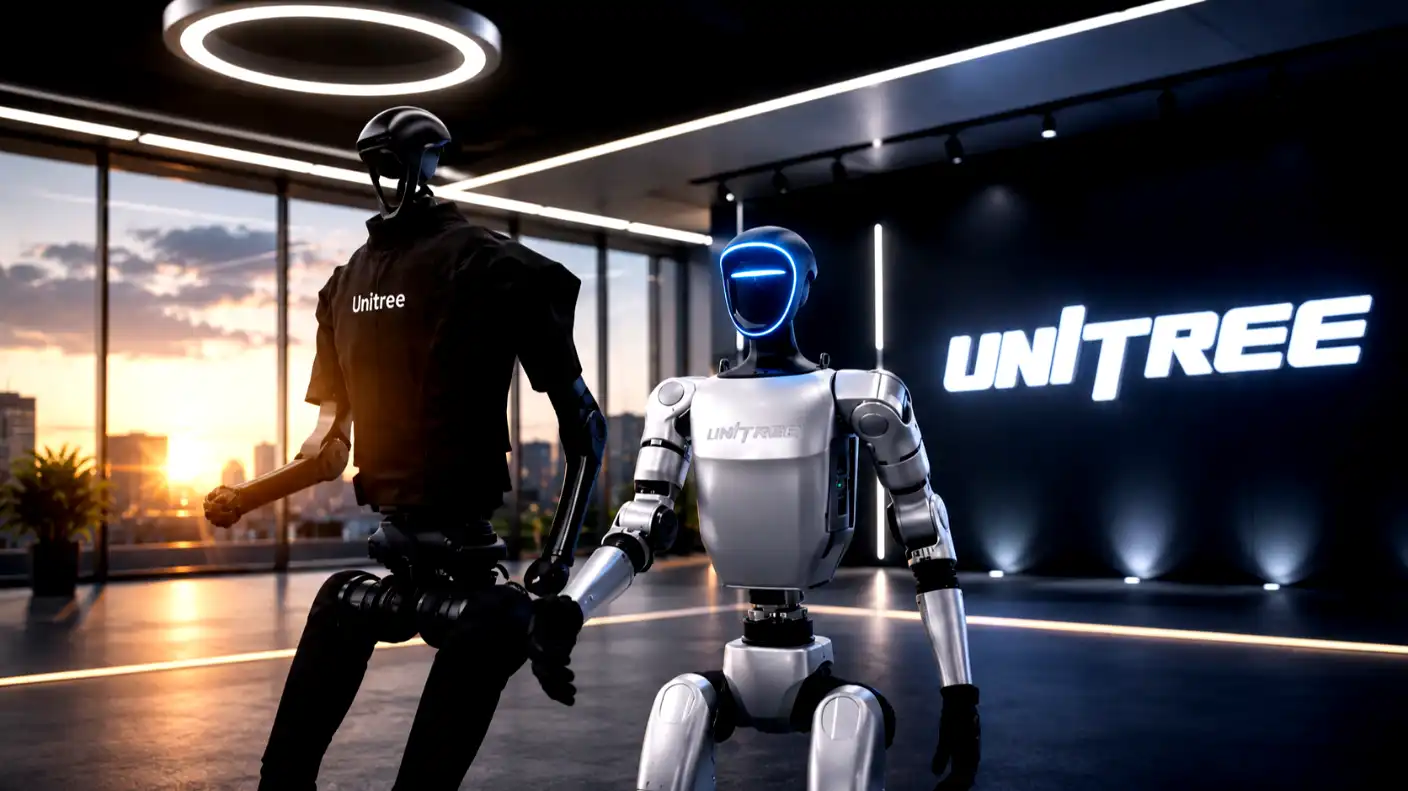
The global robotics race has officially entered a new financial era. In August 2026, Chinese robotics developer Yushu Technology, widely known as Unitree Robotics, finalized the pricing for its initial public offering on the Shanghai Stock Exchange’s STAR Market. The Hangzhou-based company has priced its landmark listing at 150.8 yuan ($22.34) per share, valuing the humanoid robotics leader at a massive 61 billion yuan ($9.04 billion).
This historic deal marks a monumental milestone for the technology sector, as Unitree officially becomes the first mainland-listed manufacturer of humanoid robots in China. By successfully taking its business public on Shanghai’s Nasdaq-style tech board, Unitree is establishing the first major public-market valuation benchmark for pure-play humanoid robotics. The transaction comes at a time of intense global hype surrounding embodied artificial intelligence, where physical machines are increasingly paired with advanced neural networks to perform autonomous physical labor.
As the offering moves closer to its official trading debut, the massive demand from institutional investors demonstrates the soaring investor appetite for the physical side of the AI boom. While traditional software companies struggle with high valuation multiples, Unitree’s successful listing proves that physical hardware manufacturers that can demonstrate scale, profitability, and practical applications are highly valued by the global investment community.
Analyzing the Financial Surge of Unitree: From Quadruped Startup to Profitable Giant
Many early-stage robotics companies struggle with long, capital-intensive research and development cycles that generate massive losses. Unitree, however, has managed to navigate this transition with remarkable speed. The company has evolved from a startup specializing in simple four-legged quadruped robodogs into a highly profitable, scaled-up industrial hardware manufacturer.
The Hyper-Growth and Rapid Profitability Transition
Financial data shows that the firm’s revenue scaling is among the fastest in hardware history. In fiscal year 2023, the company reported modest revenue of 159.1 million yuan. This figure climbed to 392.8 million yuan in 2024, before exploding to an astonishing 1.70 billion yuan in 2025. This trajectory represents a massive tenfold revenue increase in just two years, with annual growth topping 333% in 2025 alone.
This hyper-growth was accompanied by a rapid and highly reassuring transition to bottom-line profitability. Unitree reported a net loss of 11.1 million yuan in 2023. However, the company turned the corner in 2024, generating a net profit of 95.5 million yuan. In 2025, net profit surged to 278.2 million yuan. Operating profits followed an identical trajectory, rising to 367.7 million yuan in 2025. This rare combination of exponential sales growth and strong cash generation has made Unitree a highly unique asset for public-market investors who are tired of backing unprofitable tech startups.
Crushing the Humanoid Shipment Race Globally
The primary driver behind Unitree’s massive revenue explosion is its unique ability to manufacture and ship physical robots at scale. Historically, bipedal humanoid robots were treated as expensive lab curiosities, costing hundreds of thousands of dollars and requiring teams of specialized engineers to maintain. Unitree disrupted this market dynamic by drastically undercutting Western rivals, offering walking humanoids at prices that made them accessible to universities, independent developers, and tech hobbyists.
This pricing strategy allowed the company to capture massive global market share. In 2025, Unitree shipped more than 5,500 full-body, bipedal humanoid robots globally. This shipment volume represents a dominant position in the physical robotics market. To put this achievement in perspective, prominent American competitors—including Tesla, Figure AI, and Agility Robotics—collectively shipped roughly 150 humanoid units during the same period. By prioritizing volume and manufacturing efficiency, Unitree has successfully built a massive global developer base centered around its proprietary hardware, creating a powerful, self-sustaining software ecosystem.
The Mechanics of the Listing: Pricing, Subscriptions, and Valuation Demands
The official pricing announcement revealed that the final metrics of the IPO far exceeded the company’s original targets, demonstrating that institutional investors were eager to secure a stake in the landmark offering.
The Pricing Premium and Sky-High Valuation Metrics
Under the terms of the listing, Unitree is issuing 40.45 million new shares, representing exactly 10% of its post-issuance enlarged share capital. When the company first initiated its roadshow process, it targeted a modest fundraising goal of 4.20 billion yuan ($620 million), implying an initial valuation of around 42 billion yuan.
However, intense bidding during the book-building process pushed the final price to 150.8 yuan per share. This pricing allows the company to raise approximately 6.10 billion yuan ($904 million) in total gross proceeds, with net proceeds estimated at around 5.92 billion yuan. The final post-IPO market capitalization of the firm will surpass 61 billion yuan ($9.04 billion), overshooting previous expectations by more than 40%.
This massive valuation means that the IPO carries a trailing price-to-earnings ratio of 219.23 times. This valuation is significantly higher than the average trailing P/E ratio of the traditional machinery and robotics industry, which currently sits at 38.56 times. While some market analysts argue that a P/E multiple exceeding 219 times is highly speculative, the premium reflects deep investor expectations that humanoid robotics will serve as the next major growth engine of the global digital economy.
Heavily Backed by State and Strategic Investors
The IPO has attracted a formidable group of cornerstone and strategic investors, ensuring that the company has strong corporate and institutional backing as it transitions to the public markets. Institutional allocations have drawn investments from heavyweight entities, including China’s National Social Security Fund and the state-owned China National Petroleum Corporation.
The public subscription process is scheduled to officially open on August 10, 2026, with investors required to submit their final payments on August 12, 2026. Unitree plans to use the massive cash injection to fund its ambitious long-term expansion plans. The business plans to use the proceeds to develop advanced robot software, upgrade its physical motion-control systems, design and launch next-generation humanoid models, and construct a state-of-the-art robotic manufacturing base to further drive down production costs.
Deeptech Synergy: DeepSeek’s Strategic Investment and Embodied AI Alliance
One of the most exciting aspects of the Unitree IPO is the formal participation of DeepSeek, one of China’s most prominent and cost-efficient artificial intelligence startups. The partnership represents a highly strategic convergence between cutting-edge AI models and advanced mechanical engineering.
A Twenty Million Dollar Stake in Embodied Intelligence
Regulatory filings show that DeepSeek has invested 140.8 million yuan (approximately $20.8 million) directly into Unitree’s IPO. This strategic placement grants the AI lab 933,399 Unitree shares, representing a 2.31% stake in the shares allocated through the strategic placement.
The investment is not merely a financial bet; it is backed by a comprehensive procurement and development pact that closely ties the technology roadmaps of both companies together. Under the terms of the agreement, the two firms will combine DeepSeek’s advanced AI models with Unitree’s expertise in mechanical design, robotic joint motion control, and physical environment navigation.
The commercial terms of the deal create a powerful mutual favoritism. Unitree has agreed to give DeepSeek preference when procuring model-training services, natural language processing solutions, and technical AI systems. In return, DeepSeek will favor Unitree when purchasing physical robot units or exploring real-world embodied-AI applications for its software models.
Overcoming the Robot “Brain” Bottleneck
This alliance targets the most critical bottleneck currently facing the humanoid robotics industry: building a robot brain capable of understanding and interacting with unfamiliar, real-world surroundings.
While manufacturers have successfully developed relatively inexpensive, highly agile hardware capable of walking, running, climbing stairs, and performing complex acrobatic routines, these machines are still severely limited by their software. To perform useful, autonomous work in factories, warehouses, or homes, a robot must be able to understand natural language instructions, identify objects, and safely react to changing, unpredictable environments.
By pairing DeepSeek’s advanced, cost-effective artificial intelligence models with Unitree’s high-volume hardware, the alliance wants to solve this problem. DeepSeek’s models will be trained on physical-world data generated by Unitree’s massive fleet of active robots. This real-world training will allow the AI to reliably translate digital instructions into safe, precise physical actions, bringing the dream of fully autonomous, useful robotic assistants one step closer to reality.
Geopolitical Tensions and the Global Race for Robotics Hegemony
While the pricing of the Shanghai IPO represents a major corporate victory for Unitree, the company’s future growth will be shaped by intense geopolitical and trade tensions between the United States and China.
Robotics as a National Security Frontier
The Chinese government has designated the humanoid robotics sector as a strategic national priority, viewing it as a critical component of its ongoing technology rivalry with Washington. Beijing wants to build a self-reliant, domestic supply chain for high-tech manufacturing, reducing its dependence on Western software and components.
The successful listing of Unitree on the Shanghai STAR Market is a direct result of this state support, as regulators have actively fast-tracked listings for high-tech innovators and strategic hardware manufacturers.
However, this domestic focus also presents significant international risks. As Washington and Beijing continue to clash over advanced technology, the United States has steadily tightened restrictions on Chinese access to advanced semiconductor chips and high-tech equipment.
Furthermore, US policymakers have expressed growing concerns over foreign-made robotic hardware, introducing proposals that could place strict restrictions or outright bans on the importation and operation of Chinese-made humanoid and four-legged robots within the United States.
Managing the US Tariff and Export Control Risks
These international regulatory hurdles present a major challenge for Unitree’s long-term business model. The company’s current quadruped and humanoid models have secured standard U.S. regulatory approvals, allowing it to export robots to North American researchers and hobbyists.
Corporate reports show that Unitree possesses a 13.3% sales exposure to the United States market.
If Washington implements stricter tariff measures or comprehensive export controls on Chinese robotic hardware, Unitree could lose access to a vital source of revenue and developer feedback. This international risk means that the company must work quickly to build domestic demand within China’s own industrial and manufacturing sectors, ensuring it can maintain its growth trajectory even if Western markets are completely closed off.
Shaping the Future of Embodied Artificial Intelligence
The pricing of Unitree Robotics’ Shanghai IPO marks a watershed moment for the global technology industry. By securing a massive $9.04 billion valuation at a trailing P/E ratio exceeding 219 times, the company has proven that public markets are ready to place a massive premium on the physical infrastructure of the AI age.
Through its strategic partnership with DeepSeek and strong backing from state-owned institutional investors, Unitree is positioning itself to lead the next major technological transition, where digital intelligence is successfully integrated into highly agile, affordable physical bodies.
As the company prepares for its official trading debut, the success of this listing will serve as a powerful signal to developers, competitors, and policymakers worldwide, demonstrating that the future of robotics will be defined by those who can manufacture, scale, and deliver physical systems to the global marketplace.