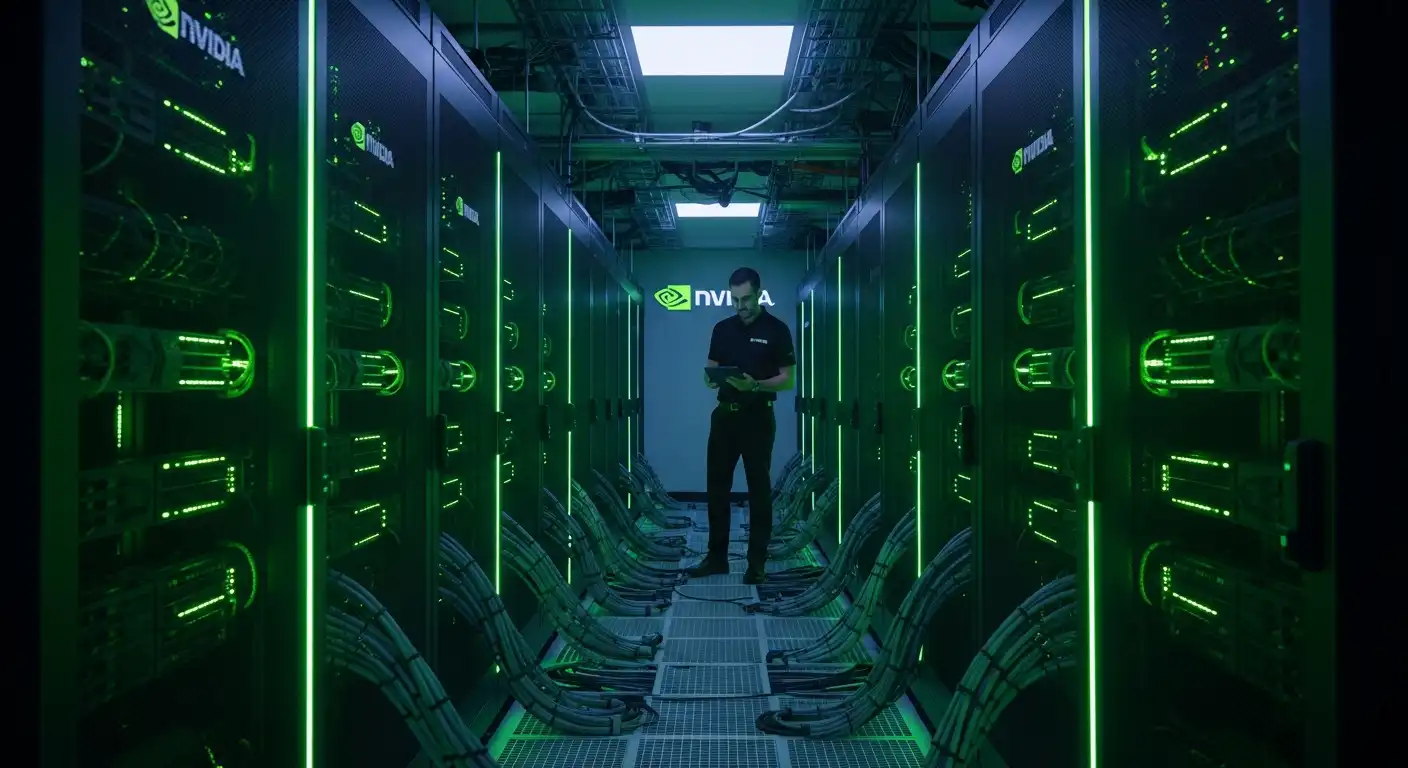
The physical and financial boundaries of the artificial intelligence era have experienced a monumental expansion. In August 2026, technology giant Nvidia Corporation announced a historic, multi-layered partnership with SoftBank-backed energy developer SB Energy and artificial intelligence pioneer OpenAI. Under the terms of the landmark agreements, Nvidia will invest $1.5 billion directly in SB Energy and provide an unprecedented $105 billion residual value guarantee to help OpenAI secure a sprawling, eight-gigawatt computing campus in Pike County, Ohio.
This massive transaction represents one of the largest infrastructure financing commitments in corporate history. By securing the essential “Land, Power, and Shell” resources required to host its high-density graphics processors, Nvidia is transforming from a mere silicon designer into the active financial and physical gatekeeper of the global digital economy. The massive campus, known as the PORTS-Pike Technology Campus, will serve as the premier, high-performance manufacturing base for OpenAI’s next-generation artificial intelligence models, cementing a powerful triple alliance that will shape the future of global technology.
The scale of the project is almost impossible to comprehend. Once fully completed, the eight-gigawatt campus will possess enough electrical capacity to power millions of American homes, making it the largest single computational and energy site on the planet. By directly underwriting this massive development, Nvidia is ensuring that its advanced hardware has a secure, optimized physical home, while proving to the market that the transition to the machine age is a highly physical, capital-intensive heavy industry that requires absolute strategic cooperation.
The Architecture of the PORTS-Pike Mega-Deal
The multi-billion-dollar transaction announced on August 17, 2026, is a highly structured, performance-driven agreement designed to optimize Nvidia’s financial flexibility while protecting its balance sheet from excessive credit concentration risks.
Breaking Down the One-Hundred-and-Five-Billion-Dollar Credit Support
The core of the transaction is a series of residual value guarantees entered into between Nvidia and SB Energy, which acted as the project’s developer and lessor. According to Nvidia’s Form 8-K filing submitted to the United States Securities and Exchange Commission, the chipmaker has agreed to provide credit support of up to $105 billion for the initial leases covering approximately 4.25 gigawatts of IT load at the Portsmouth Site.
This $105 billion figure represents the maximum, cumulative contingent obligation under the guarantees, rather than an immediate cash outlay. Because OpenAI operates as a private company and lacks an investment-grade credit rating, traditional commercial banks are reluctant to lend billions of dollars to construct custom data centers on its behalf. By having Nvidia—which possesses massive cash reserves, a pristine credit rating, and a market capitalization exceeding $5 trillion—guarantee the lease payments, the project successfully bypasses this credit rating bottleneck, allowing SB Energy to secure competitive construction financing.
The Direct One Point Five Billion Dollar Investment in SB Energy
To support the physical development of the massive campus and help SB Energy meet its extensive community and utility commitments, Nvidia is also making a direct $1.5 billion equity investment in the developer. This cash injection will be used to fund the early phases of land grading, high-voltage substation construction, and optical fiber routing, ensuring that the first tranches of computing capacity can come online on schedule.
This direct investment is highly strategic, as it strengthens the financial standing of the project’s primary developer. SB Energy will build, own, and operate the data center buildings under a strict, 20-year lease agreement with OpenAI. By injecting $1.5 billion directly into the developer, Nvidia is ensuring that SB Energy has the liquidity needed to execute the massive project safely, while securing a valuable equity stake in one of the most important infrastructure developers in the country.
The Lease Structure and Indemnification Safeguards
To protect its shareholders from the high risk of underwriting a private, unprofitable startup, Nvidia has integrated several strict legal safeguards into the contract. Under the terms of the agreements, OpenAI has agreed to fully reimburse and indemnify Nvidia for any payments the chipmaker is forced to make to SB Energy under the residual value guarantees.
If OpenAI experiences financial distress or fails to meet its monthly lease payments, Nvidia’s payment obligations will be triggered, but the chipmaker retains the legal right to seize and liquidate OpenAI’s assets to recover its funds. Furthermore, the guarantees will generally become effective in phases as each individual facility meets specified ready-for-service conditions, with the first phase of capacity expected to begin coming online in 2028. This phased timeline ensures that Nvidia only guarantees active, fully functional facilities that are already generating technological value, reducing its short-term risk exposure.
Sizing up the Eight-Gigawatt Footprint: Powering the Future of AI
The physical and electrical scale of the PORTS-Pike Technology Campus represents a monumental industrial achievement, completely reconfiguring the energy and data center landscapes of the United States.
Securing Four Point Two-Five Gigawatts with an Option for Eight
The initial phase of the agreement covers leases for approximately 4.25 gigawatts of IT load at the Pike County site, which is already larger than any other data center campus currently operating in the world. However, the contract also includes a highly valuable expansion option: Nvidia retains the sole discretion to provide additional credit support to secure approximately 3.8 gigawatts of additional capacity at the same site, bringing the potential total to an extraordinary 8.05 gigawatts.
This massive power footprint is essential for supporting OpenAI’s long-term technology roadmap. The startup intends to utilize the initial 4.25 gigawatts of capacity to deploy over 1 million of Nvidia’s advanced processing chips, running its full-stack DSX AI factory platform. This massive concentration of computing power will allow OpenAI to train its next-generation, high-reasoning frontier models with an efficiency that rival software labs cannot easily match, securing its position as the premier research laboratory in the world.
Powering Six Million American Homes: The Scale of the Portsmouth Site
To put the scale of an eight-gigawatt data center campus into perspective, one must look at the traditional energy consumption of the United States. A standard gigawatt of electricity is enough to power approximately 750,000 U.S. homes. This means that if the PORTS-Pike campus successfully expands to its maximum planned capacity of 8.05 gigawatts, it will consume enough electricity to power roughly 6 million American homes simultaneously.
This massive energy demand requires a highly sophisticated, dedicated power grid. The developers plan to fund and construct their own private electrical substations and high-voltage transmission lines, ensuring the campus has access to a continuous, reliable supply of baseload electricity without placing an unmanageable burden on the local public grid. This self-contained energy planning represents a major milestone, proving that the digital age is completely dependent on the physical capacity of the electrical grid to expand.
The Strategic Logic: Defeating the “Circular Financing” Critique
Nvidia’s direct financial participation in the PORTS-Pike project represents a bold, highly calculated response to a persistent and growing criticism of the technology sector’s financial reporting.
Shifting the Debate from Self-Funded Demand to Strategic Securitization
For several quarters, market skeptics and short-sellers have accused Nvidia of engaging in “circular financing,” claiming that the chipmaker was artificially inflating its own revenues and valuations by investing directly in its startup clients, who then used the borrowed cash to purchase Nvidia chips. This circular funding loop has fanned deep anxieties on Wall Street, with some critics warning that the high demand for AI hardware is being driven by financial engineering rather than genuine, organic consumer revenues.
Nvidia’s CEO, Jensen Huang, has firmly rejected this circular financing label. Speaking to tech news outlets following the announcement of the Ohio deal, Huang explained that the artificial intelligence revolution is no longer a speculative software battle; it has transformed into a critical national infrastructure campaign, and “Land, Power, and Shell” has emerged as the ultimate physical bottleneck.
He stated that because private startups and small cloud providers lack the creditworthiness to secure massive, multi-decade utility leases on their own, Nvidia is utilizing its own massive scale and long-term visibility to secure these physical sites. By acting as the financial anchor for these projects, Nvidia is securing the physical cleanrooms and power grids required to host its advanced hardware, ensuring that its chips have a physical home, while proving to the market that the demand for its hardware is backed by genuine, long-term infrastructure assets.
Integrating with the Wall Street Private Credit Era
This strategic asset securitization is closely connected to a broader, historic capital-raising campaign. Just last week, Nvidia partnered with six of the world’s most powerful private capital groups—including BlackRock, Blackstone, KKR, and Apollo—to launch specialized, third-party financing platforms targeting over $500 billion in infrastructure funding.
The $105 billion credit support package for the Ohio campus fits perfectly into this institutional framework. By bringing in major financial institutions to independently assess and underwrite the risk of each project, Nvidia is successfully transitioning the AI buildout into a mature, risk-managed asset class. This professional oversight ensures that the cash flows, demand metrics, and residual values of each data center are analyzed with absolute discipline, reducing the risk of a speculative overbuild and protecting the stability of the global credit markets.
Local Impact: Reindustrializing Ohio and the Eighty-Million-Dollar Community Fund
The economic and social benefits of the PORTS-Pike project represent a massive windfall for the local communities of Pike County, Ohio, turning the outback agricultural region into a highly prosperous, high-tech industrial belt.
Creating Tens of Thousands of High-Skilled Construction and Tech Jobs
The construction of the massive, eight-gigawatt computing campus is expected to be one of the largest and most labor-intensive industrial projects in Ohio’s history. Scheduled to begin delivering its first phases of capacity in 2028, the project will create tens of thousands of local construction, engineering, and tech-support jobs over the next decade.
This massive employment boom is a vital source of economic stability for Pike County, which has historically struggled with industrial decline and high unemployment.
By bringing high-paying, long-term engineering and software roles to the region, the project will encourage a new generation of local students to enter the STEM fields, rebuilding the academic pipeline and ensuring that the domestic technology recovery is led by a highly trained local workforce.
The Eighty-Million-Dollar Community Benefits Fund
To ensure that the physical expansion of the computing campus does not come at the cost of local community stability, the partners have established an innovative, highly generous community support program.
The project is anchored by an initial $80 million community benefits fund, which will be used to build local schools, finance public parks, upgrade municipal water systems, and support local clean-energy grids near the data center hub.
Furthermore, the developers have agreed to pay for the entire physical utility and power infrastructure required to connect the site to the regional grid, representing a major capital pool of over $1 billion that will be injected directly into the state’s economy, where even a 1.5% improvement in grid transmission can save operators millions of dollars annually.
This cooperative approach ensures that local residents directly benefit from the technology boom, protecting the company’s brand reputation and ensuring that the project enjoys strong, long-term community support throughout its 20-year operational life.
Establishing a Resilient Foundation for the Future of AI
The completed announcement of the Nvidia-OpenAI-SoftBank partnership to develop the massive, eight-gigawatt PORTS-Pike Technology Campus in Ohio is a landmark milestone in the corporate history of the digital era. By committing a direct $1.5 billion equity investment in SB Energy and providing a massive $105 billion residual value guarantee to back OpenAI’s lease payments, the world’s leading chipmaker has proven that its ultimate goal is to control both the financial and physical layers of the technological revolution.
While the massive scale of the credit support has triggered a complex, ongoing debate over the risks of high corporate leverage and circular funding, the strategic benefits of the triple-alliance are immense.
The $105 billion envelope secures an unassailable, long-term critical infrastructure pipeline of land, power, and shell capacity, ensuring that OpenAI has the dedicated computing power needed to maintain its global lead, while proving that the ultimate winners of the digital age will be the businesses that can successfully construct, cool, and operate the physical infrastructure of the modern age.