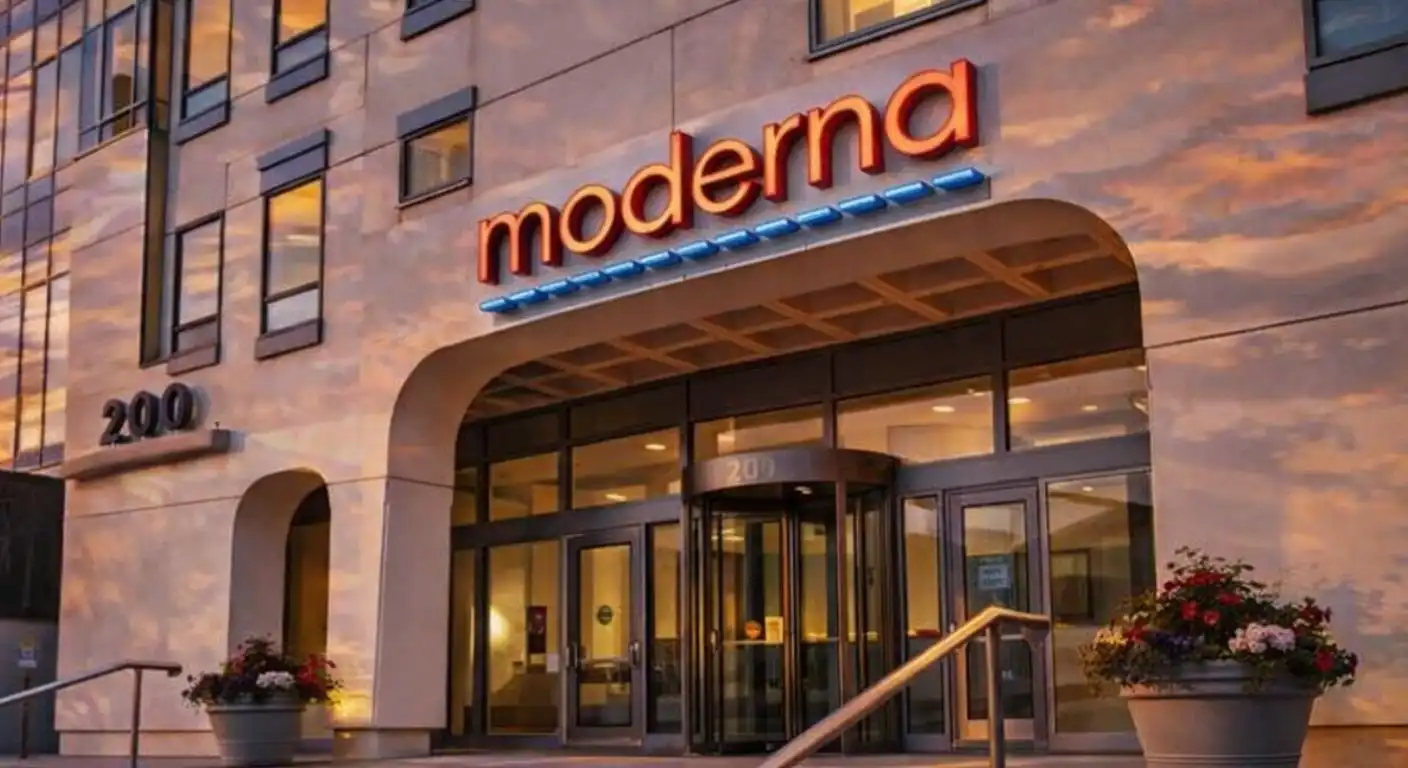
A historic milestone is reshaping the global biotechnology and medical landscapes. In August 2026, pharmaceutical giants Moderna Inc. and Merck & Co. announced an unprecedented breakthrough in oncology. Their jointly developed personalized mRNA-based cancer vaccine, Intismeran autogene, achieved its primary endpoints in a pivotal, large-scale Phase 3 clinical trial. The success of this trial represents a landmark victory for the medical community, proving that the same mRNA technology that powered the world’s pandemic response can be successfully engineered to treat advanced, high-risk cancers.
The announcement, delivered on August 19, 2026, triggered an immediate, record-breaking reaction in the financial markets. Shares of Moderna soared by as much as 160% in active trading, climbing past $140 per share as investors recognized the immense commercial and therapeutic value of the breakthrough. At the same time, Merck’s stock rose by approximately 11%, demonstrating broad-based investor confidence in the future of the joint-development program.
This successful Phase 3 trial is the first positive late-stage result for an individualized, mRNA-based cancer treatment. By proving that a vaccine can be tailored to the genetic signature of an individual’s tumor to prevent recurrence and metastasis, the two companies have established a new paradigm in oncology. This development is expected to trigger a massive wave of capital investment and scientific research, transforming the global cancer therapeutics market and offering new hope to millions of patients.
Inside the INTerpath-001 Trial: Delivering a Clinical Triumph
The clinical trial that led to this historic breakthrough was a massive, highly disciplined global study designed to test the efficacy of the vaccine under the most rigorous scientific parameters.
The Double-Defense Against Cancer Recurrence and Metastasis
The global Phase 3 study, known as the INTerpath-001 trial, enrolled 1,137 high-risk patients with stage IIB through IV melanoma, which is the deadliest and most aggressive form of skin cancer. All participants had previously undergone surgery to remove their primary tumors but remained at a highly elevated risk of their cancer returning or spreading to other organs.
The trial was randomized and double-blinded, comparing the performance of Merck’s blockbuster immunotherapy drug, Keytruda, when combined with Moderna’s personalized Intismeran autogene vaccine, against Keytruda alone over a one-year treatment course.
The pre-planned interim analysis delivered a stunning double victory, meeting both its primary and secondary endpoints ahead of schedule:
- Recurrence-Free Survival (RFS): The trial met its primary target, proving that the vaccine-immunotherapy combination significantly reduced the risk of the cancer returning compared to Keytruda alone.
- Distant Metastasis-Free Survival (DMFS): The trial met its critical secondary target, demonstrating that the combination successfully restricted the cancer from spreading to other parts of the body, such as the lungs or liver, or causing death.
- Safety Profile: The independent data monitoring board reported that no new safety signals emerged during the trial, proving that the personalized vaccine is safe and well-tolerated when combined with standard immunotherapy.
Expanding on the Strength of Five-Year Phase Two Data
The positive Phase 3 results build directly on a foundation of long-term data from earlier trials. In June 2026, the companies presented detailed five-year follow-up data from their Phase 2b study at the American Society of Clinical Oncology annual meeting.
That long-term study demonstrated that the combination of Intismeran autogene and Keytruda reduced the risk of cancer recurrence or death by an extraordinary 49% over a five-year period compared to Keytruda alone.
Furthermore, the data showed a massive 59% reduction in the risk of distant metastasis or death.
By successfully replicating these highly significant, long-term survival benefits in a much larger, global Phase 3 trial involving over 1,000 patients, the partners have validated the stability of their mRNA platform, proving that the immune system’s memory can be trained to maintain a durable, multi-year defense against cancer cells.
How Personalization Works: The Mechanics of Individualized Neoantigen Therapy
The primary innovation that sets Intismeran autogene apart from traditional, mass-produced medicines is its absolute personalization. The vaccine is not a preventative shot designed to stop people from developing cancer; instead, it is a made-to-order therapeutic treatment tailored specifically to the unique genetic mutations found inside an individual patient’s tumor.
Training the Immune System on Thirty-Four Unique Mutations
The manufacturing process of this individualized neoantigen therapy is a highly advanced, technology-driven pipeline that begins immediately after a patient undergoes surgery to remove their tumor:
- Biopsy and Sequencing: Pathologists extract samples of both the patient’s tumor tissue and healthy blood cells, sending them to specialized laboratories for high-throughput genomic sequencing.
- Algorithmic Mutation Analysis: A proprietary machine-learning algorithm analyzes the genetic data, comparing the healthy cells with the tumor cells to identify the unique mutations, or neoantigens, that exist only on the surface of that specific patient’s cancer.
- Custom mRNA Design: The algorithm selects up to 34 of these unique, patient-specific mutations and uses them to design a customized mRNA sequence.
- Vaccine Synthesis: The resulting mRNA blueprint is encapsulated inside protective lipid nanoparticles to create a highly targeted, personal vaccine.
When injected into the patient, the customized mRNA instructs their own cells to produce harmless copies of these 34 specific tumor proteins.
This exposure trains and activates the patient’s own T cells to recognize these specific markers, turning the body’s immune system into a highly precise, automated defense force.
When these trained T cells circulate through the body, they can identify and destroy any residual, microscopic cancer cells that present these same mutations while completely ignoring healthy tissue, significantly reducing the toxic side effects typically associated with traditional chemotherapy and radiation.
The Scalability of Cell-Free mRNA Manufacturing
A major advantage of Moderna’s mRNA-based platform over other personalized cancer treatments, such as CAR-T cell therapies, is its superior scalability and lower manufacturing complexity.
Unlike CAR-T therapies, which require extracting a patient’s physical T cells, shipping them to a specialized laboratory to be genetically engineered, and then infusing them back into the patient—a slow, highly delicate process that can take weeks and cost hundreds of thousands of dollars—mRNA manufacturing is entirely cell-free.
Because the vaccine utilizes synthetic genetic code rather than living cells, the manufacturing process can be automated and scaled rapidly in centralized facilities.
This scalability allows the companies to reduce their production costs and accelerate delivery times, ensuring that patients can receive their customized vaccines within weeks of their surgery, when the risk of cancer recurrence is at its highest.
Financial and Market Projections: A Three-Billion-Dollar Blockbuster
The successful clinical trial has major financial implications for the global biopharmaceutical industry, proving that advanced personalized medicine can serve as a highly profitable commercial franchise.
Plugging the Post-COVID Revenue Gap for Moderna
For Moderna, the success of the cancer vaccine is a vital corporate turning point. After generating billions of dollars in revenues during the pandemic from its spike-protein COVID-19 vaccines, the company faced a severe financial squeeze as global demand for infectious-disease shots declined rapidly over the past several years.
The company has spent the past several years aggressively diversifying its product portfolio, developing experimental shots for norovirus, Lyme disease, and influenza to plug the massive revenue gap left by waning COVID demand.
The positive Phase 3 results for Intismeran autogene prove that the company’s underlying mRNA platform is highly versatile, capable of generating entirely new, multi-billion-dollar revenue streams.
Financial analysts at J.P. Morgan and Jefferies noted that the successful launch of the cancer vaccine will be the single most important catalyst for the company to return to sustainable profitability, restoring investor confidence and driving its valuation back toward record heights.
Sizing Up the Three-Billion-Dollar Annual Sales Opportunity
The commercial market for advanced skin cancer treatments is massive and growing, with the American Cancer Society estimating that over 112,000 people will be diagnosed with high-risk melanoma in the United States alone this year.
Financial analysts at Barclays estimate that Intismeran autogene, if approved by regulators, could generate annual sales of approximately $3 billion for treating melanoma alone by 2035.
Furthermore, because the vaccine is designed to be used in combination with Merck’s blockbuster immunotherapy drug, Keytruda, which already generates over $25 billion in annual sales, the partnership provides both companies with a highly complementary, high-margin revenue engine.
While the companies have not yet finalized their official pricing, investment analysts at Jefferies estimate that the custom treatment could be priced similarly to premium immunotherapies, around $200,000 per year, which would easily support a multi-billion-dollar commercial peak sales trajectory.
The Regulatory Horizon: The Next Phase of the INTerpath Program
Following the positive Phase 3 readout, the primary focus for Moderna and Merck has shifted to securing regulatory approvals and expanding their clinical research to cover other high-stakes cancer indications.
Preparing for a Late-Stage Regulatory Filings Blitz
In interviews following the announcement, Moderna President Stephen Hoge indicated that the company plans to engage immediately with global regulatory bodies, including the United States Food and Drug Administration and the European Medicines Agency, to submit formal filing submissions for Intismeran autogene.
Because the vaccine has already secured “breakthrough therapy” designation from the FDA and “PRIME scheme” designation from the EMA, its regulatory review process will be highly accelerated.
Hoge expressed confidence that if the regulators approve the clinical data, the personalized treatment could become commercially available to high-risk melanoma patients as early as next year, establishing a new record for the rapid clinical translation of an advanced oncology product.
Launching Trials Across Lung, Bladder, and Kidney Cancers
The ultimate goal of the partnership is to prove that personalized mRNA technology can be utilized to treat any solid tumor, completely transforming how oncology is practiced on a global scale.
To achieve this, Moderna and Merck have launched the massive “INTerpath” clinical development program, which currently consists of nine separate Phase 2 and Phase 3 clinical trials across multiple tumor types.
The companies are currently conducting large-scale trials to test the combination of Intismeran autogene and Keytruda in:
- Non-small cell lung cancer (NSCLC) patients who have undergone surgical resection.
- Bladder cancer and renal cell carcinoma (kidney cancer) patients.
- Early-stage, post-surgery pancreatic and stomach cancer patients, which represent some of the most difficult-to-treat and deadly oncology indications in medicine.
This broad-based clinical campaign, which requires large-scale industrial commitments requiring over $1 billion in capital investments, is designed to prove that the immune system can be trained to fight any solid tumor.
If these trials are successful, they will establish the personalized mRNA vaccine as a standard, universal baseline for modern cancer care, ensuring that even a minor 1.5% improvement in long-term survival rates can save millions of lives globally.
A Major Re-Rating for the Biotech and Oncology Sectors
The historic announcement in Chicago has fanned a massive, industry-wide wave of enthusiasm, drawing billions of dollars of fresh investment capital back into the biopharmaceutical and oncology sectors.
For years, the public and the financial markets focused heavily on other high-tech sectors, such as artificial intelligence and cybersecurity, leaving biotech valuations relatively depressed.
The positive Phase 3 results for Intismeran autogene have successfully dragged investors’ attention back into the pharmaceutical tent, proving that advanced biotechnology remains the single most important and lucrative sector for driving human health and longevity.
The success of the trial has also fanned optimism for other developers in the space.
Moderna’s primary European rival, BioNTech—which partnered with Pfizer to develop the world’s first COVID-19 vaccine—is currently developing its own personalized mRNA-based cancer vaccine, autogene cevumeran, in mid-stage clinical trials for colon and pancreatic cancer.
The positive readout for the Moderna-Merck vaccine proves that the underlying science of mRNA-based oncology is sound, reducing the perceived development risks of the entire sector and clearing the way for a massive wave of funding to support the next generation of clinical research.
The Future of Modern Medicine
The completed publication of the Phase 3 INTerpath-001 trial results is a landmark milestone in the history of medicine. By proving that a personalized, mRNA-based cancer vaccine can successfully reduce the risk of cancer recurrence and prevent the spread of tumors in high-risk melanoma patients, Moderna and Merck have opened up a revolutionary new frontier in oncology.
While the companies must continue to navigate the complex regulatory approval process and finalize their global manufacturing scale, the financial backing of Merck, the massive $3 billion commercial sales potential, and the supportive regulatory environment in Washington ensure that the technology has a secure path forward.
As the companies continue to expand their clinical trials across lung, bladder, and kidney cancers, this historic, private-sector-led medical offensive will ensure that the human immune system remains the ultimate, most precise weapon in the fight against disease, securing a healthier, longer, and more hopeful future for patients across the globe.