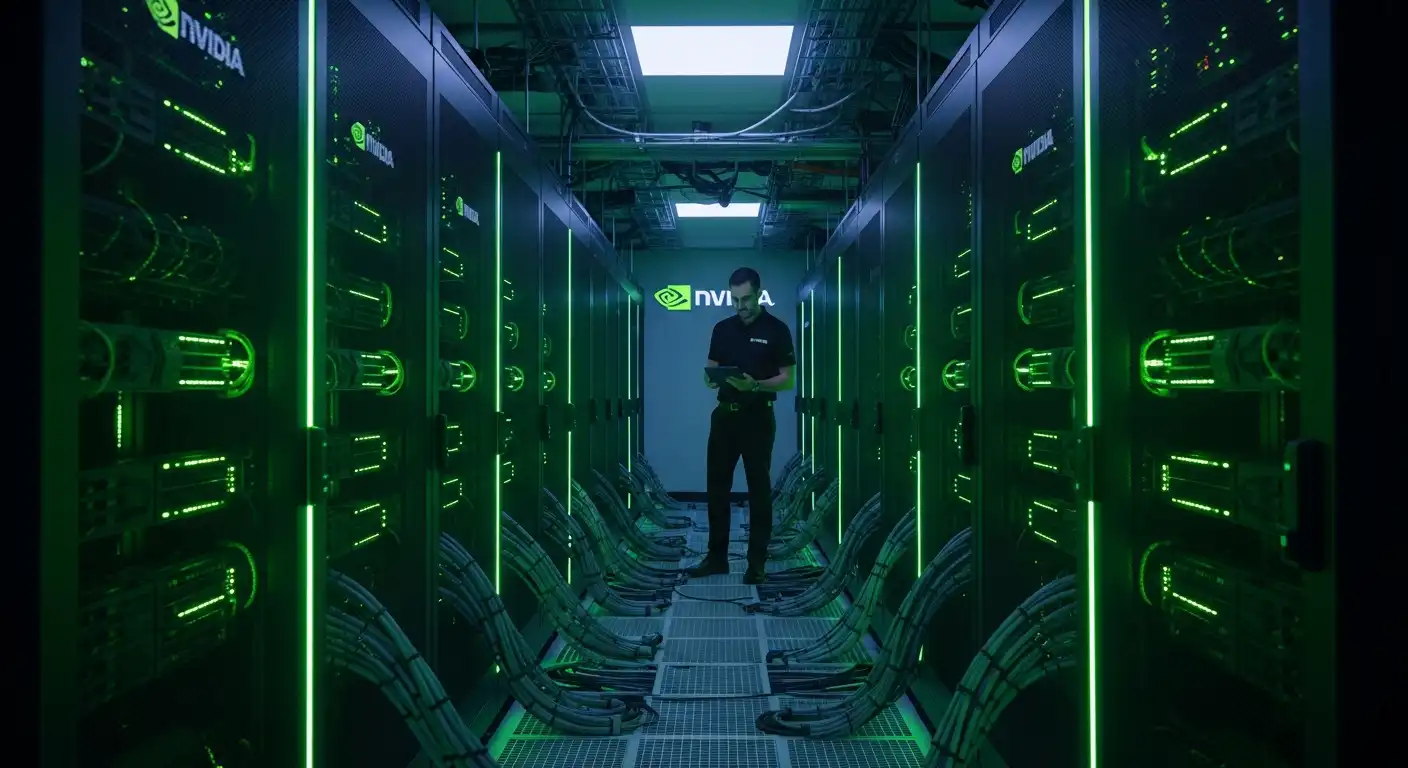
Semiconductor giant Nvidia has paused negotiations on several major deals under its newly introduced cloud financing initiative, stepping back from an aggressive business model that offered credit backstops to artificial intelligence cloud companies in exchange for a share of their recurring revenues. The decision to halt the rollout arrives less than two months after the company announced the program, following internal warnings from Nvidia employees who raised concerns that the financing arrangements could invite intense antitrust scrutiny from federal competition regulators.
The paused initiative was designed to solve a fundamental financing bottleneck for specialized artificial intelligence cloud providers, commonly known as neoclouds. Under the proposed structure, Nvidia provided credit guarantees to help emerging cloud platforms borrow capital from commercial banks to purchase expensive Nvidia computing hardware. In exchange, Nvidia secured an ongoing revenue-sharing cut of up to 50% on cloud revenues generated beyond a set threshold, while agreeing to rent back unused computing capacity if the cloud partner failed to find commercial end buyers.
While Nvidia generated bumper quarterly earnings and issued an upbeat financial outlook citing sustained demand for its graphics processing units, investor and regulatory scrutiny surrounding its ecosystem financing tactics has intensified. The company reported that existing commitments under the six-year financing program already totaled $36 billion. However, pushback from potential cloud partners over strict customer-routing mandates, combined with growing legal sensitivities around market dominance, prompted the company to freeze new agreements while executive leadership evaluates whether to revamp or restructure the initiative.
An Abrupt Pause on a $36 Billion Cloud Financing Program
Nvidia introduced the revenue-sharing and credit-support framework to expand access to computing capacity for fast-growing artificial intelligence startups, research institutions, and sovereign cloud builders. For emerging cloud providers, building multi-megawatt computing campuses requires hundreds of millions of dollars in upfront capital expenditures, a sum that traditional commercial lenders hesitate to finance without signed, long-term customer purchase contracts.
By stepping in as a financial backstop, Nvidia effectively removed credit risk for commercial lenders. The model allowed cash-poor cloud builders to secure bank loans, purchase tens of thousands of Blackwell graphics processing units, and bring high-density server halls online quickly.
However, the rapid halt to new deals highlights the friction that emerged once commercial implementation began. The decision to pause agreements occurred just weeks after the public launch, indicating that both internal legal teams and external cloud partners raised serious objections regarding the long-term operational and regulatory implications of the program.
Nvidia maintained that its underlying mission to expand compute access remains active, stating that the new business model continues to evolve to meet high demand. Yet, freezing new contract executions marks a significant tactical retreat for an initiative that management previously told Wall Street analysts could generate billions of dollars in recurring software and services revenue over the medium term.
Unpacking the Revenue-Sharing and Capacity Backstop Structure
The mechanics of Nvidia’s financing model represented a major departure from traditional semiconductor sales. In a standard hardware transaction, a chipmaker sells silicon to a customer, records product revenue, and transfers all operational and commercial risk to the buyer.
Under the new model, Nvidia engineered a multi-layered financial relationship:
- The participating cloud company secured commercial bank loans backed by Nvidia’s credit support to purchase Nvidia server hardware.
- Nvidia collected its standard upfront hardware revenue, capturing gross profit margins of roughly 75% on initial chip shipments.
- In exchange for providing credit guarantees, Nvidia negotiated a recurring revenue-sharing fee, claiming up to 50% of the cloud provider’s rental revenues above a specified utilization threshold.
- If the cloud provider experienced a lull in market demand, Nvidia agreed to rent back the unsold computing capacity for its own internal research or through its DGX Cloud software platform.
This dual-revenue structure allowed Nvidia to monetize the exact same physical silicon twice: first as an upfront hardware sale, and subsequently as an ongoing, usage-linked software earnings stream.
For small cloud operators, the capacity backstop eliminated the risk of carrying empty data centers, providing guaranteed revenue that satisfied institutional debt underwriters.
How the 50% Revenue Cut and Customer Directives Sparked Partner Resistance
While the program offered financial security, the strict commercial conditions demanded by Nvidia created immediate friction with prospective cloud partners. In the early weeks of contract negotiations, several cloud operators expressed frustration over the degree of operational control Nvidia sought to exert over their daily business operations.
Cloud executives noted that the agreements went far beyond standard vendor financing:
- Nvidia demanded up to 50% of all customer revenues generated by the hardware once rental income crossed baseline profitability thresholds.
- The chipmaker told some cloud providers that they could only lease supported computing clusters to approved end customers, restricting the host’s commercial autonomy.
- Nvidia signaled a strong preference that cloud partners distribute computing capacity among multiple smaller artificial intelligence startups rather than leasing entire server halls to a single large enterprise tenant.
- Participating cloud firms worried that sharing operational customer data and pricing models would give Nvidia deep visibility into their private customer relationships.
For ambitious cloud builders aiming to establish independent, multi-billion-dollar infrastructure platforms, accepting a 50% revenue cut while ceding customer selection authority felt less like a financial partnership and more like acting as a subcontracted data center manager for Nvidia.
Mounting Antitrust Scrutiny and Internal Legal Red Flags
The primary factor driving the internal decision to pause the program was mounting anxiety over antitrust liability. In internal discussions, some Nvidia employees warned management that requiring revenue-sharing cuts and dictating customer allocations could draw intense regulatory scrutiny from federal competition authorities in Washington and Brussels.
As Nvidia’s market capitalization climbed past $3.2 trillion, the company became the primary target of regulatory inquiries into competition within the artificial intelligence sector.
The United States Department of Justice, the Federal Trade Commission, and the European Commission have launched wide-ranging inquiries into how dominant hardware vendors influence supply chains, bundle software platforms, and structure investment deals.
Against this heightened regulatory backdrop, launching a commercial program that contractually dictates who cloud providers can sell to and captures a 50% cut of downstream cloud revenues created severe legal vulnerabilities.
Employee Concerns Over Federal Regulatory Oversight and Market Dominance
Internal legal sensitivities within Nvidia reflect a growing awareness of corporate dominance. When a company controls more than 85% to 90% of a critical technology market, commercial practices that are standard for smaller firms can be legally classified as anti-competitive behavior.
Nvidia employees who interacted with prospective cloud clients raised several legal flags:
- Concerns that conditioning credit support on revenue-sharing arrangements could be viewed by regulators as an unlawful tie-in or an abuse of market dominance.
- Risks that dictating customer approvals would be interpreted as market allocation or anti-competitive customer steering.
- The danger is that using financial backstops to favor exclusive Nvidia-based clouds could disadvantage competing hardware architectures, such as accelerators from AMD or custom cloud ASICs.
- Heightened scrutiny from congressional committees investigating market concentration across artificial intelligence foundation model developers.
By pausing the rollout of new deals, Nvidia’s executive leadership aims to conduct a comprehensive legal review, ensuring that any revised financing programs comply strictly with evolving federal antitrust guidelines.
Scrutinizing the Boundaries Between Hardware Vendor and Market Orchestrator
The controversy surrounding the revenue-sharing model illustrates a broader debate regarding the proper role of hardware suppliers in the technology ecosystem. Traditionally, hardware vendors operated as neutral equipment suppliers, selling tools to independent cloud providers who competed freely for commercial end users.
Nvidia’s financing initiative blurred these commercial boundaries, transforming the chipmaker into a centralized market orchestrator:
- Selecting which emerging cloud startups receive the credit backing needed to secure bank financing and purchase hardware.
- Dictating which end-user software developers receive access to subsidized computing allocations.
- Operating DGX Cloud as a direct competitor to the very same cloud hosting providers it supplies with silicon.
- Setting floor prices for commercial computing capacity through its guaranteed capacity buyback pledges.
Antitrust scholars and legal analysts argue that when a dominant hardware monopoly acts as a financier, landlord, software platform, and capacity broker simultaneously, it creates structural conflicts of interest that undermine fair market competition.
Previous Scaled-Back Guarantees from OpenAI to CoreWeave
The pause in cloud revenue-sharing deals follows a visible pattern of Nvidia stepping back from high-profile financial backstops that exposed the company to concentrated liability or regulatory pushback. Over recent months, the chipmaker has quietly adjusted several large-scale financing commitments across the artificial intelligence sector.
A notable example involved proposed financial guarantees for major data center developments. Nvidia previously scaled back plans to provide up to $105 billion in credit backstops to support a massive multi-gigawatt data center leasing project in Ohio connected to OpenAI.
Similarly, while Nvidia guaranteed transactions totaling $6.3 billion with specialized cloud builder CoreWeave, management has become increasingly cautious about expanding single-counterparty exposure.
These adjustments indicate that as the artificial intelligence infrastructure buildout matures, Nvidia is actively managing its financial balance sheet, ensuring that corporate reserves are not overextended as a guarantor for speculative, debt-financed computing projects.
The Economics of Circular Deals and Ecosystem Financing
The scrutiny facing Nvidia’s financing programs is tied to deep-seated market debates regarding circular financing in the artificial intelligence industry. Over the past two years, leading technology conglomerates have invested billions of dollars into emerging artificial intelligence foundation model startups and specialized cloud builders.
In many instances, the venture capital or credit support provided by a tech giant is immediately used by the recipient startup to purchase hardware or cloud computing services from that exact same corporate backer.
Critics on Wall Street have labeled these transactions round-tripping deals, warning that vendor-financing arrangements can artificially inflate reported revenue growth and obscure true market demand.
Mobilizing $500 Billion in Institutional Credit with BlackRock and Apollo
To address the staggering capital requirements of artificial intelligence infrastructure without taking excessive direct credit risk onto its corporate balance sheet, Nvidia has focused on organizing external private credit syndicates.
The company signed strategic memoranda of understanding with premier global alternative asset managers, including BlackRock and Apollo Global Management, with the goal of mobilizing more than $500 billion in institutional private capital for data center construction.
These institutional credit partnerships are designed to establish a scalable financing ecosystem:
- Institutional private credit funds provide multi-billion-dollar construction loans directly to data center developers and cloud operators.
- Nvidia acts as a technical advisor and ecosystem coordinator, validating data center engineering designs and certifying equipment configurations.
- Commercial banks underwrite debt facilities collateralized by high-value graphics processor inventories and long-term enterprise lease contracts.
- Independent infrastructure funds assume the credit risk, freeing Nvidia to concentrate on core semiconductor research, design, and manufacturing.
By shifting credit underwriting to professional asset managers, Nvidia aims to support the global data center buildout while maintaining a clean corporate balance sheet insulated from direct debt default risks.
The Debate Over Artificially Inflated Chip Demand and Round-Tripping
Despite efforts to involve third-party lenders, financial analysts continue to debate the sustainability of vendor-supported computing demand. Skeptics point out that when a hardware manufacturer provides revenue guarantees or buys back unused capacity, it masks whether downstream commercial demand for artificial intelligence software is generating real cash returns.
The mechanics of circular financing raise several accounting and economic concerns:
- Upfront Revenue Recognition: A chipmaker records immediate, high-margin product sales when hardware ships to a partner, while the associated credit backstop liabilities remain deferred over multi-year horizons.
- Capacity Overhang: If enterprise software adoption slows, cloud providers could trigger capacity buyback clauses, forcing the hardware vendor to absorb millions of dollars in unutilized data center leases.
- Market Distortion: Subsidized cloud providers offering discounted computing rates can crowd out unsubsidized competitors, creating artificial pricing benchmarks across the cloud hosting sector.
- Valuation Sensitivity: Public equity investors price semiconductor stocks on the assumption that hardware sales reflect organic end-user demand rather than vendor-financed balance sheet support.
While Nvidia’s massive revenue growth is supported by hundreds of billions of dollars in non-discretionary capital expenditures from cash-rich tech giants like Microsoft, Alphabet, and Meta, maintaining absolute transparency in transactions with smaller cloud operators is vital for preserving investor trust.
CEO Jensen Huang Defends Heavy Capital Requirements for AI Startups
Nvidia Chief Executive Officer Jensen Huang has aggressively defended the company’s investment and financing activities, pushing back against criticisms of circular dealing. In post-earnings interviews, Huang explained that building artificial intelligence infrastructure is fundamentally different from traditional software startup development.
Huang emphasized that developing and serving frontier artificial intelligence models requires extraordinary physical capital:
- Training a next-generation foundation model requires tens of thousands of specialized processors running continuously for months, demanding upfront infrastructure investments exceeding hundreds of millions of dollars.
- Emerging artificial intelligence startups cannot secure traditional commercial bank financing because banks lack the technical expertise to value computing silicon as collateral.
- Nvidia’s investments and credit support programs bridge this private capital deficit, providing promising startups with the computing horsepower needed to commercialize breakthroughs in medicine, robotics, and enterprise software.
- The company’s balance sheet support helps democratize access to computing power, preventing a small handful of trillion-dollar hyperscalers from monopolizing global artificial intelligence innovation.
Huang maintained that supporting the ecosystem is a rational, pro-innovation business strategy that accelerates the global transition from traditional general-purpose computing to accelerated artificial intelligence infrastructure.
The Fragile Rise of AI Neoclouds and Sovereign Data Centers
The pause in Nvidia’s revenue-sharing initiative carries significant operational implications for the emerging class of specialized artificial intelligence cloud providers. Over the past three years, dozens of neoclouds emerged across North America, Europe, the Middle East, and the Asia-Pacific region, marketing themselves as agile, cost-effective alternatives to legacy cloud hyperscalers like Amazon Web Services and Google Cloud.
These specialized cloud providers built their entire corporate identities around high-density Nvidia infrastructure, deploying optimized liquid cooling and specialized networking fabrics designed specifically for large language model workloads.
However, operating a specialized cloud involves high capital risks. Without the financial backstops and credit support offered by Nvidia, smaller neoclouds must compete on open credit markets, facing higher borrowing costs and intense competition from established tech giants.
Sharon AI, Firmus, and the 8-Gigawatt Global Capacity Goal
Prior to the pause, Nvidia had publicly showcased early flagship partnerships under the new financing model. Prominent international partners included Australia-based Sharon AI and Singapore-headquartered sustainable infrastructure firm Firmus Technologies.
These early agreements demonstrated the massive scale of planned deployments:
- Sharon AI signed a six-year agreement covering 72 megawatts of high-density data center capacity built to Nvidia’s advanced AI factory specifications, with plans to scale up to 40,000 Grace Blackwell GB300 processors.
- Firmus partnered with Nvidia to construct a 360-megawatt artificial intelligence infrastructure campus in Batam, Indonesia, housing 170,000 advanced accelerators to provide sovereign computing capacity across Southeast Asia.
- Nvidia’s broader network of specialized cloud partners established targets to reach roughly 8 gigawatts of total installed data center capacity by the end of 2026.
- Emerging sovereign computing projects across the Middle East and Europe relied on structured vendor financing models to secure multi-gigawatt hardware allocations.
The temporary freeze on new revenue-sharing agreements forces these specialized operators to reassess their expansion schedules, requiring developers to secure firm, multi-year commercial customer commitments before breaking ground on new data center wings.
Reassessing Risk Concentration in Specialized GPU Hosting Platforms
The rapid scaling of neoclouds has created substantial risk concentration across the hardware supply chain. Unlike diversified public cloud providers that generate steady cash flows from corporate enterprise databases, web hosting, and software-as-a-service subscriptions, specialized artificial intelligence clouds depend entirely on renting out graphics processing units.
The vulnerabilities of the pure-play neocloud business model include:
- Revenue Volatility: If an anchor enterprise client completes a major model training run and downsizes its cluster, the cloud operator faces immediate revenue drops while remaining obligated to pay fixed data center lease expenses.
- Hardware Depreciation: Rapid annual hardware release cycles from semiconductor manufacturers risk making older graphics processor clusters economically uncompetitive within two to three years.
- Power and Facility Costs: High electricity tariffs and long-term utility capacity contracts create heavy fixed overhead expenses that persist regardless of server utilization rates.
- Capital Market Sensitivity: Rising benchmark interest rates increase debt servicing costs on multi-million-dollar hardware equipment loans.
Industry analysts suggest that the pause in Nvidia’s credit support will accelerate consolidation across the neocloud sector, favoring well-funded operators with diverse enterprise customer bases over highly leveraged startups reliant on vendor guarantees.
Strategic Implications for the Future of AI Cloud Infrastructure
The decision by Nvidia to halt its cloud revenue-sharing deals marks a pivotal maturation point for the global artificial intelligence infrastructure market. As artificial intelligence transitions from an experimental research phase into an established industrial sector, commercial business practices must adapt to standard corporate governance, transparent accounting, and strict regulatory compliance.
The pause signals that the era of aggressive, vendor-backed market expansion is giving way to a more disciplined, market-driven financing environment.
How Nvidia restructures its commercial partnerships will influence how computing capacity is funded, distributed, and monetized across the global digital economy.
Balancing Recurring Usage Earnings Against 75% Hardware Margins
Nvidia’s strategic challenge is finding a sustainable balance between its highly profitable hardware sales and its long-term ambition to capture recurring software revenues. Generating gross margins of roughly 75% on physical silicon has transformed Nvidia into one of the most profitable corporations in history.
However, corporate leadership recognizes that hardware sales are inherently cyclical:
- Capturing a percentage of ongoing cloud rental revenues provides a durable, recurring earnings stream that smooths out cyclical lulls in hardware purchasing.
- Offering software runtimes, enterprise orchestration platforms, and proprietary libraries like CUDA locks customers into Nvidia’s ecosystem far more effectively than physical chips alone.
- Reaching into customer revenue streams risks alienating major cloud partners who view the chipmaker as a direct commercial competitor.
- Structuring software licensing without triggering anti-competitive tying claims requires careful legal framing and transparent public pricing.
If Nvidia decides to revamp the program, analysts expect the company to separate its software licensing tools from credit support mechanisms, offering clear, opt-in software enhancements that do not require mandatory customer-steering rules.
The Long-Term Horizon for Transparent Cloud Computing Marketplaces
The ultimate resolution of the cloud financing debate will accelerate the development of open, transparent computing marketplaces. As enterprises seek access to high-performance hardware without getting trapped in proprietary silos, the market is demanding flexible, standardized compute procurement.
Key structural trends shaping the next phase of artificial intelligence infrastructure include:
- Standardized Capacity Exchanges: The emergence of independent, secondary capacity exchanges that allow enterprises to buy and sell unused graphics processor hours without vendor restrictions.
- Transparent Multi-Tenant Pricing: Shift away from opaque revenue-sharing deals toward transparent, hourly and monthly instance pricing backed by verifiable service level agreements.
- Independent Project Debt: Expansion of institutional infrastructure debt funds that underwrite data centers based on verified tenant credit quality rather than hardware vendor guarantees.
- Multi-Architecture Cloud Environments: Cloud operators are deploying diverse hardware clusters combining Nvidia processors, AMD accelerators, and custom cloud ASICs to prevent vendor lock-in.
By transitioning toward transparent, market-driven financing structures, the artificial intelligence industry will build a more resilient, competitive, and sustainable infrastructure foundation capable of supporting long-term economic growth.
Nvidia’s decision to pause new revenue-sharing and credit-support deals with artificial intelligence cloud companies marks a significant recalibration for the world’s premier chipmaker. By stepping back from an aggressive $36 billion financing model that drew internal antitrust warnings and partner pushback over operational control, executive leadership is demonstrating necessary regulatory caution. While the company continues to generate historic quarterly revenues and commands overwhelming market dominance, managing antitrust exposure and avoiding circular financing controversies are essential to protect its $3.2 trillion valuation. As the industry moves toward transparent, institutional financing backed by independent credit markets, the pause provides Nvidia with a crucial opportunity to align its commercial strategy with standard market principles, ensuring that the global artificial intelligence buildout continues on a solid, legally secure foundation.