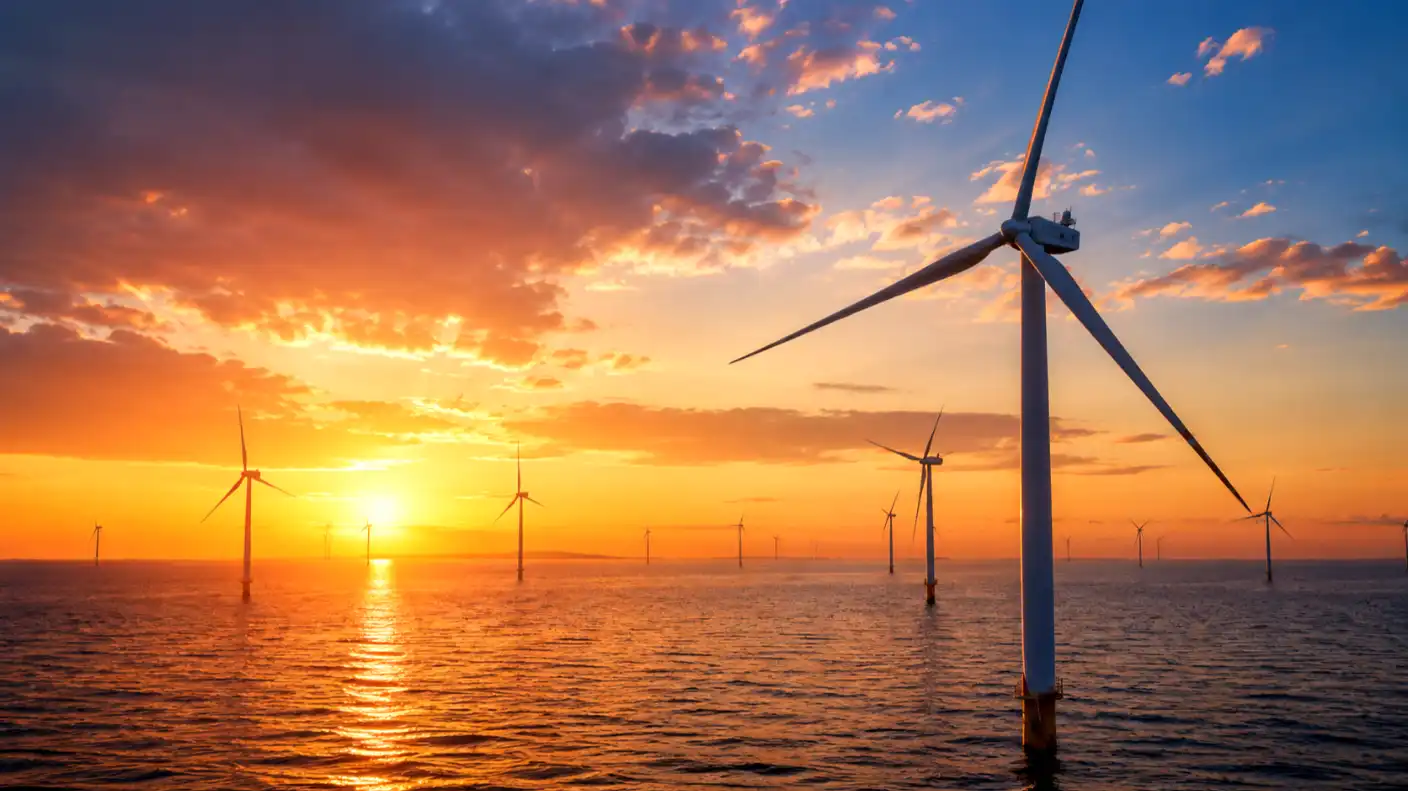
The state of California has filed a major federal lawsuit challenging the United States government’s decision to cancel legally binding offshore wind leases along the Pacific coast. Led by California Attorney General Rob Bonta and Governor Gavin Newsom, the legal action targets administrative agreements executed by the Department of the Interior and the Bureau of Ocean Energy Management that terminated commercial development rights across hundreds of thousands of ocean acres off the Northern and Central California coastlines.
The legal confrontation represents a pivotal battle over the future of American clean energy infrastructure. In December 2022, the federal government conducted a historic commercial lease auction, collecting over $757 million in winning bids from leading international energy developers, including Equinor, RWE, Invenergy, and Golden State Wind. These developers secured five deepwater lease blocks in the Humboldt and Morro Bay wind energy areas, intending to construct the first commercial-scale floating offshore wind farms in the Americas. The projects formed the backbone of California’s statutory plan to deploy 4.5 gigawatts of offshore wind capacity by 2030 and 25 gigawatts by 2045, enough clean electricity to power more than 25 million residential homes.
California prosecutors argue that federal authorities acted arbitrarily, capriciously, and without statutory authority when they moved to terminate the commercial lease agreements. The lawsuit asserts that the federal administration violated the Outer Continental Shelf Lands Act, the Administrative Procedure Act, and the National Environmental Policy Act by bypassing established administrative procedures to scrap billions of dollars in planned infrastructure investments. With California investing billions in commercial port redevelopments and grid transmission lines, the lawsuit seeks an immediate federal court injunction to reinstate the lease contracts and protect the state’s clean energy roadmap.
A Historic Legal Clash Over Pacific Clean Energy Infrastructure
The lawsuit filed in the United States District Court marks an escalation in ongoing jurisdictional disputes between California and federal executive agencies. While California has enacted aggressive statutory mandates requiring the state to generate 100% of its electricity from zero-carbon resources by 2045 under Senate Bill 100, federal energy policy has shifted toward prioritizing fossil fuel extraction and rolling back offshore renewable energy approvals.
State officials emphasized that offshore wind represents an indispensable engineering pillar of the Western power grid. Unlike terrestrial solar farms that produce electricity primarily during sunny daylight hours, Pacific Ocean winds blow strongest during late afternoon and evening hours, matching the exact time when daily consumer electricity demand peaks across the state.
Terminating the offshore lease agreements threatens to destabilize long-term energy planning, stranding hundreds of millions of dollars in private capital and depriving the state of the large-scale clean baseload power required to power electric transportation and high-density computing infrastructure.
Unpacking the Lawsuit Filed by Attorney General Rob Bonta
The formal legal complaint submitted by Attorney General Bonta establishes a comprehensive challenge to the federal government’s administrative actions. The state argues that federal officials exceeded their statutory authority by executing settlement agreements and administrative orders that canceled valid, multi-decade commercial property leases without demonstrating legitimate statutory cause.
In official statements announcing the litigation, Attorney General Bonta outlined the state’s legal position:
- The federal government entered into binding commercial contracts with private energy developers following rigorous public environmental reviews and competitive auctions.
- Federal statutes governing the Outer Continental Shelf do not grant executive agencies unilateral, discretionary power to cancel commercial leases without formal adjudicatory hearings and compensation.
- The sudden cancellation ignored comprehensive scientific data, economic impact studies, and local stakeholder consultations conducted over a seven-year planning period.
- The state of California, its coastal port authorities, and its public utility ratepayers will suffer irreparable financial and environmental harm if the federal cancellations remain in effect.
Bonta emphasized that the rule of law requires federal agencies to follow established statutory frameworks, asserting that the state will use every legal tool available to defend its clean energy investments.
The $757 Million 2022 Federal Auction and Five Deepwater Lease Areas
The commercial foundation of the disputed projects originated in the December 2022 offshore lease auction managed by the Bureau of Ocean Energy Management. The auction marked the first-ever commercial lease sale for floating offshore wind in the United States and the first-ever offshore wind sale on the Pacific Coast.
The competitive auction achieved historic commercial milestones:
- Generating $757.1 million in total winning bids across five contiguous lease areas spanning 373,268 ocean acres.
- The Humboldt Wind Energy Area, located 20 miles off the coast of Northern California, attracted winning bids totaling $331.5 million for two distinct deepwater lease tracts.
- The Morro Bay Wind Energy Area, located off the Central California coast in San Luis Obispo County, generated $425.6 million in winning bids for three expansive lease blocks.
- Winning development consortiums committed an additional $42 million in community benefit agreements and specialized workforce training funds to support regional coastal communities and maritime labor unions.
These multi-million-dollar private lease payments were transferred directly into the United States Treasury, creating legally protected contractual rights that private developers relied upon when commissioning multi-year oceanographic surveys, environmental impact assessments, and naval radar compatibility studies.
Allegations of Statutory Violations and Arbitrary Administrative Action
The central legal argument presented by California centers on the strict statutory limits governing federal energy administration. Congress enacted the Outer Continental Shelf Lands Act to establish an orderly, predictable legal framework for leasing, exploring, and developing natural resources on federal submerged lands.
Under the statute, once the federal government executes a valid commercial lease, the lessee acquires protected contractual property rights. The Secretary of the Interior can only cancel an active lease under narrow statutory conditions, such as proving imminent, irreparable harm to the marine environment that cannot be mitigated, and must follow formal administrative procedures.
California’s legal team contends that federal authorities bypassed these statutory safeguards, relying on arbitrary executive directives rather than administrative findings backed by verified scientific evidence.
Bypassing the Outer Continental Shelf Lands Act and APA Protections
The complaint filed in federal court details how the administrative cancellation violated core provisions of the Outer Continental Shelf Lands Act and the Administrative Procedure Act:
- The Department of the Interior failed to issue formal notices of non-compliance, hold public evidentiary hearings, or establish a statutory record justifying lease cancellations.
- Federal regulators provided no scientific or economic justification explaining why lease areas previously deemed suitable for commercial development were suddenly canceled.
- The administrative decision directly contradicted earlier federal environmental findings that concluded floating offshore wind farms could operate safely alongside commercial maritime shipping and naval defense operations.
- The Administrative Procedure Act strictly prohibits federal agencies from executing sudden, unexplained reversals of established policy without providing a reasoned explanation supported by empirical evidence.
Legal scholars note that federal courts routinely strike down administrative actions that fail to satisfy the standard of arbitrary-and-capricious review, providing California with a strong legal argument under established administrative law precedents.
Overriding NEPA Environmental Reviews and Contractual Property Rights
A secondary pillar of California’s lawsuit focuses on the total disregard for the National Environmental Policy Act. Under federal environmental law, any major federal action that significantly affects the quality of the human environment requires comprehensive environmental assessments and public comment periods.
Federal agencies spent more than five years conducting rigorous environmental reviews before authorizing the 2022 Pacific lease auction:
- Publishing exhaustive Environmental Assessments that evaluated potential impacts on marine mammals, commercial fisheries, migratory bird populations, and benthic sea-floor habitats.
- Incorporating extensive mitigation measures into final lease contracts, including passive acoustic monitoring for whales and dynamic vessel speed restrictions.
- Engaging in formal government-to-government consultations with federally recognized Native American tribes across the Northern and Central California coasts.
- Working with the Department of Defense and the United States Navy to establish specialized exclusion corridors and radar-mitigation agreements to preserve national defense readiness.
By abruptly terminating the leases without conducting new environmental reviews, federal authorities violated NEPA mandates. Furthermore, canceling commercial leases without paying statutory compensation exposes the federal government to hundreds of millions of dollars in takings claims from private international developers.
The Multibillion-Dollar Economic Stakes for California’s Coastal Economy
The cancellation of Pacific offshore wind leases carries immediate, destructive financial consequences for California’s industrial economy. Unlike traditional onshore renewable projects that require modest civil construction, deploying floating wind platforms requires modernizing commercial deep-water ports, assembling specialized heavy-lift cranes, and manufacturing massive composite turbine blades.
California has already allocated billions of dollars in public and private capital to transform historic maritime ports into advanced clean energy manufacturing hubs.
Halting offshore wind development threatens to strand these public infrastructure investments, eliminate thousands of projected union construction jobs, and disrupt regional supply chains across coastal communities.
Protecting the 25-Gigawatt Clean Power Mandate by 2045
The primary strategic objective of California’s energy policy is to meet statutory clean electricity targets established under state law. Assembly Bill 525 directed the California Energy Commission to establish ambitious offshore wind planning goals to replace retiring natural gas power plants and nuclear generation.
The state established explicit offshore wind generation targets:
- Deploying an initial 2.0 to 5.0 gigawatts of operational floating offshore wind capacity by 2030.
- Scaling total installed capacity to 25 gigawatts by 2045, establishing offshore wind as one of the largest sources of electricity in the Western United States.
- Generating over 85 terawatt-hours of clean electricity annually, capable of supplying more than 25% of California’s total projected electricity demand.
- Providing consistent, high-capacity evening power generation that reduces the state’s reliance on expensive battery storage and peaking natural gas generators during summer heatwaves.
Canceling the five federal leases eliminates the entire pipeline of projects needed to satisfy the 2030 and 2045 statutory targets, leaving state utility planners with a massive generation deficit as the economy electrifies.
Port Infrastructure Investments in Humboldt Bay and Long Beach Pier Wind
The physical realization of offshore wind depends on constructing specialized staging and integration ports. Because floating wind turbines stand over 850 feet tall and utilize concrete floating foundations weighing over 10,000 metric tons, completed turbines cannot fit beneath coastal bridges and must be assembled directly at deep-water port terminals.
California port authorities have committed billions of dollars to construct these specialized facilities:
- The Port of Humboldt Bay secured over $426 million in federal and state funding to construct the Humboldt Bay Offshore Wind Heavy Lift Marine Terminal, transforming a former pulp mill site into a modern assembly hub.
- The Port of Long Beach launched Pier Wind, a $4.7 billion proposed 400-acre terminal designed to assemble, stage, and deploy up to 100 floating offshore wind turbines annually.
- Coastal municipalities across San Luis Obispo, Eureka, and Los Angeles authorized long-term commercial master plans to support specialized maritime towing vessels and mooring manufacturing.
- Private engineering firms invested tens of millions of dollars in localized geotechnical surveys and maritime logistics engineering.
Halting offshore development paralyzes these multi-billion-dollar port redevelopments, threatening economic revitalization initiatives in rural coastal regions that have struggled since the decline of the timber and commercial fishing industries.
Preserving Thousands of High-Wage Green Union Construction Jobs
The development of a domestic offshore wind industry represents one of the largest union job-creation opportunities in California’s industrial history. Constructing, deploying, and maintaining 25 gigawatts of floating wind infrastructure requires a vast workforce of specialized trade workers.
Economic impact analyses published by the University of California, Berkeley, project substantial employment benefits:
- Creating over 45,000 direct, indirect, and induced jobs during peak manufacturing and construction phases.
- Supporting high-wage careers for union ironworkers, electrical workers, pile drivers, operating engineers, and commercial maritime mariners.
- Injecting over $27 billion in cumulative regional economic output across Northern and Central California supply chains.
- Establishing permanent, high-paying operations and maintenance positions that provide forty-year career pathways in coastal communities.
Major trade labor federations, including the State Building and Construction Trades Council of California, have formally supported the state’s lawsuit, warning that federal lease cancellations destroy high-wage union careers in the green economy.
The Technical Frontier of Floating Offshore Wind in Deep Waters
The disputed California lease areas sit at the absolute cutting edge of global marine engineering. Unlike the shallow waters off the United States East Coast or the North Sea, where wind turbines are anchored directly into the seabed using rigid steel monopiles at depths of less than 60 meters, the Pacific outer continental shelf drops off rapidly.
The ocean depth across the Humboldt and Morro Bay lease areas ranges from 500 to 1,300 meters (roughly 1,600 to 4,200 feet), requiring the deployment of advanced floating foundation technology.
Developing floating offshore wind platforms at this depth represents a transformative engineering milestone that will unlock deep-water renewable energy potential across the globe.
Overcoming 1,000-Meter Depth Challenges with Floating Platform Moorings
Deploying 15-megawatt to 20-megawatt wind turbines in deep ocean waters requires specialized naval architecture borrowed from offshore oil and gas extraction platforms. Floating wind turbines utilize massive semi-submersible, spar-buoy, or tension-leg platform hulls that float on the ocean surface.
The deepwater engineering architecture incorporates advanced technical systems:
- High-strength synthetic mooring lines and heavy steel anchor chains connect the floating hull to suction piles or drag-embedment anchors embedded in the deep seabed.
- Specialized dynamic electrical inter-array cables flex and sway with ocean swells, transmitting high-voltage electricity between moving turbine platforms without fatiguing internal copper conductors.
- Onboard active ballast systems automatically pump fluid between internal hull chambers to maintain vertical stability during extreme Pacific storms and 30-foot ocean waves.
- Automated condition-monitoring sensors track mooring tension and structural vibration in real time, transmitting telemetry to onshore control centers via satellite links.
International developers have already proved the viability of floating wind technology in pilot projects off the coasts of Scotland, Norway, and Portugal. The California lease areas were designed to serve as the world’s first gigawatt-scale commercial deployment, proving that floating clean energy can scale to industrial proportions.
Integrating Gigawatt-Scale Offshore Energy into California’s Regional Grid
A critical engineering component of the offshore wind initiative is modernizing California’s high-voltage electrical transmission grid. The California Independent System Operator, which manages the state’s wholesale power grid, approved a comprehensive $6.1 billion transmission expansion plan designed specifically to integrate offshore wind.
The transmission roadmap includes major high-voltage infrastructure upgrades:
- Constructing a new 500-kilovolt high-voltage alternating-current transmission corridor connecting the remote Humboldt Bay region to the primary Northern California grid.
- Developing high-voltage direct-current subsea transmission cables that move thousands of megawatts of offshore electricity directly to coastal urban centers in the San Francisco Bay Area and Los Angeles.
- Expanding existing utility substations near Morro Bay, utilizing high-capacity interconnection infrastructure left vacant following the retirement of legacy coastal natural gas and power plants.
- Integrating advanced dynamic line rating sensors that maximize power flows across existing transmission corridors based on real-time ambient cooling.
Canceling federal offshore leases disrupts these synchronized transmission investments, creating regulatory confusion for regional utility planners and private grid developers.
Strategic Implications for the National Energy Transition and Federal Authority
The legal showdown between California and the federal government carries profound constitutional and economic implications that reach far beyond state borders. The case will test the legal boundaries of executive power, examining whether a presidential administration can unilaterally dismantle commercial regulatory programs enacted under statutory congressional authority.
The outcome of this litigation will establish critical legal precedents governing federal energy leasing, corporate contract stability, and state environmental sovereignty for decades to come.
Understanding these broader strategic implications is essential for evaluating the long-term investment climate for large-scale infrastructure across the United States.
State Clean Energy Sovereignty Versus Executive Branch Energy Directives
The litigation highlights an intensifying constitutional conflict over state energy policy. Under the United States federal system, individual states possess broad police powers to regulate retail electric utilities, establish environmental standards, and mandate clean energy procurement quotas within their borders.
However, the federal government controls sovereign jurisdiction over submerged lands on the Outer Continental Shelf beyond three nautical miles from shore.
The lawsuit forces federal courts to resolve critical constitutional questions:
- Can the federal executive branch utilize its jurisdiction over federal waters to deliberately block a sovereign state from achieving statutory clean energy mandates?
- Does the cancellation of commercial lease contracts violate procedural due process and constitutional property rights under the Fifth Amendment?
- How can private infrastructure corporations commit billions of dollars to long-term capital projects if federal operating permits are subject to unilateral cancellation whenever political administrations change?
Industry leaders warn that allowing executive agencies to arbitrarily cancel commercial leases creates immense regulatory uncertainty, discouraging private domestic and international corporations from investing in American infrastructure.
The Long-Term Trajectory of American Offshore Wind Investment
The international offshore wind sector represents a multi-hundred-billion-dollar global capital market. Sovereign wealth funds, global pension managers, and international energy conglomerates are deploying capital to regions that provide regulatory certainty, predictable permitting timelines, and stable legal protections.
If federal courts uphold the arbitrary cancellation of valid Pacific lease contracts, the decision will deal a devastating blow to the broader American offshore wind industry:
- International developers will reallocate billions of dollars in growth capital to business-friendly offshore wind markets in Europe, the United Kingdom, Japan, and South Korea.
- Financial institutions will demand higher risk premiums on debt facilities for American renewable energy projects, increasing borrowing costs for domestic developers.
- Domestic manufacturing supply chains for specialized subsea cables, turbine nacelles, and floating platforms will fail to achieve critical industrial scale.
- The United States will fall further behind international competitors in mastering deepwater floating marine technology, forfeiting technological leadership in a vital future industry.
Securing a decisive judicial ruling that reinstates the Pacific leases and reaffirms the sanctity of commercial federal contracts is essential to restoring international investor confidence in the American energy market.
California’s decision to file a federal lawsuit challenging the cancellation of Pacific offshore wind leases marks a defining turning point in the nation’s clean energy transition. By defending the $757 million 2022 lease auction and protecting its statutory mandate to deploy 25 gigawatts of offshore power by 2045, California is fighting for the legal stability of its entire industrial economy. As the lawsuit moves through federal courts, the battle over deepwater floating platforms, multi-billion-dollar port redevelopments, and thousands of union construction jobs will decide whether the United States embraces the frontier of clean marine technology or retreats from global energy leadership. The legal stand taken by Attorney General Rob Bonta and Governor Gavin Newsom proves that California will use every statutory tool to defend the rule of law, protect billions of dollars in private capital, and secure a sustainable, carbon-free future for millions of citizens.