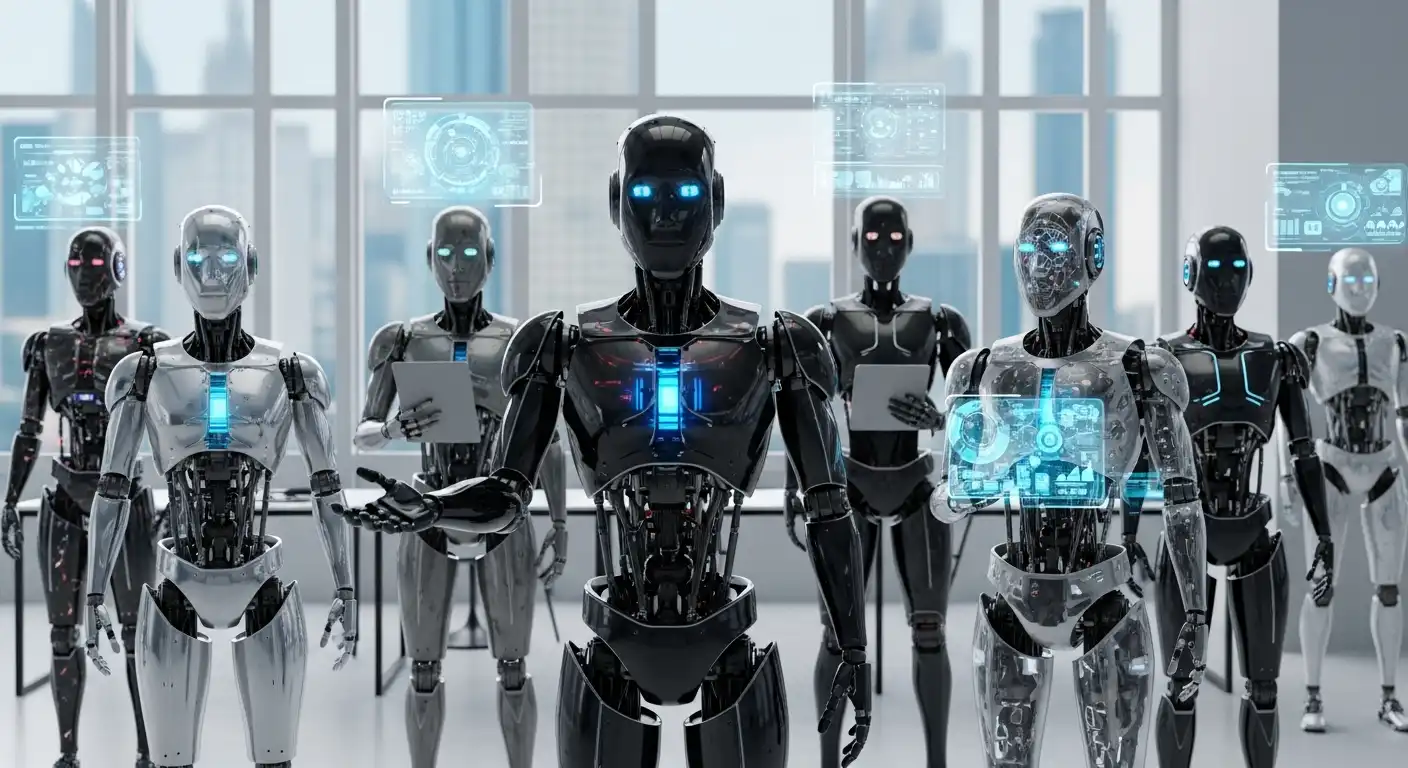
A historic athletic breakthrough on a running track in Beijing has demonstrated that modern bipedal humanoid robots can now outrun the fastest human athletes in recorded history. During high-speed dynamic trials at the World Humanoid Robot Games, advanced electric humanoid prototypes developed by leading Chinese robotics laboratories achieved sustained sprinting velocities exceeding 10.5 meters per second, completing autonomous 100-meter sprints in times that fell below the world-record human benchmark of 9.58 seconds.
The achievement marks a dramatic leap forward in mechanical engineering, power density, and embodied artificial intelligence. For decades, robotic locomotion was defined by slow, cautious, and rigid walking patterns. Today, a convergence of high-torque electric joint actuators, lightweight carbon-fiber composite skeletons, and reinforcement learning models trained across billions of simulated footsteps has transformed bipedal machines into high-velocity kinetic systems capable of matching and surpassing biological human physics.
While breaking human running records demonstrates remarkable mechanical agility, it also highlights the stark contrast between gross motor athletic locomotion and the delicate, fine-motor dexterity required for practical factory work. China’s robotics industry is scaling production rapidly, delivering more than 40,000 humanoid robots in the first half of the year alone. As robotics developers transition these high-speed machines from athletic obstacle courses into operational automotive plants, logistics sorting hubs, and disaster-response environments, the global race to master embodied artificial intelligence has entered a decisive new phase.
A Historic Athletic Milestone on the Beijing Running Track
The dynamic track events held inside the National Speed Skating Oval in Beijing provided a stunning public demonstration of how rapidly bipedal robotics has evolved. While earlier robotics exhibitions featured machines that walked with awkward, mechanical steps at speeds of less than 1.5 meters per second, the latest generation of humanoid sprinters moved with fluid, biological grace, generating explosive ground-reaction forces that propelled them down synthetic running lanes.
Multiple independent robotics laboratories showcased prototypes that sprinted at sustained speeds between 10.0 and 12.0 meters per second. For comparison, legendary Olympic sprinter Usain Bolt reached a peak top speed of 12.42 meters per second during his historic 9.58-second world-record 100-meter dash, averaging approximately 10.44 meters per second over the entire course.
The fact that mass-produced mechanical assemblies powered by electric brushless motors can match or surpass the peak athletic performance of elite human sprinters proves that the physical limits of bipedal locomotion are no longer bounded by biological muscle physiology.
Outpacing Human Sprint Limits with Sub-Nine-Second 100-Meter Runs
The record-breaking sprint times recorded during closed-circuit time trials were enabled by fully autonomous onboard motion-control systems. Unlike remote-controlled models, the competing humanoid robots operated under autonomous algorithmic guidance, utilizing onboard inertial measurement units, real-time foot-force sensors, and computer vision cameras to maintain dynamic balance across high-frequency stride cycles.
The mechanical sprinters delivered remarkable athletic performance metrics:
- Peak running velocities touched 12.2 meters per second during mid-stride acceleration phases on flat running tracks.
- Automated 100-meter sprint times dropped to an astonishing 8.8 to 9.2 seconds during standardized electronic timing tests.
- High-frequency balance algorithms executed dynamic joint corrections within 200 microseconds, preventing dangerous falls during sudden stride transitions.
- High-rate discharge lithium-polymer battery packs delivered continuous peak bursts of electrical power exceeding 8.5 kilowatts during explosive sprint starts.
These performance figures proved that electric joint motors can generate higher torque-to-weight ratios than human skeletal muscles, allowing robotic legs to cycle and strike the running surface significantly faster than human biological legs.
Showcasing 2,056 Humanoids Across 666 Teams in Beijing
The sprint trials took place as part of the broader World Humanoid Robot Games and the World Robot Conference, which gathered 2,056 humanoid robots from 666 competing teams representing 16 countries. The massive gathering served as the largest physical gathering of bipedal machines in industrial history.
The competition spanned 51 distinct competitive categories, organized across two primary tracks:
- Athletic and Dynamic Sports: Encompassing 100-meter sprints, 400-meter relays, bipedal soccer matches, martial arts demonstrations, and gymnastic obstacle courses.
- Scenario-Based Industrial Tasks: Testing 21 practical industrial operations, including precision cable connection, electronic component sorting, automated package handling, and delicate tool manipulation.
The broad participation across Chinese universities, private startups, and established industrial conglomerates highlighted the immense depth of the domestic robotics ecosystem. The event served as a proving ground where research scientists tested the outer limits of mechanical speed, joint durability, and motor-control software under demanding real-world conditions.
The Mechanical and Algorithmic Engineering Behind Supersonic Locomotion
Achieving high-speed bipedal running is one of the most difficult engineering challenges in modern robotics. When a four-legged robotic dog runs, it distributes impact forces across four contact points, providing natural stability. In contrast, a two-legged humanoid must maintain continuous dynamic equilibrium while balancing its entire body mass on a single foot during alternating stride phases.
At sprint speeds exceeding 10 meters per second, the impact forces generated when a robotic foot strikes the running track exceed four to six times the total weight of the machine.
To prevent mechanical joints from shattering and avoid catastrophic balance failures, engineers combined advanced materials engineering with artificial intelligence-driven motion control.
The breakthrough resulted from the integration of three foundational technologies: high-torque electric actuators, simulation-accelerated reinforcement learning, and aerospace-grade structural composites.
High-Torque Electric Actuators Delivering Over 400 Newton-Meters
The core physical muscles powering modern humanoid robots are proprietary high-torque-density electric actuators. Historically, high-force robotics relied on heavy hydraulic systems that required messy oil hoses, high-pressure pumps, and noisy valves.
Chinese robotics innovators, including Unitree Robotics, Robotera, EngineAI, and LimX Dynamics, pioneered lightweight, all-electric joint actuators:
- Integrating ultra-compact planetary and cycloidal gearboxes that deliver peak joint torques exceeding 360 to 400 Newton-meters in hip and knee assemblies.
- Utilizing high-grade neodymium permanent magnets and custom stator winding patterns to maximize power density while minimizing motor weight.
- Incorporating high-resolution dual-encoder systems that measure joint position and angular velocity thousands of times per second.
- Deploying advanced field-oriented motor controllers that dynamically adjust electrical current within fractions of a millisecond to absorb landing shocks.
These powerful electric joints allow robotic limbs to generate massive rotational acceleration, snapping legs forward and striking the ground with precise, modulated force.
Reinforcement Learning in Simulation Engines Accelerating Gait Optimization
The software that controls these high-speed physical movements was not designed using traditional, hand-coded mathematical trajectories. Writing explicit mathematical equations for every leg movement at 10 meters per second is practically impossible due to non-linear physical friction, air resistance, and slight surface irregularities.
Instead, robotics engineers trained deep reinforcement learning neural networks inside high-performance physics simulation engines like Isaac Gym and MuJoCo:
- A digital twin of the humanoid robot is deployed across thousands of parallel virtual simulation environments running on high-density graphics processor clusters.
- The neural network explores millions of random running gaits, receiving algorithmic rewards for forward velocity and stability while receiving heavy penalties for falling or excessive energy consumption.
- The model simulates decades of continuous running experience within a few hours of compute time, discovering optimal biomechanical movement patterns that mimic natural animal running.
- Domain randomization techniques inject simulated wind gusts, slick surfaces, and mechanical motor noise into the simulation, ensuring that the learned gait transfers robustly to physical hardware without falling.
This simulation-to-real transfer allows robots to master dynamic balancing, forward body leaning, and adaptive foot placement before the physical machine ever touches a real-world running track.
Lightweight Aerospace Carbon Fiber and Shock-Absorbing Footwear
Managing the immense kinetic energy generated during high-speed running required fundamental innovations in structural materials and mechanical damping. If a robot’s skeleton is too heavy, the actuators cannot accelerate the limbs quickly; if it is too brittle, impact vibrations will crack mechanical joints.
Engineers utilized high-strength, lightweight materials borrowed from the aerospace industry:
- Skeleton chassis structures are fabricated from high-modulus carbon fiber composites and high-strength aviation aluminum-lithium alloys, keeping total robot weight between 35 and 55 kilograms.
- Knee and ankle linkages utilize high-precision titanium forgings that withstand extreme mechanical shock without bending.
- Robotic feet incorporate multi-layer elastomeric damping pads and carbon-fiber spring plates that absorb 60% of landing impact energy, returning kinetic energy to the next stride.
- Internal vibration-isolated mounting bays protect onboard computing processors, solid-state LiDAR sensors, and inertial measurement units from structural shockwaves.
By minimizing structural weight and maximizing shock absorption, engineers created durable mechanical bodies capable of enduring hundreds of high-speed sprint cycles without mechanical fatigue.
The Remaining Engineering Frontier: Fine Dexterity and Energy Density
While China’s humanoid robots have established their supremacy in raw mechanical speed and dynamic agility, industry leaders recognize that athletic stunts represent only the first step toward commercial utility. A robot that can sprint at 10 meters per second is useless inside a semiconductor cleanroom or electronics assembly plant if it cannot pick up a tiny component without dropping it.
The robotics sector is confronting Moravec’s paradox: the computational reality that gross motor skills like sprinting, jumping, and backflips are relatively easy to solve with physics simulation, while everyday fine motor skills like untangling a wire or fastening a small screw remain difficult.
Furthermore, physical power consumption during high-speed running rapidly drains onboard battery reserves, creating an energy bottleneck that limits operational range.
Moravec’s Paradox: Why Sprints are Easier than Inserting a Cable
The contrast between running speed and hand dexterity was vividly demonstrated during practical scenario trials at the Beijing conference. While robotic sprinters set track records, humanoid machines competing in workbench dexterity tasks struggled to complete basic physical assignments:
- In the precision cable connection trial, where robots were tasked with identifying a USB charging plug and inserting it into an electronic port, fewer than 60% of qualifying teams completed the task within the allotted time.
- Handling deformable, flexible materials like rubber hoses, electrical wire harnesses, and textiles continues to puzzle computer vision systems because flexible objects constantly alter their physical shape when touched.
- Human hands possess thousands of tactile nerve endings that feel microscopic slippage and texture, allowing humans to adjust grip force automatically without looking.
- Standard robotic grippers lack high-density tactile electronic skin, forcing them to rely on visual cameras that can be blocked by shadows, glare, or the robot’s own mechanical fingers.
Robotics companies are investing heavily in vision-language-action foundation models and multi-articulated hands featuring 20 or more degrees of freedom to close this dexterity gap, recognizing that commercial success depends on delicate hand manipulation rather than running speed.
Managing High-Discharge Lithium Battery Packs and 60-Minute Limits
The physical energy required to sprint at 10 meters per second is immense. High-power joint actuators drawing continuous high-amperage current generate massive thermal heat and drain electrical storage rapidly.
Current energy storage technology imposes strict operational time limits:
- High-speed running and dynamic jumping deplete standard 48-volt and 72-volt lithium-ion battery packs within 20 to 40 minutes of continuous operation.
- In standard walking and light industrial handling modes, modern humanoid batteries deliver an operational runtime of roughly two to four hours before requiring recharging.
- High continuous discharge rates cause battery cells to heat up, requiring integrated thermal management cooling channels within the robot’s torso.
- Transitioning to full eight-hour factory shifts will require solid-state battery chemistry, automated hot-swappable battery stations, or wireless floor induction charging pads.
Until energy density improves, commercial deployments will focus on stationary workstations or structured factory environments where robots can dock with charging stations during scheduled rest cycles.
Commercial Scaling Across Chinese Industrial and Warehouse Facilities
The rapid advancement of Chinese robotics is backed by a massive, state-supported industrial scaling drive. The Chinese Ministry of Industry and Information Technology designated embodied artificial intelligence and humanoid robotics as strategic national industries, establishing comprehensive supply chain ecosystems in Beijing, Shanghai, Shenzhen, and Hangzhou.
China’s domestic manufacturing ecosystem provides robotics startups with an insurmountable cost and speed advantage. Startups can design a new custom actuator, procure precision gearboxes, source carbon-fiber chassis parts, and assemble a physical prototype within 72 hours by tapping into regional supplier networks in the Pearl River and Yangtze River deltas.
This rapid prototyping capability has allowed Chinese manufacturers to move from experimental laboratory research directly into mass commercial manufacturing.
Deploying Over 40,000 Humanoid Units Across First-Half Manufacturing
Official industrial production data reveals that Chinese robotics companies delivered more than 40,000 humanoid and advanced bipedal units in the first half of the year alone. This volume represents a dramatic scaling milestone, establishing China as the world’s largest producer of humanoid hardware.
The capital markets responded with intense financial backing:
- Unitree Robotics executed a blockbuster public listing on the Shanghai Stock Exchange’s Star Market, raising 6.1 billion yuan (roughly $904 million) as its stock surged by 460% on its debut trading day.
- Emerging startups like AgiBot, Robotera, and Leju secured hundreds of millions of dollars in private venture capital from tech conglomerates like Tencent and Alibaba.
- Commercial humanoid hardware prices have dropped dramatically, with mass-produced research models selling between $16,000 and $35,000 per unit, down from over $150,000 five years ago.
- High-volume manufacturing plants are utilizing automated industrial assembly lines to build robotic actuators, lowering unit production costs through economies of scale.
Lowering hardware prices allows industrial factory operators to purchase trial fleets of humanoid robots, accelerating real-world testing on live manufacturing lines.
Transitioning from Theatrical Sports Demonstrations to Factory Floor Utility
Automotive manufacturing plants and logistics fulfillment centers are serving as the primary commercial proving grounds for humanoid deployment. Major domestic automakers, including BYD, Geely, SAIC Motor, and Dongfeng, have deployed trial fleets of humanoid robots inside operational assembly facilities.
Humanoid workers are assigned to specific, ergonomically challenging manufacturing tasks:
- Heavy Component Handling: Lifting stamped steel chassis parts and positioning them into precision robotic welding jigs.
- In-Cabin Assembly: Walking through standard automobile door openings to install interior wire harnesses, seat bolts, and dashboard trim panels.
- Quality Inspection: Utilizing high-resolution vision cameras to inspect body paint finishes, measure panel gaps, and verify fastener torque specifications.
- Logistics Restocking: Moving heavy component bins, scanning barcoded inventory crates, and restocking mobile assembly line carts.
Deploying humanoids alongside human factory workers allows manufacturing plants to automate repetitive, high-strain physical tasks while gathering operational data to refine motion-control algorithms.
Strategic Implications for Global Robotics and Industrial Labor
China’s rapid strides in humanoid robotics carry profound strategic implications for the global high-technology economy and the future of human labor. As birth rates decline and populations age across major industrial economies in East Asia and Europe, manufacturing sectors face severe structural labor shortages.
Humanoid robots provide a flexible, scalable automation solution that can operate within existing human-designed infrastructure without requiring companies to spend billions of dollars rebuilding factories.
The international competition to lead this physical artificial intelligence transition will define global manufacturing dominance for the next half-century.
Competing in the International Embodied AI Arena Against US Rivals
The global robotics race is coalescing into an intense technological contest between the United States and China. American innovators, led by Tesla’s Optimus program, Boston Dynamics, Figure AI, and Apptronik, are investing billions of dollars to develop general-purpose humanoid workers powered by advanced artificial intelligence foundation models.
The two competing ecosystems feature distinct competitive advantages:
- American Strengths: Leading the development of multi-modal foundation models, advanced neural reasoning engines, and software developer platforms.
- Chinese Strengths: Dominating physical hardware manufacturing, controlling low-cost precision actuator supply chains, and executing rapid real-world factory deployments at scale.
- Cross-Border Innovation: Open-source software models developed globally are integrated into low-cost Chinese hardware bodies, accelerating development cycles worldwide.
- Market Penetration: Chinese robotics manufacturers are actively exporting low-cost commercial humanoids to industrial buyers across Southeast Asia, the Middle East, and Latin America.
The convergence of American cognitive software intelligence and Chinese high-speed hardware manufacturing is accelerating the timeline toward general-purpose physical automation.
The Long-Term Horizon for Human-Robot Collaboration and Factory Automation
The ultimate objective of modern robotics is establishing seamless, safe collaboration between human workers and autonomous mechanical platforms. Rather than completely replacing human labor, humanoid robots will absorb hazardous, repetitive, and physically exhausting jobs, allowing human workers to transition into supervisory, engineering, and creative roles.
Key technological milestones that will shape the next decade of automation include:
- Standardized Tactile Sensing: Integrating high-density electronic skin that provides sub-millimeter tactile feedback across all robotic fingers.
- Full-Shift Battery Power: Deploying solid-state battery packs that deliver eight to ten hours of continuous operational runtime on a single charge.
- Common Safety Protocols: Implementing hardware-enforced emergency stops and soft-contact-compliant actuators that eliminate collision risks for nearby human technicians.
- Natural Language Instruction: Enabling factory supervisors to assign complex assembly tasks to robotic workers through conversational voice commands without writing computer code.
As these technologies mature, humanoid robots will become standard fixtures across modern factories, warehouses, construction sites, and healthcare facilities worldwide.
China’s record-breaking robotic strides on the running track in Beijing mark a historic turning point in the evolution of physical automation. By engineering electric bipedal humanoids that outrun elite human sprinters at speeds exceeding 10.5 meters per second, robotics developers have proven that mechanical joint engineering and simulation-trained artificial intelligence can surpass biological physical limits. Supported by high-torque actuators, lightweight carbon-fiber composites, and a manufacturing engine that delivered over 40,000 units in the first half of the year, China is translating athletic records into industrial power. As the industry tackles the remaining frontiers of fine hand dexterity and battery endurance, humanoid robots are moving rapidly from athletic showcases to factory assembly lines, ushering in a transformative new era in global manufacturing and human-robot collaboration.