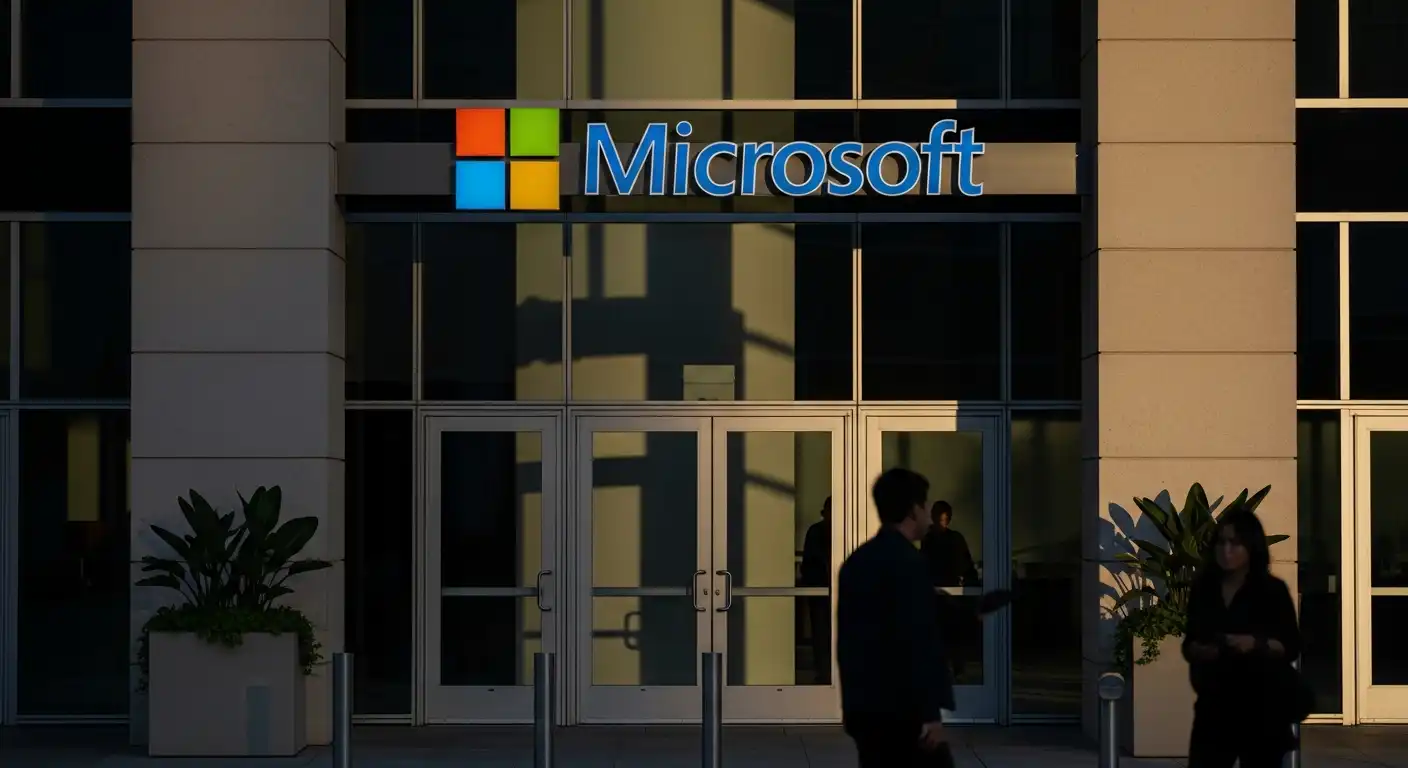
Tech giant Microsoft is facing growing internal dissent and public scrutiny over the environmental footprint of its artificial intelligence data centers. The company has poured tens of billions of dollars into high-density computing facilities across the globe to support OpenAI workloads and its Copilot ecosystem. However, that rapid expansion has pushed its sustainability goals off track, sparking friction among software engineers, climate researchers, and sustainability teams at its Redmond, Washington, headquarters.
The friction centers on Microsoft’s ambitious 2020 pledge to become carbon negative, water positive, and zero waste by 2030, with plans to erase its historical carbon footprint since 1975 by 2050. The reality of the generative artificial intelligence boom tells a different story. Company disclosures show that Microsoft’s total carbon emissions have surged roughly 29% to 30% above its 2020 baseline, driven primarily by Scope 3 indirect emissions from constructing concrete-and-steel data centers and procuring high-power semiconductor hardware.
The environmental footprint reaches beyond carbon emissions. High-density graphics processor clusters consume massive amounts of electricity and millions of gallons of treated municipal drinking water for evaporative cooling. As local communities, municipal utilities, and environmental regulators push back against grid saturation and water depletion, Microsoft leadership is trying to balance corporate environmental pledges with the commercial race for artificial intelligence dominance.
Growing Internal Dissent Over Corporate Climate Commitments
For years, Microsoft built a reputation as a global leader in corporate environmental stewardship. The company was among the first major technology firms to institute an internal carbon fee, require carbon accounting from suppliers, and commit to verifiable carbon removal projects.
The launch of ChatGPT and the subsequent race to deploy artificial intelligence infrastructure upended those sustainability frameworks. To train foundation models and serve real-time inferences to hundreds of millions of users, Microsoft had to build, lease, and energize high-capacity data centers as quickly as possible.
This infrastructure push created an internal divide. Staff members have questioned whether the company is quietly abandoning its core environmental principles to chase short-term software market share.
Unpacking the 30% Surge in Total Carbon Emissions
The central metric driving internal debate is the sharp upward trajectory of Microsoft’s greenhouse gas emissions. In its foundational 2020 sustainability charter, Microsoft promised to cut its Scope 1 direct emissions, Scope 2 electricity emissions, and Scope 3 supply chain emissions by more than 50% by 2030.
Recent environmental sustainability reports show that emissions have moved in the opposite direction:
- Total greenhouse gas emissions rose nearly 30% above 2020 baseline levels, reaching approximately 15.4 million metric tons of carbon dioxide equivalent annually.
- Scope 1 and Scope 2 operational emissions dropped by roughly 6% due to long-term renewable energy purchase contracts for data center electricity.
- Scope 3 indirect supply chain emissions grew by more than 31%, accounting for over 96% of the company’s total environmental footprint.
- Capital expenditures allocated to data center construction, high-voltage substations, and server hardware purchases topped $55 billion in a single fiscal year.
The surge in Scope 3 emissions stems directly from the carbon-intensive materials required to build physical computing campuses. Manufacturing low-carbon concrete foundations, structural steel framing, high-density fiber-optic networking cables, and silicon microchips produces substantial industrial emissions long before a server rack is ever turned on.
Software Engineers and Sustainability Teams Clash with Leadership
The gap between corporate marketing pledges and physical emissions data has created tension inside Microsoft’s campuses. Internal discussion forums, employee town halls, and internal chat channels have featured pointed debates between research scientists, software engineers, and executive management.
Employees have raised several core operational and ethical concerns:
- Corporate sustainability teams built granular carbon-accounting models for five years, only to see emission baselines disrupted by sudden artificial intelligence computing investments.
- Environmental researchers within Microsoft Research questioned whether massive parameter models deliver enough real-world productivity to justify multi-megawatt training runs.
- Employees expressed frustration that Microsoft continues to market specialized artificial intelligence tools to oil and gas corporations to accelerate fossil fuel extraction.
- Product teams faced internal criticism for integrating power-hungry generative artificial intelligence tools into standard productivity software without giving corporate enterprise administrators opt-out sustainability toggles.
Executive leadership, led by Chairman and Chief Executive Officer Satya Nadella and Vice Chair and President Brad Smith, has defended the investments. Management maintains that generative artificial intelligence will ultimately serve as the essential technological catalyst required to discover new clean-energy materials, optimize power grids, and invent advanced carbon-capture chemistry.
The Physical Strain of High-Density AI Computing
The artificial intelligence hardware boom places unique, concentrated demands on physical utility infrastructure. Traditional enterprise cloud computing workloads—such as hosting basic business databases, web portals, and office email servers—distribute moderate power demands across large physical server rooms.
Artificial intelligence training and inference clusters operate under completely different physical parameters. Thousands of high-performance graphics processors, such as Nvidia Hopper and Blackwell systems, are packed into dense, liquid-cooled server racks that run flat at 100% capacity around the clock.
This density consumes immense amounts of electrical energy and water, straining the utility networks of host cities and suburban municipalities.
Escalating Electricity Demands and 100-Kilowatt Server Racks
The power density of modern computing hardware has scaled faster than traditional data center engineering designs can handle. A standard enterprise cloud server cabinet historically consumed between 6 kilowatts and 12 kilowatts of electrical power.
Modern artificial intelligence compute racks have pushed power density to historic highs:
- High-density server cabinets housing Grace Blackwell superchips consume between 100 kilowatts and 120 kilowatts of continuous power per rack.
- A single 100-megawatt hyperscale data center campus draws as much continuous electricity as a medium-sized industrial city of 80,000 residential homes.
- Microsoft has contracted more than 20 gigawatts of global renewable energy capacity, making it one of the largest corporate clean energy buyers in the world.
- Long-term corporate modeling projects that Microsoft’s total annual electricity consumption will more than double by the end of the decade, approaching 50 terawatt-hours annually.
Supplying this volume of uninterrupted power requires utilities to keep older fossil-fuel peaking plants running, complicating regional efforts to retire coal and natural gas generation assets.
Millions of Gallons in Evaporative Water Cooling Consumption
Beyond electricity consumption, water use for data center thermal management has triggered fierce pushback from local municipal water authorities and community residents. High-performance computing processors generate intense heat that must be dissipated to prevent hardware failure.
Many existing data center facilities utilize evaporative cooling systems, which spray millions of gallons of potable municipal water across heat exchangers, evaporating clean water into the atmosphere:
- Microsoft’s global municipal water consumption climbed by more than 34% in recent years, exceeding 7.8 million cubic meters (roughly 2.06 billion gallons) annually.
- A single high-capacity training run for a multi-trillion-parameter foundation model can consume hundreds of thousands of liters of clean freshwater for on-site cooling and power generation.
- In drought-prone regions across Arizona, Texas, Spain, and the Netherlands, local agricultural communities and environmental groups have protested data center zoning permits.
- Municipalities have introduced strict local water quotas and higher utility rates, forcing tech companies to find alternative, closed-loop cooling methods.
To protect its water-positive 2030 commitment, Microsoft is retrofitting server halls with direct-to-chip liquid cooling systems and testing advanced dielectric immersion tanks that eliminate continuous evaporative water consumption.
Community Pushback and Regional Grid Bottlenecks
The environmental footprint of hyperscale data centers has transformed regional planning and zoning meetings into heated political battlegrounds. Across premier computing corridors in North America and Western Europe, local communities are resisting data center expansion.
Residents and municipal leaders express concern that technology giants are consuming local power capacity, driving up residential utility bills, taking over productive agricultural land, and generating continuous low-frequency hums from industrial cooling chillers and backup diesel generators.
These local conflicts have created severe permitting delays, forcing Microsoft to rethink its infrastructure development strategy.
Loudoun County, Silicon Valley, and European Grid Saturation
In primary data center markets, public electrical grids have reached capacity limits, preventing utilities from energizing new computing facilities without multi-year infrastructure overhauls.
Regional transmission bottlenecks are visible across multiple geographic hubs:
- In Northern Virginia’s Data Center Alley, regional transmission operator PJM Interconnection instituted temporary interconnection freezes to review transmission stability.
- In Silicon Valley and the Pacific Northwest, commercial developers face waiting lists of four to seven years to connect new 100-megawatt computing facilities to high-voltage lines.
- In Ireland and Germany, national energy regulators enacted strict moratoria on new data center grid connections to protect national grid stability and preserve residential power supplies.
- In the Netherlands, local government authorities halted plans for massive hyperscale campuses following public protests over land use and renewable energy diversion.
These grid constraints have slowed data center delivery schedules, prompting Microsoft to seek alternative power arrangements outside congested metropolitan corridors.
Municipal Battles Over Ratepayer Cross-Subsidies and Diesel Pollution
A major legal and financial battleground involves utility rate design. When a regulated electric utility invests billions of dollars in new natural gas power stations, high-voltage transmission lines, and substation expansions to serve a 500-megawatt computing customer, those capital costs are traditionally rolled into the general utility rate base.
Consumer advocates, small business alliances, and state attorneys general have filed regulatory challenges to prevent everyday households from cross-subsidizing corporate infrastructure:
- State public utility commissions in Virginia, Ohio, and Georgia are considering mandatory large-load customer tariffs requiring tech companies to pay 100% of dedicated transmission costs upfront.
- Regulators are mandating minimum 10-to-15-year take-or-pay power contracts, ensuring that utilities recover infrastructure investments even if technology companies scale back local computing operations.
- Community groups are challenging air-quality permits for massive on-site diesel backup generator farms, which house hundreds of large diesel engines that emit particulate soot and nitrogen oxides during testing and grid emergencies.
- Environmental organizations are demanding that computing facilities install battery storage systems and zero-emission green hydrogen backup generators to replace legacy diesel units.
These regulatory and legal interventions have raised compliance costs, forcing cloud operators to demonstrate verifiable community benefits before securing construction approvals.
Next-Generation Nuclear, Geothermal, and Carbon-Free Power Deals
Confronted with public grid bottlenecks and internal carbon targets, Microsoft is investing in next-generation clean energy technologies. The company recognizes that wind and solar generation alone cannot provide the continuous, 24/7 carbon-free baseload power required to run high-density computing clusters without interruption.
Microsoft is executing first-of-their-kind commercial power purchase agreements across advanced nuclear energy, next-generation deep geothermal systems, and high-capacity battery storage.
These investments aim to decouple computing expansion from fossil fuel emissions, providing a scalable model for zero-carbon industrial power generation.
The Historic Three Mile Island Restart Agreement with Constellation Energy
The most high-profile clean energy transaction executed by Microsoft is its landmark 20-year power purchase agreement with Constellation Energy to support the commercial restart of the Crane Clean Energy Center at Three Mile Island in Pennsylvania.
The historic agreement establishes an unprecedented commercial blueprint for dedicated nuclear data center power:
- Restoring and modernizing the 835-megawatt Unit 1 nuclear reactor, which was retired in 2019 for economic reasons, with commercial re-commissioning scheduled for 2028.
- Supplying Microsoft’s regional data center campuses with 100% carbon-free baseload electricity 24 hours a day, 365 days a year for two decades.
- Investing roughly $1.6 billion in private capital to replace main power transformers, overhaul steam turbines, and upgrade cooling water infrastructure.
- Preserving and creating thousands of high-wage nuclear engineering and union maintenance jobs in central Pennsylvania.
Restarting an operational nuclear reactor allows Microsoft to add hundreds of megawatts of zero-carbon baseload electricity to the regional PJM grid without generating greenhouse gas emissions.
Backing Small Modular Reactors and Deep-Earth Geothermal Microgrids
Beyond restarting legacy nuclear facilities, Microsoft is investing heavily in emerging frontier energy technologies. The company has signed commercial off-take agreements and research partnerships with advanced nuclear and geothermal startups:
- Small Modular Reactors: Microsoft signed an advanced power purchase agreement with Helion Energy to procure electricity from its planned commercial nuclear fusion generator, while exploring partnerships with small modular fission reactor developers to deploy 50-to-300-megawatt reactors directly on future data center campuses.
- Next-Generation Geothermal: Partnering with Fervo Energy to deploy advanced enhanced geothermal systems that utilize horizontal drilling and hydraulic stimulation to extract continuous thermal energy from deep subsurface rock formations.
- Long-Duration Battery Storage: Integrating multi-hour iron-air and sodium-ion battery energy storage systems adjacent to data center substations to store surplus renewable energy for evening discharge.
- Grid-Interactive Data Centers: Developing automated demand-response software that throttles non-essential artificial intelligence model training workloads during extreme heatwaves or peak winter electricity demand hours.
These clean energy investments provide Microsoft with a pathway to scale its computing capacity while gradually reducing its reliance on fossil-fuel-dominated utility grids.
Re-Engineering Hardware and Algorithmic Efficiency
While securing clean energy supplies solves part of the environmental puzzle, Microsoft’s engineering teams are attacking the sustainability challenge from within the software and hardware stack. The most effective way to reduce the environmental footprint of computing is to build software models that require significantly less energy to train and run.
Computer scientists across Microsoft Research are advancing model distillation, sparse mixture-of-experts architectures, and lightweight small language models that deliver high cognitive performance with a fraction of the computational overhead.
This focus on algorithmic frugality aims to lower the cost and carbon intensity of artificial intelligence for corporate enterprise clients.
Developing Small Language Models and Mixture of Experts
The initial phase of the artificial intelligence boom prioritized building massive, multi-trillion-parameter monolithic foundation models. However, running a 1-trillion-parameter model to summarize a brief corporate email or extract data from a customer receipt is an inefficient use of computing resources.
Microsoft is deploying compact, highly specialized models across its software ecosystem:
- The Phi-3 and Phi-4 small language model family delivers performance that rivals large foundation models while running on lightweight hardware configurations.
- Compact language models, ranging from 1.3 billion to 14 billion parameters, can run locally on edge devices, personal computers, and smartphones, bypassing centralized cloud data centers entirely.
- Sparse Mixture of Experts architectures route specific user queries to specialized sub-networks, activating only a small percentage of total parameters per token and cutting inference energy consumption by up to 70%.
- Model quantization frameworks compress neural network weights from 16-bit floating-point numbers down to 8-bit, 4-bit, or 2-bit representations, reducing high-bandwidth memory access and heat generation.
Deploying compact, fine-tuned models allows Microsoft to serve millions of corporate enterprise tasks while keeping data center energy consumption manageable.
Low-Carbon Concrete, Recycled Aluminum, and Circular Server Supply Chains
To address its Scope 3 supply chain emissions, Microsoft is overhauling how it designs, constructs, and retires physical data center infrastructure. The company is establishing strict circular economy standards for all hardware and building materials.
Key structural and supply chain initiatives include:
- Low-Carbon Building Materials: Mandating the use of biogenic concrete alternatives, low-carbon geopolymer cements, and recycled structural steel in all new data center construction projects, reducing embodied structural carbon by up to 45%.
- Circular Hardware Centers: Operating specialized Circular Centers inside primary data center hubs to disassemble, refurbish, test, and reuse decommissioned server components, achieving a 90% reuse and recycling rate for retired hardware.
- Direct-to-Chip Liquid Cooling: Deploying microfluidic copper cold plates and closed-loop liquid cooling loops that reduce data center energy consumption by eliminating noisy, power-hungry mechanical airflow fans.
- Supply Chain Carbon Pricing: Expanding its internal corporate carbon fee to cover Scope 3 supply chain emissions, charging internal business units $100 or more per metric ton of carbon generated to incentivize engineering teams to choose low-carbon suppliers.
These circular engineering practices allow Microsoft to decouple data center physical expansion from unchecked raw material extraction and industrial carbon emissions.
Strategic Implications for the Technology Industry and Enterprise ESG
The internal debates and environmental challenges facing Microsoft carry profound strategic implications for the broader technology sector and global capital markets. As artificial intelligence models become the foundational infrastructure for modern commerce, the tension between rapid technological innovation and environmental sustainability will define corporate governance for the next decade.
Institutional investors, environmental, social, and governance funds, and corporate enterprise customers are demanding transparent, audited carbon disclosures from technology providers.
How Microsoft navigates this environmental reckoning will establish the operating standard for how Big Tech manages the resource demands of next-generation computing.
Shifting from Theoretical Pledges to Audited Physical Realities
The era of issuing aspirational, unverified corporate sustainability press releases has ended. Financial regulators, including the United States Securities and Exchange Commission and the European Union under the Corporate Sustainability Due Diligence Directive, are enacting mandatory climate disclosure rules that require multinational corporations to audit and report their direct and indirect greenhouse gas emissions.
This regulatory scrutiny is driving fundamental changes in corporate reporting:
- Technology companies must provide third-party-verified emissions data covering Scope 1, Scope 2, and Scope 3 supply chains.
- Enterprise corporate buyers are calculating the embedded carbon footprint of the artificial intelligence software tools they procure, demanding low-carbon cloud hosting options.
- Credit rating agencies and commercial banks are linking corporate debt interest rate margins to verified environmental performance benchmarks.
- Failure to achieve published sustainability targets exposes technology corporations to greenwashing lawsuits from shareholder activist groups and consumer protection agencies.
By confronting its emissions surge openly and investing in verifiable physical infrastructure like nuclear restarts and direct-to-chip cooling, Microsoft is demonstrating that real corporate leadership requires solving difficult engineering problems rather than hiding behind creative carbon-offset accounting.
The Long-Term Horizon for Sustainable High-Performance Computing
The ultimate resolution of the artificial intelligence environmental challenge will require an industrial transformation that unites the technology sector with the global energy industry. Artificial intelligence cannot scale in a vacuum; its growth depends entirely on society’s ability to construct clean, abundant, and resilient energy systems.
Key structural trends that will define the future of sustainable computing include:
- Spatial Computing Distribution: Relocating non-latency-sensitive model training supercomputers to remote rural regions with abundant, stranded clean energy, such as Nordic hydroelectric hubs and Southwestern geothermal basins.
- Grid-Positive Data Centers: Engineering computing facilities that act as virtual power plants, utilizing on-site battery storage and clean microgrids to support public power networks during extreme weather emergencies.
- Native AI-Driven Discovery: Deploying advanced artificial intelligence models to design breakthrough battery chemistries, discover room-temperature superconductors, and optimize nuclear fusion plasma controls to expand global clean energy generation.
- Transparent User Carbon Metrics: Providing real-time carbon telemetry on user dashboards, showing corporate employees the exact electricity and water footprint generated by every search query and document generation prompt.
By integrating physical clean energy assets with advanced algorithmic efficiency, the technology industry can build a sustainable foundation that powers the artificial intelligence revolution without compromising the health of the planet.
Microsoft’s internal struggle over the environmental impact of its artificial intelligence data centers marks a critical moment of reckoning for the high-technology sector. The rapid 30% surge in corporate carbon emissions, combined with billions of gallons of water consumption and saturated regional power grids, has exposed the sharp tension between aggressive software innovation and corporate climate pledges. However, by listening to internal scientific dissent, investing in historic nuclear power agreements like the Three Mile Island restart, deploying direct-to-chip liquid cooling, and engineering lightweight small language models, Microsoft is building the engineering blueprint required to balance compute scale with environmental stewardship. As the global digital economy transitions from traditional software to accelerated artificial intelligence, the companies that successfully bridge the divide between advanced computing algorithms and physical clean energy will lead the next century of sustainable technological progress.