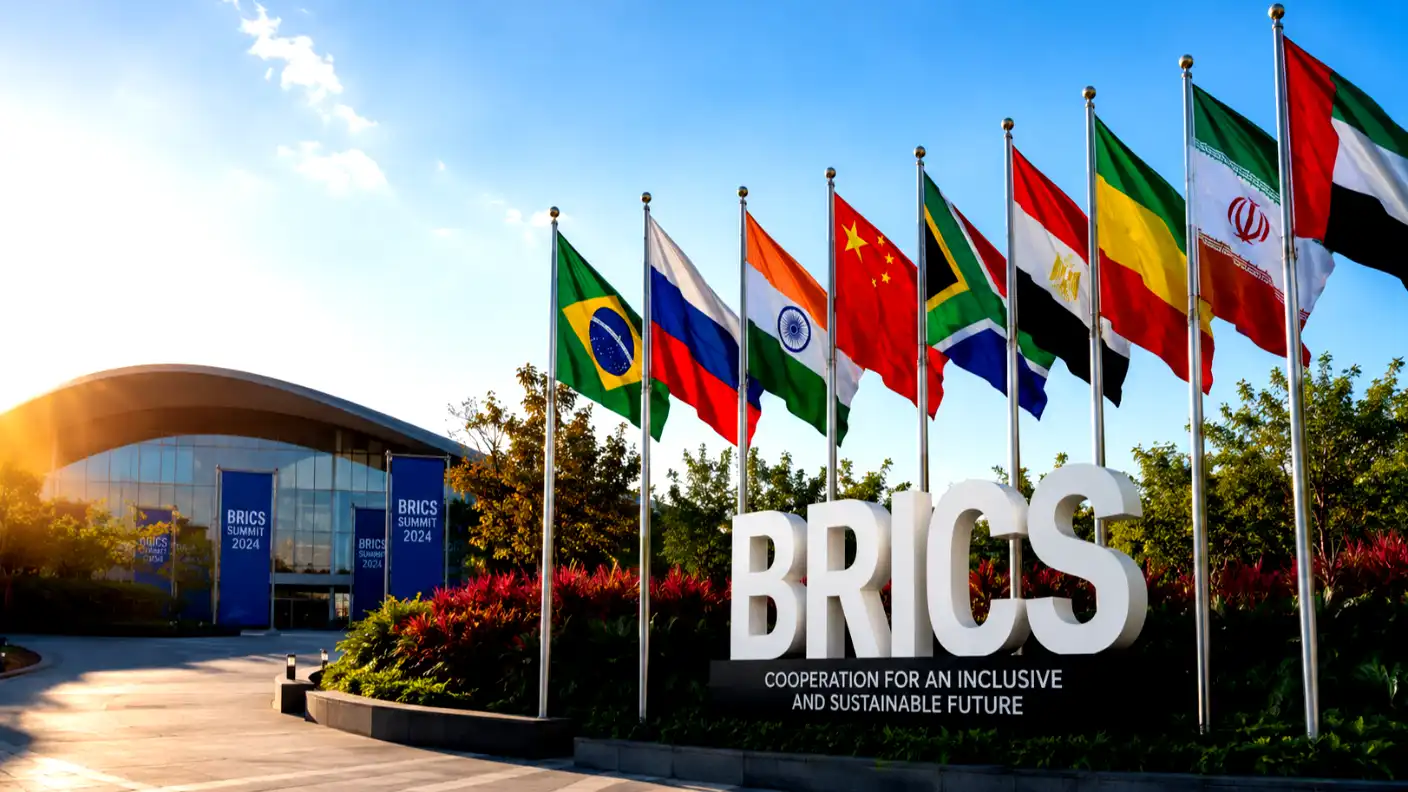
The global economic order faces a decisive stress test as leaders of the expanded BRICS bloc assemble in New Delhi for the 18th annual leaders’ summit. Hosting the summit under the theme of building for resilience, innovation, cooperation, and sustainability, India sits at the center of an intricate geopolitical triangle. The summit convenes a newly enlarged coalition of emerging market powers that accounts for more than 45% of the global population and over 36% of global gross domestic product measured by purchasing power parity.
However, the gathering takes place under the shadow of sharp economic warnings from Washington. United States President Donald Trump has repeatedly threatened to impose 100% tariffs on exports from BRICS nations if the bloc pursues a shared alternative currency or creates non-dollar settlement systems designed to undermine the United States dollar. As member states navigate diverging national interests, internal border rivalries, and volatile trade disputes, the Delhi summit will determine whether BRICS can operate as a cohesive economic counterweight to Western institutions or remain a loose platform of competing regional powers.
The Expansion Dynamic and Internal Strategic Realignment
The transformation of BRICS from its original five-nation foundation into an expanded multi-regional alliance has multiplied the group’s economic weight while complicating its internal consensus.
Integrating New Middle Eastern and African Member States
The recent inclusion of key regional powerhouses—including the United Arab Emirates, Egypt, Ethiopia, Iran, and Indonesia alongside partner economies—has fundamentally altered the bloc’s geopolitical identity. The addition of major energy producers in the Persian Gulf and strategic maritime gatekeepers around the Suez Canal gives the group substantial leverage over global oil supplies, critical shipping chokepoints, and mineral reserves.
Yet, this rapid geographic expansion introduces deep ideological divides. While founding members like Brazil and South Africa advocate for institutional reform within existing multilateral frameworks, newer members like Iran view the grouping as an essential diplomatic and financial shield against Western economic sanctions.
Integrating these divergent foreign policy orientations into unified summit declarations requires intense diplomatic negotiation. In pre-summit ministerial meetings, member delegations spent days debating language surrounding regional conflicts, unilateral sanctions, and cross-border payment integration, illustrating the difficulty of forging common policies across eleven distinct capital cities.
Managing the Complex India-China-Russia Power Triangle
At the core of BRICS lies a delicate balance of power between India, China, and Russia. Each nation brings distinct strategic priorities to the negotiating table, preventing any single state from dictating the group’s collective direction.
China represents the group’s overwhelming industrial and financial heavyweight, contributing roughly 65% of the total economic output of the expanded membership. Beijing consistently pushes to expand the bloc’s institutional footprint and accelerate the adoption of the Chinese yuan in cross-border settlements. Russia, facing extensive Western financial restrictions and trade embargoes, actively promotes the creation of alternative financial messaging platforms that bypass Western banking networks entirely.
India provides a vital diplomatic counterweight to Sino-Russian dominance. Maintaining a multi-aligned foreign policy, New Delhi insists that BRICS must remain a non-Western forum dedicated to economic modernization rather than an anti-Western geopolitical alliance. Indian diplomats have resisted efforts to transform the summit into an overtly confrontational platform against Washington, working to protect India’s strategic technology partnerships and bilateral trade pacts with the United States and Europe.
Washington’s 100 Percent Tariff Warning and Currency Defense
The escalating rhetoric between Washington and emerging market capitals highlights the central vulnerability of the global economic architecture: the dominance of the United States dollar as the primary global reserve currency.
The Fight Over De-Dollarization and Alternative Payment Rails
For decades, the dollar has served as the bedrock of international commerce, invoicing roughly 80% of global trade and comprising nearly 58% of global foreign exchange reserves. However, the aggressive deployment of financial sanctions, asset freezes, and export controls by Western governments has created widespread anxiety among emerging market central banks.
In response, several member states have called for accelerated de-dollarization strategies. These proposals include creating a unified accounting unit, establishing shared digital reserve pools, and expanding bilateral local currency trade settlements.
The prospect of a coordinated move away from the greenback drew fierce pushback from the White House. President Trump issued public warnings stating that any nation attempting to replace the United States dollar or backing an alternative common currency would face immediate 100% tariffs on all goods exported to the American consumer market. This tariff threat carries severe financial implications, particularly for export-reliant manufacturing giants like China and resource exporters like Brazil, where access to American consumer demand remains vital for domestic employment.
BRICS Pay and Local Currency Settlement Frameworks
Despite tariff threats, member states are steadily constructing parallel financial pipelines to reduce operational reliance on Western banking infrastructure. A central initiative is BRICS Pay, a decentralized digital payments and messaging framework designed to link national retail payment systems and central bank digital currencies.
Rather than launching a single, volatile multinational paper currency—an ambition that most financial economists view as technically unworkable given vast differences in domestic inflation and monetary policies—the bloc focuses on bilateral currency clearing. Under this framework, participating enterprises settle commercial import and export invoices directly in their respective national currencies, such as the Indian rupee, Chinese yuan, Russian ruble, or UAE dirham.
By utilizing local currency clearing houses and sovereign currency swaps, member states have increased non-dollar intra-bloc trade settlements to over 30% of total reciprocal commerce. This transition lowers foreign exchange conversion costs by 1.5% to 3% per transaction, protecting commercial supply chains from external currency clearing freezes.
India’s Delicate Balancing Act Between East and West
Hosting the summit in New Delhi presents Indian Prime Minister Narendra Modi with a challenging diplomatic test. India must demonstrate decisive leadership across the Global South while preserving its vital economic and security relationships with Western democracies.
Guarding Strategic Autonomy Without Alienating Washington
India’s national security doctrine relies fundamentally on strategic autonomy. While New Delhi participates actively in the Quad alongside the United States, Japan, and Australia to maintain maritime stability across the Indo-Pacific, it simultaneously leverages its BRICS membership to secure discounted energy supplies, access critical fertilizers, and expand industrial exports across developing markets.
Indian policymakers have repeatedly clarified that participating in local currency trade arrangements is a risk-mitigation tool to protect domestic energy security rather than an ideological campaign to dethrone the dollar. Bilateral trade between the United States and India exceeds $190 billion annually, with American technology corporations pouring tens of billions of dollars into Indian semiconductor assembly plants, artificial intelligence research centers, and software hubs. Indian negotiators are using their summit chairmanship to moderate summit declarations, ensuring that final communiqués emphasize sustainable development and trade facilitation rather than anti-American rhetoric.
Promoting Global South Advocacy Over Anti-Western Rhetoric
Under India’s leadership, the summit agenda centers on structural development challenges confronting developing economies across Africa, Asia, and Latin America. These priorities include food security, climate adaptation financing, public health infrastructure, and affordable digital technology access.
India is showcasing its proprietary Digital Public Infrastructure—spanning real-time mobile payment networks, digital identity protocols, and open-source data systems—as a low-cost, scalable technology stack for developing nations. By framing BRICS as an innovation and capacity-building partner for the Global South, New Delhi seeks to move the multilateral narrative away from destructive superpower trade wars and toward tangible economic modernization for developing populations.
Economic and Industrial Integration Across Member Economies
Beyond geopolitical maneuvering and summit communiqués, the practical economic connections binding member nations have expanded significantly across critical industrial supply chains.
Energy Security and Oil Trade Re-Routing
The global energy map has been fundamentally redrawn over the past three years. With traditional European pipeline routes restricted by sanctions, massive volumes of crude oil, refined fuels, and liquefied natural gas have shifted eastward toward Asian refining hubs.
India and China currently import millions of barrels of crude oil daily from member producers, processing discounted feedstocks to supply domestic industrial transportation grids and export high-value refined petroleum products. The inclusion of the United Arab Emirates and Iran inside the group further consolidates the world’s primary crude oil export capacity within a single multilateral forum. This energy integration provides member economies with predictable, low-cost baseline power, insulating developing manufacturing plants from global price volatility driven by Western financial markets.
The New Development Bank and Multilateral Infrastructure Funding
A cornerstone of the group’s financial architecture is the New Development Bank, headquartered in Shanghai. Established with an initial authorized capital of $100 billion, the multilateral lender was created to finance clean energy, transportation networks, water sanitation, and urban development projects across emerging economies without imposing rigid structural adjustment conditions.
The bank has approved more than $35 billion in development loans for hundreds of critical infrastructure projects worldwide. To insulate its balance sheet from currency volatility and foreign sanctions, the institution is expanding local currency lending, targeting at least 30% of its total loan portfolio denominated in domestic currencies rather than United States dollars. This localized financing model allows municipal water boards and regional transport authorities to borrow capital for essential civil works without incurring catastrophic currency mismatches if their domestic exchange rates depreciate.
Long-Term Outlook for Global Multipolar Governance
The deliberations at the Delhi summit highlight a broader, generational transition in how international power, commerce, and diplomacy are organized.
Reforming the Bretton Woods Architecture and Trade Routes
The foundational institutions of modern global governance—including the International Monetary Fund, the World Bank, and the World Trade Organization—were designed more than eight decades ago by Western powers in the aftermath of World War II. Today, emerging economies argue that these legacy institutions fail to represent the modern distribution of global economic power and demographic reality.
Developing nations face severe structural challenges, including prohibitive borrowing costs that force African and Latin American governments to pay interest rates four to eight times higher than those of Western nations for sovereign green transition bonds. The expansion of the BRICS platform provides developing countries with alternative sources of development finance, emergency liquidity facilities through the Contingent Reserve Arrangement, and collective bargaining power in international climate negotiations.
Furthermore, member states are investing heavily in alternative transport corridors, such as the International North-South Transport Corridor and multimodal maritime routes across the Indian Ocean. These overland and maritime transit corridors bypass congested Western-controlled chokepoints, reducing cargo shipping times by up to 40% and creating secure trade links across Eurasia and Africa.
The Next Phase of Global Geopolitical Realignment
The Delhi summit proves that the international system has moved definitively past the post-Cold War era of unipolar dominance into a complex, fragmented multipolar reality. The world is not dividing into clean ideological camps; instead, sovereign nations are practicing flexible, issue-based diplomacy.
Countries will continue to trade with Western markets while simultaneously participating in non-Western economic alliances to hedge their strategic risks. While internal rivalries, border frictions, and differing economic models will prevent the bloc from acting as a monolithic military or political alliance, the group’s collective economic gravity makes it impossible for Western capitals to ignore.
The 18th leaders’ summit in New Delhi serves as a critical milestone for modern international relations. By balancing internal rivalries, managing external tariff threats, and pioneering non-dollar financial infrastructure, the expanded group is actively constructing a diversified, multipolar world order.
Whether the bloc can maintain its internal unity while navigating aggressive trade friction with Washington will determine the stability and prosperity of the global economy for decades to come.