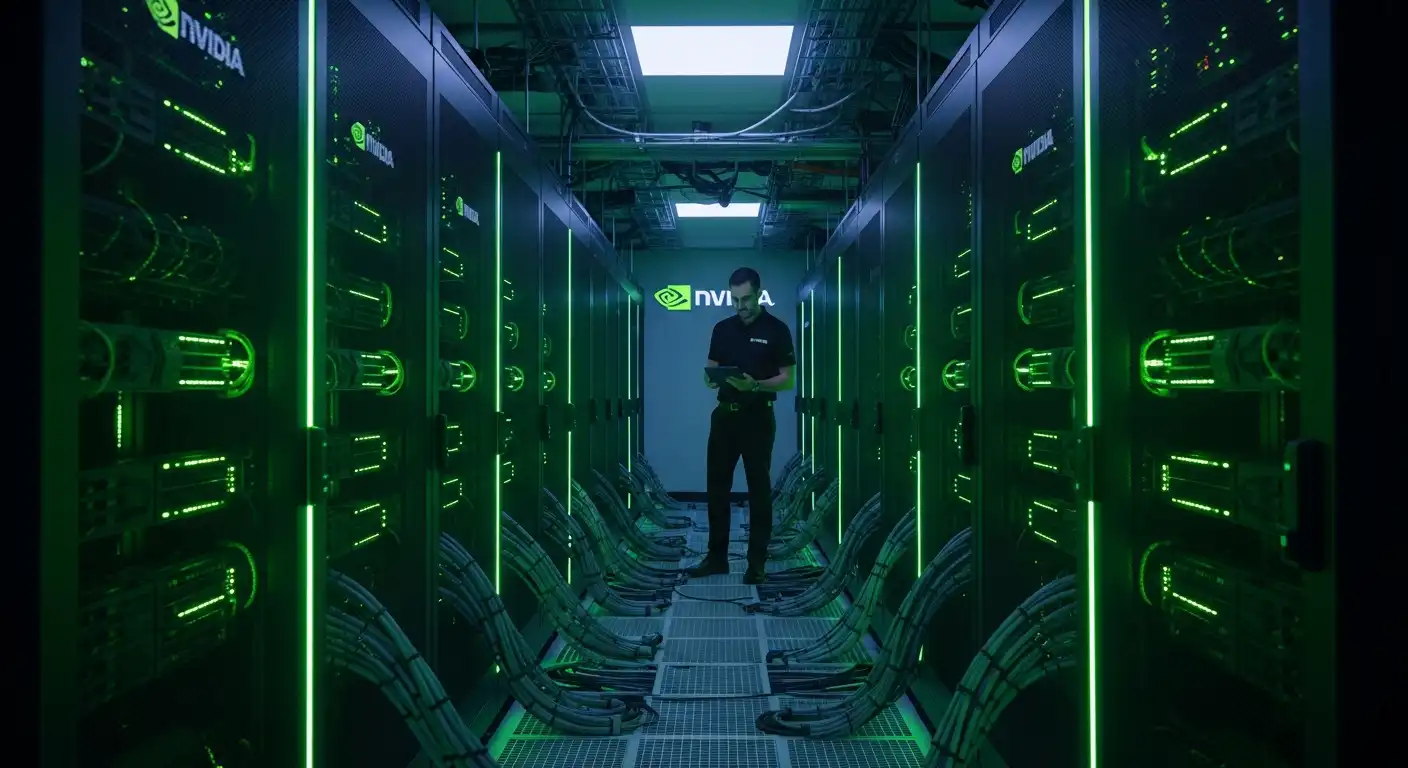
Artificial intelligence compute demand has triggered a major infrastructure push across the Southern Hemisphere. Semiconductor titan Nvidia has formed a strategic alliance with eight leading Australian cloud and data center operators to build a massive network of dedicated artificial intelligence factories. The multi-partner initiative targets up to 2 gigawatts of high-density computing capacity by 2027, more than doubling the nation’s entire existing data center power load.
The ambitious buildout unites top regional infrastructure providers, including AirTrunk, NEXTDC, CDC Data Centres, IREN, Sharon AI, Firmus Technologies, ResetData, and Megaport. Under the collaborative framework, Australian operators will build, own, and run the physical facilities, power substations, and cooling systems. Nvidia will supply its full-stack DSX architecture, high-performance graphics processors, Quantum InfiniBand, Spectrum-X networking fabrics, and enterprise software. This infrastructure expansion positions Australia as a primary computing hub for the Asia-Pacific region, giving local software developers, research universities, and enterprise giants the compute power needed to train large-scale generative models and deploy autonomous agent fleets.
The 2 Gigawatt Infrastructure Blueprint Across Australia
Australia currently operates approximately 1.6 gigawatts of total commercial data center capacity. Adding 2 gigawatts of dedicated artificial intelligence compute within a tight three-year window represents one of the fastest digital infrastructure expansions in the country’s history.
Sharon AI’s 68,000 GPU Deployment Strategy
Leading the specialized compute deployment is Australian cloud provider Sharon AI, which has committed to deploying up to 68,000 high-end Nvidia graphics processing units across regional sites. Distributing tens of thousands of accelerated processors requires advanced networking protocols to prevent latency bottlenecks during distributed training jobs.
Sharon AI is building its clusters using a hybrid networking architecture that combines Nvidia Quantum InfiniBand with Spectrum-X Ethernet. This dual-fabric network architecture delivers ultra-low latency and predictable packet routing across thousands of computing nodes. By establishing modular, high-throughput clusters, Sharon AI aims to provide local startups, government agencies, and research teams with on-demand access to multi-thousand-GPU supercomputers without sending proprietary data to offshore cloud hubs in North America or East Asia.
IREN and the 800 Megawatt Bundey Campus Buildout
Data center developer IREN is bringing massive physical scale to the partnership through its expansive land and energy portfolio. A central pillar of its commitment is the Bundey mega-campus in South Australia, a site engineered to support up to 800 megawatts of total operational capacity.
IREN is integrating Nvidia’s DSX factory design directly into its modular building architecture. The Bundey facility combines high-voltage grid connections, expansive industrial land parcels, and direct access to regional renewable energy corridors. By standardizing physical structural shells around factory-ready server pods, IREN can commission new compute blocks in rapid increments, shortening deployment timelines for enterprise customers who need hundreds of megawatts of active compute delivered on tight operational schedules.
Australia’s Data Center Ecosystem Gears Up for AI Workloads
Traditional cloud facilities designed for general web hosting and enterprise database storage cannot handle the electrical draw and thermal density of modern artificial intelligence hardware. Australian operators are redesigning physical facilities from the ground up to support high-density compute racks.
CDC and AirTrunk Scaling Renewable Powered Megasites
Commercial data center giants CDC Data Centres and AirTrunk are expanding their operational footprints to meet the rising demand for accelerated computing. CDC currently operates more than 550 megawatts of data center capacity across Australia and New Zealand, with an additional 800 megawatts under active construction.
CDC’s infrastructure strategy emphasizes complete environmental sustainability, sourcing 100% renewable electricity across its facilities while implementing zero-water-consumption closed-loop cooling architectures. Meanwhile, hyperscale operator AirTrunk is preparing its sprawling campuses across Sydney and Melbourne to host high-density server configurations. By providing powered-shell buildings equipped with multi-megawatt backup power systems and redundant fiber routes, these operators give cloud providers the physical real estate needed to deploy multi-generation accelerator platforms.
High-Density Liquid Cooling and Software-Defined Networking
Modern artificial intelligence processors generate intense thermal heat during maximum training and inference runs, with single server cabinets consuming more than 100 kilowatts of electrical power. Traditional air-conditioning systems cannot dissipate this heat without consuming immense amounts of electricity and floor space.
Infrastructure specialists ResetData, NEXTDC, and Firmus Technologies are deploying direct-to-chip liquid cooling systems and immersive thermal management loops across their new facilities. Circulating dielectric fluids and chilled liquid directly over processor cold plates allow operators to maintain optimal silicon operating temperatures while lowering overall Power Usage Effectiveness ratings toward 1.15.
Simultaneously, global network interconnection provider Megaport is linking these dispersed computing hubs through its software-defined network fabric. Megaport’s programmable optical network allows enterprises to spin up dedicated, high-speed data pipelines between separate data center campuses within minutes, enabling distributed training runs and real-time data ingestion across state lines.
Powering Enterprise and Sovereign AI Across the Asia-Pacific
Building domestic compute infrastructure is closely tied to Australia’s economic ambition to establish sovereign capability in artificial intelligence development, data privacy, and critical industry automation.
Atlassian and Healthcare Pioneers Deploying Nemotron Models
The arrival of local high-performance compute clusters is already accelerating commercial software development across leading Australian corporations. Enterprise software giant Atlassian is leveraging Nvidia’s accelerated computing stack and Nemotron open-weight models to build intelligent agents, automated coding assistants, and collaboration tools for millions of global business users.
In the healthcare and life sciences sector, digital health innovator Heidi is using local compute clusters to process complex clinical records, generate real-time patient summaries, and assist physicians with automated diagnostic documentation. Furthermore, academic research institutions and biotechnology laboratories are utilizing high-density server clusters to process population-scale genomics datasets, accelerating personalized cancer treatment research and vaccine discovery. Running these computationally heavy tasks inside domestic borders ensures full compliance with national health data privacy regulations and keeps sensitive patient information within Australian legal jurisdiction.
Establishing Sovereign Computing Autonomy for Local Innovators
Relying entirely on foreign cloud providers creates severe economic and strategic vulnerabilities for mid-sized economies. When global cloud platforms experience regional capacity crunches, international customers often receive second-tier hardware allocations, slowing down domestic research and commercial product launches.
By constructing a 2-gigawatt domestic compute network, Australia secures its technological independence. Local artificial intelligence startups, software developers, and universities gain direct access to cutting-edge hardware without waiting in long international queues. This domestic compute access fosters a thriving local innovation ecosystem, encouraging domestic tech entrepreneurs to build, test, and scale proprietary algorithms at home rather than relocating their engineering teams and intellectual property to Silicon Valley.
Energy Demands, Grid Integration, and Environmental Scrutiny
The massive power requirements of large-scale data centers have sparked an important national conversation regarding electrical grid stability, water usage, and carbon emissions across Australia.
Navigating Water and Electricity Consumption Pressures
Operating 2 gigawatts of continuous computing capacity requires an astonishing amount of electrical energy—roughly equivalent to the power consumed by more than 1.5 million suburban households. In urban centers like Sydney and Melbourne, local community groups and municipal planners have raised concerns that adding multi-megawatt data centers could strain municipal electrical substations and drive up utility costs for residential consumers.
Furthermore, traditional evaporative cooling systems consume millions of liters of fresh water annually to keep server rooms cool during hot summer months. In a drought-prone continent, heavy industrial water consumption faces strict regulatory oversight. In response, data center developers are eliminating evaporative cooling towers in favor of dry coolers and closed-loop liquid systems that recycle cooling fluids indefinitely, minimizing water waste and reducing environmental friction with local municipal authorities.
Coupling Mega-Clusters with Wind and Solar Generation
To satisfy growing power demands without increasing national greenhouse gas emissions, data center operators are locating new campuses directly adjacent to major renewable generation hubs. Australia possesses world-class solar irradiance across its interior deserts and strong coastal wind patterns, providing abundant clean energy potential.
Operators like IREN and CDC are signing long-term power purchase agreements with utility-scale solar farms, wind developments, and big-battery storage facilities. In South Australia, where renewable energy regularly supplies over 70% of total grid electricity, data center developers are utilizing variable clean power to run heavy batch-training workloads. By pairing high-density compute facilities directly with clean energy assets, operators transform surplus wind and solar electrons into digital value right at the generation source, supporting national decarbonization targets while powering the modern digital economy.
Global Implications of Australia’s Emergence as a Compute Superhub
Australia’s rapid expansion into large-scale artificial intelligence infrastructure carries significant geopolitical and economic importance for the broader Indo-Pacific region.
Positioned as the High-Bandwidth Gateway to the Indo-Pacific
Geographically, Australia offers a stable, secure, and well-regulated environment situated between North America and the fast-growing economies of Southeast Asia. Trans-Pacific and regional subsea optical cables landing in Sydney, Perth, and Darwin connect the continent directly to major international internet exchanges.
As neighboring Southeast Asian nations experience rapid digital transformation but face domestic land and energy constraints in crowded urban centers like Singapore, Australia offers the expansive land parcels, institutional stability, and clean energy capacity required to host regional supercomputers. Multinational corporations, international financial institutions, and global tech platforms can base their Asia-Pacific artificial intelligence processing in Australia, benefiting from strong intellectual property laws, stable legal frameworks, and resilient power networks.
The Long-Term Economics of Modular DSX AI Factories
The shift from traditional generic data centers to specialized DSX AI factories marks a fundamental transition in how digital infrastructure creates economic value. Standard data centers operate as digital warehouses that store static files, while AI factories function as active manufacturing plants that produce tokens, reasoning outputs, and predictive models.
The economic returns of these facilities depend on maximizing token throughput while minimizing the cost per unit of compute. By standardizing on Nvidia’s integrated hardware and software stack—spanning silicon accelerators, specialized compilers, and open foundation models—Australian operators achieve high hardware utilization rates and extended asset lifespans. This operational efficiency lowers the total cost of ownership, allowing regional cloud providers to offer competitive pricing to enterprise customers while generating sustainable operating profit margins.
Building the Foundations of Next-Generation Computing
The collaboration between Nvidia and Australia’s leading data center operators marks a historic milestone in the nation’s technological evolution. Adding up to 2 gigawatts of dedicated compute capacity by 2027 transforms Australia from a consumer of overseas digital services into an international producer of artificial intelligence compute power.
By combining Nvidia’s advanced hardware platforms with Australian expertise in renewable energy integration, high-density liquid cooling, and software-defined networking, the partnership creates a sustainable, scalable template for regional infrastructure development. As enterprises across healthcare, enterprise software, and national defense integrate autonomous agents and generative workflows into daily operations, Australia’s expanding network of AI factories will provide the computational engine driving economic productivity, scientific discovery, and digital innovation for decades to come.