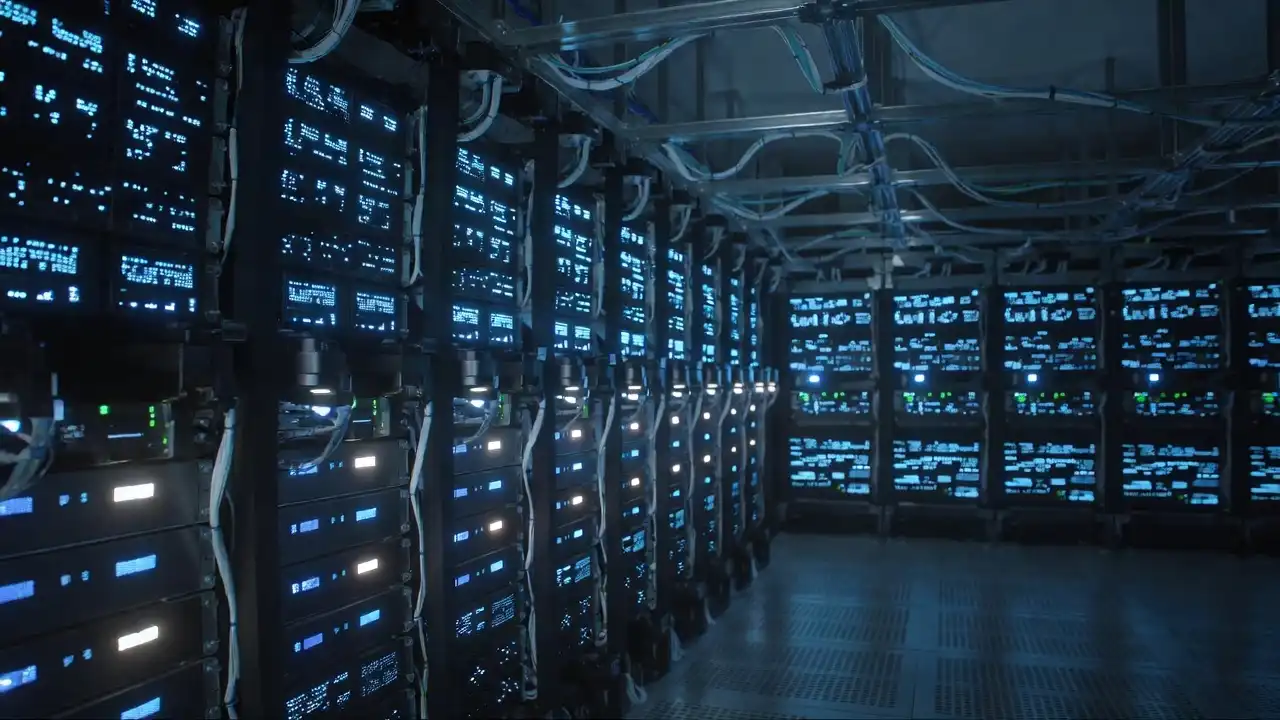
Electricity consumption from Australian data centers will jump nearly sevenfold over the coming decade as artificial intelligence workloads, cloud computing expansions, and sovereign digital infrastructure projects accelerate nationwide. Official projections from the Australian Energy Market Operator reveal that computing facilities will consume approximately 34 terawatt-hours of electricity annually by the 2035-2036 fiscal year. This marks a massive leap from the 5 terawatt-hours currently drawn by digital facilities, raising data centers’ share of the National Electricity Market from roughly 3% today to more than 13%.
The dramatic forecast highlights a brewing conflict between surging digital power requirements and the physical realities of Australia’s energy transition. The National Electricity Market covers eastern and southeastern states, supplying power to more than 80% of the country’s population. As hyperscale technology operators expand computing campuses to train complex artificial intelligence models, data centers are shifting from minor grid users into massive, continuous industrial loads that rival entire manufacturing sectors.
The timing of this digital boom creates severe operational challenges for power grid planners. Over the exact same ten-year window, Australia plans to shut down roughly 13 gigawatts of aging coal-fired generation capacity and nearly 2 gigawatts of gas-fired plants. Balancing an unprecedented surge in continuous power demand while retiring legacy baseload generators will require tens of billions of dollars in new solar, wind, battery storage, and transmission line investments.
The Sevenfold Power Surge Facing the National Electricity Market
Data centers represent one of the fastest-growing classes of electricity demand in modern Australian history. Historically, electrical demand on the national grid tracked population growth and industrial output at a modest 1% to 2% annual rate. However, the sudden arrival of high-density artificial intelligence computing clusters has completely disrupted traditional load forecasting models.
Just twelve months earlier, energy planners projected that data centers would not reach double-digit shares of grid demand until well after 2040. The latest Electricity Statement of Opportunities updates those assumptions, bringing the timeline forward by more than fifteen years.
This acceleration reflects an explosion in planned infrastructure projects. Over the past year, the pipeline of known data center projects tracking toward grid connection expanded from 97 to 225 facilities, with global tech conglomerates competing aggressively for substation capacity across major metropolitan corridors.
Unpacking the Jump from 5 to 34 Terawatt-Hours
The jump from 5 terawatt-hours to 34 terawatt-hours annually represents a sustained annual compound growth rate exceeding 21%. A single terawatt-hour equals 1 billion kilowatt-hours of electrical energy. Moving an additional 29 terawatt-hours of annual demand onto the power network requires generating and transmitting enough power to run multiple industrial cities.
Currently, 165 operational data centers draw power across the National Electricity Market, supporting enterprise banking, telecommunications, government services, and consumer mobile apps. These existing facilities operate within manageable grid parameters, using roughly 3% of available power generation.
The projected 34 terawatt-hour demand by 2036 assumes that high-density computing clusters will ramp up rapidly. Unlike traditional server farms that run general enterprise software, artificial intelligence training clusters pack tens of thousands of power-hungry graphics processing units into tightly cooled server racks. A single hyperscale computing campus under development can require 200 to 500 megawatts of dedicated capacity, equivalent to the power draw of a major commercial aluminum smelter.
Comparing Digital Compute Loads to Residential Household Consumption
To understand the sheer magnitude of 34 terawatt-hours, grid analysts compare the projected compute load directly to residential household consumption. The combined annual electricity consumption of all residential households across New South Wales and Victoria totals approximately 38 terawatt-hours.
Within ten years, the computers powering search algorithms, automated enterprise workflows, generative media platforms, and cloud storage will consume almost as much electricity as every home, apartment, and residential kitchen in Australia’s two most populous states combined.
This comparison illustrates the structural pressure facing regional utilities. Supplying residential communities involves daytime peaks and nighttime lulls that give generators time to cycle and cool. Feeding millions of processors running continuous mathematical calculations requires unwavering power delivery every single second of the day, leaving zero margin for transmission interruptions.
Structural Clashes Between Continuous Load and Coal Plant Retirements
The central challenge facing Australia’s energy transition is the distinct operating profile of digital infrastructure. Most conventional electricity loads follow predictable diurnal cycles. Factory shifts conclude in the late afternoon, office towers switch off commercial lighting in the evening, and residential air conditioning follows regional weather patterns.
Data centers operate under completely different rules. Computing servers, networking backbones, and cooling chillers run flat, drawing identical amounts of power at two o’clock in the afternoon and three o’clock in the morning. This constant, unyielding demand profile creates complex challenges for an electricity network transitioning from steady fossil fuel generators to variable renewable energy sources.
The Flat Baseload Challenge of Artificial Intelligence Workloads
Grid operators describe flat, continuous electricity demand as both a benefit and a burden. On the one hand, consistent consumption provides predictable revenue for renewable energy developers seeking long-term offtake agreements. On the other hand, a flat load exerts relentless pressure on the grid during periods when overall system generation runs thinnest.
During overnight hours, rooftop solar panels and utility-scale solar farms produce zero electricity. If wind speeds drop across southern states, the grid must rely on stored hydropower, grid-scale battery systems, or peaking gas plants to keep high-voltage lines stable.
If data centers draw thousands of megawatts of steady baseload power during these low-generation windows, they can deplete regional battery reserves before the morning sun returns. Managing this overnight demand without reigniting shuttered fossil fuel plants requires vast investments in multi-hour storage and interconnected transmission links.
Retiring 13 Gigawatts of Coal and Gas Generation
The data center surge coincides with the largest power plant retirement cycle in Australian history. Australia’s fleet of coal-fired power stations is aging rapidly, suffering frequent boiler tube leaks and unplanned mechanical outages. Over the next ten years, energy companies plan to retire roughly 13 gigawatts of coal-fired generation capacity across Queensland, New South Wales, and Victoria.
In addition, nearly 2 gigawatts of older gas-fired generation will shut down over the same timeframe. Combined, these plant closures will remove approximately 15 gigawatts of traditional dispatchable generation from the National Electricity Market.
While private developers installed a record 9 gigawatts of new renewable supply and battery storage over the past twelve months, replacing 15 gigawatts of continuous thermal baseload requires building three to four times that capacity in solar and wind farms to account for weather intermittency. The rapid influx of 34 terawatt-hours of data center demand means clean energy projects must deploy even faster just to keep pace with digital growth.
Commercial Pipelines and the A$150 Billion Infrastructure Wave
The expansion of digital infrastructure is driving an unprecedented wave of private capital into the Australian economy. Research from Commonwealth Bank of Australia estimates that the total pipeline of data center developments, substation upgrades, and associated computing hardware could reach A$150 billion by 2030.
Australia has emerged as the second most attractive destination for data center capital globally, trailing only the United States. International cloud providers and private equity infrastructure funds view Australia as a safe, politically stable gateway to serve the booming digital economies of the wider Asia-Pacific region.
However, translating pipeline announcements into energized facilities requires overcoming severe physical grid bottlenecks and protracted transmission connection queues.
The Surge to 225 Projects Across New South Wales and Victoria
Development activity remains heavily concentrated around Australia’s two largest economic centers. Of the 225 known data center projects currently progressing through planning and connection stages, more than 80% sit within New South Wales and Victoria.
Sydney and Melbourne serve as the primary landing hubs for trans-Pacific subsea fiber-optic telecommunications cables. Financial institutions, multinational software providers, and enterprise cloud users demand sub-millisecond network latency, compelling data center operators to cluster facilities near metropolitan business districts.
In New South Wales alone, transmission operator Transgrid has received connection inquiries representing more than 14 gigawatts of potential data center demand. While developers will likely weed out speculative applications, the concentration of massive computing loads around suburban Sydney threatens to overwhelm localized distribution networks and high-voltage substations.
Grid Connection Queues and Transmission Bottlenecks
Securing permission to connect to the high-voltage transmission grid has become the single biggest obstacle for data center developers. Power utilities must conduct extensive engineering studies to verify that plugging in a 300-megawatt computing facility will not destabilize voltage levels or cause frequency fluctuations for nearby residential communities.
Currently, large-scale projects face connection queues stretching between two and four years from initial application to final energization. Key transmission hurdles include:
- Limited thermal capacity on existing 330-kilovolt and 500-kilovolt overhead transmission corridors connecting regional renewable zones to urban centers.
- Long procurement lead times for high-voltage power transformers and gas-insulated switchgear, with delivery backlogs exceeding three years globally.
- Complex system strength requirements that force developers to install expensive synchronous condensers to keep grid frequencies stable.
- Local community opposition to new overhead transmission lines traversing agricultural lands and regional conservation parks.
Unless state governments and transmission operators streamline connection frameworks, hundreds of billions of dollars in planned digital investments could remain stalled in administrative backlogs.
Regulatory Frameworks and Mandatory Renewable Energy Mandates
To protect the broader public from rising electricity costs and carbon emissions, federal and state political leaders are developing comprehensive regulatory frameworks for the data center sector. Prime Minister Anthony Albanese and state premiers have placed digital infrastructure oversight at the top of national cabinet agendas.
The central goal of these government initiatives is to establish a “user-pays” model. Policymakers want to prevent a scenario where multinational technology corporations consume vast amounts of cheap domestic electricity while everyday households and small businesses foot the bill for expensive grid upgrades.
The proposed national rules establish strict conditions governing how computing campuses source electricity, utilize water for cooling, and support national decarbonization targets.
Enforcing Power Purchase Agreements and Additionality Rules
The cornerstone of the proposed regulatory framework is the principle of additionality. Under draft rules under consideration by the federal government and state energy departments, data center operators will not be allowed to simply purchase existing clean energy certificates from operational wind or solar farms.
Instead, developers must prove that their facilities directly support the construction of brand-new renewable energy generation:
- Executing long-term power purchase agreements with new solar and wind projects that have not yet reached final investment decisions.
- Requiring at least 40% of contracted renewable electricity to come from wind generation to provide balanced overnight output.
- Co-locating or funding dedicated battery energy storage systems equivalent to at least 25% of the data center’s peak demand for a minimum four-hour duration.
- Implementing automated demand-response systems capable of curtailing non-essential compute loads by up to 25% during critical grid emergencies.
By enforcing these additionality rules, authorities intend to turn data centers into engines that accelerate clean energy development rather than competitors that drain existing power reserves.
Water Conservation Standards and Regional Siting Strategies
Beyond electricity consumption, the environmental footprint of data center cooling has triggered fierce debate among municipal water authorities. A large hyperscale computing campus using evaporative cooling towers can consume up to 5 million gallons of potable water daily to prevent processor overheating.
In a country subject to severe recurring droughts, consuming millions of liters of municipal drinking water for computer cooling is politically unacceptable. New regulatory standards will force operators to adopt closed-loop liquid cooling systems, direct-to-chip water loops, or advanced air-cooled heat exchangers that eliminate continuous water evaporation.
Furthermore, state governments are offering financial and tax incentives to encourage developers to build regional computing precincts away from crowded metropolitan centers. Siting facilities near regional renewable energy zones in central New South Wales, northern Victoria, and South Australia allows operators to connect directly to clean generation sources without overloading urban transmission substations.
Future Grid Reliability and Capital Investment Pathways
The rapid rise of data center power consumption represents a profound stress test for Australia’s National Electricity Market, but it also creates immense economic opportunities. If managed with disciplined planning, the influx of private tech capital can underwrite the modernization of Australia’s entire energy system.
Energy experts emphasize that Australia possesses unmatched renewable advantages, including world-class solar irradiance, vast wind resources, and abundant land. Connecting these natural resources to high-density digital infrastructure can establish the country as the green computing engine of the Asia-Pacific basin.
Battery Energy Storage and Low-Emissions Demand Flexibility
The integration of grid-scale battery energy storage systems represents the most vital technical solution for balancing digital demand. Batteries provide the sub-second responsiveness needed to stabilize grid frequencies when computing loads surge or cloud cover rolls over solar arrays.
Over the past year, Australia has connected massive four-hour and eight-hour battery storage projects, with small-scale and utility-scale battery capacity projected to jump to 35 gigawatts over the coming decades. Data center operators are increasingly incorporating large-scale battery banks directly into their on-site power substations.
These on-site batteries serve a dual purpose: they provide mission-critical uninterrupted power during local grid faults and act as virtual power plants that discharge surplus clean energy back into the public grid during peak evening demand hours, generating ancillary revenue for operators while stabilizing the broader network.
Protecting Consumer Power Bills Amid Industrial Expansion
Public support for the digital economy depends heavily on protecting everyday consumers from rising electricity bills. Economic modeling from the Climate Council warns that if data center growth is not matched with corresponding investments in new renewable generation and transmission, wholesale power prices could climb by more than 20% across the national grid by 2035.
Because wholesale electricity costs make up roughly 40% of a standard residential power bill, unmanaged industrial demand could translate into hundreds of dollars in added living expenses for average Australian families.
By implementing strict cost-recovery mechanisms, ensuring data center operators pay the full cost of their grid connections, and enforcing long-term renewable contracting, government regulators aim to shield households from cost spillovers. If executed successfully, the data center boom will expand Australia’s digital economy while funding the renewable infrastructure needed to deliver cheaper, cleaner electricity for all citizens.
The projection that Australian data center power use will jump sevenfold to 34 terawatt-hours by 2036 marks a transformative moment for the nation’s digital and energy landscapes. As high-density computing clusters claim 13% of the National Electricity Market, the race between retiring coal generators and deploying new clean infrastructure will define Australia’s economic future. By combining strict renewable energy additionality rules, advanced battery storage, and coordinated transmission planning, Australia can build the digital backbone of the modern economy while securing a reliable, affordable, and sustainable power grid for generations to come.