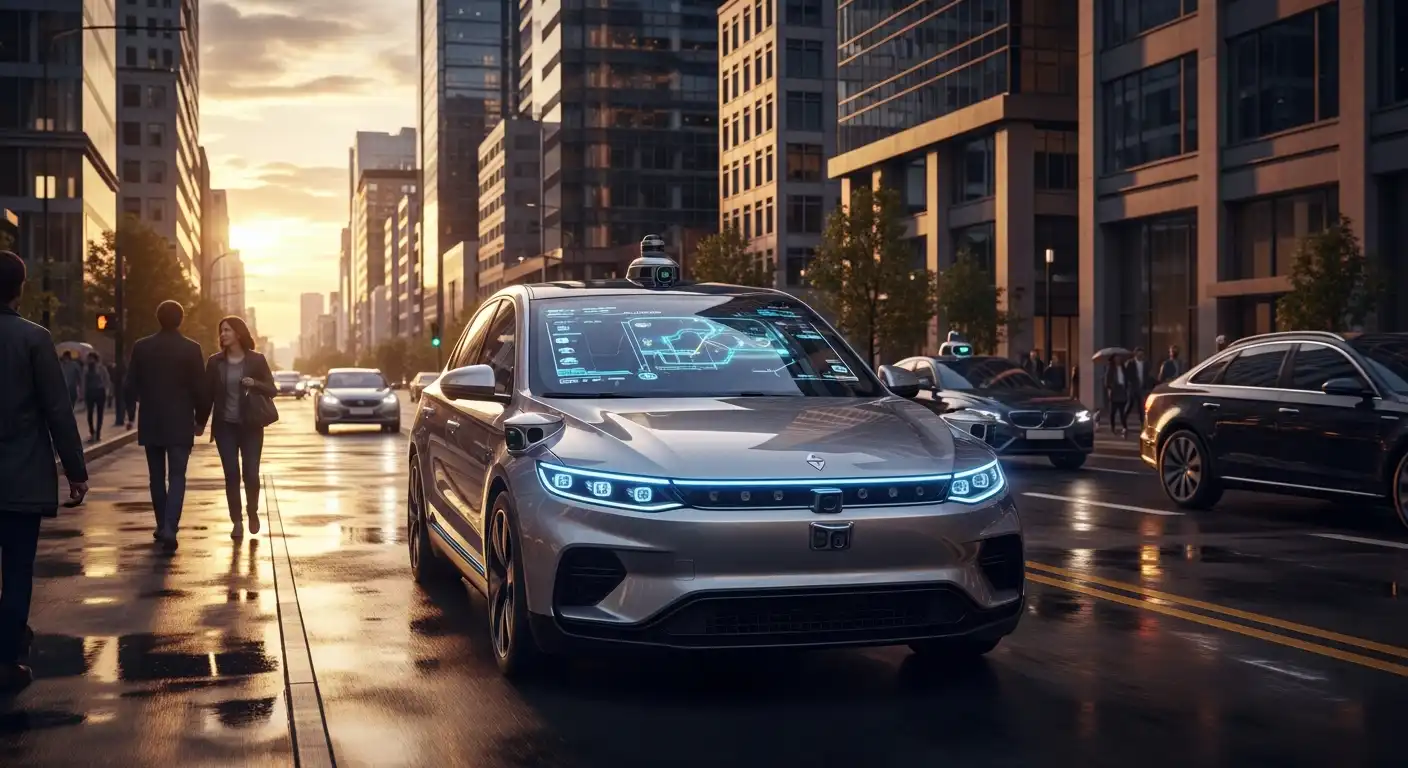
The commercial development of self-driving transportation is reaching an important regulatory milestone. For over a century, automotive design operated under a single foundational assumption: every motor vehicle traveling on public roads requires a human driver sitting behind a steering wheel with foot pedals at their disposal. Federal safety standards were written around this human-centered framework, specifying where pedals, mirrors, warning lights, and steering columns must be placed.
That historical framework is now being dismantled. Regulators at the National Highway Traffic Safety Administration confirmed that the federal government will evaluate eliminating steering wheel requirements for vehicles designed strictly for autonomous operation.
This announcement follows an official proposal to eliminate the mandate for manual brake pedals in vehicles built without human controls, updating Federal Motor Vehicle Safety Standard Number 135.
The rationale behind these policy changes is simple: if a vehicle is engineered to operate exclusively through an automated driving system with no human operator, requiring manual steering wheels and foot pedals is redundant.
Furthermore, including unnecessary manual controls in a passenger cabin can create safety hazards, as passengers could accidentally or intentionally interfere with pedals or wheels while the vehicle is in motion.
These regulatory updates represent a major victory for purpose-built robotaxi developers, including Tesla, Amazon’s Zoox, and Alphabet’s Waymo.
By replacing outdated rules with safety standards designed for automated driving systems, federal transportation officials are clearing a path for the large-scale production and commercial deployment of vehicles designed from the ground up without driver seats.
Overhauling Decades-Old Safety Standards
To understand the significance of these policy changes, one must examine the legacy of Federal Motor Vehicle Safety Standards. Many of these rules were written decades before automated driving systems existed.
For instance, Federal Motor Vehicle Safety Standard Number 135, which has governed light vehicle braking systems since 1995, explicitly required service brakes to be activated by a foot-operated pedal and parking brakes to be controlled by a hand or foot lever.
Under previous law, automakers attempting to deploy vehicles without steering wheels or pedals faced severe administrative hurdles.
To test or operate a vehicle without human controls, manufacturers had to file formal petitions for temporary exemptions.
These exemptions were capped by federal law at just 2,500 vehicles per manufacturer annually, and the petition review process frequently stalled in bureaucratic review for years.
General Motors, for example, filed petitions in 2018 and 2022 to deploy its steering-wheel-free Cruise Origin robotaxi, but the lengthy review process delayed deployment until the company eventually withdrew the application.
Rather than forcing manufacturers to navigate slow exemption processes for small fleets of 2,500 vehicles, federal regulators are shifting toward permanent, updated safety standards.
This modernization effort extends beyond pedals and steering wheels. Regulators are also updating Federal Motor Vehicle Safety Standard Number 110, which governs tire selection and rim placement.
The update allows vehicle manufacturers to place mandatory tire placards on the left side of the cabin when a vehicle lacks a traditional “driver’s side,” reflecting the reality of symmetrical, passenger-only interiors.
Crucially, removing physical control mandates does not lower the safety threshold for stopping performance.
Under the updated rules, fully autonomous vehicles must still meet the exact same rigorous stopping distance criteria and braking performance metrics as traditional human-driven cars.
The rule change simply removes the physical foot pedal, allowing software systems and redundant electromechanical actuators to command the brakes directly.
The Purpose-Built Robotaxi Boom
Eliminating the mandate for manual controls allows automakers and technology firms to abandon traditional interior layouts and reimagine what a vehicle cabin can be.
Without the need for an engine bay, steering column, instrument cluster, or pedal assembly, designers can optimize interior space exclusively for passenger comfort, cargo efficiency, or social interaction.
Tesla’s Cybercab Ambitions
The regulatory shift provides immediate support for Tesla’s commercial robotaxi strategy.
Tesla recently unveiled its Cybercab, a purpose-built two-seat electric vehicle designed entirely without a steering wheel, accelerator pedal, or brake pedal.
Chief Executive Officer Elon Musk has consistently advocated for a streamlined federal framework for autonomous vehicles, arguing that state-by-state patchwork rules slow down technological innovation.
Tesla has already begun initial production runs of the Cybercab, aiming to launch a commercial robotaxi network.
Without updated federal safety standards, Tesla would have been restricted to deploying small, exemption-capped fleets or forced to retrofit manual controls into a vehicle designed to function without them.
The removal of brake pedal and steering wheel mandates provides a clear certification pathway for the Cybercab, allowing Tesla to pursue mass production and commercial fleet scaling.
Amazon’s Zoox and Bi-Directional Shuttles
Amazon’s autonomous vehicle subsidiary, Zoox, stands to benefit significantly from these modernized safety rules.
Unlike traditional passenger cars, the Zoox robotaxi is a purpose-built, bi-directional electric shuttle with carriage-style seating where four passengers face each other.
The vehicle features no steering wheel, no driver seat, and no traditional front or rear dashboard.
Zoox previously petitioned federal regulators for permission to deploy up to 2,500 of these purpose-built shuttles on public roads for commercial testing.
The transition toward permanent federal standards eliminates the need for temporary waivers, allowing Zoox to scale its operations in active markets like Las Vegas and San Francisco.
By removing driver-centric components, Zoox can maximize interior legroom, integrate four-point seatbelt systems, and place protective airbags across the entire perimeter of the cabin.
Waymo and Nuro’s Commercial Fleet Scaling
Alphabet’s Waymo, the leading operator of paid robotaxi rides in the United States, is also adapting its fleet strategy to utilize purpose-built designs.
While Waymo initially operated retrofitted consumer vehicles like the Jaguar I-PACE, the company is integrating custom vehicle platforms, such as the Geely Zeekr electric shuttle, designed specifically for autonomous ride-hailing.
Similarly, autonomous delivery company Nuro, which received a temporary federal exemption in 2020 for its occupantless R2 delivery pod, can now scale its specialized goods-delivery vehicles without requesting custom waivers.
For delivery vehicles that carry no human passengers or drivers, removing steering wheels, windshield wipers, rearview mirrors, and pedals significantly reduces manufacturing costs, lowers overall vehicle weight, and frees up additional volume for commercial cargo.
Safety, Accountability, and Emergency Vehicle Coordination
While the elimination of manual driving controls removes significant manufacturing and design barriers, it also places total responsibility for vehicle performance on automated software systems.
Regulators are making it clear that eliminating physical hardware mandates does not relieve autonomous vehicle developers from strict safety oversight and operational accountability.
First Responder Interference Directives
A primary challenge facing commercial robotaxi fleets is their interaction with emergency vehicles and public safety personnel.
Across cities like San Francisco, Phoenix, and Austin, municipal authorities have documented incidents where autonomous vehicles stopped unexpectedly, blocked fire truck bays, interfered with police scenes, or failed to yield to emergency vehicles using sirens and flashing lights.
To address these operational friction points, federal safety regulators issued a formal directive giving autonomous vehicle operators until the end of July to resolve software issues related to first responder interference.
Regulators emphasized that as physical human controls are removed, autonomous driving software must demonstrate flawless recognition of emergency vehicles, construction zones, and manual hand signals from traffic officers.
Companies that fail to address these operational issues face potential safety investigations, mandatory software recalls, or operational suspensions.
The Federal Framework versus State-Level Regulation
The effort to modernize Federal Motor Vehicle Safety Standards highlights an ongoing debate between federal authority and state sovereignty.
The National Highway Traffic Safety Administration oversees vehicle design, construction, and safety equipment standards at the federal level.
However, individual states retain the legal authority to regulate traffic laws, commercial licensing, vehicle registration, and operational access to public roads.
Currently, states take vastly different approaches to self-driving technology.
States like Arizona, Texas, and Florida have established permissive legal frameworks that encourage autonomous vehicle testing and commercial deployment.
Conversely, other states require extensive local permitting, dedicated safety drivers, or strict operational boundaries.
A unified federal safety standard for steering-wheel-free vehicles creates a baseline for manufacturing certification across all 50 states.
Once an autonomous vehicle complies with Federal Motor Vehicle Safety Standards, individual states cannot ban the vehicle simply because it lacks a steering wheel or brake pedal.
This legal clarity allows automakers to design a single, standardized vehicle layout for the entire national market, lowering engineering costs and simplifying supply chain management.
The Economic and Industrial Impact on the Mobility Sector
The transition to purpose-built autonomous vehicles is set to restructure the economics of the broader mobility sector, impacting traditional automakers, ride-hailing networks, and urban transit systems.
By removing the steering wheel, pedals, steering column, and traditional dashboard, automakers can reduce the bill of materials for purpose-built robotaxis.
While autonomous sensor suites—including lidar, radar, high-resolution cameras, and compute modules—add material cost, removing legacy mechanical controls helps offset these expenses.
Furthermore, purpose-built electric robotaxis are engineered for high-utilization commercial life cycles, designed to run continuously for hundreds of thousands of miles with minimal maintenance downtime.
For ride-hailing platforms like Uber and Lyft, the commercial deployment of driverless robotaxis presents both a competitive threat and a strategic opportunity.
Drivers currently represent the largest operational expense for ride-hailing networks, accounting for roughly 70% to 80% of the total fare cost.
Autonomous fleets eliminate the driver expense, enabling a dramatic reduction in the cost-per-mile for consumer transportation.
As the cost of an autonomous ride approaches the cost of private vehicle ownership, consumer transit habits could shift dramatically.
In dense urban areas, many households may choose to forgo private vehicle ownership entirely, relying instead on subscription-based access to purpose-built robotaxis.
This shift could reduce the overall demand for personal passenger cars while increasing the demand for fleet-operated, purpose-built autonomous vehicles that run continuously throughout the day.
Reimagining the Future of Road Transportation
The willingness of federal safety regulators to eliminate steering wheel and brake pedal mandates marks a permanent shift in the history of the automobile.
By updating Federal Motor Vehicle Safety Standards to accommodate vehicles controlled exclusively by automated driving systems, transportation officials are modernizing regulations to match rapid technological innovation.
This regulatory evolution enables a new generation of purpose-built electric vehicles, ranging from two-seat passenger Cybercabs and bi-directional shuttles to occupantless delivery pods.
While automakers must still prove that their software systems can navigate complex real-world traffic scenarios and respect emergency responders, the removal of legacy hardware mandates clears the primary structural roadblock for autonomous mobility.
As purpose-built robotaxis transition from low-volume experimental fleets to mass-produced commercial transportation networks, the interior layout of the automobile will undergo its most significant transformation since the invention of the assembly line.
The era of the human driver at the center of vehicle design is drawing to a close, making way for a future where the cabin is defined entirely by the needs, safety, and comfort of the passenger.