

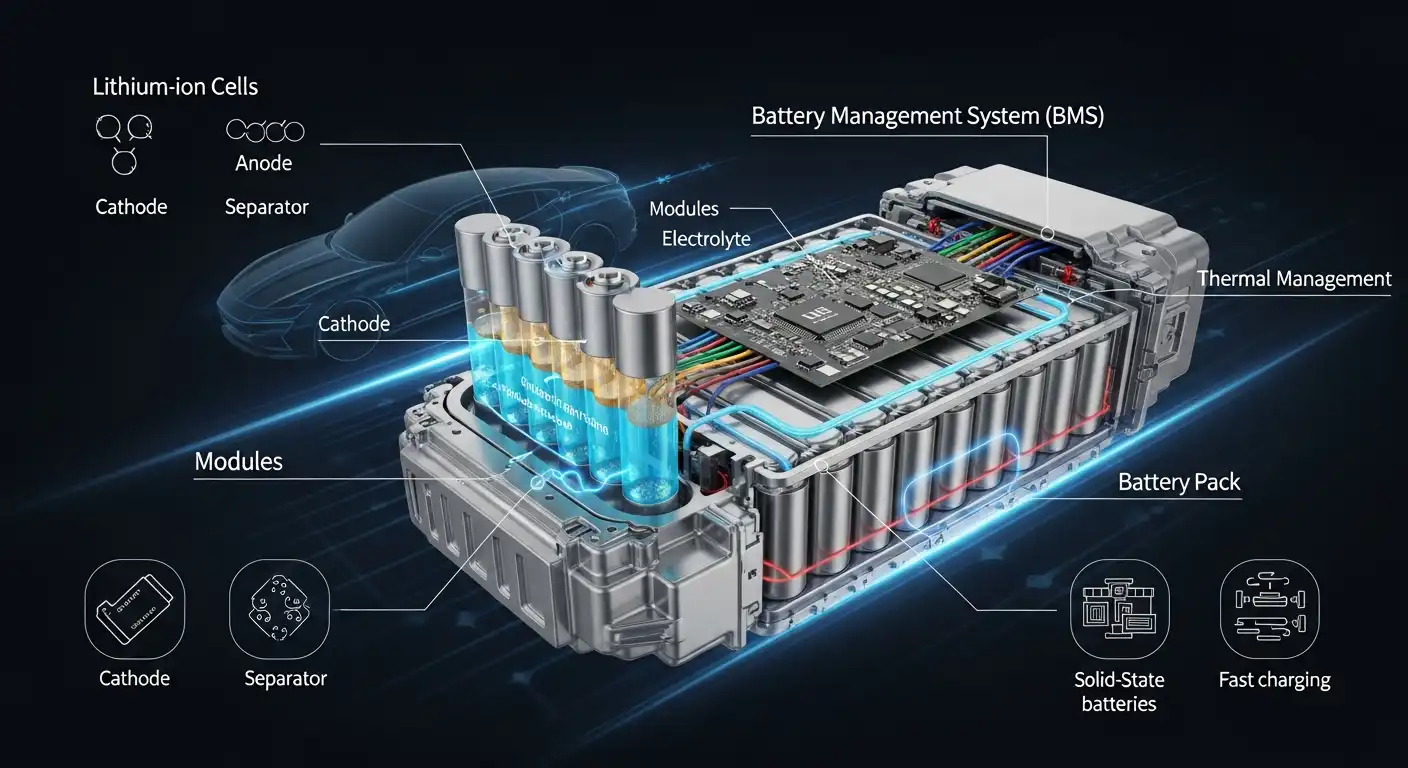
China has transitioned to electromobility faster than any other nation. In recent years, the country has filled its streets with electric cars, plug-in hybrids, and battery-powered commercial trucks. Last year, the domestic production and sales of these new energy vehicles both exceeded 16 million units. This milestone meant that electrified models captured more than half of all new passenger car sales in the country. However, this rapid manufacturing expansion has created a massive industrial challenge: managing the end-of-life cycle for millions of large, heavy battery packs.
Because lithium-ion vehicle batteries typically degrade after five to eight years of continuous use, the first generation of mass-market electric vehicles is now reaching retirement age. This retirement wave is arriving rapidly, bringing a massive influx of spent battery cells. This volume represents a significant environmental hazard if left unmanaged, but it also represents a highly valuable domestic source of critical minerals.
To capture this material safely, Chinese regulatory authorities have launched a comprehensive cleanup of the domestic battery recycling industry. By introducing strict digital tracking systems, enforcing high mineral recovery benchmarks, and targeting unlicensed black-market workshops, the government is transforming a fragmented, often unsafe informal sector into a highly regulated circular economy.
The Looming Tsunami of Retired Power Cells
For more than a decade, the narrative surrounding China’s electric vehicle industry focused almost entirely on manufacturing capacity and market expansion. Today, the focus must be split between production and the decommissioning, dismantling, and recycling of the batteries that powered this initial growth.
Surging Volumes and the 2030 Milestones
According to data from the Ministry of Industry and Information Technology, the volume of retired power batteries grew more than 30% last year to reach 400,000 metric tons. This upward trend is expected to accelerate significantly over the coming years. Industry analysts and government planners project that the annual volume of spent battery packs will exceed 1 million metric tons by 2030, equivalent to roughly 1.1 million U.S. tons.
This rapid rise in battery waste is partly driven by consumer trends in the Chinese automotive market. Unlike conventional gasoline-powered cars, which drivers often keep for a decade or more, electric vehicles are frequently treated like consumer electronics. Because digital infotainment systems, autonomous driving features, and software-defined chassis technologies evolve so quickly, Chinese drivers frequently upgrade their vehicles after only five to six years. This short ownership cycle significantly accelerates the rate at which vehicle batteries enter retirement and recycling channels.
The Urban Mine and Resource Security
While an influx of 1 million metric tons of chemical waste poses serious storage, safety, and pollution risks, policymakers view these retired batteries as a highly valuable domestic resource. This concept of the urban mine is central to the country’s broader resource security strategy.
Although domestic companies dominate the global refining and processing of battery-grade minerals, the country remains highly dependent on foreign imports for raw mineral ores. China currently imports approximately 85% of its nickel, 95% of its cobalt, 70% of its lithium, and 80% of its copper. Relying so heavily on external supply chains leaves the domestic automotive sector vulnerable to geopolitical disruptions, export controls, and volatile global commodity prices.
Systematic recycling helps mitigate these vulnerabilities. When processed in state-of-the-art facilities, spent batteries provide a steady, domestic supply of high-purity battery ingredients. Approved recyclers on the government’s official list already achieve high efficiency levels, extracting up to 99.6% of the nickel, cobalt, and manganese, and 96.5% of the lithium from spent packs. The demand for these recycled materials is so high that domestic processors also import recycled black mass. Last year, China imported approximately 28,000 metric tons of black mass, valued at 1.26 billion yuan, equivalent to about $173 million. This import activity highlights the scale of the recycling infrastructure designed to feed the domestic manufacturing base.
Cleaning Up the Wild West of Unlicensed Operators
The rapid growth of the battery recycling sector initially outpaced the development of regulatory oversight. This regulatory gap allowed a highly fragmented, informal industry to emerge, where unlicensed operators frequently squeezed out legitimate, environmentally compliant businesses.
The Proliferation of Black Workshops and Price Wars
According to the corporate database Qichacha, China had more than 180,000 registered battery-recycling companies by late last year. Crucially, more than 60% of these enterprises were established within the previous three years alone, illustrating a massive gold rush of new market entrants.
However, the vast majority of these registered firms are small, informal operators often referred to as black workshops. These unlicensed businesses operate with minimal overhead. They do not invest in expensive pollution-abatement systems, industrial ventilation, professional fire safety equipment, or automated dismantling machinery. Instead, workers often disassemble high-voltage battery packs manually using basic hand tools, exposing themselves to toxic chemicals and severe electrical hazards.
Because these black workshops bypass environmental and safety compliance costs, they operate with low margins and can offer much higher purchasing prices for spent batteries. Legitimate, state-approved recycling centers, burdened with high capital expenditures and strict waste-disposal costs, find themselves priced out of the raw material market. This dynamic has triggered intense price wars. As a result, many state-approved, high-tech recycling plants operate at utilization rates below 20%, losing money even as a record number of batteries reach their end-of-life.
The Ministry of Industry and Information Technology Whitelist
To separate legitimate industrial players from bad actors, the Ministry of Industry and Information Technology established an official whitelist of approved battery recycling enterprises. To earn a spot on this list, companies must pass rigorous technical, environmental, and operational audits.
The whitelist categories are divided into distinct roles based on the company’s focus. Comprehensive utilization enterprises are large-scale facilities equipped to handle both the physical repurposing and chemical regeneration of retired power batteries. Repurposing enterprises specialize in the testing, sorting, disassembling, and reassembling of spent cells into secondary energy storage products. Finally, regeneration enterprises operate hydrometallurgical and pyrometallurgical processing plants designed to crush, sort, and smelt batteries down to their core metallic elements.
The qualification standards are demanding. Applicants must demonstrate legitimate land-use rights, align their factory layouts with regional zoning plans, and utilize advanced, mechanized platforms for safe dismantling. More importantly, the ministry enforces strict metal recovery targets. Whitelisted regeneration companies must achieve minimum recovery rates of 98% for nickel and cobalt, and at least 85% for lithium. Regulators plan to increase the lithium recovery target beyond 90% to eliminate less efficient operations. By late 2023, the ministry had approved just 156 companies across the country, showing the massive gap between compliant operations and the thousands of unregistered scrap yards.
A Digital Shield: Traceability and the Regulatory Crackdown
To address the challenges in the informal sector, Chinese authorities have introduced a new regulatory framework. This approach combines real-time digital tracking with coordinated, nationwide law enforcement campaigns.
The National Digital Battery Identity System
New interim measures jointly issued by the Ministry of Industry and Information Technology and five other key government departments officially took effect on April 1. This regulatory update introduced a comprehensive tracking framework for every single vehicle battery pack in the country.
Under these measures, every power battery manufactured or imported into China is assigned a unique digital identity, commonly referred to as a digital battery passport or battery ID. This digital ID links directly to a centralized national traceability information platform. From the moment a battery leaves the assembly line, its unique digital code records every major milestone in its lifecycle. This includes the specific vehicle model and VIN into which it is installed, ongoing maintenance records, repair history, battery-swapping events, the eventual decommissioning of the vehicle, and the final receipt at an authorized recycling facility.
This continuous tracking replaces older, self-reported traceability guidelines. It prevents vehicle owners, insurance companies, and scrap yards from selling spent battery packs to unregulated buyers. If a battery’s digital signal disappears from the national platform without a matching receipt from a whitelisted recycler, automated alerts notify local market regulators to initiate an immediate investigation.
The Nationwide Anti-Dumping and Scrap Campaign
To enforce these new digital standards, the ministry and four other departments launched a coordinated, nationwide law enforcement campaign in April. This special enforcement drive ran through the end of June, sending inspectors into industrial zones, scrap processing hubs, and regional recycling centers to locate and close down illegal operations.
The campaign targeted illegal dumping and the unsafe disposal of solid industrial waste, specifically focusing on the unauthorized dismantling of scrapped motor vehicles and used power batteries. Law enforcement officers shut down hundreds of unregistered black workshops, seized non-compliant equipment, and levied heavy fines on businesses that sold spent batteries to uncertified buyers.
Additionally, the measures established a clear policy regarding second-life, or tiered, battery utilization. Previously, degraded vehicle batteries were frequently repurposed into low-power packs for electric bicycles, local backup generators, or small agricultural vehicles. However, because informal workshops often performed this repurposing without adequate quality controls, it led to a surge in electric bicycle battery fires and apartment building explosions. The new rules placed strict limits on secondary battery usage, banning repurposed cells from electric bicycles and other high-risk consumer applications. This severely restricted the gray market for secondhand batteries.
Economic Pressures and Green Technical Innovations
While tightening regulations help clean up the recycling sector, approved operators still face significant economic pressures due to global commodity market dynamics.
The Profitability Challenge of Legitimate Recyclers
The long-term economic viability of the battery recycling industry remains tied to the market prices of the materials it recovers. Following a dramatic spike in the early 2020s, the global prices of battery-grade lithium carbonate, nickel, and cobalt fell sharply. This price correction significantly reduced the value of the metals extracted from spent batteries, squeezing the profit margins of legitimate recycling companies.
Legitimate, state-approved recyclers, burdened with high capital expenditures and strict environmental compliance costs, find themselves unable to operate profitably when metal prices are low. To survive in this environment, approved recyclers must achieve high economies of scale and maximize processing efficiency. This economic reality explains why the government’s crackdown on black workshops is so critical. By shutting down unlicensed operators, regulators can redirect the flow of retired batteries to whitelisted facilities, helping them raise their utilization rates and reach the processing volumes needed for profitability.
Green Innovations in Battery Recovery
To improve operating margins and reduce environmental impacts, Chinese research institutions are developing cleaner, more cost-effective recycling technologies. Traditional battery recycling relies on pyrometallurgical methods, which require energy-intensive furnaces operating above 1,000°C, or hydrometallurgical methods, which use strong inorganic acids and generate large volumes of hazardous wastewater. Both approaches carry high environmental and operating costs.
Researchers at the Chinese Academy of Sciences introduced an innovative lithium extraction method published in Nature Communications. This technique uses only carbon dioxide and water under mild, low-temperature conditions. By grinding the spent cathode materials to disrupt their crystalline structure, scientists allow lithium atoms to migrate to the particle surface. When the material is soaked in carbonated water, the dissolved carbon dioxide reacts selectively with the lithium, extracting it with over 95% efficiency.
This process bypasses the need for toxic chemical reagents and energy-heavy smelting. It also converts the remaining nickel, cobalt, and manganese into high-value industrial catalysts. Developing and scaling these green extraction methods will be crucial for helping legitimate recyclers lower their operating costs and remain competitive in a low-commodity-price environment.
A Structured Path to Resource Independence
China’s coordinated campaign to clean up its battery recycling industry represents a strategic effort to secure its green transition. By introducing digital battery passports, establishing a strict whitelist, and launching targeted law enforcement crackdowns, the government is building a highly structured circular economy.
This transition is not without challenges. Approved recyclers must still navigate low commodity prices and high raw material costs. However, as the volume of retired electric vehicle batteries rises toward 1 million metric tons annually, the operational efficiencies gained from this regulatory cleanup will be vital. By successfully turning its spent batteries into a reliable domestic supply of critical minerals, China is building a resilient, closed-loop industrial model. This approach secures its supply chains and sets a highly organized precedent for circular industrial manufacturing.






