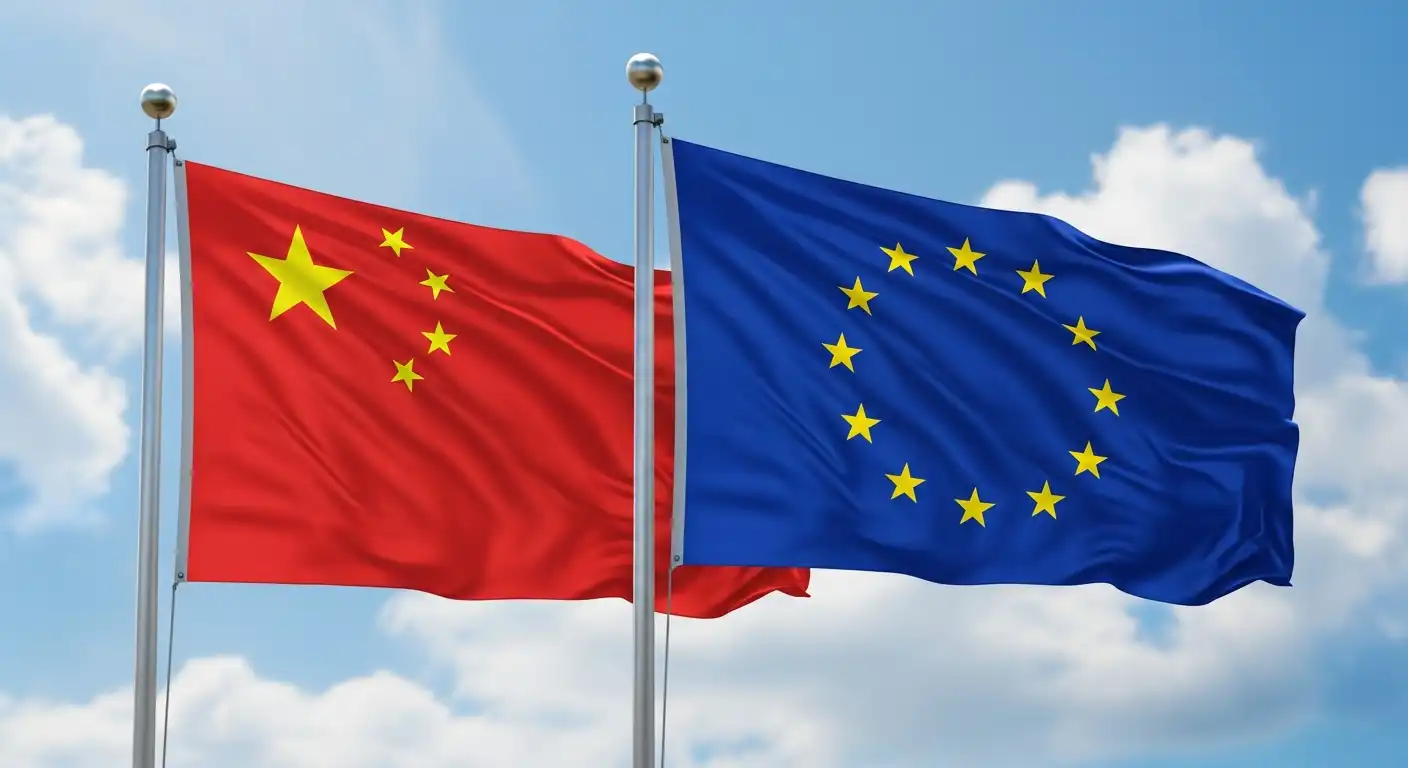
The global trading system is experiencing a rapid, highly volatile fragmentation. For decades, the steady integration of international supply chains has allowed businesses to lower manufacturing costs, access new markets, and drive global economic growth. Today, that old model of open, multilateral trade is breaking down under the weight of rising geopolitical rivalries and industrial protectionism.
The latest and most significant escalation in this global trade conflict is playing out between the world’s largest manufacturing powerhouse, China, and the European Union. Following the EU’s decision to impose steep, anti-subsidy tariffs of up to 38.1% on Chinese-made electric vehicles (EVs), Beijing has warned that the bloc’s protectionist policies risk triggering a full-scale trade war.
In a detailed, highly confident commentary, China’s state broadcaster CCTV declared that the country possesses the economic resilience to easily withstand any potential “trade freeze” with the European Union.
The commentary, published late Saturday through the prominent social media account Yuyuan Tantian, warned that the European Union actually stands to suffer far more from a prolonged trade disruption. By blocking low-cost Chinese clean-tech imports, the EU will inevitably drive up consumer prices, stall its own ambitious decarbonization timeline, and trigger a catastrophic market share collapse for European carmakers who depend on the lucrative Chinese consumer base.
The Geopolitical Context: The High-Stakes EV Tariff Dispute
The trade dispute between Brussels and Beijing represents a critical, high-stakes battle to control the future of the global automotive industry. As vehicles transition from traditional combustion engines to advanced, software-defined electric platforms, the speed and scale of Chinese manufacturers have caught European legacy automakers off guard.
In early June, the European Commission announced the preliminary results of its nine-month anti-subsidy investigation into Chinese electric vehicles. The Commission concluded that Chinese EV makers benefit from unfair state subsidies, allowing them to sell vehicles in Europe at prices that local manufacturers cannot match.
To protect its domestic car industry, the EU announced plans to apply additional countervailing duties of up to 38.1% on Chinese EV imports, on top of the existing 10% import tariff.
Beijing has strongly rejected these allegations, arguing that its clean-tech dominance is the result of rapid technological innovation, efficient supply chains, and intense domestic competition rather than state subsidies. The Chinese Ministry of Commerce (MOFCOM) has characterized the EU’s tariffs as a clear violation of World Trade Organization rules and a naked act of protectionism.
By threatening to restrict trade across a bilateral corridor that handles over €1.5 billion ($1.6 billion) worth of goods every single day, the EU has set off a dangerous, escalatory spiral that threatens to disrupt the entire international economic order.
Decoding the Yuyuan Tantian Commentary: China’s Economic Shield
The commentary published by CCTV’s Yuyuan Tantian account is not a generic, defensive statement. It is a highly analytical, state-sanctioned assessment of China’s structural economic advantages, designed to convince both domestic audiences and global investors that Beijing holds the winning hand in a trade standoff.
Leveraging the Power of a Vast Domestic Market
The primary argument advanced by Chinese state media is the sheer, unmatched scale of China’s own domestic consumer market. Over the past twenty-five years, China’s rapid economic development has created a massive middle class with significant purchasing power.
For major global industries—ranging from German luxury automobiles and French high fashion to Swiss industrial machinery—the Chinese consumer market is not just an export destination; it is the single most important source of corporate revenue and profit growth.
If the European Union proceeds with its trade freeze, Beijing can easily implement retaliatory measures to restrict European companies’ access to its domestic market. This internal demand block would deal a devastating blow to European corporate balance sheets, while China’s vast domestic market can easily absorb its own industrial output, shielding local manufacturers from the impact of European trade barriers.
Strategic Diversification to Southeast Asia and Latin America
The second pillar of China’s defensive strategy is the successful, multi-year diversification of its global trade networks. While the United States and the European Union have historically been China’s largest trading partners, Beijing has spent years actively building deep, highly resilient trade alliances with emerging economies in the Global South.
This diversification strategy has been highly successful. Today, the Association of Southeast Asian Nations (ASEAN) has surpassed both the EU and the US to become China’s largest trading partner, with bilateral trade reaching record volumes.
Additionally, China’s trade with Latin America and Africa has experienced explosive, double-digit growth under the framework of the Belt and Road Initiative.
By directing its high-quality, affordable clean-tech exports—including solar panels, advanced batteries, and electric vehicles—to these fast-growing emerging markets, China can easily offset any decline in export volumes to Europe.
These alternative markets in the Global South are eager to acquire affordable green technologies to power their own industrial developments, providing China with a highly reliable, politically insulated global sales network that completely bypasses Western trade blocks.
The Threat of a Severe European Industrial Slump
While Chinese state media is highly confident in Beijing’s ability to survive a trade freeze, it has issued a highly realistic, sobering warning regarding the severe industrial fallout that European nations will face if they continue on their protectionist path.
The Collateral Damage Facing German Automakers
The primary victims of a U.S.-style European tariff wall will be Europe’s own legacy carmakers, particularly the major German automotive groups, who have built their entire corporate strategies around the Chinese market.
German giants like the Volkswagen Group, BMW, and Mercedes-Benz derive a massive portion of their global revenues and profits from their highly successful joint ventures in China.
These joint ventures are not just sales outlets; they are highly integrated engineering and manufacturing hubs.
If Beijing decides to implement retaliatory tariffs on large-engine gasoline vehicles or restrict European companies’ operating licenses in China, the impact on these German carmakers will be catastrophic.
This vulnerability is already highly visible. Volkswagen is currently preparing a massive, painful restructuring plan to cut up to 100,000 jobs globally and close four of its historic German factories to lower its high operating costs.
At the same time, BMW has had to cut its expected automotive operating margins to historic lows, citing a steep, double-digit sales slump in China.
If a full-scale trade freeze occurs, these struggling European industrial champions will lose access to their most profitable market, accelerating their financial decline, triggering a wave of mass layoffs across Europe, and permanently damaging Germany’s standing as a global industrial leader.
Stalling the European Green Deal and Decarbonization Timeline
The secondary victim of the trade freeze will be the European consumer and the EU’s own ambitious climate goals. Under the European Green Deal, the bloc has committed to cutting its greenhouse gas emissions by 55% by 2030 and achieving full climate neutrality by 2050.
To meet these targets, Europe must rapidly replace millions of fossil-fuel-powered cars with clean, electric vehicles. However, European carmakers are currently unable to manufacture affordable electric cars at scale.
By imposing steep, 38.1% tariffs on low-cost Chinese EV imports, the EU is effectively driving up the price of electric cars for its own citizens, turning what should be an affordable public utility into a luxury good that is out of reach for middle-class families.
Without access to China’s highly efficient, low-cost solar panels, wind turbines, battery cells, and electric vehicles, the cost of Europe’s green transition will skyrocket.
The lack of affordable clean technology will force utility companies to delay their decarbonization projects and keep older, dirtier fossil-fuel power plants online for longer, making it nearly impossible for the EU to meet its binding climate targets and permanently damaging the bloc’s credibility as a global environmental leader.
The Global Rise of Tech-Driven Protectionism
The escalating trade conflict between China and the European Union is not an isolated event. It is part of a broader, highly volatile global trend toward tech-driven protectionism, where national governments are increasingly using trade barriers to protect their domestic technology and industrial bases.
This trend was highlighted in the United States, where the Trump administration has finalized massive, 100% tariffs on Chinese-made electric vehicles and threatened to impose a 100% tariff on any country that levies a digital services tax on American technology firms.
By treating software-defined vehicles, advanced semiconductors, and green technologies as critical national security assets, governments are building deep regulatory walls around their economies.
This rising protectionism has created an incredibly complex, high-risk environment for multinational corporations. Companies can no longer design their products or build their supply chains assuming that global trade will remain free and open.
Instead, they must prepare for a highly fragmented, regionalized market, where changing trade policies, sudden tariff hikes, and national security regulations can instantly make their business models obsolete, forcing them to build localized, highly resilient supply networks to survive.
Beijing Holds the Winning Hand in a Trade Standoff
The detailed commentary published by China’s state broadcaster CCTV via its Yuyuan Tantian account is a powerful, highly realistic warning to European policymakers. By proving that China possesses the economic resilience to easily withstand any potential trade freeze with the European Union, Beijing has signaled that it will not bow to protectionist pressure or accept discriminatory tariffs.
While the EU’s proposed 38.1% countervailing duties aim to protect domestic carmakers from foreign competition, the real-world consequences of these trade barriers will likely be highly damaging to Europe’s own economy.
As struggling industrial giants like Volkswagen prepare for mass layoffs and BMW grapples with a steep Chinese sales slump, the loss of access to the lucrative Chinese market will deal a devastating blow to Europe’s manufacturing base.
At the same time, blocking affordable Chinese green technologies will drive up consumer prices and stall the EU’s own ambitious decarbonization timeline.
As the world’s most powerful manufacturing nation continues to diversify its trade networks toward the fast-growing economies of the Global South, Beijing has shown that it holds the winning hand in a trade standoff.
European leaders must decide whether they want to proceed with a costly, self-destructive trade war or choose a path of pragmatic, open collaboration to secure a stable and sustainable future for global industry.