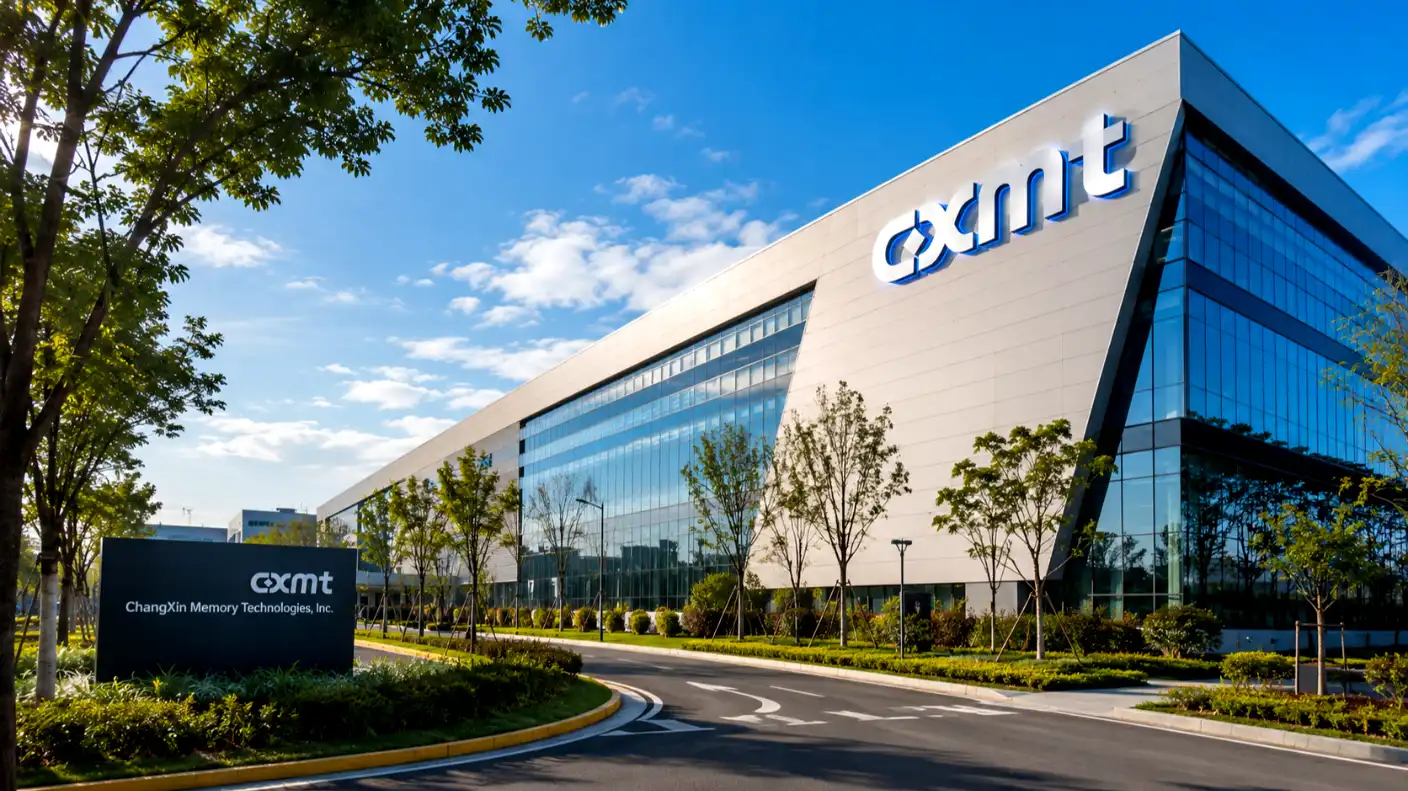
The global semiconductor industry is currently defined by a high-stakes, multi-trillion-dollar race for supremacy. As artificial intelligence architectures continue to scale, the demand for sophisticated memory components—specifically Dynamic Random-Access Memory (DRAM)—has become the primary bottleneck for every major technology conglomerate. Standing at the center of this geopolitical and industrial storm is ChangXin Memory Technologies, the Hefei-based manufacturer that serves as China’s primary, state-backed hope for achieving total semiconductor self-reliance.
Recent market data has highlighted a fascinating, highly consequential valuation gap for the chipmaker. Following its massive initial public offering on the Shanghai STAR Market, which raised approximately $8.55 billion, analysts have begun comparing the company’s market capitalization against the multi-trillion-dollar valuations of Western and East Asian semiconductor champions. This valuation divide is not merely a statistical curiosity; it serves as a precise, numbers-driven indicator of the immense geopolitical and technical risks currently strangling China’s domestic chip ambitions. Investors are now forced to weigh the massive, state-sponsored growth potential of the firm against the brutal, unforgiving realities of U.S.-led export controls and advanced lithography supply chain blockades.
This analysis delves into the structural chasm between China’s domestic memory powerhouse and the established global leaders. While ChangXin Memory Technologies has achieved rapid, highly visible domestic success, the road to closing the valuation gap with industry giants like Samsung Electronics, SK Hynix, and Micron Technology requires far more than just domestic political support. It demands the mastery of sub-10-nanometer manufacturing processes, the creation of a reliable, high-yield advanced packaging ecosystem, and the ability to survive in a global marketplace where Western regulatory barriers are increasingly becoming the default state of play.
The Architecture of the Trillion-Dollar Memory Gap
The valuation gap separating ChangXin Memory Technologies from global memory leaders is rooted in a fundamental disparity in manufacturing maturity. To achieve a valuation that rivals international memory giants, a company must demonstrate its ability to produce cutting-edge DRAM nodes—such as the 1-alpha, 1-beta, and 1-gamma architectures—at a volume of millions of units per month with near-perfect yield. These advanced nodes are essential because they provide the density, power efficiency, and speed required by modern artificial intelligence accelerators and high-performance server processors.
ChangXin Memory Technologies has made commendable, state-supported progress in catching up to the global frontier. However, independent industry audits suggest that the firm still operates roughly three to four years behind the manufacturing nodes currently deployed by its Korean and American competitors. This technological lag forces the Chinese firm to rely on more mature, lower-density manufacturing processes, which limits its ability to compete for the high-end, high-margin orders from major AI hardware developers. As long as this technology gap persists, global institutional investors will continue to assign a significant “innovation discount” to the company’s equity, keeping its valuation well below the levels seen in more advanced international competitors.
Scaling Through State-Sponsored Infrastructure
The sheer financial commitment behind the firm’s attempt to close this gap is staggering. The Hefei-based manufacturer is the centerpiece of a massive, government-funded industrial cluster designed to create an independent memory ecosystem. By securing $8.55 billion in its public market debut, the company has built a financial war chest that allows it to bypass the traditional, multi-year capital-raising cycles that plague smaller startups. This capital is being deployed immediately into the construction of third and fourth-generation fabrication plants, the acquisition of advanced automated etching tools, and the recruitment of elite engineering talent from around the world.
State ownership provides an operational safety net that does not exist in the private, competitive memory markets of South Korea or the United States. If the company faces a temporary, cyclical downturn in memory pricing—a common, painful feature of the highly volatile DRAM sector—it does not need to worry about investor panic or short-term share price dilution. Instead, it can rely on further capital injections from state-backed industrial investment funds, known colloquially as the “Big Fund,” to keep its fabrication plants running at full capacity, maintain its workforce, and continue its aggressive research and development programs until the market cycle inevitably turns.
The Geopolitical Constraints on Advanced Lithography Tools
The most significant barrier preventing ChangXin from closing the valuation gap is the global regulatory environment surrounding advanced manufacturing equipment. Modern memory chips with a node size of 10 nanometers or smaller cannot be printed without using extreme ultraviolet lithography systems, a highly complex technology controlled exclusively by the Dutch firm ASML. Under the current, strict international export control regime, Western nations have effectively blocked the sale of these advanced machines to Chinese foundries, viewing the technology as a critical, dual-use asset that could easily be weaponized for military modernization.
This supply chain blockade forces the Chinese manufacturer to rely on older, less efficient Deep Ultraviolet lithography systems. To print circuit features that should technically require EUV machines, engineers must employ highly complex, multi-patterning techniques that drastically increase the number of physical steps required to manufacture a single silicon wafer. This process significantly increases the manufacturing cost, lowers the production yield, and limits the overall performance of the finished chips. Until domestic Chinese equipment manufacturers can develop their own, viable alternatives to ASML’s advanced lithography tools, the firm will continue to face a systemic, physical ceiling on its manufacturing capabilities, leaving it at a structural disadvantage compared to foreign rivals who enjoy unrestricted access to the world’s most advanced lithography systems.
The AI Hardware Buildout and the Shift in Memory Demand
The global artificial intelligence revolution has completely redefined the economics of the memory market. Two years ago, the demand for memory was driven by cyclical, relatively stable categories like personal computers, smartphones, and automotive electronics. Today, the sector is dominated by a completely new, insatiable category: High Bandwidth Memory, or HBM. These specialized, high-capacity memory stacks are the critical, non-negotiable bottlenecks for training generative artificial intelligence models.
The current artificial intelligence infrastructure buildout requires a massive increase in total memory capacity. Because frontier-class reasoning models must access hundreds of billions of parameters in a fraction of a second, the industry requires memory architectures that can deliver data at speeds several orders of magnitude higher than traditional DDR5 modules. This HBM supercycle is currently generating the highest profit margins in the history of the memory industry, allowing companies like SK Hynix and Micron Technology to generate record-breaking revenues while their manufacturing facilities operate at near-total capacity.
Capturing the High-Bandwidth Memory Pipeline
ChangXin Memory Technologies is racing to build its own domestic HBM capability to participate in this highly lucrative market. The company understands that it cannot achieve a multi-hundred-billion-dollar valuation without becoming a primary supplier of the memory stacks that Nvidia, Broadcom, and other global AI hardware designers require. By investing the proceeds from its $8.55 billion offering into advanced vertical-stacking and thermal-compression-bonding research, the firm is trying to leapfrog the traditional DRAM node progression and establish a leadership position in the next generation of HBM.
This pivot toward HBM is essential for the company’s long-term commercial survival. As the global data center economy continues to mature, the price gap between generic, commodity DRAM and specialized, high-performance HBM will only widen. If the Chinese firm can demonstrate that its domestic HBM products meet the quality, speed, and thermal stability requirements of Western-designed artificial intelligence hardware, it could easily capture massive, recurring contracts from local Chinese cloud giants and international data center operators, effectively bypassing the competitive stagnation of the commodity memory market.
Domestic Supply Chain Resilience as an Economic Moat
The company’s ability to build and scale its own, independent memory supply chain acts as its most important strategic moat. The firm is not just building fabrication plants; it is actively cultivating a domestic network of chemical suppliers, mask designers, and specialized testing laboratories. By fostering these close, geographical partnerships, the company creates a highly efficient, localized innovation loop. If a design flaw appears on a new 1-gamma memory node, the engineers can consult with their local materials suppliers in the same afternoon to swap out a chemical precursor or adjust the etching gas ratio, drastically reducing the time required to iterate and improve manufacturing yields.
This regional concentration is a significant competitive advantage in an era of global shipping disruptions and geopolitical instability. Because the entire manufacturing process—from raw design to final, packaged product—occurs inside the domestic borders of the same national economy, the firm remains completely immune to the port strikes, maritime blockades, and export embargoes that frequently paralyze the operations of its international rivals. For Chinese hardware customers who value absolute supply chain predictability above all else, this regional manufacturing model is highly attractive, ensuring the company can generate steady, high-margin revenue regardless of the wider geopolitical temperature.
Navigating the Competitive Landscape: The Oligopoly of Memory
To evaluate where the stock’s valuation may trade in the future, investors must understand the unique, highly concentrated oligopoly that defines the global DRAM market. For decades, the memory industry has been controlled by a tiny group of three giant manufacturers—Samsung Electronics, SK Hynix, and Micron Technology—who together hold over 90 percent of the global market share. This high level of concentration allows these companies to practice what analysts call “rational supply management.”
When the market demand for memory weakens, these giants can collectively decide to slash their production capacity, reducing the global supply of chips to prevent price collapses. This collaborative price-management strategy ensures that even during periods of cyclical softness, these manufacturers can maintain their high-margin profit structures and protect their stock valuations. ChangXin Memory Technologies is currently the primary challenger to this global oligopoly. Its aggressive, low-price expansion strategy is designed to capture market share from these entrenched giants, but its success will inevitably trigger a defensive price war that will squeeze the profit margins of every memory chip manufacturer, including the market incumbents themselves.
The Samsung and SK Hynix Competitive Response
South Korean memory giants Samsung and SK Hynix are highly cognizant of the threat posed by the rapid scale-up of Chinese competitors. Both companies have launched massive, multi-billion-dollar R&D programs focused on maintaining their technological lead in high-stack 3D DRAM and advanced HBM architectures. They are leveraging their deep experience in micro-fabrication and their massive existing patent libraries to stay at the absolute frontier of semiconductor innovation, making it incredibly difficult for newer market entrants to close the performance gap.
Furthermore, these Korean incumbents possess decades of deep, entrenched relationships with the world’s most powerful cloud hyperscalers. The trust, quality assurance, and long-term supply guarantees provided by Samsung and SK Hynix are considered the “gold standard” by Western technology giants, creating a psychological and operational barrier that any new entrant must overcome to secure a seat at the table.
For the Chinese firm to successfully close the valuation gap, it must prove that its manufacturing yield, product reliability, and supply-chain stability are not just “good enough” for domestic consumption, but are fully on par with the international best-in-class standards required by global technology companies.
The Pricing Power Paradox of the Modern Semiconductor Era
The core tension in the memory sector is determining who holds the ultimate pricing power: the manufacturer who prints the silicon or the technology designer who creates the artificial intelligence architecture. While the foundry giants are currently experiencing a windfall due to the AI supercycle, this pricing power is inherently transient.
It exists only as long as the demand for advanced compute capacity exceeds the available global manufacturing supply.
If the current, aggressive expansion of fabrication facilities in the United States, Japan, and Taiwan leads to a massive, global oversupply of memory chips, the resulting price war will be devastating for every participant in the sector, leading to sharp, double-digit contractions in operating margins.
The successful semiconductor leaders of the future will be those who can maintain their pricing power even when the market enters a state of oversupply, through highly specialized technology, superior manufacturing yields, and a defensible, locked-in client base.
Long-Term Sustainability and the Valuation Re-Rating
The historic $8.55 billion IPO serves as the starting gun for the company’s next phase of existence. As the firm transitions from a state-subsidized startup to a publicly traded market leader, it must satisfy the demanding financial requirements of public shareholders. The “innovation discount” that currently depresses its market valuation will only disappear when the firm can prove that it has permanently exited the research phase and entered a period of consistent, repeatable, and high-margin operational excellence.
Analysts suggest the company’s path to re-rating involves three distinct stages: achieving manufacturing parity with global memory nodes, securing long-term supply contracts with major, non-domestic technology leaders, and demonstrating absolute, independent profitability without relying on continued state-backed liquidity injections.
Achieving these milestones will be an incredibly difficult, multi-year process that will test the company’s engineering discipline, its financial transparency, and its ability to navigate the shifting currents of global semiconductor geopolitics.
For global investors, the Chinese memory market presents a fascinating, highly complex opportunity. It is a sector defined by massive, structural demand, deep government involvement, and absolute technological necessity. While the geopolitical and regulatory risks are significant, the opportunity to participate in the growth of the largest semiconductor project in history is a compelling prospect for any portfolio.
As the company scales its fabrication output, innovates at the atomic layer of its memory architectures, and asserts its presence on the global stage, it will challenge the traditional rules of the chip industry, proving that the future of computing will be dictated by whoever can manufacture the silicon that runs the world’s most sophisticated and intelligent digital systems.