Step into downtown Los Angeles’s cultural district, and you will find a massive shift in how humanity experiences art. The opening of DATALAND, the world’s first museum of artificial intelligence arts and digital ecosystems, marks a milestone in contemporary culture. Located inside the stunning Frank Gehry-designed Grand LA complex, this permanent museum offers an immersive experience that blends machine intelligence, environmental science, and artistic expression. Spanning roughly 2,300 square meters—or about 20,000 square feet—the museum features five custom-built galleries designed to turn cold, calculated data into a warm, multisensory human experience.
Founded by pioneering media artist Refik Anadol and cultural researcher Efsun Erkilic, DATALAND rejects the passive viewing experience of traditional museums. Here, visitors do not simply look at static paintings on a wall. Instead, they step directly into a living digital ecosystem. Upon entry, guests receive wearable sensors that measure their physiological signals, turning their biological presence into an active participant in the artwork. Visual, auditory, and olfactory elements throughout the museum shift continuously in response to real-time data streams and human movement.
The grand opening of this unique space highlights how quickly generative technology is transforming creative fields. While public anxiety grows over whether computer software might eventually replace human artists, the team behind DATALAND offers a different vision. They showcase how human-machine collaboration can expand our understanding of both natural ecosystems and digital futures. Through years of research, custom software development, and global partnerships, the founders have created a cultural hub that redefines what a museum can be.
DATALAND Redefines Art Through Machine Collaboration
For more than a decade, Refik Anadol Studio has pushed the boundaries of digital art. The studio, which grew from a small project into a 20-person team representing 10 different countries and speaking 12 languages, has consistently explored the creative potential of machine learning. Their signature technique involves taking massive datasets and using machine learning models to synthesize them into fluid “data paintings” and “data sculptures”. At DATALAND, this technique moves beyond single projections to take over entire rooms.
The five galleries utilize state-of-the-art visual technology, including massive three-dimensional LED screens and custom spatial sound systems, to envelop the audience. The objective is to make the invisible layers of our world visible. By translating raw digital information into vibrant streams of light and sound, the museum challenges visitors to reconsider how they perceive the flow of information in their daily lives.
How Data Becomes Pigment in Five Galleries
Traditional cultural institutions preserve the past by displaying static objects frozen in time. In contrast, DATALAND acts as a platform for living art. The installations never repeat the exact same sequence twice. This dynamic nature relies heavily on custom software developed by a multi-disciplinary team of artists, computer scientists, and environmental researchers.
The team views the computer not as a tool for automation, but as a true creative partner. By feeding high-performance algorithms ethically sourced information, the artists allow the machine to generate unexpected visual interpretations. This collaborative process yields complex, shifting geometries that feel organic rather than computer-generated. Visitors watch as digital patterns mimic the flow of water, the movement of wind, or the growth of plants, bridging the gap between the artificial and the natural.
Machine Dreams Explores the Natural World with the Large Nature Model
The inaugural exhibition, “Machine Dreams: Rainforest,” takes visitors on an extraordinary journey through the world’s most vital ecosystems. This exhibition is powered by the Large Nature Model (LNM), the world’s first open-source generative AI model devoted entirely to nature. Refik Anadol Studio trained the LNM on massive nature datasets to ensure the digital representation of the rainforest remains highly accurate.
To build this model, the studio partnered with prestigious scientific and cultural institutions, including the Smithsonian Institution, the London Natural History Museum, and the Cornell Lab of Ornithology. The team also traveled directly to 16 distinct rainforest environments around the world to collect data firsthand. Using advanced tools like LiDAR, photogrammetry, and specialized audio arrays, they captured the sights, sounds, and structural details of these environments with extreme fidelity.
Training the Large Nature Model on 1.5 Billion Pixels
Creating an AI model that can dream of a rainforest requires massive computational power and an unprecedented amount of data. The Large Nature Model processes over half a billion ethically sourced images and sound recordings, translating them into approximately 1.5 billion pixels of high-definition visual output. This extensive dataset allows the AI to understand the complex structural relationships between various plants, animals, and fungal networks.
During the exhibition, the system utilizes this training to render real-time landscapes that shift and morph dynamically. The squawks of macaws, the heavy rustle of canopy leaves, and the visual patterns of tropical flora evolve based on the audience’s proximity and engagement. Rather than presenting a simple pre-recorded loop, the galleries display the AI’s continuous, real-time interpretation of a living forest. This interactive framework invites the public to reflect on the fragility of global biodiversity and the urgent need for environmental conservation.
Smart Sensors and the Connectome Drive Interactive Art
The interactive experience at DATALAND goes far beyond typical motion-activated displays. Every visitor wears a specialized, medical-grade, watch-like device upon entering the museum. These wrist sensors monitor physiological changes in real time, including heart rate, skin temperature, and subtle galvanic skin responses reflecting emotional changes.
At the same time, wall-mounted sensors and camera tracking systems monitor physical movement and spatial positioning throughout the five galleries. To make the immersion truly omni-sensory, visitors also carry a portable scent diffuser that releases custom-developed aromas of wet earth and tropical flora designed to match the visual scenes.
Mapping the Connectome: The Brain of the Museum
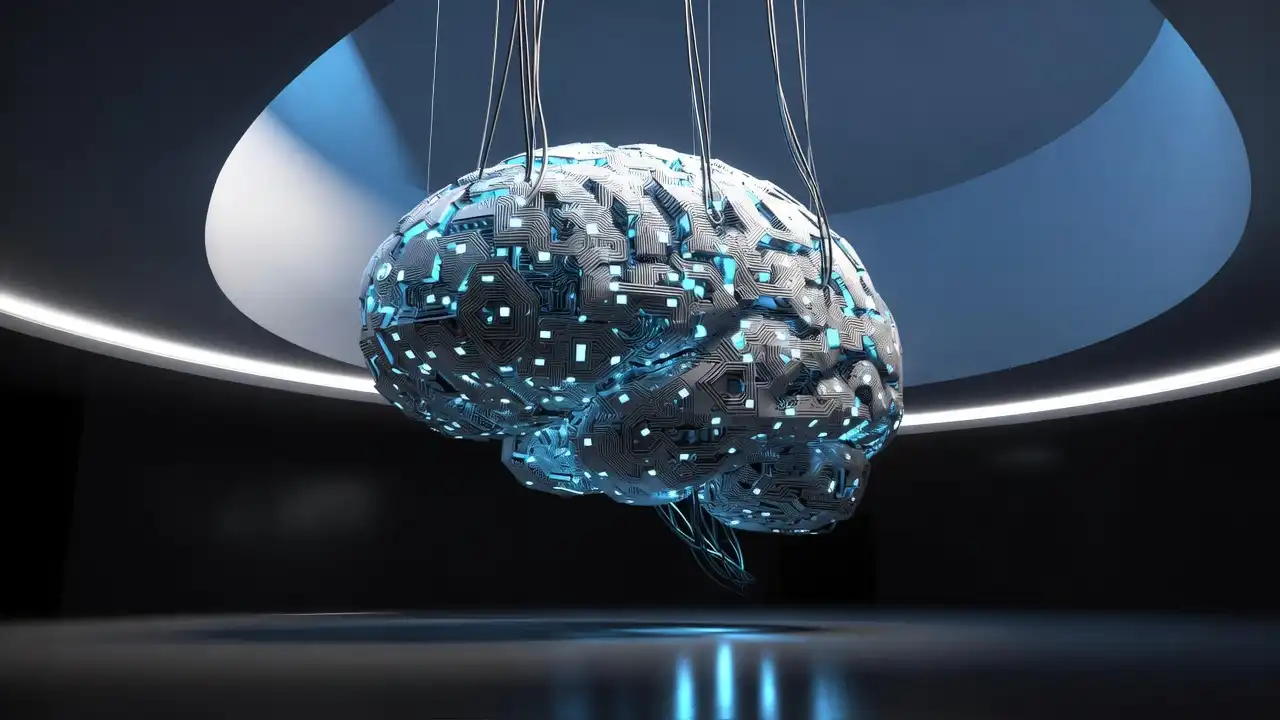
The true technical innovation of DATALAND lies in its persistent digital memory system, known as the Connectome. In most digital art exhibitions, the projection software resets after each cycle or when a new visitor enters the room. The Connectome eliminates this limitation by establishing a persistent, building-wide memory that links the visitor’s physiology to the artwork.
By saving and processing the aggregated biological and physical data of thousands of visitors, the Connectome acts as a centralized brain for the entire museum. As visitors move through the rooms, their collectively generated reactions slowly guide the evolution of the machine-learning models. Over days and weeks, the colors, tempos, and soundscapes of “Machine Dreams: Rainforest” undergo permanent, subtle shifts. This means that a visitor returning to the museum a month later will experience a noticeably different version of the artwork, reflecting the shared human journey that occurred in the interim.
The Engineering Powerhouse: 10 Million Lines of Code
Building a permanent museum of this scale required an extraordinary engineering effort. Over 10 million lines of custom code were written to power the museum’s software architecture. The project was in development for three full years by a dedicated, multi-disciplinary team at Refik Anadol Studio, working at the intersection of art, science, and computer engineering.
Running real-time generative models with 1.5 billion pixels requires immense computing power. To achieve this, the studio partnered with Google Cloud to handle massive machine-learning pipelines remotely. Meanwhile, on-site NVIDIA DGX stations and advanced GPUs handle the real-time, high-frame-rate rendering across the museum’s custom 3-dimensional LED sculptures.
Google Cloud and NVIDIA Fuel the Digital Ecosystem
The partnership with major tech firms highlights how the boundary between software engineering and creative art is disappearing. The 10 million lines of code written for DATALAND do not just run background scripts; they function as the brushes, pigments, and canvas of the modern era. By optimizing these codebases to run with low latency, the engineers ensured that the machine’s dreams react instantly to a human heartbeat, creating a seamless loop between biological life and machine logic.
In addition, Google Arts & Culture supported the initiative to help document the process and make the ethical datasets accessible to a global audience. By utilizing Google Cloud’s scalable infrastructure, the studio can run complex computational models that would otherwise be impossible to operate in a real-time museum setting.
Navigating the Ethical AI Debate in Creative Fields
The launch of DATALAND occurs against a backdrop of intense global debate regarding the ethics of generative artificial intelligence. Many artists and creators fear that massive commercial models trained on scraped web data will devalue human labor and replace traditional craftsmanship.
Refik Anadol Studio addresses these concerns directly by championing “ethical AI”. Unlike large language and image models that scrape intellectual property without permission, the Large Nature Model is trained exclusively on ethically sourced, public-domain, or partner-provided ecological data. By maintaining strict control over its datasets, the studio proves that advanced generative models can respect intellectual property while pushing the boundaries of creativity. The founders emphasize that the museum’s purpose is human-machine collaboration, keeping human intent and artistic curation at the absolute center of the digital ecosystem.
The Dawn of the Living Museum
DATALAND represents a major shift in how society interacts with art and technology. By moving beyond static exhibitions and embracing a living, responsive digital ecosystem, the founders have established a new model for 21st-century cultural institutions. The success of the “Machine Dreams: Rainforest” exhibition shows that the public is eager to engage with technology in a way that feels organic, sensory, and deeply connected to the natural world.
As artificial intelligence continues to reshape every aspect of human life, spaces like DATALAND will play a critical role in demystifying these powerful technologies. Rather than fearing the rise of machine intelligence, visitors are invited to see it as a mirror reflecting our own biology and the delicate ecosystems of the planet we inhabit. By combining art, science, and engineering, the museum opens a door to a future where technology does not alienate us from nature, but helps us appreciate its magic with the wonder of a child.