Key Points:
- United States President Donald Trump traveled to Beijing for a 3-day summit with Chinese President Xi Jinping.
- Trump wants China to buy more American farm products and Boeing airplanes ahead of the November elections.
- The leaders will discuss the ongoing United States and Israeli war on Iran and the closed Strait of Hormuz.
- The meeting agenda also covers Taiwan’s security, the artificial intelligence competition, and North Korean diplomacy.
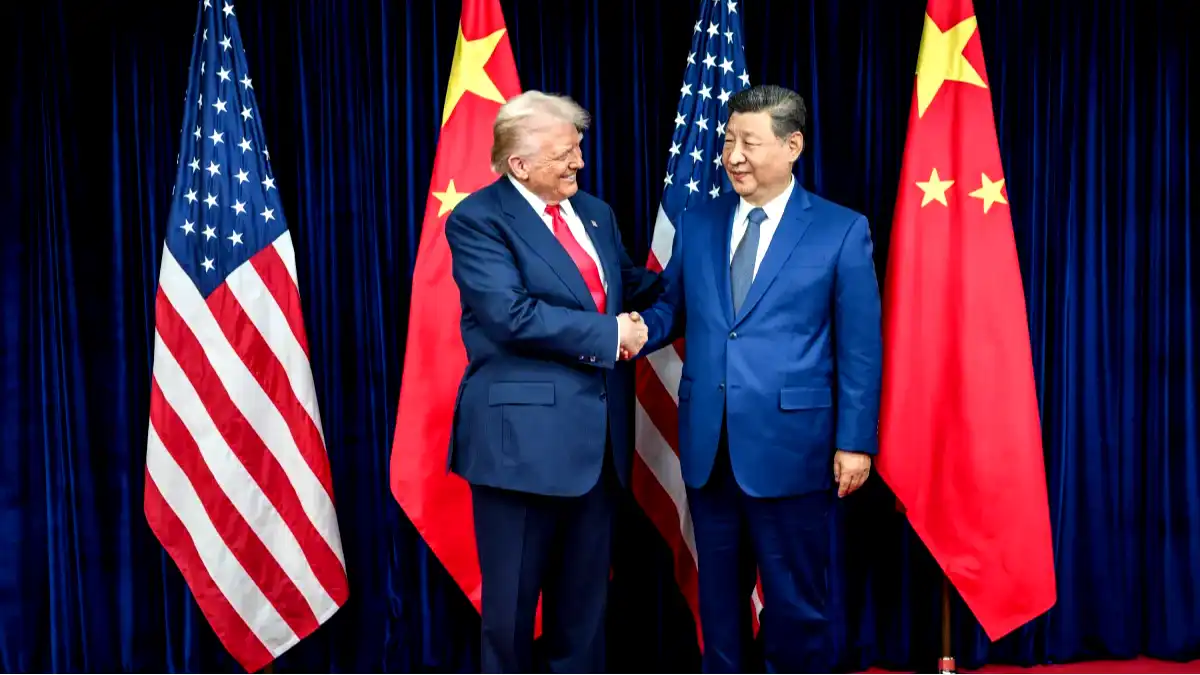
United States President Donald Trump and Chinese President Xi Jinping sit down for high-stakes summit talks in Beijing this Thursday. The two world leaders plan to tackle massive global issues, including international trade, the ongoing United States and Israeli war on Iran, the security of Taiwan, and intense technological competition. Following a grand welcome ceremony at the famous Great Hall of the People, the presidents will dive straight into these heavy topics. The entire international community watches this meeting closely because these decisions carry massive economic and security consequences.
Trump landed in the Chinese capital on Wednesday evening to kick off his 3-day visit. This journey marks his very first official trip to China since November 2017. He arrives at a critical moment for global security. Peace talks between the United States and Iran currently remain completely stalled. Trump desperately wants to find an exit from the months-old Middle East war and find a way to reopen the Strait of Hormuz for international shipping safely.
The two presidents last spoke face-to-face in Busan, South Korea. They met on the sidelines of the Asia-Pacific Economic Cooperation summit and hammered out a temporary deal. During that previous meeting, Trump and Xi agreed to a strict 1-year trade truce. This agreement aimed to reduce existing tariffs and prevent both countries from imposing any new trade restrictions. For example, China agreed to suspend its harsh export limits on highly valuable rare earth elements.
Before boarding his flight to China, Trump made it clear that trade is at the very top of his priority list. The American president wants to secure massive, tangible economic wins before American voters head to the polls. He hopes a strong trade deal will boost voter confidence ahead of the crucial United States midterm elections scheduled for November.
To achieve this economic win, Trump plans to demand concrete purchasing commitments from the Chinese government. He specifically wants China to buy massive amounts of American farm products. American farmers hope to export millions of tons of soybeans and beef directly to Chinese markets. Trump also wants China to place large orders for expensive Boeing aircraft and the specialized mechanical components needed to build them.
Beyond trade, the violent conflict in the Middle East will dominate the conversation. Trump actively seeks a fast exit from the ongoing war with Iran. The fighting completely paralyzed the Strait of Hormuz, one of the most important shipping lanes on the planet. Reopening this narrow waterway remains vital to the global economy because it allows large cargo ships to transport crude oil, agricultural fertilizer, and other essential commodities worldwide.
China shares this deep anxiety over the war in the Middle East. The Chinese economy relies heavily on a constant flow of foreign energy. The massive disruptions to commercial shipping in the Strait of Hormuz seriously threaten China’s daily energy supplies. To protect itself, the Chinese government currently maintains massive strategic oil stockpiles and rapidly builds alternative energy sources. However, the prolonged war still poses dangerous long-term economic risks for the world’s 2nd-largest economy.
When the conversation shifts away from the Middle East, the two leaders will clash over Taiwan’s security. China firmly views the self-governing democracy as a permanent part of its own territory. The United States continues to support Taiwan, creating a constant source of tension between the two superpowers. In addition, Trump and Xi will debate their fierce, ongoing technological competition, with a focus on the rapidly growing field of artificial intelligence.
Political experts also expect the two leaders to discuss the situation in North Korea. Trump recently expressed a strong desire to restart his diplomatic relationship with North Korean leader Kim Jong-un. Because China maintains steady diplomatic and economic exchanges with Pyongyang, Xi holds significant influence over the North Korean government. Trump likely wants Xi to help facilitate a new round of peace talks.
After they finish their heavy political discussions, the two leaders will switch to cultural events. The president plans to visit the historic Temple of Heaven park, a massive imperial complex located in central Beijing. Later on Thursday evening, Trump will attend a formal state banquet hosted by the Chinese government.
The diplomatic trip wraps up on Friday morning. Trump and Xi will share a traditional tea service and sit down for one final working luncheon. After this final meal, the American president will board his plane and head back home to the United States.
This week’s crucial summit is just the first of a series of planned meetings between Trump and Xi this year. The two leaders expect to hold more bilateral talks in the coming months. They plan to meet again on the margins of the Asia-Pacific Economic Cooperation summit in Shenzhen, China, this November. One month later, they will gather for the Group of 20 summit in Florida in December.