Key Points:
- Elon Musk is speaking virtually at ASML’s private tech conference to outline his Terafab chip plan.
- The presentation occurs as SpaceX prepares for its historic public market debut under the ticker symbol SPCX.
- The proposed $55 billion-$119 billion Terafab joint venture aims to manufacture chips for SpaceX and Tesla.
- ASML holds a global monopoly on the Extreme Ultraviolet lithography machines required to make these advanced chips.
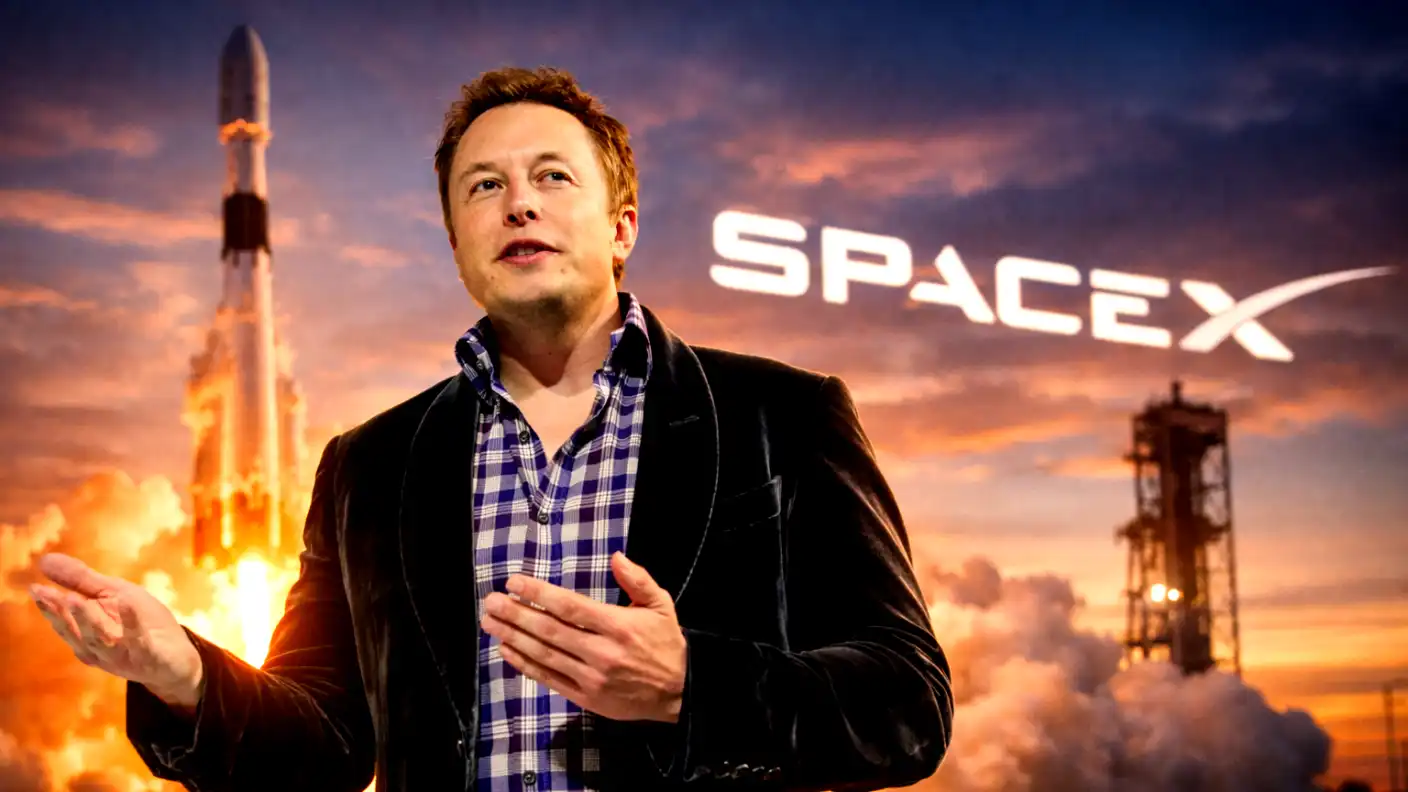
Elon Musk will appear virtually at an internal technology conference hosted by computer chip equipment giant ASML to present his ambitious plans for a massive semiconductor factory. The high-profile appearance comes at a critical moment, occurring just as Musk’s space exploration company, SpaceX, prepares for its historic public market debut. Musk intends to pitch the “Terafab” concept—a giant advanced chipmaking plant designed to feed the growing computing appetites of his industrial empire. By presenting directly to the engineers of the world’s leading chip-tool supplier, Musk wants to secure a vital partnership that could reshape his companies’ hardware capabilities.
The timing of the presentation is highly strategic, aligning with what could become the largest initial public offering in stock market history. Underwriters expect to price the historic SpaceX initial public offering on the Nasdaq exchange under the ticker symbol SPCX. The massive public offering aims to sell 555.6 million shares at $135 per share, raising approximately $75 billion in fresh capital. If successful, the public listing will push SpaceX’s valuation to a staggering $1.75 trillion. This public market debut will transform Musk into the head of two separate trillion-dollar enterprises, giving him immense financial leverage to fund future deep-tech projects.
A substantial portion of the capital raised from the public debut could eventually support the Terafab project. Musk plans to construct the colossal semiconductor manufacturing facility in Texas through a joint venture involving SpaceX, Tesla, and Intel. Preliminary cost estimates for building out the manufacturing complex range from $55 billion to $119 billion, reflecting the immense technical complexity of advanced chip fabrication. If realized, the factory could eventually double the total semiconductor manufacturing output of the United States, giving Musk’s enterprises a secure, local supply of proprietary silicon.
Musk’s companies have developed an insatiable appetite for advanced computing hardware, driving this aggressive move toward vertical integration. SpaceX needs a vast, uninterrupted supply of microchips to support its ambitious orbital data center program, which aims to deploy up to one million servers into low Earth orbit. Simultaneously, Tesla requires high-performance processors to power its autonomous driving software and run the neural networks of its Optimus humanoid robots. Rather than relying on third-party foundries that face constant geopolitical and capacity bottlenecks, Musk wants to control the entire microchip supply chain in-house.
However, building advanced semiconductor factories is impossible without the specialized machines manufactured by Netherlands-based ASML. The company is Europe’s largest technology firm by market capitalization and holds an absolute global monopoly on extreme ultraviolet lithography systems. These bus-sized machines use laser-generated light to print microscopic circuits onto silicon wafers, serving as the gatekeepers of cutting-edge computing. Musk recognized the company’s absolute importance to his plans, writing on social media that ASML is arguably the greatest company in Europe and that governments should treasure and support it.
The private technology conference will feature a virtual fireside chat between Musk and ASML’s newly appointed Chief Executive Officer, Christophe Fouquet. The virtual event is an internal, employee-only conference where engineers share technical innovations and breakthrough designs. The ASML spokesperson confirmed that Musk will share his expansive vision regarding artificial intelligence, robotics, space exploration, and advanced semiconductor manufacturing during the closed-door session. While some ASML employees have reportedly expressed mixed feelings about Musk’s appearance, the executive team views the collaboration as a valuable partnership.
Industry analysts emphasize that while the Terafab project represents a massive long-term opportunity, it will not instantly boost ASML’s near-term order book. The initial phase of the Texas project focuses primarily on building a development plant to manufacture lithography masks, which chipmakers use as stencils during the printing process. This means the multi-billion-dollar orders for actual ASML lithography machines will likely materialize only if prototyping successfully transitions to high-volume production. Nevertheless, the collaboration gives ASML incredible visibility into the future computing demands of the aerospace and robotics sectors.
By establishing direct ties with ASML on the eve of the SpaceX public listing, Musk is sending a clear signal to global investors. He is demonstrating that SpaceX is no longer just a rocket launcher or a satellite internet provider, but an integrated leader in the global war over artificial intelligence and physical computing. By tying his space ambitions directly to local semiconductor manufacturing and advanced robotics, Musk is building a highly resilient, self-sustaining technological ecosystem. The success of this massive chip gamble will ultimately dictate whether his vision of space-based data networks and humanoid automation can become a reality.