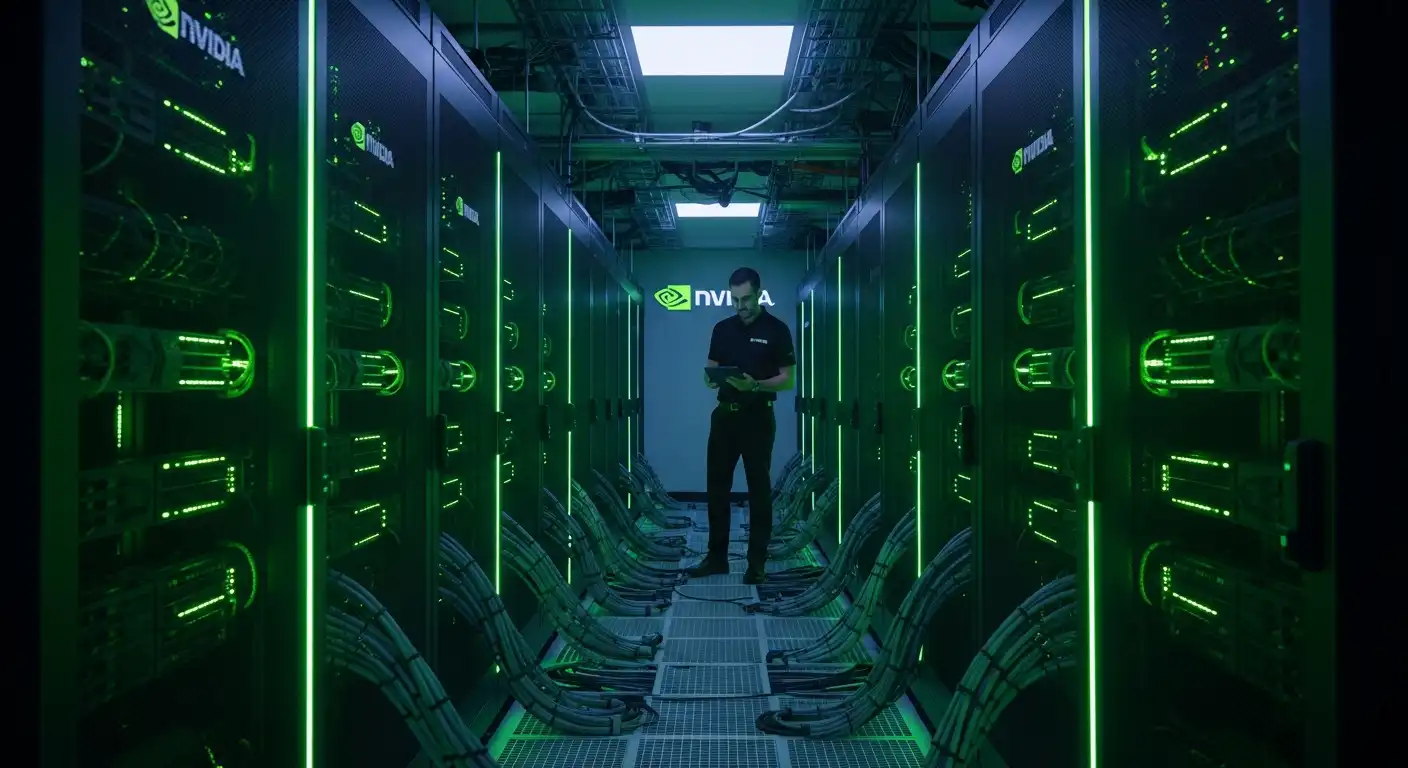
Digital infrastructure leader Equinix has expanded its strategic collaboration with semiconductor powerhouse Nvidia and open-source platform Together AI to launch the Equinix Inference Exchange, a distributed artificial intelligence platform engineered to power real-time enterprise model serving. The commercial initiative marks a major evolution in how corporations deploy, manage, and scale generative artificial intelligence, positioning the world’s largest data center real estate investment trust at the center of the enterprise computing boom.
The strategic partnership arrives as Equinix experiences an extraordinary financial surge. Shares of the Redwood City, California-based infrastructure giant have climbed by 33% over recent trading cycles, lifting the company’s total equity market capitalization toward the $100 billion threshold. By combining Nvidia’s enterprise reference architectures, Together AI’s high-speed inference engine supporting more than 200 open-source foundation models, and Equinix’s global network of 281 interconnected data centers across 77 metropolitan markets, the platform provides Fortune 500 enterprises with an alternative to renting closed-source software from centralized cloud hyperscalers.
The launch of the Inference Exchange, scheduled for commercial deployment in early 2027 alongside the rollout of the Equinix Fabric One interconnection mesh, represents a calculated shift in data center economics. While public attention has focused heavily on massive, multi-gigawatt rural facilities built to train multi-trillion-parameter foundation models, the daily operating expenses of the artificial intelligence economy reside in inference: the real-time processing of user prompts, image generation, and automated business workflows. By placing high-performance computing clusters in urban centers directly adjacent to corporate data repositories, Equinix is carving out a highly profitable niche that bypasses regional electrical grid bottlenecks and satisfies strict corporate data sovereignty mandates.
A Strategic Expansion into Distributed Enterprise AI Inference
The collaboration between Equinix, Nvidia, and Together AI reflects the changing infrastructure requirements of enterprise software. During the initial wave of the generative artificial intelligence boom, technology companies concentrated computing power in remote, monolithic supercomputing centers. These warehouse-sized facilities were ideal for training massive foundation models over months of uninterrupted compute runs.
However, as global corporations transition from experimental research into live commercial production, centralized training architectures create severe operational hurdles. Serving millions of daily user queries from distant server farms introduces latency delays, inflates cloud bandwidth egress fees, and exposes proprietary corporate data to public network vulnerabilities.
Equinix Chief Executive Officer and President Adaire Fox-Martin highlighted this infrastructure shift, explaining that the physical location where inference runs has become a defining strategic choice for modern enterprises.
By decentralizing artificial intelligence compute across major metropolitan business corridors, Equinix allows corporate clients to run advanced reasoning models locally with sub-millisecond response times.
The initiative establishes a turnkey software-and-hardware ecosystem. Rather than purchasing complex hardware components and assembling private server racks from scratch, corporate clients can deploy pre-validated Nvidia computing clusters that integrate directly into existing enterprise networks with minimal administrative friction.
Unpacking the Equinix Inference Exchange and Together AI Integration
The Equinix Inference Exchange functions as an integrated, carrier-neutral execution environment designed specifically for high-throughput model serving. The service combines physical data center colocation with specialized software orchestration to optimize token generation speeds.
The technical architecture of the exchange incorporates several core capabilities:
- Deploying Nvidia’s full-stack enterprise computing systems, including high-density graphics processors, BlueField data processing units, and high-speed Spectrum-X networking fabrics.
- Integrating Together AI’s specialized inference engine, which utilizes custom GPU kernels to double token generation speeds on open-source foundation models.
- Supporting more than 200 open-source and open-weight model architectures, including Meta’s Llama series, Mistral AI platforms, and Alibaba’s Qwen models.
- Enabling hybrid multi-cloud routing through Equinix Fabric, allowing enterprises to connect private on-premises servers directly to major public clouds.
This modular software stack ensures that corporate engineering teams can swap model checkpoints, adjust temperature parameters, and fine-tune models on private corporate data without rebuilding underlying server infrastructure.
Equinix Stock Surges 33% as Market Cap Touches $100 Billion
Public equity markets responded enthusiastically to Equinix’s artificial intelligence roadmap. The company’s stock advanced by 33%, outperforming broader real estate and technology indexes and establishing Equinix as the most valuable pure-play digital infrastructure REIT in the world.
The financial metrics driving investor confidence include:
- Trailing twelve-month corporate revenues climbed past $8.45 billion, representing an 8.2% year-over-year organic expansion.
- Annual positive free cash flow generation exceeded $1.12 billion, up 5.4% year-over-year, supported by high customer retention rates.
- A strong liquidity profile featuring $2.35 billion in cash reserves and a manageable debt-to-equity ratio of 1.42.
- Expanding capital expenditure budgets to construct dedicated, high-density artificial intelligence campuses in key international growth hubs, including a $2.0 billion expansion program in Singapore.
Institutional asset managers have accumulated significant equity positions, viewing Equinix as a prime pick-and-shovel infrastructure provider that captures steady recurring revenues from artificial intelligence adoption without taking direct software obsolescence risk.
The Architectural Pivot: Shifting from Centralized Training to Edge Inference
The structural divergence between model training and real-time inference represents the most significant architectural evolution in modern computing. Training a frontier foundation model is a centralized, computationally intense process that requires linking tens of thousands of processors into a single unified cluster for several months.
In contrast, model inference is an ongoing, highly distributed operational workload. Every time a consumer submits a question to a customer service agent, a doctor queries an automated medical diagnostic tool, or an autonomous vehicle processes camera frames, the system executes an inference calculation.
Industry analysts estimate that inference workloads will eventually account for more than 80% of all computational cycles across the global artificial intelligence economy.
By engineering its data centers specifically for inference optimization, Equinix is positioning its physical facilities to capture the largest and most durable revenue stream in the high-technology sector.
Solving the Data Gravity Bottleneck Across 281 Global Data Centers
A fundamental physical reality governing enterprise computing is data gravity: the principle that as data sets grow larger, they become increasingly difficult, expensive, and slow to move across public networks. Fortune 500 corporations store petabytes of proprietary financial ledgers, customer transaction logs, patient health records, and supply chain telemetry inside private on-premises servers and regional colocation facilities.
Attempting to transmit this massive volume of proprietary data across public internet connections to distant hyperscale cloud data centers introduces severe operational bottlenecks:
- High Network Latency: Round-trip network transmission times across long-distance fiber corridors introduce lag that ruins real-time conversational voice agents and automated financial trading software.
- Punitive Egress Fees: Public cloud service providers charge heavy fees for exporting data out of their walled-garden cloud environments.
- Bandwidth Congestion: Moving terabytes of raw data daily strains corporate wide-area networks, creating data transfer queues that slow operational decision-making.
- Data Privacy Vulnerabilities: Exposing unencrypted corporate intellectual property to public internet routers increases the risk of man-in-the-middle cyber interceptions.
Equinix resolves the data gravity crisis by operating 281 data centers situated inside 77 of the world’s most populous metropolitan business hubs. By placing Nvidia computing clusters inside the exact same physical facilities where corporate databases already reside, Equinix allows enterprises to run artificial intelligence models directly adjacent to their data, eliminating transmission latency and network transfer fees.
Sub-Millisecond Latency and Private Cloud Interconnections via Equinix Fabric One
To link these distributed computing clusters into a unified enterprise network, Equinix unveiled Equinix Fabric One. The software-defined interconnection platform allows corporate clients to establish private, dedicated fiber-optic connections between on-premises infrastructure, private cloud clusters, and external service providers within minutes.
The private interconnection fabric delivers critical operational advantages:
- Delivering sub-millisecond network latency between local enterprise servers and Nvidia inference clusters.
- Providing non-blocking private bandwidth capacities reaching up to 100 gigabits per second per connection.
- Establishing direct, private on-ramps to all major public cloud platforms, including Amazon Web Services, Microsoft Azure, Google Cloud, and Oracle Cloud.
- Bypassing the public internet entirely, ensuring that sensitive corporate data transfers remain protected from external cyber threats and distributed denial-of-service attacks.
This private networking mesh allows multinational corporations to construct flexible, hybrid computing architectures that route complex computational tasks to local GPUs while maintaining seamless connectivity to public cloud storage.
Supporting Over 200 Open-Source Foundation Models on Nvidia Architectures
A key commercial differentiator of the Equinix Inference Exchange is its partnership with Together AI, a high-performance open-source cloud and research platform. While proprietary cloud providers lock corporate customers into specific commercial model APIs, Equinix and Together AI provide complete model freedom.
The platform supports a vast, open-weight model ecosystem:
- Pre-optimizing over 200 open-source model checkpoints for immediate deployment across Nvidia enterprise reference hardware.
- Incorporating specialized open models for software code generation, mathematical reasoning, multilingual translation, and visual image analysis.
- Enabling continuous low-bit quantization, allowing enterprises to run large models in 8-bit, 4-bit, or 2-bit formats to maximize memory efficiency.
- Providing automated model compilation that optimizes compute execution for specific processor micro-architectures.
Offering open model flexibility protects enterprise customers from vendor lock-in, allowing corporate engineering teams to deploy the newest, most cost-effective open-source models the day they are released to the global developer community.
Overcoming Power Grid Constraints and Urban Data Center Advantages
The global expansion of artificial intelligence computing is running directly into an acute electrical power crisis. In major computing regions across North America, Europe, and Asia, public utilities are struggling to provide the massive electrical allocations required to power high-density computing campuses.
Connecting a newly constructed 500-megawatt rural training campus to the public transmission grid now takes between four and eight years due to severe shortages of large power transformers and saturated high-voltage transmission lines.
Equinix bypasses these multi-year grid delays by leveraging its existing, energized urban data center footprint.
Because Equinix built its global facilities over three decades, its data centers hold secured, long-term power allocations inside established municipal utility substations.
Siting Inference Workloads Within 77 Metropolitan Business Corridors
The physical location of data center infrastructure dictates its economic utility. While massive multi-hundred-megawatt training facilities are constructed in remote rural regions where cheap land and power exist, real-time inference workloads must operate close to end users.
Equinix’s geographic concentration in 77 premier metropolitan markets provides an insurmountable logistical advantage:
- Siting computing clusters inside key financial and industrial capitals, including New York, London, Tokyo, Frankfurt, Singapore, and Silicon Valley.
- Placing computing hardware within a 10-millisecond physical transit radius of more than 80% of the world’s major corporate headquarters and consumer populations.
- Modernizing existing operational facility power distribution units to deliver high-density liquid cooling without requiring new municipal utility substations.
- Utilizing modular power retrofits that upgrade existing server halls to support 40-kilowatt to 100-kilowatt server racks within existing electrical capacity envelopes.
This urban distribution allows Equinix to monetize its existing real estate assets, bringing artificial intelligence capacity online years faster than greenfield rural competitors.
Bypassing Multi-Year Rural Transmission Interconnection Queues
The multi-year waiting lists paralyzing rural data center construction have created significant execution risks for cloud hyperscalers. Developers who purchased thousands of acres of rural farmland are finding that regional transmission operators cannot energize facilities until the 2030s.
Equinix avoids these transmission bottlenecks through disciplined facility management:
- Operating with secured, long-term utility capacity contracts that guarantee uninterrupted electrical baseload power across all global sites.
- Contracting long-term renewable power purchase agreements to match 100% of global facility electricity consumption with clean solar, wind, and hydroelectric generation.
- Deploying advanced energy management software that optimizes cooling chiller operations in real time, reducing facility Power Usage Effectiveness to near 1.25.
- Utilizing on-site battery energy storage systems and uninterruptible power supplies to smooth peak power loads and provide frequency regulation to local municipal grids.
By maximizing the computing density of its existing power footprint, Equinix delivers immediate capacity to enterprise clients who cannot afford to wait years for rural grid upgrades.
Enterprise Data Sovereignty and Regulated Sector Compliance
A primary barrier preventing traditional corporate enterprises from embracing public cloud artificial intelligence tools is the complex web of international data sovereignty and privacy regulations. In heavily regulated industries like banking, healthcare, aerospace, and public government administration, corporate legal officers face strict statutory mandates governing where customer data is processed and stored.
Regulations such as the European Union’s General Data Protection Regulation and the EU AI Act impose severe financial penalties on corporations that transmit sensitive customer data across international borders or upload proprietary records to unverified public foundation models.
Equinix’s carrier-neutral, private colocation model provides regulated enterprises with the legal certainty required to deploy artificial intelligence safely.
Protecting Sensitive Healthcare and Financial Data Behind Dedicated Firewalls
The Equinix Inference Exchange is engineered to satisfy the rigorous security standards demanded by institutional compliance officers. Rather than sharing computing infrastructure with thousands of anonymous public cloud users, enterprises can deploy models on dedicated, physically isolated hardware.
The private infrastructure architecture enforces robust corporate safeguards:
- Total Data Isolation: Ensuring that customer prompts, proprietary business documents, and model outputs never leave the enterprise’s private network perimeter.
- Zero Model Training Leaks: Guaranteeing that private corporate data is never logged, stored, or used by third-party model developers to train public base models.
- Hardware-Level Cryptographic Security: Utilizing Nvidia confidential computing hardware that encrypts data in use, protecting active model weights and memory states from unauthorized access.
- Audit-Ready Compliance: Generating immutable, cryptographically signed audit logs that document every data query, model response, and administrative access event to satisfy statutory regulatory reviews.
These security protections allow multinational banks, hospital networks, and government agencies to deploy generative artificial intelligence tools while maintaining complete compliance with international privacy laws.
Cisco Secure AI Factory and Presidio P.A.T.H. Lab Collaborations
To simplify enterprise deployment, Equinix expanded its partner ecosystem to include leading enterprise networking and systems integration champions. The company collaborated with Cisco and IT solutions provider Presidio to deploy the Cisco Secure AI Factory across its global data center footprint.
The collaborative initiative provides enterprise clients with comprehensive deployment support:
- Cisco Secure AI Factory: Delivering pre-tested, standardized infrastructure blueprints that combine Cisco high-speed networking, advanced cybersecurity firewalls, and Nvidia computing hardware into turnkey enterprise packages.
- Presidio P.A.T.H. Lab: Operating dedicated Programmable AI Technology Hub laboratories inside Equinix data centers, allowing enterprise clients to test, benchmark, and validate custom artificial intelligence workloads in real-world environments before initiating full commercial rollouts.
- Automated Policy Management: Utilizing Cisco automated security software to enforce role-based access controls and micro-segmentation across distributed computing clusters.
- Systems Integration Support: Providing specialized engineering support to help corporate IT teams connect legacy mainframe databases directly to modern GPU acceleration clusters.
These enterprise partnerships lower technical barriers, allowing non-specialist corporate IT departments to transition from initial artificial intelligence experimentation to enterprise-wide commercial production with total operational confidence.
Strategic Implications for the Multi-Trillion-Dollar AI Infrastructure Market
The strategic alliance between Equinix, Nvidia, and Together AI carries profound implications for the structure of the global high-technology economy. As enterprise computing transitions from basic software-as-a-service applications into complex, autonomous agentic networks, the physical infrastructure hosting these systems will determine corporate winners and losers.
The global race to build artificial intelligence infrastructure has evolved into a multi-trillion-dollar industrial super-cycle that touches real estate, electrical power generation, semiconductor manufacturing, and software engineering.
Equinix’s successful positioning proves that established, carrier-neutral infrastructure providers will capture substantial economic value by acting as the trusted physical bridge between silicon designers and corporate enterprise clients.
Competing in a Market Heading Toward $7 Trillion in Global Investment
Comprehensive economic projections from global management consultancy McKinsey estimate that worldwide capital investments in data center infrastructure will approach $7 trillion by 2030.
While public attention often focuses on the multi-billion-dollar capital expenditure budgets of hyperscalers like Microsoft, Amazon, and Google, enterprise corporations are demanding independent alternatives that prevent vendor lock-in.
The market dynamics driving enterprise infrastructure spending include:
- Multi-Cloud Redundancy: Enterprises adopting multi-cloud strategies that distribute computing workloads across multiple independent platforms to prevent single-vendor dependencies.
- Open-Source Superiority: Rapid advancements in open-weight models are narrowing the performance gap with proprietary models, encouraging enterprises to host cost-effective open models on private infrastructure.
- Sustainable Infrastructure Mandates: Corporate ESG commitments requiring computing infrastructure to operate with high energy efficiency and verifiable clean-energy sourcing.
- Edge AI Proliferation: The rapid growth of autonomous robotics, smart manufacturing, and connected retail requires distributed computing nodes located at the network edge.
By providing an open, carrier-neutral platform that supports all leading hardware architectures and open-source models, Equinix ensures that it will capture an expanding share of global enterprise technology budgets.
The Long-Term Horizon for Hybrid Enterprise AI Deployment
Looking toward the end of the decade, the corporate computing landscape will be defined by hybrid architectures that unite private on-premises servers, distributed colocation hubs, and public cloud platforms into a synchronized, intelligent ecosystem.
Key structural trends that will shape the next decade of enterprise artificial intelligence include:
- Decentralized Autonomous Agents: Millions of specialized software agents running 24 hours a day on local metropolitan computing nodes, automating complex business operations without human intervention.
- Liquid Cooling Standardization: High-density direct-to-chip liquid cooling is becoming the universal standard across all enterprise data center facilities.
- Private Sovereign Intelligence: Sovereign governments and multinational corporations operating private foundation models behind secure national firewalls to protect economic and strategic independence.
- Frictionless Multi-Asset Interconnection: Software-defined private networking fabrics enabling instantaneous, secure data transfers between distributed computing clusters worldwide.
Equinix’s decisive moves in partnership with Nvidia and Together AI position the company at the absolute forefront of this technological transformation, ensuring that it remains the indispensable digital exchange where the world’s leading enterprises run their most critical computing workloads.
Equinix’s expanded partnership with Nvidia and Together AI to launch the Equinix Inference Exchange marks a defining turning point in the commercialization of artificial intelligence. By pairing Nvidia’s industry-leading computing architectures and Together AI’s open-source model engine with an unmatched global footprint of 281 data centers across 77 metropolitan hubs, Equinix is solving the fundamental bottlenecks of data gravity, network latency, and power grid constraints. Supported by a 33% stock surge and a $100 billion market valuation, the digital infrastructure pioneer has proven that the future of artificial intelligence belongs not only to massive rural training centers but to distributed, high-speed, and secure inference platforms located right where enterprise business happens. As the global computing economy marches toward a $7 trillion infrastructure wave, Equinix stands as the trusted, neutral foundation powering the real-world deployment of the artificial intelligence revolution.