The global automotive sector is undergoing a profound structural transformation. At the Fourth China International Supply Chain Expo (CISCE) in Beijing, this shift is highly visible. An electric vehicle (EV) is no longer viewed merely as a finished product displayed on a showroom floor. Instead, it serves as a window into a massive, highly integrated industrial chain that spans continents, links diverse manufacturing sectors, and redefines global trade.
This supply chain starts deep in the earth with iron ore mining, runs through high-precision metallurgy, incorporates advanced hardware and software engineering, and ends with state-of-the-art vehicles moving from manufacturing hubs to roads across the world. Gathering more than 670 exhibitors from 85 countries and international organizations, the expo demonstrates that the future of clean transportation depends on a highly coordinated, transnational ecosystem. From raw material miners to software developers, every participant in this chain must work in harmony to drive the efficiency, safety, and performance of the modern electric car.
Upstream Metallurgy: The Foundation of Electric Powertrains
The foundation of any vehicle remains its physical structure, and the electric vehicle transition has placed unprecedented, highly specialized demands on raw material producers. While traditional automobiles relied on standard steel alloys to construct rigid frames, modern EVs require advanced materials that can withstand high temperatures, reduce weight, and support high-speed electromagnetic rotations.
The Strategic Alliance of Baowu Steel and Rio Tinto
The upstream end of this industrial chain is anchored by massive, long-term partnerships between raw material extractors and steel manufacturers. At the Beijing expo, China Baowu Steel Group and the British-Australian mining giant Rio Tinto are exhibiting together for the third consecutive year to showcase their deepening cooperation. A primary focus of their joint display is the Simandou iron ore project in Guinea, one of the world’s largest untapped high-grade iron ore deposits.
For Rio Tinto, the partnership represents a highly lucrative, stable channel to supply the world’s largest manufacturing market. The mining giant revealed that its annual procurement in China reached a record-high $4.2 billion in 2025. This scale of procurement shows that even as the automotive industry transitions to digital and electric technologies, the demand for high-quality, sustainably sourced iron ore remains a critical priority.
Frank Xu, Rio Tinto China’s chief executive officer, emphasized that the supply chain expo has created an invaluable platform for the company to connect efficiently with both upstream and downstream partners. By integrating raw material sourcing with advanced smelting technologies, the mining company can ensure its products are tailored to meet the strict carbon reduction and material standards demanded by modern automotive brands.
The Physics of Electrical Steel in EV Motors
The transition from internal combustion engines to electric powertrains has completely redefined the role of basic materials. In a conventional gasoline-powered car, the engine is the physical heart of the vehicle. In an electric car, this role is taken by the drive motor. The performance, efficiency, and driving range of this motor depend heavily on its internal components, specifically the stator and the rotor.
Constructing these components requires ultra-thin, high-performance electrical steel, also known as silicon steel. Baowu Steel utilizes high-grade iron ore to produce these specialized materials through a complex series of smelting, hot-rolling, and cold-rolling processes. This electrical steel is designed to have highly specific magnetic properties, allowing it to channel electromagnetic fields with minimal resistance.
By delivering high-strength car bodies and high-safety battery pack structures, Baowu provides critical material solutions that protect fragile battery cells during collisions while minimizing the overall weight of the vehicle. The material must be incredibly clean and precise to prevent internal energy loss, ensuring that every kilowatt-hour of battery power is converted into forward momentum rather than lost as wasted heat.
Accelerating Material Iteration Through Market Scale
One of the most significant challenges in traditional steel manufacturing is the long timeline required to bring new products to market. Historically, a new steel formulation required five to eight years of testing and adjustment before it could be safely used in high-volume automotive applications. This slow development cycle frequently acted as a bottleneck for automotive engineering.
China’s rapid, large-scale shift toward intelligent electric vehicles has shattered these traditional timelines. Because China operates the largest and most competitive EV market in the world, materials companies have access to an unmatched real-world testing ground.
Bao Ping, chief engineer of Automotive Plate Technical Services at Baowu Group, explained that the sheer size of the Chinese market, combined with the presence of dozens of automakers pursuing different technical routes, gives materials suppliers immediate opportunities to test, adjust, and improve their products. Rather than waiting years to receive feedback from slow, academic trials, steelmakers can monitor how their materials perform in real-world driving scenarios, reducing the product maturation cycle from nearly a decade to just a few years.
Overcoming the Rotational Barrier from 10,000 to 30,000 RPM
This rapid, market-driven iteration has led to extraordinary breakthroughs in motor performance. To deliver stronger acceleration and higher efficiency, EV manufacturers want their drive motors to rotate at increasingly higher speeds. However, higher rotational speeds place immense physical stress on the stator and rotor, causing standard steel components to warp or experience catastrophic electrical losses.
By utilizing the real-world feedback loops of the Chinese EV market, Baowu’s engineers successfully developed ultra-thin electrical steel capable of handling these extreme forces. Improvements in these materials have helped raise the rotational speed of some EV drive motors from just over 10,000 revolutions per minute (RPM) in early models to around 30,000 RPM in the latest configurations.
This 200% increase in rotational velocity allows automakers to build smaller, lighter motors that deliver stronger power, lower energy loss, and higher overall vehicle efficiency. This dynamic represents a powerful two-way relationship: downstream demand gives upstream companies a viable market and immediate testing data, while upstream material innovation gives automakers the physical room to improve vehicle power, safety, and design.
Midstream Components and the Evolution of the Tier-1 Supplier
Moving from upstream materials to midstream assembly, the supply chain reaches the Tier-1 component manufacturers who package these raw materials into complex, highly integrated vehicle systems. The rapid evolution of the EV market has forced these traditional component giants to completely rewrite their business playbooks.
Bosch Reimagines Motion Control and Thermal Management
German automotive engineering giant Bosch is a prime example of this midstream transition. At the Beijing expo, Bosch is showcasing a wide range of advanced components, including vehicle motion control systems, low-voltage batteries, and thermal management solutions designed specifically for new energy vehicles.
Thermal management has emerged as one of the most critical challenges in the EV sector. Unlike gasoline cars, which generate vast amounts of waste heat that can be easily redirected to warm the cabin, electric vehicles must manage their heat budgets with extreme precision.
An EV’s thermal management system must keep the battery pack at its optimal operating temperature, heat the passenger cabin during freezing winters, and cool the electric motors during high-speed driving. Bosch’s integrated thermal systems combine these functions into a single, highly efficient loop, helping to preserve critical battery power and maximize real-world driving range in cold climates.
Shifting to High-Flexibility Hardware and Software Integrations
The role of the traditional Tier-1 supplier is also undergoing an accelerated restructuring. Historically, companies like Bosch operated as “black-box” suppliers. They would manufacture a rigid, complete component—such as an anti-lock braking system—and deliver it to an automaker, who had very little ability to modify the internal software or customize how the hardware behaved.
Today, Chinese EV makers operate on highly compressed development cycles, frequently designing and launching new vehicle models in less than two years. To survive in this competitive environment, these automakers demand unprecedented flexibility from their suppliers.
Liu Xiaofei, director of Corporate Communication at Bosch China, noted that automakers now ask for hardware-only, software-only, or fully integrated solutions depending on their own unique technical strategies. This shift has forced Bosch to separate its software development from its physical manufacturing.
An automaker can now buy a physical braking system from Bosch, but write its own custom software to control how those brakes respond during autonomous driving. Xu Daquan, president of Bosch China, emphasized that open collaboration and coordinated innovation are the only ways to handle this rapid restructuring, enhance supply chain resilience, and promote high-quality industrial growth.
Downstream Integration: Tesla’s Shanghai Gigafactory as a Global Base
The final stage of the EV supply chain is the downstream integration, where materials and components are assembled into finished vehicles. No company illustrates the power of this downstream localization more clearly than Tesla and its highly successful Shanghai Gigafactory.
Achieving 95 Percent Component Localization
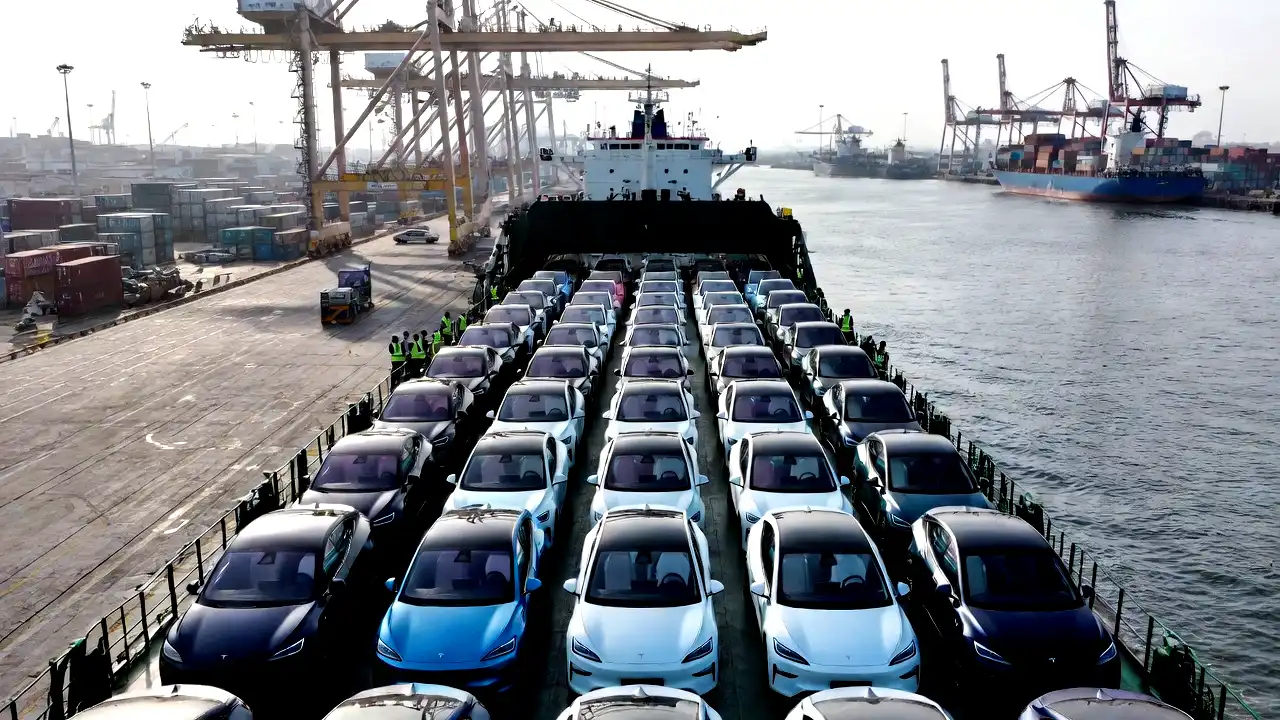
When Tesla first announced plans to build a factory in Shanghai, critics doubted that the company could build a local supply chain fast enough to meet its aggressive production targets. Today, Tesla’s Shanghai Gigafactory has achieved a component localization rate of over 95%. This means that almost every single part used to build a Model 3 or Model Y in Shanghai—from the battery cells to the window seals—is sourced from local suppliers located within a short radius of the factory.
This high level of localization is not just a matter of replacing imported parts with locally manufactured copies. It represents a deep, collaborative integration. More than 60 Chinese suppliers have successfully entered Tesla’s global supply chain, meaning they now export their locally developed components to Tesla’s other factories in Texas, California, and Germany.
Grace Tao, vice president of Tesla, pointed out that the relationship has moved into a stage of joint development. Tesla’s engineers work directly with local Chinese suppliers to optimize designs, improve manufacturing efficiency, and co-develop new technologies, allowing both parties to serve the global market far more efficiently.
The Model Y L and the Power of Diverse Market Testing
A prominent example of this collaborative innovation is the six-seat Model Y L, which was manufactured at the Shanghai Gigafactory and made its debut in the Chinese market in 2025. The long-wheelbase version (Model Y L) features a versatile three-row, six-seat layout, an adaptive suspension system, and vehicle-to-load (V2L) capabilities.
In 2026, the Model Y L has transitioned into a highly successful global export, rolling out to markets across South Korea, Australia, India, and Malaysia, with a U.S. launch scheduled for late 2026 out of the Gigafactory in Texas. The global success of this model demonstrates how product designs developed to satisfy the highly demanding Chinese consumer are now being exported to upgrade Tesla’s operations worldwide.
For Tesla, the Chinese market offers an unmatched combination of scale, efficiency, a complete industrial chain, and highly skilled engineering talent. This complete ecosystem serves as the foundation for the company’s long-term global investment, proving that strong, competitive vehicle models must be tested and refined in the world’s most demanding market before they can succeed on the global stage.
The Future of Collaborative Supply Chain Resilience
The fourth edition of the China International Supply Chain Expo comes at a time of growing geopolitical tension and talk of global economic decoupling. Many Western politicians have advocated for “de-risking” or isolating national supply lines to protect domestic industries from foreign competition.
However, the reality displayed on the floor of the Beijing expo tells a completely different story. The modern electric vehicle industry is too complex, too fast-moving, and too capital-intensive to function within isolated, national borders.
No single country possesses a complete monopoly on the entire EV supply chain. While Australia and Guinea hold some of the richest deposits of high-grade iron ore, China has built the world’s most advanced metallurgical facilities to convert that ore into ultra-thin electrical steel. While German engineering firms like Bosch lead the world in mechanical motion control, Chinese teams and suppliers excel at the rapid software iteration and manufacturing localization required to bring these technologies to market in record time.
Attempting to sever these highly integrated, transnational connections in the name of protectionism would only slow down the global transition to clean energy, drive up vehicle costs for consumers, and stifle the collaborative innovation that is actively pushing the boundaries of automotive performance. As Vice Premier Ding Xuexiang noted during his opening keynote speech, maintaining the resilience and stability of global industrial and supply chains is a critical guarantee for global economic development. Keeping these supply channels open, stable, and highly collaborative is not just a matter of corporate profit; it is a shared global interest that will decide the speed and success of the clean energy transition worldwide.
A Unified Path for Global Automotive Innovation
The Fourth China International Supply Chain Expo has demonstrated that the electric vehicle represents a monument of global collaboration. By tracing the industrial chain from a raw iron ore mine in Guinea to a high-speed, 30,000 RPM electric motor in Shanghai, the expo highlights how upstream material innovation and downstream market demand are locked in a continuous, highly productive feedback loop.
As traditional Tier-1 suppliers like Bosch pivot to meet the flexible, fast-changing demands of automakers, and global leaders like Tesla build highly localized, 95% integrated supply ecosystems, the automotive industry is proving that isolation is no longer a viable path to success.
The future of clean transportation belongs to those who embrace open collaboration, coordinated innovation, and global supply chain resilience. By linking the world’s resources, engineering talent, and manufacturing scale, the global EV supply chain is not just building more efficient vehicles; it is paving a highly integrated, sustainable path for the future of global industry.