In the landscape of artificial intelligence, Generative AI stands as a remarkable innovation that has unlocked new frontiers of creativity and problem-solving. The Generative AI market has experienced rapid growth, driven by the convergence of cutting-edge machine learning techniques, creative exploration, and the quest for novel solutions.
Generative AI Market Analysis
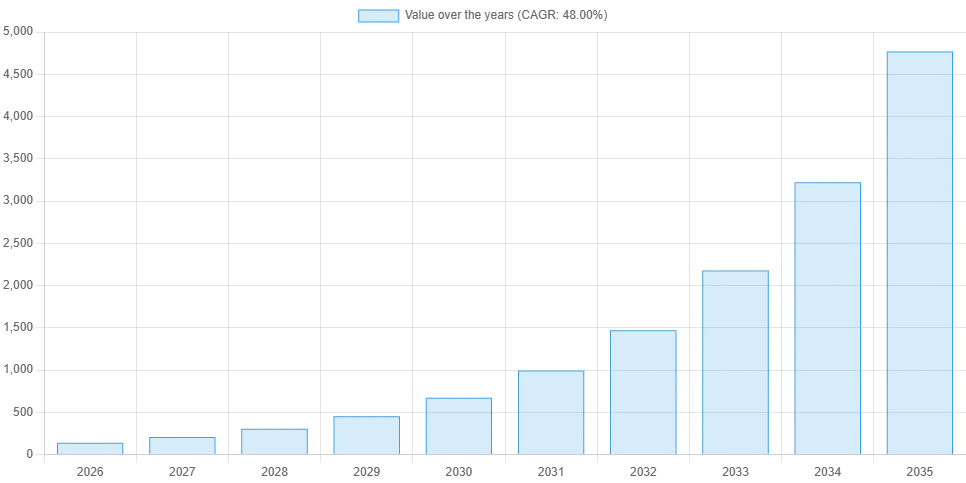
The preliminary estimate from the Techgolly market analysis team is that the global Generative AI market size was at least USD 140 billion in 2026 and is projected to reach up to USD 4769.62 billion by 2035. The growth is expected to continue at a compound annual growth rate (CAGR) of 46% to 48% from 2026 to 2035.
Reasons for Generative AI Market Growth
From its potential to generate realistic content to its applications in art, design, and problem-solving, Generative AI encompasses a realm of possibilities that have reshaped industries and the creative process. The pivotal catalysts driving the growth of the Generative AI market are discussed below.
Creative Potential and Content Generation
The growth of the Generative AI market is driven by its unique ability to generate creative content, including images, music, and text. This capability has found applications in art, media, and entertainment, revolutionizing content creation and enabling new forms of artistic expression.
Data-Driven Innovation
Generative AI leverages large datasets to learn patterns and generate new instances. This approach drives innovation by allowing AI systems to explore variations and generate novel solutions, making it valuable in product design and optimization.
Personalization and Customization
Generative AI enables the creation of personalized experiences by tailoring content to individual preferences and needs. This personalization enhances user engagement, customer satisfaction, and the overall user experience.
Complex Problem Solving
The growth of the Generative AI market is driven by its ability to tackle complex problems across various domains. From drug discovery to scientific research, Generative AI aids in hypothesis generation and optimization, accelerating innovation.
Enhanced Design and Architecture
In fields such as architecture and design, Generative AI helps professionals explore diverse design possibilities and generate innovative concepts that align with specific criteria and constraints.
Simulation and Prototyping
Generative AI facilitates scenario simulation and prototype creation. It is invaluable in industries such as engineering, where it accelerates product development and reduces the costs associated with physical prototypes.
Natural Language Generation
Generative AI’s ability to produce coherent, contextually relevant text has applications in automated content creation, chatbots, and customer service, thereby enhancing communication and interaction.
Entertainment and Gaming
The gaming and entertainment industries have benefited from Generative AI’s ability to create dynamic, interactive environments, characters, and narratives, enhancing immersive experiences.
Artificial Creativity and Innovation
Curiosity drives the Generative AI market to replicate and amplify human creativity. The AI community aims to push the boundaries of artistic expression and innovation by developing algorithms capable of producing original, imaginative content.
Research and Exploration
Generative AI facilitates data exploration and pattern discovery in scientific research. It aids in uncovering hidden insights, accelerating the discovery of new phenomena, and advancing knowledge.
Key Market Players
The major Generative AI vendors are Microsoft Corporation, Google LLC, Amazon Web Services, Inc., International Business Machines Corporation, Synthesia, Adobe Inc., Genie AI Ltd., MOSTLY AI Inc., D-ID, and Rephrase.ai.
Conclusion
Generative AI stands at the forefront of technological innovation, reshaping industries and creative processes alike. With its ability to generate content, solve complex problems, and personalize experiences, Generative AI has become a transformative force across sectors, such as art, design, healthcare, and entertainment. As major players like Microsoft, Google, and IBM continue to innovate and invest in Generative AI technologies, the landscape is poised for continued expansion and evolution. The ongoing exploration of AI’s creative and problem-solving capabilities promises to unlock new frontiers of possibility, profoundly shaping the future of technology and human-machine interaction.