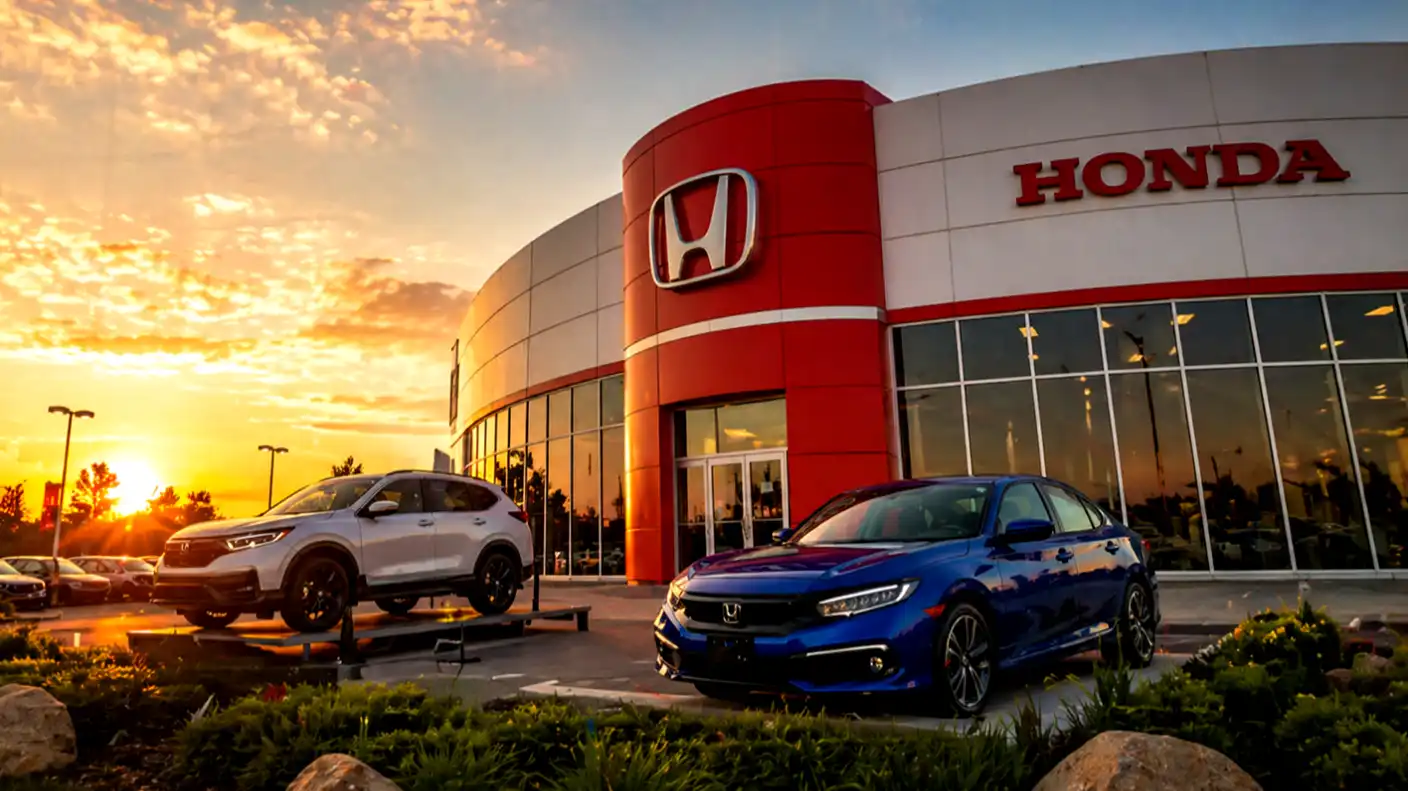
The highly competitive North American automotive market is experiencing a profound structural realignment. In a major announcement that highlights the cooling consumer demand for pure battery-electric vehicles, Honda Motor Company has officially decided to end its electric vehicle presence in the United States. The Japanese carmaker informed its American dealer network that it will halt sales of the Honda Prologue—the last and only all-electric vehicle in its U.S. lineup—after the 2026 model year, shifting its strategic focus entirely to hybrid gas-electric and traditional internal combustion engine vehicles.
The decision represents a major strategic retreat for the Tokyo-based automaker, which had previously announced ambitious plans to build a multi-billion-dollar domestic electric vehicle hub in Marysville, Ohio. By pulling the plug on the Prologue and cancelling its upcoming next-generation electric sedans and SUVs, Honda is acknowledging a harsh commercial reality: American consumers are not adopting pure electric vehicles at the speed or volume that corporate planners and government regulators originally predicted.
While the company will continue to develop and sell electric vehicles in other global markets—where local subsidies, lower manufacturing costs, and different consumer demographics keep demand robust—its North American operations will return to what the company calls a sensible balance of internal combustion and hybrid technologies. For Honda, this pivot is a pragmatic business decision designed to protect its operating margins and align its product portfolio with the physical, near-term demands of the American driveway.
The Strategic Shift: Inside Honda’s Decisive U.S. EV Retreat
The decision to cease production of the Prologue later this year brings Honda’s battery-electric vehicle inventory in the United States down to absolute zero. For an automaker that has spent years marketing its commitment to an all-electric future, the move is a dramatic, highly public concession to the current state of consumer demand.
The change in strategy became official after Honda’s U.S. sales leadership team concluded that the market had reached an electric vehicle plateau. While early adopters and tech enthusiasts rushed to buy electric vehicles during the initial phase of the boom, mainstream buyers have remained highly skeptical. High retail purchase prices, public charging infrastructure deficits, and high interest rates have combined to create an atmosphere of purchasing caution, forcing major automakers to scale back their electrification targets.
Lance Woelfer, the head of Honda’s U.S. sales operations, explained the decision by pointing out that the key to the modern marketplace is a balance of internal combustion and hybrid technologies. While the company achieved some early success with the Prologue, it can no longer justify the immense capital requirements and low profit margins of a dedicated, low-volume electric vehicle line. By focusing entirely on its highly profitable hybrid models, Honda is building a more resilient, consumer-aligned business capable of generating steady cash flows through the rest of the decade.
The Epilogue of the Prologue: Why the GM Partnership Failed to Deliver
To understand why Honda is killing the Prologue, one must look at the complicated corporate history of the vehicle itself. The Prologue was never an entirely original Honda product; rather, it was a joint-development project built in partnership with General Motors.
The vehicle was assembled at GM’s manufacturing facility in Ramos Arizpe, Mexico, utilizing GM’s proprietary Ultium battery platform and sharing its core mechanical underpinnings with the Chevrolet Blazer EV.
While this joint-venture model allowed Honda to bring an electric vehicle to the U.S. market quickly without spending billions of dollars developing its own platform from scratch, it also introduced severe structural limitations.
Because the car utilized GM’s technology and was assembled in a competitor’s factory, Honda had to pay substantial licensing and manufacturing fees to GM on every vehicle sold. This shared-margin structure meant that the Prologue was inherently less profitable for Honda than its internally developed hybrid models, making it a difficult product to support when sales began to decline.
The Dismal Sales Trajectory and the Forty Percent June Slump
Despite offering competent specifications—including an EPA-estimated 308 miles of range on a single charge and a spacious, comfortable interior—the Prologue struggled to find traction with American car buyers. In 2025, the company sold a mere 39,194 Prologues across the entire country, making it one of the worst-selling mainstream models in Honda’s U.S. catalog.
The final blow to the project arrived during the second quarter of the year, when sales figures plunged into a steep downward spiral. The company’s June sales reports revealed that Prologue deliveries slumped by 40 percent month-over-month, and took a devastating 48.5 percent year-on-year hit.
With inventory stacking up on dealer lots and operating costs rising, the company’s executive board realized that continuing to subsidize a slow-selling, joint-venture product was no longer financially defensible, setting up the decision to officially kill the model after the 2026 model run.
The Price Cut Squeeze and the Loss of Federal Subsidies
The financial viability of the Prologue took another major hit when changes in U.S. tax regulations stripped the Mexican-made SUV of its eligibility for the federal $7,500 electric vehicle tax credit. To keep the vehicle competitive with domestic rivals that still enjoyed the subsidy, Honda was forced to slash prices across the entire Prologue lineup by an equal $7,500, dropping the starting MSRP to $39,900.
While these deep price cuts successfully created some highly attractive lease deals—with dealers offering the Prologue for as low as $279 a month, making it cheaper to lease than a compact Civic Hybrid—they destroyed the vehicle’s profit margins.
Selling an advanced, battery-electric SUV at a sub-$40,000 price point while paying manufacturing royalties to GM resulted in significant, unsustainable losses on every unit shipped, proving to Honda’s leadership that the business model of importing third-party EVs into the U.S. was fundamentally broken.
The Grand Strategic Pivot: Scrapping the Zero Series for the Hybrid Boom
The cancellation of the Prologue is part of a much larger, highly coordinated strategic retreat. In March, Honda’s global headquarters announced a massive, multi-billion-dollar reassessment of its global automobile electrification strategy, citing high international tariffs, the elimination of consumer subsidies, and changing market preferences.
As part of this massive corporate pivot, Honda officially canceled its plans to launch its highly anticipated “0 Series” (Zero Series) electric vehicles in the North American market. The futuristic lineup, which debuted as a series of spaceship-esque concept cars at the Consumer Electronics Show, was originally slated to enter commercial production in Ohio.
By pulling the plug on the 0 Series Saloon and the 0 Series SUV, Honda has wiped all evidence of battery-electric vehicles from its North American product roadmap, choosing instead to focus its entire capital budget on hybrid technologies.
Putting the Ohio EV Hub on Ice
The cancellation of the 0 Series has had immediate consequences for Honda’s manufacturing operations in the United States. The company had previously announced a massive commitment to invest billions of dollars to upgrade its Marysville Auto Plant in Ohio, aiming to transform the facility into the primary manufacturing hub for its domestic electric vehicles.
This ambitious Ohio project has been officially put on ice. The company has delayed or canceled the planned cleanroom installations, equipment orders, and battery assembly lines, choosing instead to preserve its capital and focus the Ohio plant on producing high-volume, highly profitable internal combustion and hybrid models.
While the decision represents a major disappointment for local economic planners and clean-energy advocates, it protects Honda’s shareholders from the massive, cash-burning risks of operating an underutilized electric vehicle plant in a weak market.
The Fifteen New Hybrids Roadmap to 2030
To replace its canceled electric vehicle plans, Honda is doubling down on its highly successful, extraordinarily profitable line of gas-electric hybrids. The company has announced a new strategic roadmap that will see it launch 15 brand-new hybrid models primarily in North America by March 2030, with the first of these new vehicles scheduled to make its public debut next year.
The pivot to hybrids is backed by spectacular sales performance. While deliveries of the electric Prologue collapsed, sales of Honda’s hybrid models surged. In the first half of the year, Honda’s overall sales rose by 2.4%, driven almost entirely by insatiable consumer demand for the hybrid versions of its best-selling CR-V compact SUV, Accord midsize sedan, and Civic compact sedan.
Hybrids now account for more than one-third of Honda’s total U.S. sales volume, proving that consumers are highly eager to purchase fuel-efficient, reliable, and affordable gas-electric vehicles that do not require them to worry about public charging infrastructure or range degradation.
Global Diversification: Winning the EV Race Outside of North America
While Honda is completely withdrawing from the electric vehicle segment in the United States, the company is pursuing a highly different, diversified strategy in other global markets, where localized manufacturing costs, government incentives, and consumer behaviors remain favorable for electrification.
The company is focusing its global EV efforts heavily on fast-growing emerging markets like India and its home market of Japan. By shifting its manufacturing footprint to lower-cost countries, the company can produce advanced, compact electric vehicles at a price point that makes them highly competitive without requiring massive government subsidies.
The Compact 0 Alpha SUV and India’s Manufacturing Hub
The primary focus of Honda’s international electric vehicle strategy is the “0 Alpha” (Zero Alpha), a highly advanced, compact electric SUV that was first showcased as a concept car at the Japan Mobility Show.
Unlike the canceled American models, the 0 Alpha is designed with extreme cost-efficiency and space-utilization in mind, utilizing an ultra-thin battery packaging system and a streamlined aerodynamic body to deliver a projected 300-mile driving range.
To keep production costs low, Honda will manufacture the 0 Alpha locally at its advanced Tapukara production plant in Rajasthan, India, starting in early 2027.
By utilizing India’s highly competitive manufacturing base and skilled engineering pool, Honda can build a world-class electric vehicle at an estimated price point of roughly 17 to 22 Lakh, equivalent to approximately $20,000.
This low cost structure allows Honda to sell the vehicle profitably in the Indian domestic market and export the completed cars directly back to Japan, proving that the company can successfully compete in the global EV race as long as it operates outside of the high-cost North American manufacturing zone.
Navigating the Intense Competition in Emerging Markets
The launch of the 0 Alpha in India will serve as a critical test for Honda’s international technology division. The compact electric SUV segment in India is becoming highly competitive, with established regional giants like Hyundai, Suzuki, and Mahindra preparing to launch their own advanced, low-cost electric models.
To win this race, Honda is packing the 0 Alpha with advanced technology, including Level 2 advanced driver-assist systems, six standard airbags, and a highly advanced, proprietary in-house operating system.
By offering a premium, feature-loaded, and highly efficient vehicle at a price point that middle-class consumers can actually afford, Honda expects the 0 Alpha to serve as its primary global growth engine, demonstrating that the company’s commitment to electrification remains fully active, even if it must bypass the stagnant U.S. market to achieve its goals.
The Structural Realities of the North American EV Market
The sudden, dramatic retreat of Honda from the U.S. electric vehicle market is a powerful, real-world indicator of the structural challenges facing the entire automotive industry. For years, government regulators and environmental groups operated under the assumption that they could force a rapid transition to zero-emission vehicles through administrative mandates and consumer tax credits.
The experience of 2026 has proved that the market cannot be so easily forced. When the temporary consumer excitement faded, and federal tax credits became increasingly restricted, the underlying demand for pure battery-electric vehicles collapsed.
American consumers are sending a clear, unequivocal message to the auto industry: they want reliable, practical, and affordable transportation, and right now, the hybrid gas-electric vehicle is the only technology that successfully delivers on all three counts.
By listening to its customers, cutting its losses on the slow-selling Prologue, and focusing its massive resources on its high-performing hybrid lines, Honda is executing a highly pragmatic, defensive maneuver that protects its corporate profitability and secures its long-term financial health.
While the company may eventually return to the U.S. electric vehicle market when charging infrastructure matures, and battery technologies achieve real price parity, its current hybrid-first strategy ensures that the company remains highly profitable and competitive, proving that in the volatile world of global commerce, listening to the actual demands of the consumer is always the ultimate path to success.