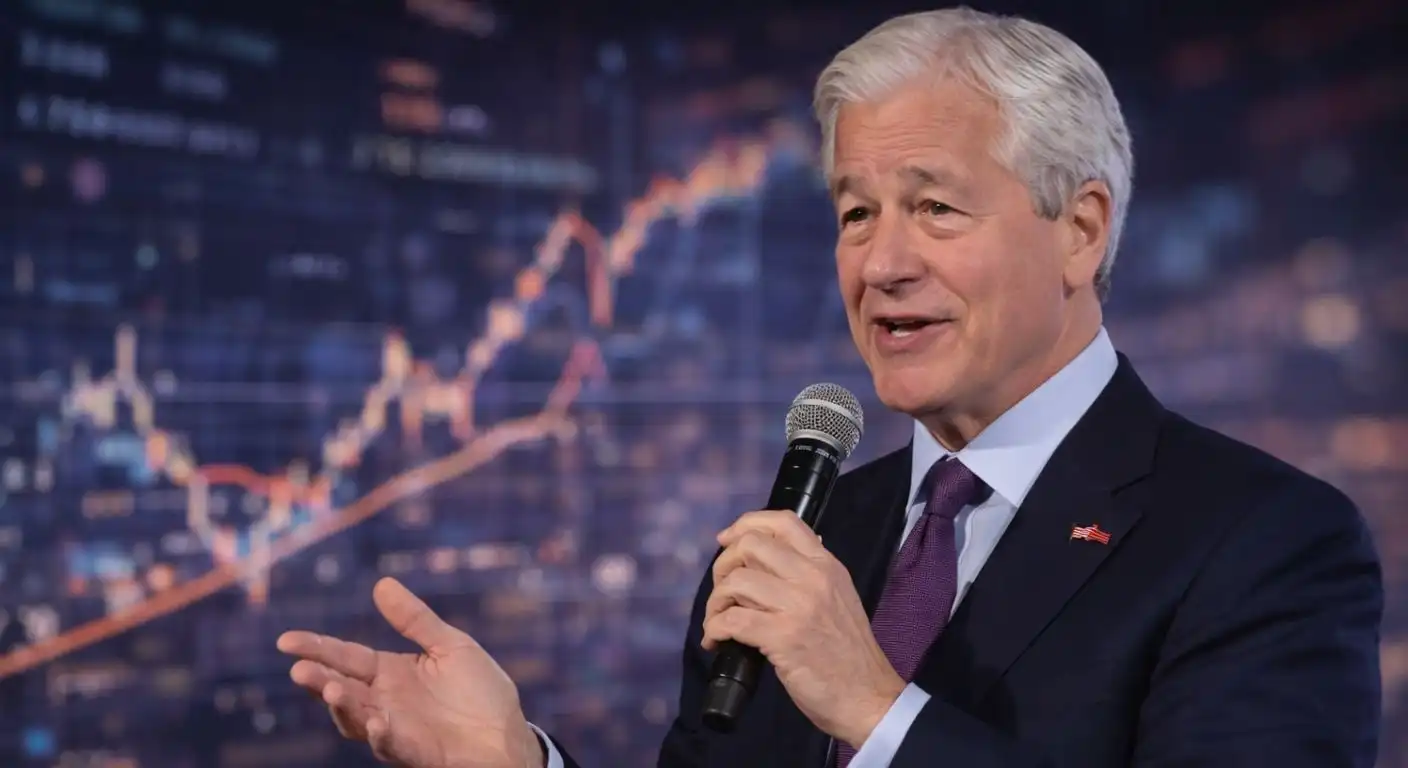
The second-quarter earnings season of 2026 has opened with a striking financial paradox. JPMorgan Chase, the largest and most powerful bank in the United States, delivered a blowout quarterly performance that completely shattered Wall Street expectations, showcasing the incredible resilience of American corporate activity and consumer spending. Yet, even as the bank’s internal profit engines roared at record speeds, its legendary chief executive officer, Jamie Dimon, refused to join the market celebration. Instead, he chose to deliver one of his most serious, structurally grounded warnings to date.
In the bank’s official earnings release, Dimon shifted away from his traditional, weather-based metaphors. For years, the banking veteran used atmospheric analogies to describe the global economy, famously warning of an impending “economic hurricane” in June 2022. Now, during the release of the bank’s second-quarter earnings, Dimon swapped the weather report for a far more slow-moving, geomorphic metaphor. He warned that several massive economic risks are currently shifting below the surface like tectonic plates, threatening to trigger severe, unpredictable disruptions to the global financial system.
This metaphor shift is highly significant. A hurricane is an acute, visible weather event that eventually passes, allowing communities to rebuild on stable ground. Tectonic plates, by contrast, represent massive, slow-moving, subterranean forces that shift quietly for years without announcing themselves. The ground appears perfectly solid, and the economy looks completely resilient, until the plates suddenly collide or shift, triggering a massive, devastating earthquake that completely alters the physical landscape. For investors, Dimon’s warning is a clear message: do not let today’s record corporate earnings blind you to the massive, structural changes quietly building beneath the global economy.
Dissecting JPMorgan’s Historic Q2 2026 Earnings Blowout
The cautious nature of Dimon’s warning stands in stark contrast to the absolute strength of his bank’s balance sheet. JPMorgan Chase handed Wall Street a set of financial figures that surpassed even the most optimistic analyst forecasts. The bank reported an adjusted earnings per share of $7.70, representing a massive 47% jump compared to the same period a year earlier. This blowout figure easily cleared the consensus Wall Street expectations, which had projected the bank’s earnings per share to land somewhere between $5.44 and $5.59.
The bank’s total managed revenue for the quarter cleared $58 billion, easily beating the consensus analyst estimate of $51 billion. JPMorgan reported that every single line of its business hit record revenue levels during the quarter, showcasing the bank’s unparalleled scale and market dominance. Investors responded to the blowout report with immediate enthusiasm, though concerns over Dimon’s cautious outlook ultimately caused the stock to slide 2% in premarket trading as market participants digested the long-term risks.
The financial performance was driven primarily by a powerful resurgence on Wall Street. Investment banking fees rose by 30% year-over-year, accelerating to their highest level since the peak of the market in 2021. This surge was fueled by an insatiable corporate appetite for mergers and acquisitions advisory work and a robust revival in initial public offerings. At the same time, the bank’s markets division posted its best quarter in history, with trading revenue growing 35% year-over-year to $12.1 billion, driven primarily by an extraordinary 86% spike in equity markets revenue.
The Investment Banking Revival: Releasing Pent-Up Corporate Demand
The 30% jump in investment banking fees indicates that corporate America is finally adjusting to a higher-for-longer interest rate environment. For several years, companies postponed major acquisitions and delayed public listings, waiting for central banks to cut rates back to zero. By mid-2026, corporate executives realized that waiting for cheap money was a losing strategy.
This realization unleashed a massive wave of pent-up demand. Large corporations are actively consolidating their industries to achieve scale, while private equity firms are deploying their massive cash reserves to secure high-growth assets. JPMorgan, as the premier advisor on Wall Street, captured the lion’s share of these lucrative advisory and underwriting fees, proving that even a restrictive monetary environment cannot halt corporate consolidation if the strategic necessity is strong enough.
The Markets Surge: Capitalizing on Geopolitical and Inflation Volatility
The extraordinary 35% increase in trading revenue highlights how large-scale investment banks profit from macroeconomic instability. The markets division thrived by acting as a primary market maker during periods of extreme volatility across the bond, commodity, and foreign exchange desks.
When geopolitical tensions flare or inflation data surprises to the upside, asset prices revalue rapidly. This volatility drives heavy transaction volumes as institutional investors, hedge funds, and multinational corporations scramble to rebalance their portfolios and hedge their currency and interest rate risks. By providing liquidity to these desperate buyers and sellers, JPMorgan’s trading desks minted historic profits, demonstrating that while macroeconomic uncertainty is a threat to long-term corporate planning, it remains a major profit engine for Wall Street’s dominant market makers.
The Four Tectonic Plates Threatening the Global Economy
Despite his bank’s record-breaking performance, Dimon emphasized that these short-term profits should not be used as an excuse for corporate complacency. He argued that the U.S. economy’s current resilience, while notable, is being supported by temporary tailwinds that cannot indefinitely offset the massive, slow-moving risks shifting below the surface. Dimon identified four specific “tectonic plates” that pose a direct threat to global financial stability: geopolitical instability, persistent inflation, large global fiscal deficits, and elevated asset prices.
The danger of these tectonic forces is that they do not operate in isolation. They are deeply interconnected, constantly grinding against one another and multiplying their individual risks. A geopolitical shock in the Middle East can instantly trigger an inflation spike, which forces central banks to keep interest rates high, worsening national deficit burdens and ultimately popping stretched asset valuations. This interconnectedness makes predicting how these forces will ultimately play out nearly impossible, forcing risk managers to prepare for a wide range of volatile outcomes.
Persistent, Sticky Inflation and the Higher-for-Longer Interest Rate Reality
The first tectonic plate shifting below the surface is the persistent nature of global inflation. While central banks have made significant progress in bringing headline inflation down from its post-pandemic peaks, core inflation remains stubbornly “sticky” in mid-2026. This stickiness is driven by big, structural changes in the global economy that are inherently inflationary, including the decoupling of global supply chains, massive domestic manufacturing re-shoring programs, and the rising cost of the green energy transition.
Dimon warned that these structural forces mean interest rates will likely remain elevated for much longer than Wall Street’s optimistic models suggest. For over a decade, investors operated under the assumption that central banks would always step in to cut rates and print money at the first sign of economic weakness.
The reality of sticky inflation has destroyed this safety net. If central banks are forced to keep rates high to prevent inflation from reigniting, it will place immense pressure on highly leveraged corporations, commercial real estate portfolios, and regional banking institutions, slowly grinding down the foundations of economic growth.
Swollen Global Fiscal Deficits and the Threat of Sovereign Debt Crises
The second major risk is the massive, unprecedented fiscal deficits being run by governments around the world. The United States is currently running a current account deficit of roughly $1.12 trillion and a trade deficit hovering near $1 trillion, even as its economy operates at near-full employment. This level of peacetime deficit spending has no historical precedent.
This massive government borrowing requires a continuous, multi-billion-dollar issuance of new Treasury debt, putting immense pressure on the bond markets. To entice investors to buy this mountain of paper, yields must remain high, directly competing with private investments and driving up borrowing costs for households and corporations.
Dimon has consistently warned that these swollen deficits are highly inflationary and unsustainable over the long term. If international investors begin to lose faith in the fiscal discipline of Western governments, it could trigger a sudden, catastrophic repricing of sovereign debt, destabilizing the global financial system and destroying the value of traditional paper assets.
Geopolitical Instability and the New Era of Global Rearmament
The third, and most critical, tectonic plate is the rapid deterioration of the global geopolitical landscape. Dimon has repeatedly stated that geopolitical risk is the absolute greatest threat facing the global economy, far outweighing any traditional business or cyclical economic concern. The world has entered a dangerous new era defined by expanding regional conflicts, trade wars, and the threat of supply chain blockades.
This instability has forced nations to abandon the globalized, frictionless trade models of the past decade in favor of economic nationalism and aggressive rearmament. Governments are spending hundreds of billions of dollars to build up their militaries and secure their strategic technology supply chains.
JPMorgan Chase took this threat so seriously that it established a dedicated Center for Geopolitics to analyze hundreds of risk vectors and help its corporate clients build supply chain resilience. This geopolitical friction is structurally inflationary, as companies must pay a premium to build redundant supply chains and manufacture goods in safe, friendly jurisdictions rather than lower-cost emerging markets.
Stretched Asset Valuations and the Speculative AI Capex Risk
The fourth tectonic plate involves the stock market itself. Driven by the massive excitement surrounding the artificial intelligence boom, equity valuations have reached historically stretched levels. Investors have poured billions of dollars into a narrow group of technology megacaps, pricing these stocks for absolute perfection.
While Dimon acknowledged that artificial intelligence-driven capital investment serves as a powerful short-term tailwind for the economy, he warned that these elevated asset prices are vulnerable to a sudden, painful correction. If the massive capital outlays currently being deployed by technology companies fail to translate into rapid, high-margin revenues, the market’s optimistic growth assumptions will collapse.
A severe correction in the technology sector would not remain confined to Silicon Valley; it would trigger a synchronized, global pullback in capital, destroying consumer confidence and threatening the stability of the broader financial markets.
Building a Fortress Balance Sheet: JPMorgan’s Defensive Playbook
To survive these shifting tectonic plates, JPMorgan Chase has spent years building what Dimon famously calls a “Fortress Balance Sheet.” The bank’s primary defensive strategy is to avoid betting its corporate future on any single economic scenario. Instead, JPMorgan deliberately positions its balance sheet to survive and thrive across a wide range of highly volatile outcomes.
The bank maintains massive capital reserves, high liquidity ratios, and a conservative credit portfolio, ensuring that it can withstand a sudden sovereign debt crisis, a geopolitical trade blockade, or a severe stock market correction without compromising its ability to support its customers.
This defensive positioning is highly expensive, often requiring the bank to hold billions of dollars in low-yield cash equivalents rather than investing in higher-yield but higher-risk commercial assets. However, this discipline is precisely what allowed JPMorgan to rescue failing regional banks during previous financial crises and expand its market dominance when its competitors were forced into defensive retreats.
The Quiet Digital Asset and Blockchain Buildout
As part of this long-term risk management strategy, JPMorgan is quietly building the infrastructure for the future of global finance. The bank operates Onyx, an enterprise-grade blockchain platform designed to facilitate institutional settlement, tokenized asset transfers, and international payments.
JPMorgan’s JPM Coin already processes billions of dollars in daily transactions for massive corporate clients, proving that blockchain technology has successfully crossed the boundary from experimental science to core financial utility.
Additionally, the bank has expanded its custody services to support institutional clients navigating the rapidly evolving digital asset space, including strategic exposure to recently approved spot Bitcoin ETFs. By building these advanced digital capabilities today, the bank ensures that it will maintain its clearing and settlement dominance, regardless of how the traditional banking system is impacted by future technological disruptions.
Strategic Outlook: Why Investors Must Heed the Warning
For retail and institutional investors alike, Jamie Dimon’s tectonic plates warning serves as a vital call for portfolio stress-testing. In a market dominated by short-term trading algorithms and sensational earnings headlines, it is incredibly easy to lose sight of the massive, structural forces quietly shifting beneath the surface.
Relying on past historical correlations or assuming that tomorrow’s market will behave exactly like yesterday’s is a recipe for severe financial underperformance. To survive the rest of the decade, investors must move beyond passive index tracking and implement robust, cross-asset hedges.
This means diversifying portfolios into tangible real assets like physical commodities, rotating capital into defensive value stocks with strong cash flows, and maintaining high levels of liquidity.
The ground may appear perfectly solid today, and corporate profits may continue to hit record highs, but the tectonic plates are moving. The investors who survive the eventual collision will be those who heeded the warning of Wall Street’s most experienced banker, building their own fortress balance sheets long before the first tremors begin to shake the global markets.