Key Points:
- SkyDrive successfully completed two 6-minute remote demonstration flights, reaching 86 kilometers per hour over the Seto Inland Sea.
- The three-seat electric vertical takeoff and landing aircraft traveled a 2-kilometer route to simulate future eco-friendly sightseeing tours.
- The Japanese aerospace startup previously achieved a stable top speed of 100 kilometers per hour during rigorous performance testing in June.
- Commercial passenger services are on track to launch by 2028, expanding on early flight demonstrations conducted at the Osaka World Expo.
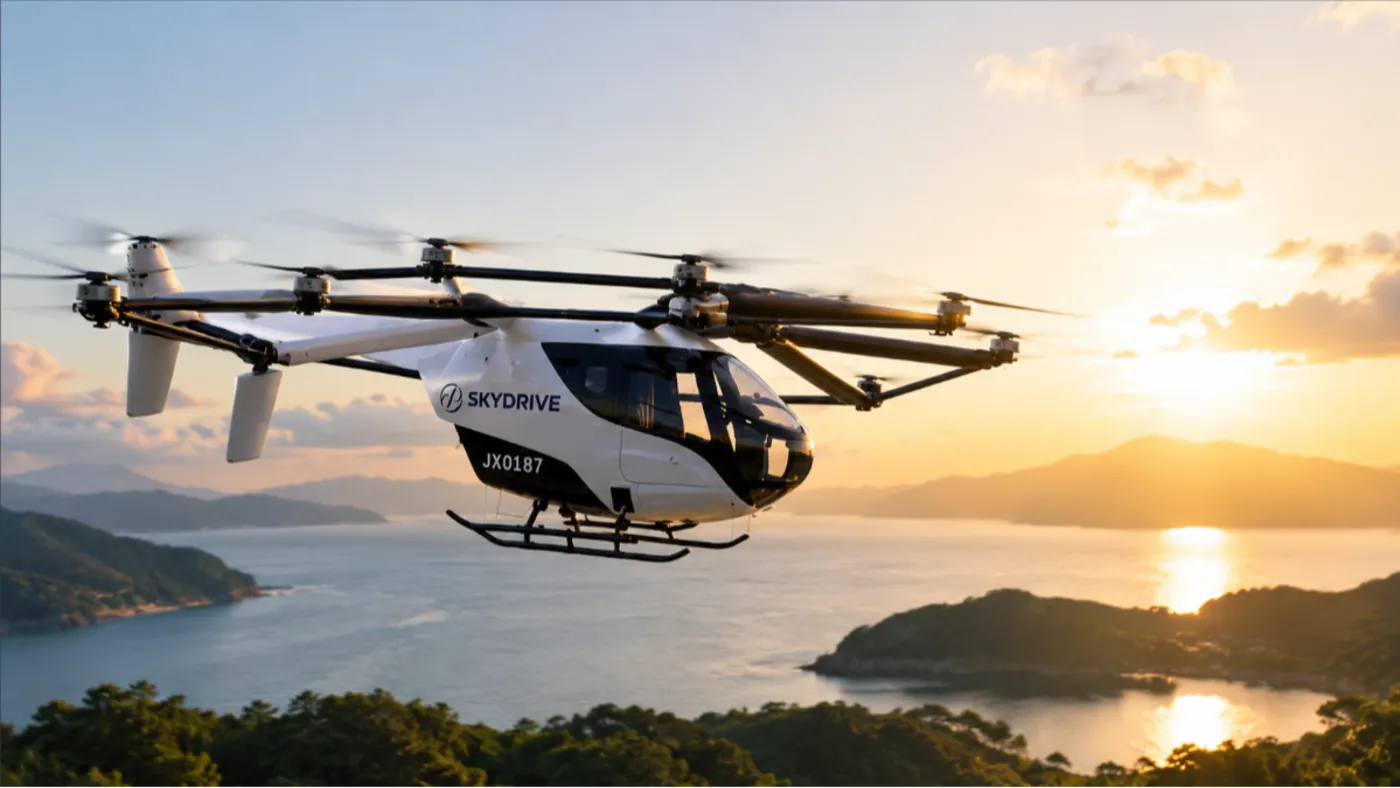
The dream of soaring over traffic in a zero-emission air taxi moved one step closer to everyday reality this week. Japanese aerospace startup SkyDrive successfully executed high-speed demonstration flights of its electric vertical takeoff and landing aircraft at a specialized test facility in Yamaguchi. The recent flight tests specifically aimed to simulate a scenic sightseeing tour over the beautiful Seto Inland Sea, proving that the technology can handle real-world coastal wind conditions while delivering a smooth passenger experience. This milestone pushes the company closer to its goal of commercializing short-hop aerial transit before the end of the decade.
During the demonstration, the company remotely operated its sleek, three-seat aircraft, which is designed to carry one pilot and two passengers. As the multiple electric propellers mounted on the roof spun up to speed, the vehicle lifted vertically off the launch pad without the need for a traditional runway. It then transitioned into forward flight, heading out over the sea. The aircraft covered a distance of roughly 1 kilometer over the water before banking into a smooth turnaround, accelerating on its return path to reach a top speed of 86 kilometers per hour. Engineers executed the entire six-minute flight sequence twice to verify the consistency of the battery output and aerodynamic stability.
SkyDrive Chief Executive Officer Tomohiro Fukuzawa watched the trials closely and highlighted the specific purpose of the coastal route. He expressed hope that the demonstration gave the public a clear sense of how electric aircraft can tour the beautiful Seto Inland Sea in a way that respects both the environment and the local community. Because electric motors generate a fraction of the noise produced by traditional combustion-engine helicopters, these flying cars can operate in sensitive tourist areas and dense urban centers without causing severe noise pollution. Furthermore, the complete lack of exhaust emissions aligns perfectly with national initiatives to decarbonize the domestic transportation sector.
The successful flights in Yamaguchi build upon a rapid sequence of technical achievements for the company. Just last June, the engineering team pushed the aircraft to a stable flight speed of 100 kilometers per hour during uncrewed performance testing. Hitting that 100-kph threshold proved that the unique multi-rotor design could sustain the aerodynamic lift required for rapid city-to-city transit. The development team, based in the industrial hub of Toyota in Aichi Prefecture, uses these progressive speed tests to gather millions of data points on rotor vibration, battery thermal management, and autonomous flight control responsiveness.
The ultimate vision for this technology extends far beyond luxury sightseeing tours. Urban planners and transport authorities expect electric vertical takeoff and landing vehicles to solve severe modern infrastructure problems. Major metropolitan areas suffer from crippling daily traffic congestion and overcrowded commuter trains. By moving a portion of that daily traffic into the lower airspace, cities can drastically reduce gridlock. Financial analysts estimate that the global market for advanced air mobility and flying cars could expand into a $1.5 trillion industry by 2040, as logistics companies, emergency medical responders, and ride-hailing networks adopt the technology.
SkyDrive already holds a massive public relations advantage in the domestic market. The company captured global attention last year by conducting highly publicized demonstration flights at the World Exposition in Osaka. Showcasing the technology at the World Expo allowed international regulators, investors, and potential customers to see the physical hardware in action. That global stage helped normalize the concept of flying cars for the general public, proving that the vehicles are safe, stable, and ready to transition out of the research phase and into active service.
Looking ahead, the company maintains a strict timeline for launching its commercial services. SkyDrive aims to begin offering paid passenger flights around 2028. The initial commercial rollout will focus on two primary regions: Osaka and Oita prefectures. Osaka will serve as the primary urban testing ground, ferrying business travelers across the dense metropolitan skyline. Meanwhile, Oita prefecture, famous for its remote hot spring resorts, provides the perfect environment for regional tourism flights. A flying car can transport tourists directly from the regional airport to a mountain resort in minutes, bypassing hours of winding, mountainous road travel.
Securing final regulatory approval remains the largest hurdle before that 2028 launch date. Aviation authorities require unprecedented levels of safety data before allowing new aircraft types to carry civilian passengers. To meet these strict standards, SkyDrive designed its aircraft with massive mechanical redundancy. The vehicle utilizes 12 independent motors and propellers. If a bird strike or electrical fault disables one or two motors mid-flight, the flight computer instantly redistributes power to the remaining rotors, allowing the aircraft to maintain stability and execute a safe emergency landing. This fail-safe architecture is critical to winning the trust of both regulators and future passengers.
The Japanese startup is not racing toward this future alone. The advanced air mobility sector features fierce international competition. American developers have raised billions of dollars to fund their own multi-rotor designs, while European aerospace firms are actively testing models for urban use. However, SkyDrive focuses heavily on building a compact, lightweight airframe. A smaller physical footprint allows the Japanese vehicle to land on existing building rooftops and standard helipads, avoiding the need to construct massive, expensive new infrastructure in highly congested Asian mega-cities.
As the engineering team analyzes the telemetry data from the Yamaguchi flights, the path to commercialization looks increasingly clear. By successfully demonstrating high-speed, over-water flight capabilities, the company proved its hardware can endure complex environmental variables. The next three years will require intensive endurance testing, battery optimization, and pilot training programs. If the company hits its remaining developmental milestones, the sight of electric air taxis buzzing quietly over the Seto Inland Sea will soon shift from a rare technological demonstration to an ordinary part of the daily commute.