Key Points:
- AMD officially launched its first rack-scale AI system, Helios, designed to compete with Nvidia’s Blackwell and Vera Rubin.
- Microsoft has committed to deploying Helios “at scale” on Azure to power next-generation model inference and AI services.
- The custom-built Helios rack integrates 72 Instinct MI455X GPUs, 6th-Gen EPYC Venice CPUs, and Pensando networking.
- Market analysts predict the release could help AMD capture a 20% to 25% share of the highly lucrative data center GPU market.
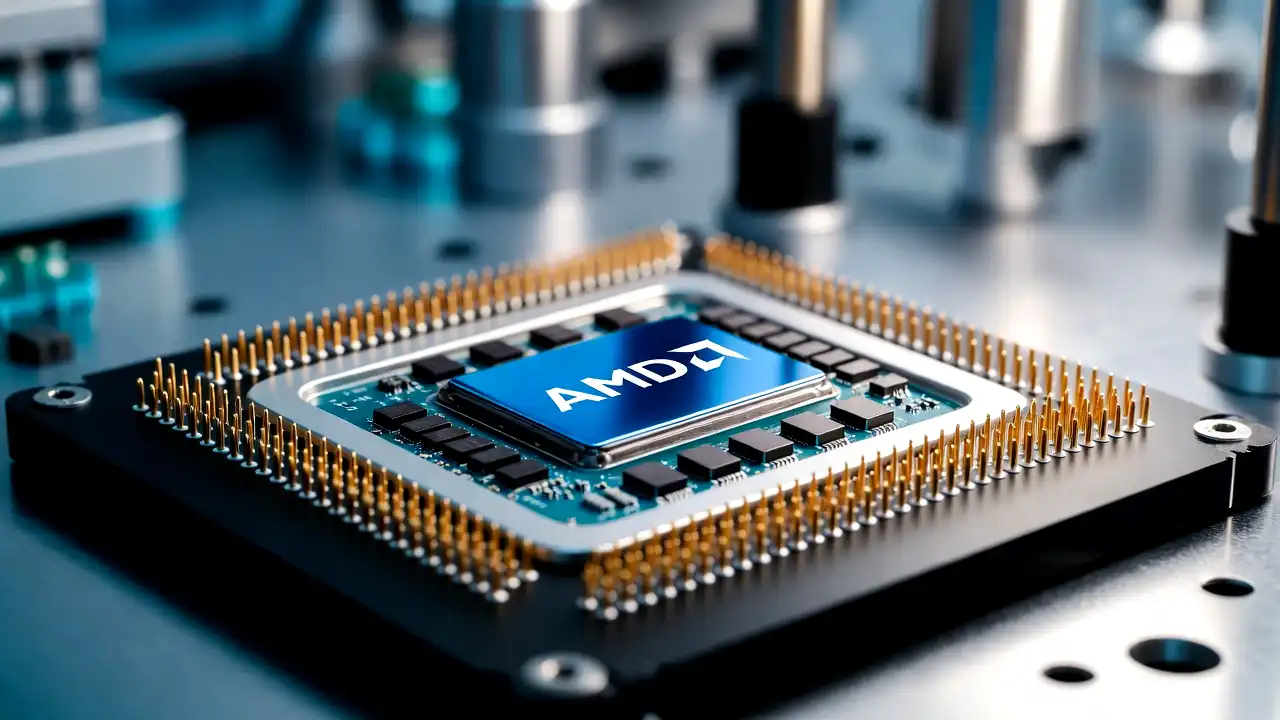
A major structural transition is taking place in the artificial intelligence hardware market as the chip industry’s primary challenger launches its most aggressive attack yet on the dominant market leader. Advanced Micro Devices (AMD) has officially introduced its first complete, rack-scale AI infrastructure, named Helios. Designed to compete directly with Nvidia’s highly sought-after Grace Blackwell and next-generation Vera Rubin architectures, the system has scored an immediate and massive market victory. Microsoft has committed to deploying the newly launched rack-scale platforms at scale across its global Azure cloud data centers, signaling a period of intense, multi-billion-dollar competition at the very top of the tech sector.
The launch of the new rack-scale system represents a critical shift in how the semiconductor industry sells computing power. Historically, the battle for AI market share was won or lost on the strengths of individual graphics processing units (GPUs). However, as model sizes and processing demands reach astronomical levels, the competitive landscape has transitioned. The true contest is now won at the full-rack level, requiring hardware providers to deliver fully integrated, pre-tested packages combining GPUs, central processing units (CPUs), high-speed networking, advanced liquid cooling, and optimized software compilers to ensure rapid deployment.
The physical and technical specifications of the newly unveiled rack demonstrate an incredible concentration of processing power. A single, custom-designed Helios cabinet combines 72 of the company’s next-generation Instinct MI455X graphics chips, sixth-generation EPYC “Venice” processors, and advanced Pensando data processing units (DPUs) to manage backend networking. Running on the company’s open-source ROCm software stack, the fully integrated system delivers up to 2.9 exaFLOPS of FP4 computing power, 1.4 exaFLOPS of FP8 performance, and a massive 31 terabytes of next-generation HBM4 memory capacity.
Rather than engaging in a destructive price war, the chipmaker’s competitive strategy focuses on delivering superior total cost of ownership (TCO) and lower operating expenses. Industry researchers note that while the unit price of a complete Helios rack is higher than rival configurations, its highly optimized architecture delivers a significantly lower cost per unit of computing power—otherwise known as the cost per token. By proving that its unified CPU, GPU, and networking stack can execute complex model inference and training workloads more efficiently, the company is pitching the system as a highly practical, margin-boosting investment for corporate buyers.
Securing Microsoft as a premier launch partner provides invaluable commercial validation for the new hardware platform. As one of the world’s most influential and well-capitalized AI infrastructure buyers, Microsoft operates the Azure cloud network, hosts the massive workloads of ChatGPT-maker OpenAI, and spends billions of dollars annually to expand its global data center footprint. By deploying the new rack-scale system at scale, the tech giant is securing a reliable, high-performance alternative to Nvidia, ensuring that its future cloud expansion does not depend entirely on a single, supply-constrained hardware vendor.
The strategic partnership between the two technology giants extends beyond hosting the new hardware racks to include new, specialized cloud-computing instances. Microsoft will introduce two new virtual machine instances on Azure powered by the chipmaker’s latest Venice CPUs. The first new instance will focus heavily on advanced, multi-step agentic AI applications and complex data-processing pipelines. The second is designed specifically to handle highly intensive semiconductor design workloads, giving corporate clients more options to optimize their local workloads using advanced AMD silicon.
Microsoft is not the only tech giant rushing to secure this next-generation computing capacity. The newly launched platform has already amassed a highly prestigious roster of early adopters, including social media titan Meta, OpenAI, and database pioneer Oracle. Meta has recently outlined plans to deploy these systems at a massive scale of up to 1 gigawatt (GW) in the short and medium term, as part of a broader commitment to utilize up to 6 GW of the company’s GPUs over time. This broad-based institutional backing confirms that the world’s most advanced technology firms are eager to diversify their hardware supply chains.
The commercial success of the new rack-scale system could fundamentally reshape the market share dynamics of the global data center business. Historically, Nvidia has maintained an unshakeable, near-total monopoly in the sector, controlling over 95% of the data center GPU market, while AMD accounted for a meager 4.5%. However, industry analysts predict that the successful rollout of the new platform, backed by massive commitments from Microsoft and Meta, could allow the challenger to capture 20% to 25% of the highly lucrative market in the coming years. This shift would represent hundreds of billions of dollars in new, high-margin revenue.
The financial foundation supporting this aggressive hardware expansion is already highly robust. During the first quarter of the year, the chipmaker’s data center division recorded a spectacular 57% year-on-year revenue surge to reach $5.78 billion, accounting for the vast majority of its total corporate sales. Management expects to begin booking tens of billions of dollars in data center AI revenues starting in 2027, with the majority of that growth driven by the high-volume delivery of these new rack-scale platforms, positioning the firm for a highly profitable long-term trajectory.
Ultimately, the commercial debut of the new rack-scale AI system represents a definitive turning point in the global hardware race. By moving past individual chip sales to deliver a fully integrated, high-performance, and cost-effective computing cabinet, the semiconductor challenger has successfully established a viable alternative to the market leader. As volume deliveries to Microsoft, Meta, and OpenAI begin in the second half of the year, the success of this unified hardware platform will demonstrate whether the future of advanced artificial intelligence will remain under a single corporate monopoly or transition into a more competitive, diversified digital economy.