Key Points:
- Unitree Robotics is expanding manufacturing capacity in Hangzhou to mass-produce humanoid robots.
- The company’s G1 humanoid robot disrupted the market with an aggressive $16,000 starting price.
- Factory automation and local supply chains enable Unitree to produce thousands of robots annually.
- Humanoid robots are transitioning from university research labs to industrial assembly lines and logistics hubs.
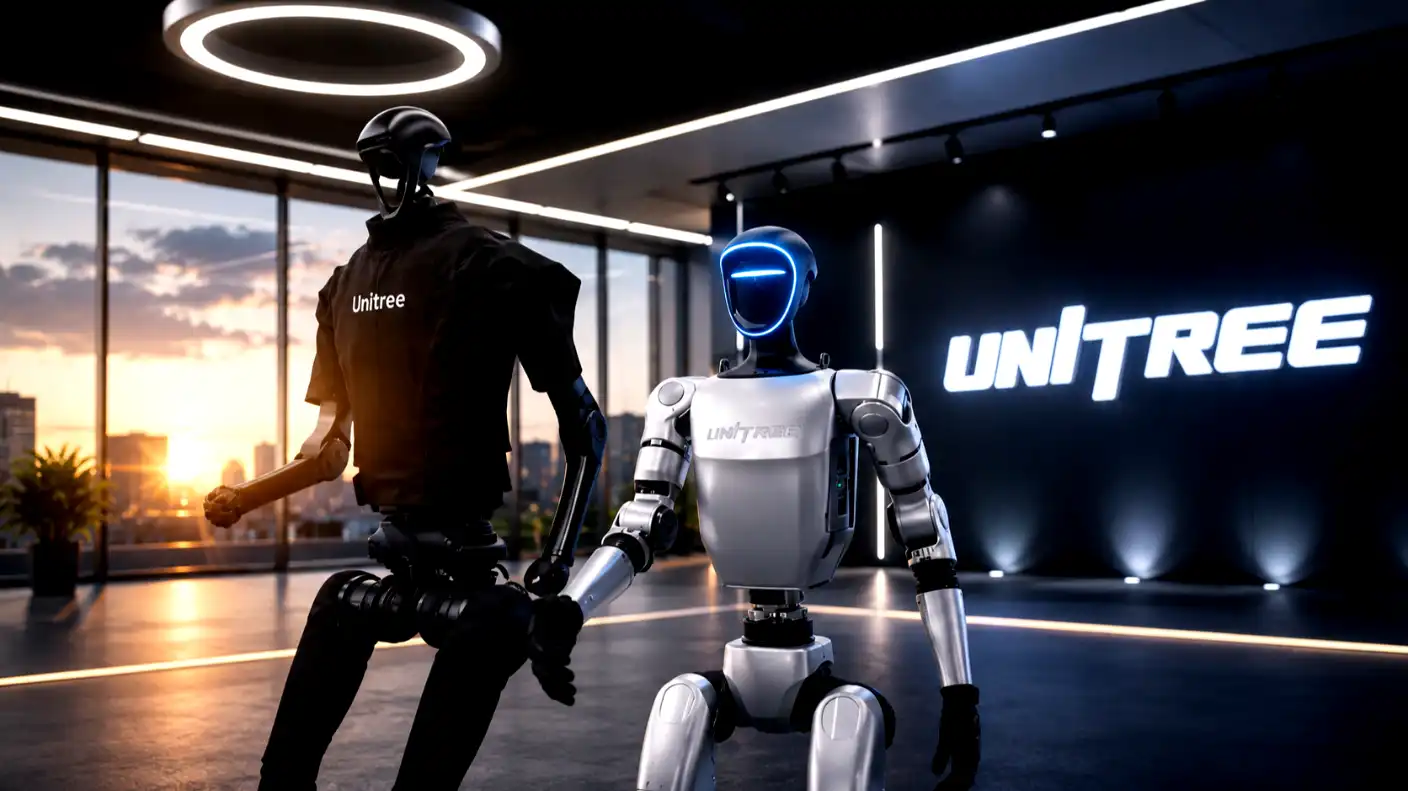
Chinese robotics pioneer Unitree Robotics is preparing a major manufacturing expansion to satisfy surging global demand for humanoid robots and quadruped machines. Speaking during a corporate strategy update, Unitree Founder and Chief Executive Officer Wang Xingxing revealed that the Hangzhou-based hardware maker is actively scaling factory floor space and installing automated assembly lines. The production boost aims to transition bipedal humanoid robots from experimental research prototypes into mass-market industrial and commercial workforce tools.
At the forefront of Unitree’s commercial expansion sits its compact humanoid model, the Unitree G1. By establishing an aggressive baseline price tag of $16,000 (roughly 99,000 yuan), Unitree completely disrupted an international industry where commercial humanoid robots historically cost over $100,000. Standing nearly 4.3 feet tall and weighing 35 kilograms, the G1 features between 23 and 43 degrees of freedom across its joints, force-controlled dexterous hands, 3D LiDAR sensors, and a unique foldable body frame that allows users to pack the robot into a standard travel suitcase.
For heavy industrial tasks requiring full human height, Unitree manufactures the full-sized H1 humanoid robot. Priced around $90,000, the 5.9-foot-tall H1 gained international acclaim by setting a world speed record for full-sized bipedal humanoids, running at 3.3 meters per second (7.4 miles per hour). Equipped with high-torque joint motors generating 360 Newton-meters of force, 3D depth cameras, and advanced balance control systems, the H1 executes heavy payload carries, stair climbs, and backflips in complex industrial environments.
To meet thousands of pending commercial orders from North America, Europe, and Asia, Unitree is expanding its primary manufacturing complex in Hangzhou, Zhejiang province. A key competitive advantage driving Unitree’s low prices is deep supply chain integration. The company manufactures its core hardware components in-house—including high-density coreless motors, specialized harmonic reducers, proprietary motor drives, and tactical IMU sensors. Manufacturing key mechanical components internally cuts bill-of-materials costs by up to 60% compared to competitors who source third-party industrial parts.
Unitree’s rapid scaling in humanoid robotics builds upon years of high-volume quadruped manufacturing. Founded in 2016, Unitree established global market dominance in four-legged robotic dogs through its consumer-grade Go2 model—priced at an accessible $1,600—and its heavy-duty B2 industrial quadruped. Shipping tens of thousands of quadruped robots to research universities, electric utilities, and logistics firms gave Unitree the operational experience, factory quality control, and testing protocols required to launch mass production lines for complex two-legged humanoid frames.
Hardware engineering represents only half of Unitree’s robotics roadmap, as the company invests heavily in embodied artificial intelligence software. Unitree uses simulation-to-real (Sim2Real) reinforcement learning algorithms to train its humanoid robots inside virtual computer environments before flashing neural networks onto physical onboard processors. Using deep reinforcement learning, Unitree’s G1 and H1 humanoids autonomously learn complex physical tasks—such as opening doors, manipulating hand tools, cracking eggs, and recovering balance after heavy physical impacts—without requiring manual human programming.
Commercial enterprises are aggressively testing Unitree’s humanoid robots to solve labor shortages across hazardous industrial environments. Automotive manufacturers, electronics assembly plants, and chemical processing facilities are deploying G1 and H1 humanoids to perform repetitive material handling, quality inspection, and machine tending. Furthermore, public safety agencies and energy grid operators are evaluating Unitree robots for dangerous search-and-rescue missions, high-voltage power substation inspections, and disaster response where human presence poses severe safety risks.
Unitree’s production expansion places the Chinese startup in direct competition with global tech giants and well-funded American startups entering the humanoid robotics arena. Unitree is racing against Elon Musk’s Tesla Optimus program, Boston Dynamics’ electric Atlas, and Silicon Valley-backed Figure AI. However, Unitree’s ability to deliver functional, affordable humanoid hardware immediately gives the Chinese firm a major head start over Western rivals whose humanoid models remain in closed development or carry high commercial price tags.
The company’s expansion aligns closely with national industrial goals set by China’s Ministry of Industry and Information Technology. Chinese trade officials published a national robotics blueprint urging domestic tech firms to achieve mass production of humanoid robots and establish a complete domestic component supply chain. Backed by private venture capital, regional municipal government grants, and high domestic supplier density, Unitree is positioned to spearhead China’s push to become the world’s primary manufacturing hub for embodied artificial intelligence.
Unitree Robotics’ capacity boost signals a fundamental transition in how global industry views autonomous robotics. As generative AI models combine with low-cost, high-torque robotic hardware, humanoid workers are moving rapidly from science fiction into commercial reality. By building high-volume production lines in Hangzhou and pricing humanoids below $20,000, Unitree is laying the physical foundation for a future where general-purpose humanoid robots work alongside humans across factories, warehouses, and homes worldwide.