

Key Points:
- AMD projected the broader AI and data center computing market will reach $2 trillion by 2030.
- The chipmaker unveiled “Helios,” its first-generation AI server rack designed to compete directly with Nvidia.
- The new Instinct MI455X GPU features 320 billion transistors and 432 gigabytes of HBM4 memory.
- AMD secured major supply deals with Anthropic, OpenAI, and Meta while expanding deployment on Microsoft Azure.
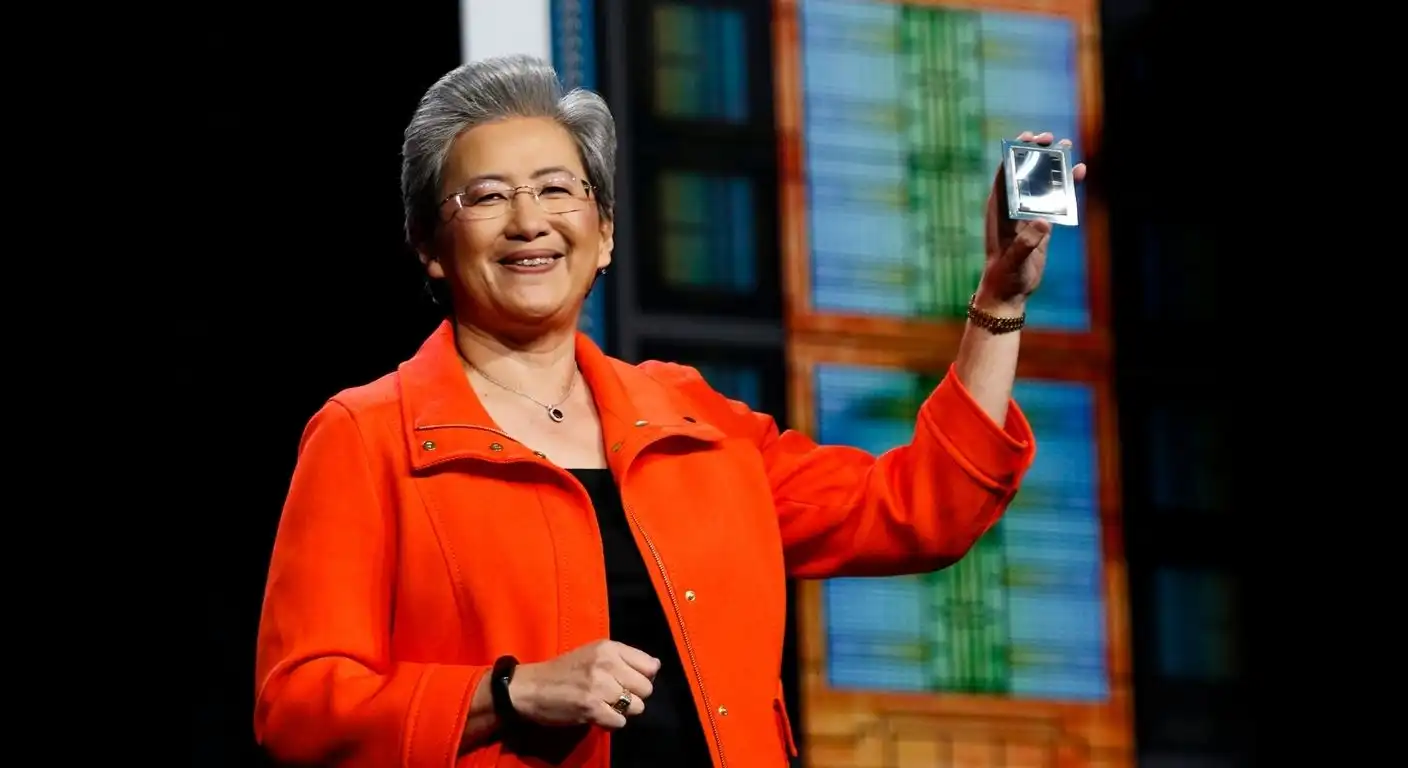
Advanced Micro Devices is launching an ambitious wave of next-generation artificial intelligence hardware to capture a computing market that executives expect to reach $2 trillion by 2030. Speaking at the Moscone Convention Center in San Francisco, AMD Chairman and Chief Executive Officer Dr. Lisa Su outlined a massive expansion of the company’s data center portfolio. To directly challenge Nvidia’s dominance in hyperscale cloud environments, AMD introduced its first-generation “Helios” server rack system alongside the flagship Instinct MI455X accelerator chip.
AMD revised its long-term financial expectations upward as enterprise demand for artificial intelligence infrastructure continues to accelerate globally. Su predicted that the AI accelerator market alone will grow at a 45% compound annual growth rate, exploding from $200 billion in 2025 to $1.4 trillion by 2030. When combined with server central processing units—a market expected to expand at a 50% annual rate to $200 billion—the broader computing opportunity will top $2 trillion by the end of the decade.
The updated forecast represents a dramatic upgrade from AMD’s prior projections. Just one year ago, leadership estimated that the AI accelerator market would reach $500 billion by 2028. Su admitted to the audience that her previous estimate proved overly conservative in hindsight as technology companies, research labs, and governments rush to build massive data centers. She emphasized that no single chip manufacturer can service the entire global demand on its own, creating a clear opening for competitive alternatives.
At the heart of AMD’s hardware expansion sits the new Instinct MI455X GPU, engineered specifically for agentic AI and trillion-parameter model workloads. Built using advanced 3D stacked packaging that combines TSMC’s 2-nanometer and 3-nanometer manufacturing nodes, the chip packs an extraordinary 320 billion transistors across 12 distinct chiplets. Each MI455X accelerator features 432 gigabytes of next-generation HBM4 high-bandwidth memory, allowing cloud providers to run massive artificial intelligence models with minimal latency.
Recognizing that cloud hyperscalers require fully integrated server cabinets rather than standalone processors, AMD showcased its new “Helios” rack-scale platform. A single Helios rack integrates over 18,000 CDNA5 GPU compute units, more than 4,600 sixth-generation EPYC “Venice” CPU cores, and 31 terabytes of HBM4 memory. Supported by Salina Data Processing Units and Vulcano AI Network Interface Cards, the Helios architecture offers an integrated computing block that competes directly with Nvidia’s Grace Blackwell and Vera Rubin systems.
AMD is positioning the Helios rack as a high-efficiency solution that maximizes output while offering superior token value for enterprise clients. Industry analysts estimate the price of a complete Helios rack system between $5 million and $5.5 million. Although the upfront hardware cost reflects premium components, AMD argues that pairing its high-core Venice CPUs with high-bandwidth GPUs allows cloud data centers to process significantly more AI queries per dollar compared to rival setups.
The product rollouts follow a series of massive multi-gigawatt supply agreements with top-tier artificial intelligence companies. AMD recently finalized a deal to supply up to 2 gigawatts of Instinct MI450 series chips to AI research laboratory Anthropic starting in early 2027, backed by an equity investment of up to $5 billion in the Claude creator. This agreement builds upon earlier six-gigawatt chip commitments secured with both OpenAI and Meta Platforms, ensuring AMD’s hardware will power the next generation of frontier AI models.
Commercial adoption of AMD’s rack systems is expanding rapidly across tier-one public cloud networks. Microsoft confirmed plans to deploy the Helios rack platform across its Microsoft Azure cloud infrastructure starting later this year. Specialized AI cloud infrastructure providers, including Vultr and TensorWave, also showcased operational AMD data center clusters on the convention floor. These cloud partnerships give software developers immediate global access to AMD’s hardware and open-source ROCm software stack.
AMD’s aggressive hardware roadmap signals a fundamental shift in the global semiconductor landscape. While Nvidia currently holds roughly 95% of the data center GPU market, AMD’s ability to deliver complete rack-scale platforms combining custom CPUs, GPUs, and high-speed networking is eroding that single-vendor monopoly. By locking in long-term supply contracts with major hyperscalers and delivering continuous architectural upgrades, AMD is firmly establishing itself as an indispensable powerhouse in the multi-trillion-dollar AI revolution.






