Key Points:
- Blue Origin is launching its first-ever external funding round to raise $10 billion, valuing the rocket maker at $130 billion.
- Investment firm Coatue Management is poised to lead the historic round with a $4 billion commitment.
- Founder Jeff Bezos will personally contribute $2 billion, while the remaining $4 billion has drawn strong institutional demand.
- The capital injection will alleviate pressure on Bezos to sell Amazon stock while funding ambitious lunar lander and satellite network projects.
The commercial space race is entering a massive new phase of institutional expansion as one of the industry’s most historically reclusive players officially prepares to open its books to private capital markets. Blue Origin, the rocket enterprise founded by billionaire entrepreneur Jeff Bezos, is launching its first-ever external funding round. The company is seeking to raise a staggering $10 billion in a transaction that establishes a pre-funding valuation of $130 billion. The historic capital raise marks a fundamental departure from the company’s quarter-century history of exclusive self-funding, transforming the aerospace pioneer into a highly scrutinized, market-priced corporate player.
The finalized structure of the multi-billion-dollar transaction features a highly coordinated mix of founder commitment and institutional capital. Technology-focused asset manager Coatue Management is poised to lead the funding round with a massive $4 billion investment, representing a 40% share of the total raise. To signal his long-term confidence in the company’s competitive roadmap, Bezos will personally contribute an additional $2 billion to the round. The remaining $4 billion has already attracted intense demand from a vetted group of major global investment funds, sovereign wealth managers, and tech-focused family offices eager to secure a piece of the commercial space industry.
This sudden decision to invite outside investors builds directly on top of a highly favorable market environment created by competitors. Last month, chief rival SpaceX completed a historic initial public offering on the Nasdaq, raising nearly $86 billion and securing a peak market valuation approaching $2 trillion. The blockbuster reception of SpaceX’s listing demonstrated that institutional portfolios possess an insatiable appetite for high-barrier aerospace infrastructure. By opening its doors now, Blue Origin can capitalize on this “space sector halo effect,” using the market’s enthusiasm to secure its own premium valuation before shifting macroeconomic indicators can alter investor risk tolerance.
For the Amazon founder, the injection of $10 billion in external capital provides substantial personal and corporate relief. For 25 years, Bezos funded the rocket venture exclusively through the systematic liquidation of his personal Amazon common stock, selling approximately $1 billion in shares annually to bankroll the company’s research budgets. However, as the scale of the space race has intensified, the company’s capital requirements have swelled to an estimated $5 billion in annual spending, putting an unsustainable burden on his personal holdings. Establishing a market-based valuation benchmark allows the company to self-fund future expansions using its own equity rather than relying on continuous retail liquidations.
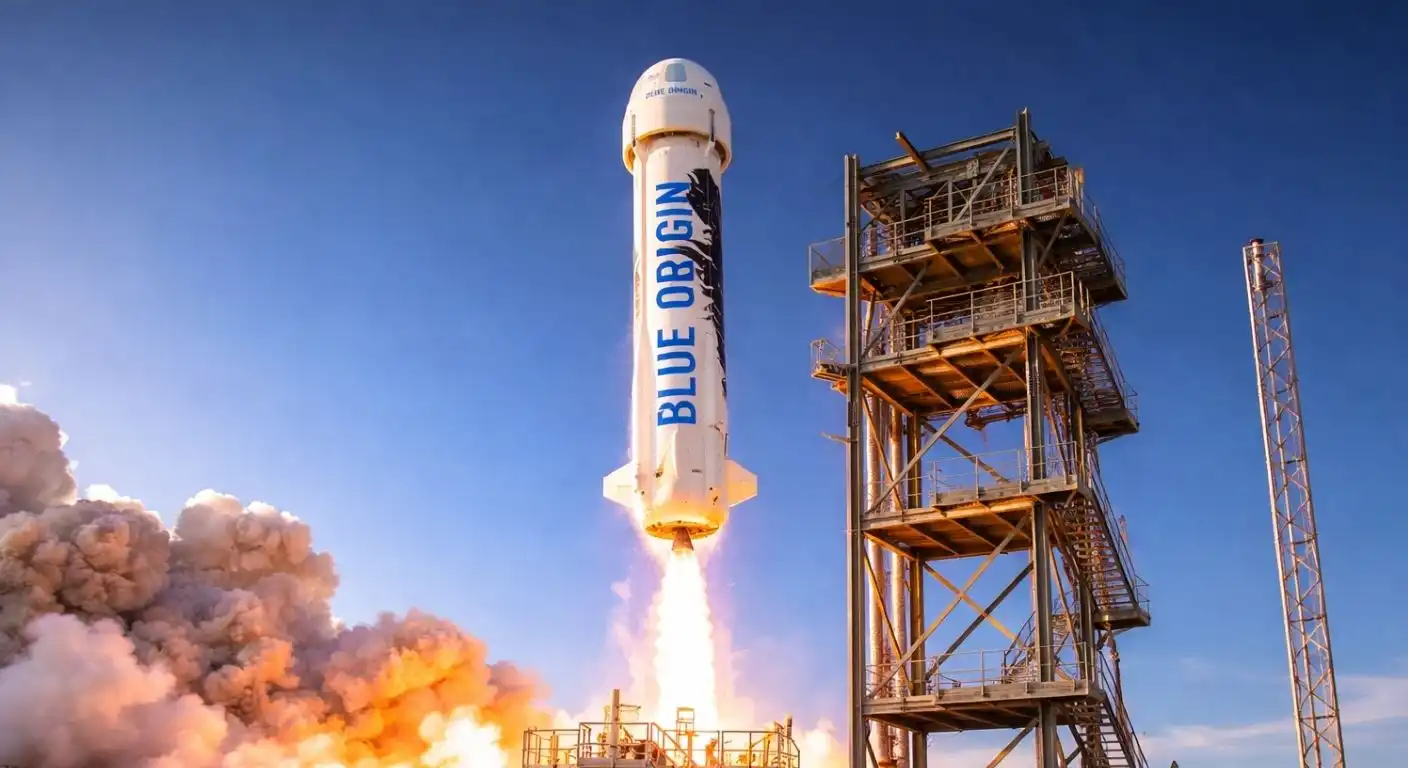
The massive capital influx will flow directly into the company’s most critical, heavy-lift hardware programs. Chief among these is the final development, testing, and volume manufacturing of the New Glenn rocket. This giant, reusable booster is designed to carry heavy commercial satellites and military payloads into Earth orbit, providing a direct, low-cost competitor to SpaceX’s dominant Falcon 9 and Falcon Heavy systems. Scaling up the New Glenn launch cadence is essential for the firm to fulfill its multi-billion-dollar commercial launch agreements, which include launching thousands of satellites for major global communication arrays over the next five years.
The funding arrives at a critical operational moment as the company recovers from a severe technical setback. In late May, a New Glenn first-stage booster exploded in a massive fireball during a static hot-fire engine test at Cape Canaveral Space Force Station in Florida. While the automated emergency protocols functioned correctly and prevented any injuries, the intense blast caused severe damage to the company’s sole active launchpad. Rebuilding the high-tech concrete and steel structures, verifying the structural integrity of the fuel transport lines, and completing the engineering review to identify the engine anomaly is expected to consume hundreds of millions of dollars and several months of intensive repair work.
Beyond standard satellite launches, the company is consolidating its role as a key strategic partner for the United States government’s deep-space exploration programs. The firm holds a massive NASA contract to design, construct, and verify the “Blue Moon” human landing system for the upcoming Artemis V mission. This highly complex lunar lander is tasked with transporting astronauts safely from lunar orbit to the South Pole of the Moon. Winning this high-profile federal contract was a major victory for the company, and deploying a portion of the $10 billion funding round to advance its cryogenic propellant systems is essential to meet NASA’s rigid launch deadlines.
The company’s long-term business strategy also extends beyond launch vehicles into the highly lucrative data transmission and processing sectors. The firm is deploying significant capital to build its TeraWave satellite communications network, a high-capacity constellation designed to provide high-speed orbital internet connections to commercial and defense clients. Additionally, engineering teams are actively working on orbital data center technology, aiming to place high-density computing servers directly into low Earth orbit to process spatial data without the latency delays of traditional ground-to-satellite relays.
Ultimately, the transition of this aerospace giant from a privately funded passion project into a multi-billion-dollar commercial powerhouse marks a critical milestone in the privatization of space. By opening its doors to external investment, the company has secured the financial war chest necessary to survive the capital-intensive infrastructure phase of the new space economy. The coming months will reveal how quickly the new owners can repair their launch infrastructure, complete the New Glenn maiden flight, and begin executing on their massive backlog of commercial and federal contracts. But for now, the successful structuring of this historic $10 billion funding round has officially cemented the firm’s position as a permanent, sovereign pillar of the global space industry.