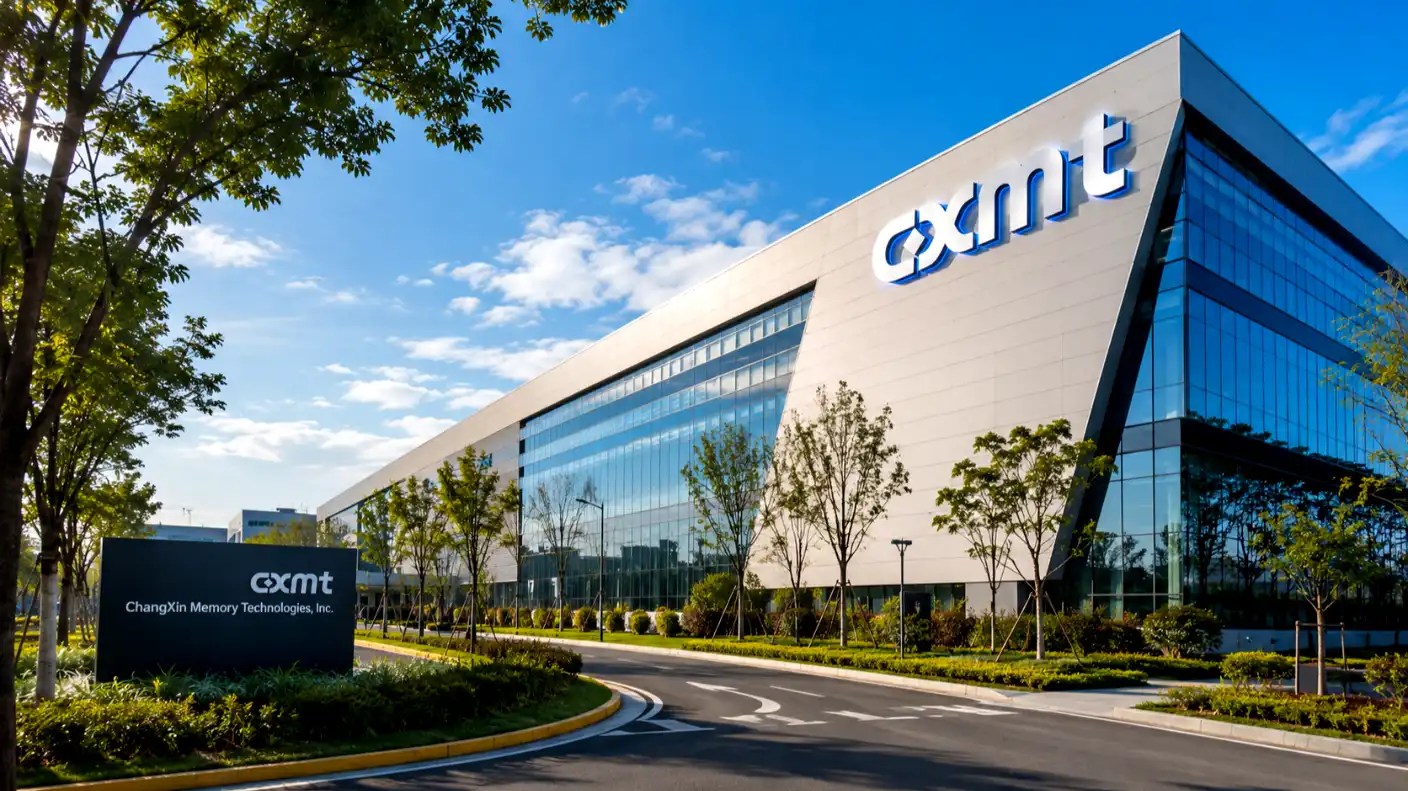
Key Points:
- ChangXin Memory Technologies reported first-half revenue surged 873.6% year-on-year to reach 150.31 billion yuan ($22.4 billion).
- Net profit swung into the black, reaching 77.61 billion yuan ($11.6 billion) compared to a 2.33 billion yuan loss in the prior-year period.
- Strong global DRAM shortages driven by artificial intelligence infrastructure expansion pushed the company’s gross margin to 84.84%.
- CXMT secured fourth place in global DRAM market share while shipping initial samples of its next-generation LPDDR6 memory chips.
China’s premier memory semiconductor manufacturer, ChangXin Memory Technologies, delivered an explosive turnaround in its debut financial report as a public company. Disclosing its interim financial results, the Hefei-based chipmaker revealed that first-half revenue surged nearly tenfold year-over-year. Driven by an unprecedented global shortage of dynamic random-access memory and soaring chip prices fueled by the artificial intelligence boom, the company generated multi-billion-dollar net profits, vastly outperforming its pre-listing guidance.
For the six-month period ending in June, the semiconductor company posted total consolidated revenue of 150.31 billion yuan, equivalent to approximately $22.4 billion. The top-line result reflects a staggering 873.64% increase compared to the same period in the previous year. Net profit attributable to shareholders reached 77.61 billion yuan ($11.6 billion), marking a dramatic swing into profitability after recording a net loss of 2.33 billion yuan during the first half of 2025. In just six months, the enterprise surpassed its total financial performance for all of last year.
Profitability scaled rapidly as the year progressed. The company generated 52.84 billion yuan ($7.9 billion) in net profit during the second quarter alone, representing a 113% sequential increase from the 24.76 billion yuan posted in the first three months. The interim results crushed the company’s pre-initial public offering guidance by roughly 25% on revenue and 36% on net profit, fueled by an exceptional gross profit margin of 84.84% and net operating cash flows surging past 131.15 billion yuan.
The primary catalyst driving the company’s financial surge is an acute structural shortage in the global memory market. As cloud hyperscalers and tech giants race to construct artificial intelligence data centers, dominant international memory fabricators—including Samsung Electronics, SK Hynix, and Micron Technology—reallocated massive portions of their wafer capacity toward high-value High Bandwidth Memory modules. This supply shift starved the broader technology sector of standard server, PC, and smartphone DRAM, causing prices for DDR4 and DDR5 memory to skyrocket and handing high-volume fabricators immense pricing power.
The enterprise capitalized on this supply crunch by rapidly ramping up output of higher-margin memory generations. Revenue from DDR-series memory reached 69.47 billion yuan, accounting for 46.3% of the company’s core business sales, up sharply from 31.9% last year. As PC manufacturers, workstation builders, and server assemblers struggled to secure memory allocations from Western suppliers, the Chinese chipmaker expanded commercial shipments to major clients, including Alibaba Cloud, ByteDance, Tencent, Lenovo, and Xiaomi.
The revenue explosion cemented the company’s standing on the global semiconductor stage. Market research data shows that the manufacturer solidified its ranking as the world’s fourth-largest DRAM producer by revenue, capturing roughly 7% to 9% of the global market. While the company still trails international leaders Samsung Electronics at 39%, SK Hynix at 26%, and Micron Technology at 25%, it has established itself as the first Chinese enterprise capable of competing at large commercial scale against the traditional memory triumvirate.
Beyond standard server memory, the manufacturer is accelerating research on mobile and automotive memory platforms. Corporate filings confirmed that the enterprise has begun shipping verification samples of its self-developed LPDDR6 memory chips to key smartphone and automotive clients. The next-generation low-power chip achieves peak data transfer speeds of up to 12,800 megabits per second with a maximum capacity of 16 gigabytes, marking the first time a Chinese memory maker has entered the commercialization race for a new mobile memory standard alongside global frontrunners.
Despite the blowout financial performance, corporate leadership warned that the business faces complex international trade risks. The company noted that geopolitical friction, tightening export controls on advanced semiconductor equipment, and potential international sanctions pose ongoing supply chain challenges. To mitigate these vulnerabilities, the enterprise invested 6.86 billion yuan into research and development during the first half, maintaining a specialized research workforce of 7,491 engineers and amassing over 7,800 domestic and international patents.
As the global artificial intelligence boom continues to strain semiconductor manufacturing capacity, the memory market’s pricing power shows no signs of cooling down. Management projects that the worldwide DRAM shortage will persist through the remainder of the year, providing strong tailwinds for continued revenue expansion. By converting global memory deficits into record-breaking profits and advancing into next-generation silicon architectures, ChangXin Memory Technologies is proving that China’s domestic semiconductor strategy is achieving formidable commercial maturity.