Key Points:
- Commercial space enterprise LandSpace successfully recovered the first stage of its Zhuque-3 orbital rocket on land using landing legs.
- The 66.1-meter stainless-steel rocket delivered the Honghu-03 internet satellite into orbit before touching down in Gansu Province.
- The achievement makes China the second country after the United States to recover an orbital-class rocket booster on land.
- The mission validates liquid oxygen-methane propulsion and stainless-steel manufacturing as China builds low-cost reusable space constellations.
The global space race has entered a transformative new phase as reusable launch technology takes root outside the United States. In a major aerospace milestone, a massive rocket booster touched down vertically in the desert terrain of northwestern China, marking the country’s first-ever successful land recovery of an orbital-class launch vehicle. The accomplishment, achieved by Beijing-based private space enterprise LandSpace, represents a vital engineering leap in the push to lower launch costs and narrow the technological gap with American launch pioneer SpaceX.
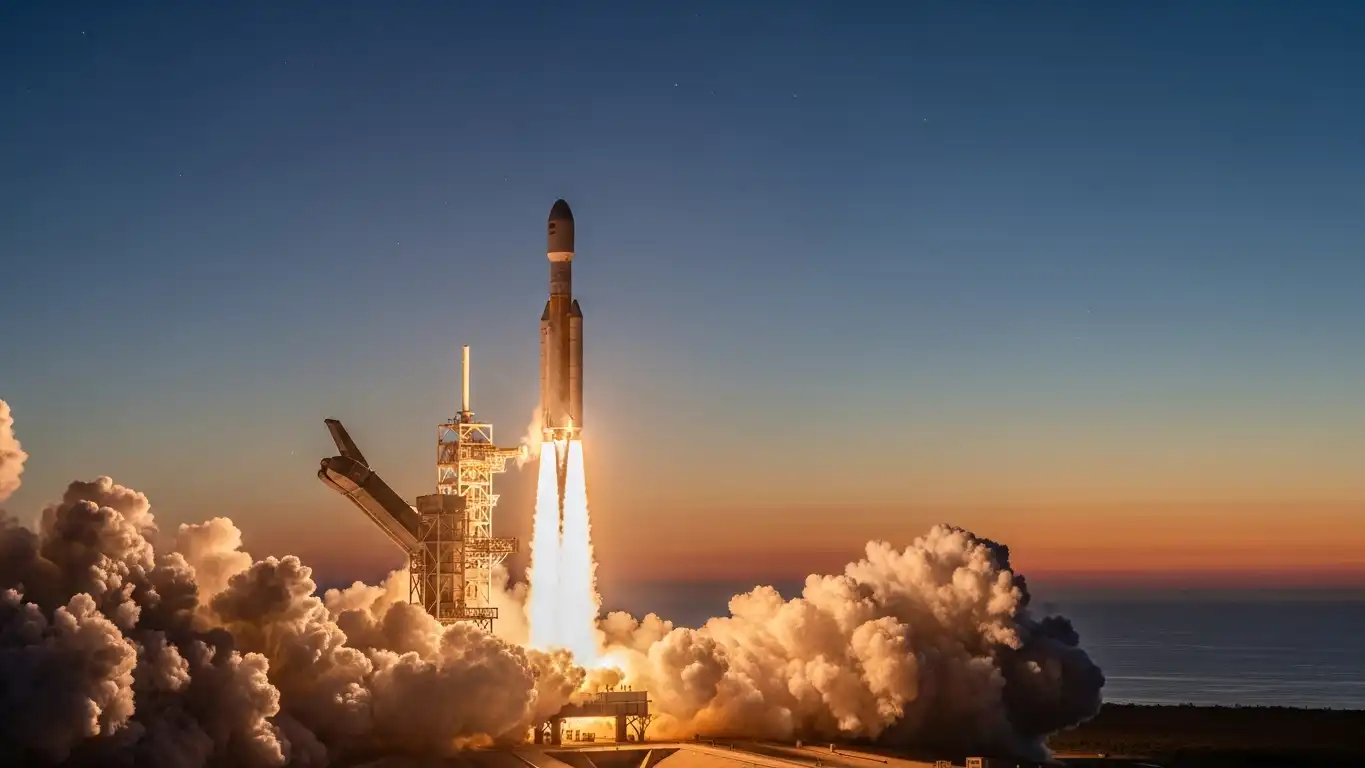
The high-stakes mission centered on the Zhuque-3 Y2 carrier rocket, a 66.1-meter-tall launch vehicle powered by liquid oxygen and methane engines. Lifting off from the Jiuquan Satellite Launch Center in the Gobi Desert, the rocket carried the Honghu-03 internet communications satellite into orbit. While previous Chinese recovery tests focused on short low-altitude hops or sea-based captures, this mission marked the first time a private Chinese firm launched a payload into orbit and guided the booster back to terra firma using deployable landing legs.
The flight sequence unfolded with precision across hundreds of kilometers. Approximately 137 seconds after liftoff, the rocket’s first and second stages separated at the edge of space. While the upper stage continued upward to place the satellite into its designated orbital path, the booster initiated a controlled descent back through the atmosphere. Navigating with aerodynamic grid fins, the booster reignited its central engine at an altitude of roughly 3 kilometers above the ground to decelerate, deployed four landing legs, and touched down upright on a concrete landing pad in Minqin County, Gansu Province, roughly 390 kilometers southeast of the launch pad.
The engineering architecture of the Zhuque-3 highlights a distinct technological direction. Unlike the Falcon 9, which uses aluminum-lithium alloy and kerosene propellant, the Chinese booster uses cold-rolled stainless steel and liquid methane. Stainless steel provides superior thermal resistance during intense atmospheric re-entry and substantially lowers manufacturing expenses. At the same time, liquid methane burns cleaner than traditional rocket kerosene, preventing heavy carbon buildup inside engine nozzles and enabling rapid refurbishment between flights.
This successful land recovery follows an earlier breakthrough where state-owned aerospace contractors tested a sea-based net-capture recovery system for the Long March 10B rocket. By developing parallel recovery architectures—state-backed platforms for crewed lunar exploration alongside private commercial ventures for orbital cargo—China is establishing a dual-track aerospace ecosystem. This competitive dynamic accelerates technology verification, transforming rocket recovery from an experimental novelty into standard operational practice.
Developing reusable rockets is essential for China’s broader space ambitions, particularly the deployment of massive low-Earth-orbit broadband constellations. National projects like Qianfan and Guowang require launching tens of thousands of satellites over the next decade to build a global communications network. Without reusable launch vehicles, manufacturing expendable rockets for thousands of satellites would create unsustainable financial and manufacturing bottlenecks. Recovering first-stage boosters slashes launch costs dramatically, enabling commercial operators to increase launch frequency.
The successful recovery also provides a major boost to LandSpace’s commercial roadmap. The startup is currently preparing an initial public offering on the Shanghai Stock Exchange sci-tech innovation board, aiming to raise 7.5 billion yuan, equivalent to roughly $1 billion. Demonstrating reliable booster recovery gives institutional investors concrete proof of engineering maturity as the firm targets full commercial operations and long-term profitability before the end of the decade.
By nailing the vertical land touchdown, the private enterprise joins a select global club alongside SpaceX and Blue Origin, capable of recovering orbital rocket boosters intact. With a payload capacity capable of lifting up to 14.2 metric tons to low-Earth orbit, the launch vehicle offers commercial satellite operators an affordable alternative for orbital deployment. As factory assembly lines scale up, the company plans to increase its annual launch cadence to serve both domestic satellite networks and international commercial clients.
The successful land recovery of the Zhuque-3 signals a permanent end to the era of disposable rocketry in China. As global demand for satellite broadband, scientific research, and orbital infrastructure continues to soar, building reusable launch capacity ensures that commercial space transport becomes as routine and economical as commercial aviation. By mastering propulsive vertical landings, China’s commercial space sector establishes a solid foundation to compete at the absolute forefront of the global aerospace industry.