Key Points:
- China released its 15th Five-Year Plan targeting new energy vehicles to account for 70% of new passenger car sales by 2030.
- The plan mandates a 40% electrification target for commercial vehicles and large-scale autonomous driving on public roads.
- Energy standards target average EV power consumption of 11.5 kWh per 100 km and hybrid fuel usage of 3.3 liters per 100 km.
- Authorities introduced strict controls on factory overcapacity, halting disorderly subsidies and consolidating inefficient automakers.
Chinese government authorities unveiled a comprehensive industrial roadmap for the automotive sector, setting an official target for new energy vehicles to account for 70% of all domestic passenger car sales by 2030. Jointly released by nine state departments, including the Ministry of Industry and Information Technology and the National Development and Reform Commission, the 15th Five-Year Plan for the intelligent connected vehicle sector establishes sweeping benchmarks for electrification, autonomous driving, energy efficiency, and industrial consolidation through 2030.
The policy blueprint establishes distinct sales targets across different automotive segments over the five-year cycle spanning 2026 through 2030. While new energy vehicles—which encompass pure battery-electric cars, plug-in hybrids, and hydrogen fuel-cell models—must reach 70% of new passenger vehicle sales, the plan mandates that electric and alternative-fuel models capture 40% of all new commercial vehicle sales by 2030. The ambitious commercial vehicle target reflects an aggressive state push to electrify municipal bus fleets, urban delivery vans, and heavy-duty freight trucks.
The 70% passenger car benchmark formalizes China’s rapid market transition as domestic consumers switch to electric mobility faster than previously forecast. Monthly new energy vehicle penetration rates across China recently crossed the 60% mark, reaching roughly 65% in recent summer months as price competitiveness and expanding charging infrastructure accelerated adoption. By establishing a 70% baseline, policymakers aim to transition the domestic auto market away from pure volume expansion toward high-quality technological leadership and software integration.
Autonomous driving deployment serves as the central technological pillar of the 2030 roadmap. The five-year plan directs automakers and technology developers to achieve large-scale commercial deployment of high-level automated driving systems across national expressways, urban highways, and selected city streets before the end of the decade. Crucially, the directive establishes a strict safety performance mandate, requiring autonomous driving systems to substantially outperform human drivers on collision prevention and road safety before securing commercial fleet approvals.
In addition to market penetration and autonomy, the government introduced stringent vehicle efficiency and energy consumption benchmarks. Under the new standards, the average fuel consumption of traditional and hybrid passenger vehicles must drop to 3.3 liters per 100 kilometers by 2030. For battery-electric passenger cars, the plan mandates that average power consumption must fall to approximately 11.5 kilowatt-hours per 100 kilometers, pushing automakers to develop aerodynamic vehicle bodies, efficient silicon carbide inverters, and lightweight chassis materials.
The strategic roadmap also functions as an aggressive cleanup mechanism to address chronic domestic manufacturing overcapacity and curb destructive price wars. The plan establishes strict regulatory conditions for approving new standalone vehicle manufacturing projects, while tightening state oversight over battery production capacity and regional industrial parks. Regulators are ordering municipal governments to eliminate inappropriate regional subsidies, encouraging mergers and acquisitions to eliminate unprofitable automakers and consolidate factory assembly lines.
To elevate manufacturing efficiency, the plan mandates a 15% increase in industry-wide labor productivity per worker compared to 2025 baselines. Automotive manufacturers must accelerate the deployment of smart manufacturing robotics, digital twins, and artificial intelligence quality inspection systems across factory cleanrooms. By modernizing production lines, Beijing aims to elevate multiple Chinese automotive conglomerates into the world’s top 10 automakers by global sales volume, while propelling dozens of domestic parts suppliers into the global top 100 auto parts rankings.
The five-year roadmap emphasizes disciplined international expansion to protect Chinese automakers from rising geopolitical trade barriers. While Chinese vehicle exports expanded rapidly to exceed 5 million units in recent months, the government is directing automakers to shift away from simple vehicle dumping. The directive instructs carmakers to build local assembly plants, establish regional spare-parts supply warehouses, comply with foreign data privacy laws, and cooperate with international engineering firms to establish durable overseas operations across Europe, Southeast Asia, and Latin America.
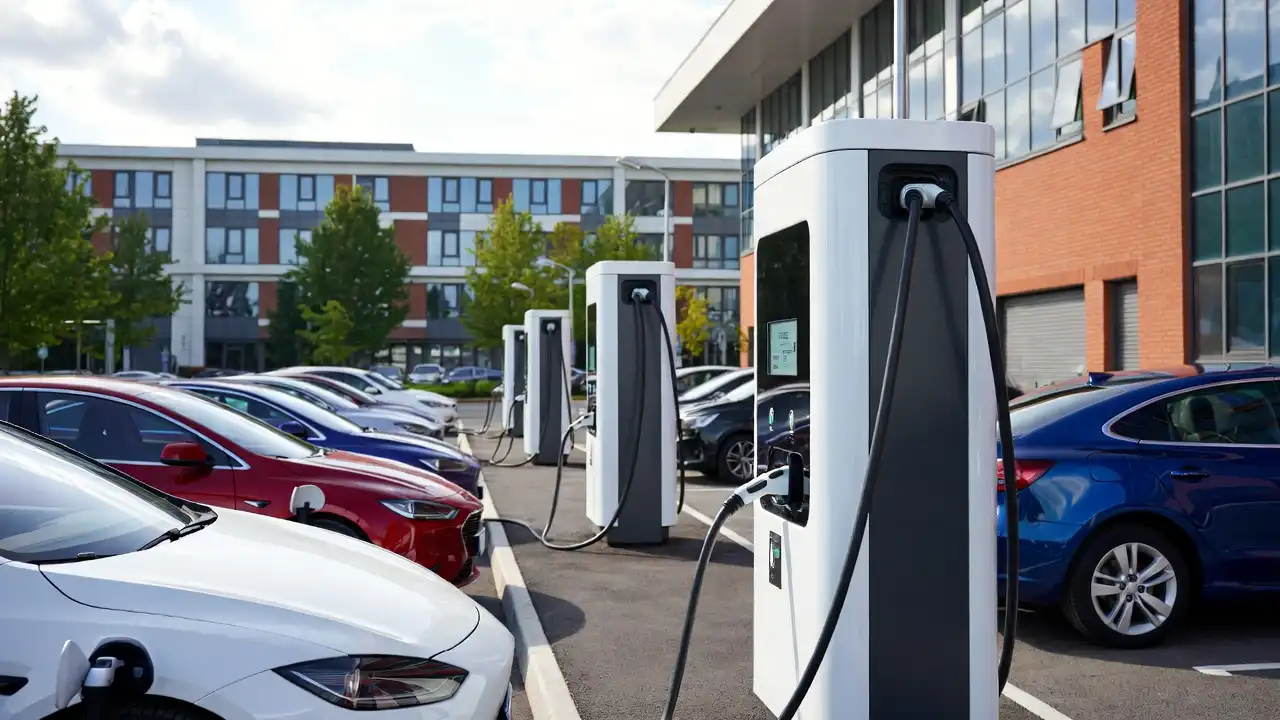
Supporting physical and digital infrastructure will undergo substantial upgrades to support the 2030 targets. The plan accelerates the rollout of vehicle-road-cloud integration across major first- and second-tier metropolitan centers, equipping thousands of kilometers of urban expressways with smart cellular sensors and 5G-Advanced communication beacons. China already operates roughly 23 million electric vehicle charging piles, and the government plans to expand ultra-fast megawatt charging stations along national highway corridors to eliminate range anxiety for long-distance drivers.
As government ministries and automotive manufacturers begin implementing the 15th Five-Year Plan, the policy sets a definitive trajectory for the future of global mobility. By combining 70% domestic electrification targets with strict capacity controls, mass-scale autonomous driving, and global brand building, China is transforming its automotive sector from a fast-growing manufacturing hub into a technologically dominant, self-reliant global automotive powerhouse.