Key Points:
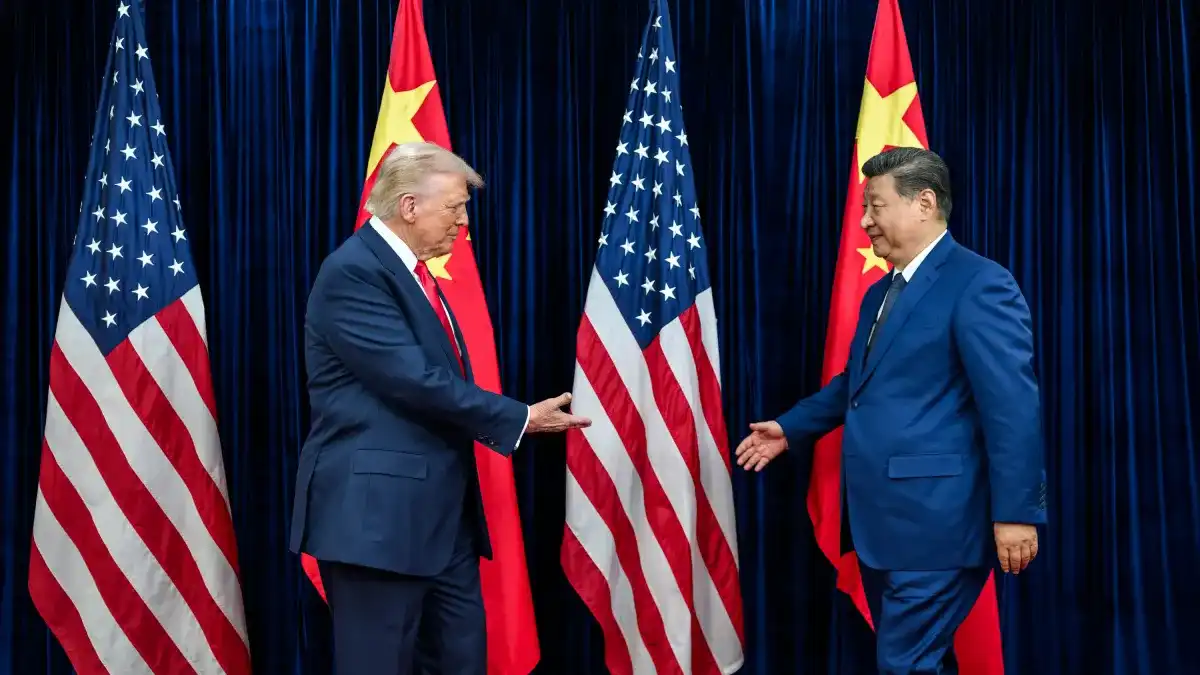
- US President Donald Trump and Chinese President Xi Jinping are meeting in Washington to negotiate trade, tariffs, and technology.
- The White House postponed a trade report recommending a 7.5% tariff on Chinese goods to preserve negotiating room.
- Talks focus on extending a one-year trade truce, lifting Chinese rare earth export curbs, and easing US chip sanctions.
- European Union officials are watching the summit closely ahead of their own high-level trade negotiations with Beijing.
United States President Donald Trump and Chinese President Xi Jinping are preparing for a pivotal bilateral summit in Washington, holding high-stakes discussions that could dictate the trajectory of the global economy. The meeting between the leaders of the world’s two largest economic powers covers contentious issues spanning import tariffs, semiconductor export restrictions, critical mineral supply bottlenecks, and artificial intelligence governance. Financial markets and international corporate leaders are watching closely to see whether the two superpowers can extend a fragile one-year trade truce or trigger a renewed cycle of retaliatory economic warfare.
At the core of the diplomatic agenda is the future of the bilateral trade truce that temporarily halted new tariffs following previous talks in Beijing. Chinese negotiators want to extend the tariff detente through the remainder of the presidential term to give Chinese manufacturers stable access to American markets during a domestic economic transition. However, American trade negotiators are pushing for a shorter, performance-based extension to maintain economic leverage and compel Beijing to fulfill multi-billion-dollar agricultural purchase pledges and remove bureaucratic non-tariff trade barriers.
To preserve a constructive negotiating atmosphere ahead of the summit, the White House postponed the release of a comprehensive Section 301 trade investigation into China’s manufacturing overcapacity. The delayed federal report had recommended imposing an additional 7.5% tariff on Chinese manufactured imports, which would have lifted cumulative second-term duties on Chinese goods to roughly 20%. Delaying the tariff announcement allows negotiators to use the proposed duties as bargaining leverage during closed-door meetings rather than sparking pre-summit retaliatory measures.
Critical mineral export restrictions represent one of the most contentious flashpoints confronting both leaders. In response to Western semiconductor sanctions, Beijing enacted strict export quotas on non-radioactive rare earths, gallium, germanium, and graphite. These export restrictions have created severe supply chain bottlenecks for American and European defense contractors, automotive manufacturers, and renewable energy developers. United States trade officials are demanding that China lift mineral export curbs and guarantee open access to refined permanent magnet materials.
In return, Chinese delegates are pushing Washington to roll back sweeping export controls on advanced semiconductor hardware and semiconductor manufacturing equipment. Over the past three years, the United States Commerce Department has restricted shipments of high-performance graphics processing units, high-bandwidth memory chips, and extreme ultraviolet lithography tools to Chinese technology companies. Beijing argues that technological blockades violate international trade principles, while American officials maintain that hardware restrictions are essential to prevent foreign military modernization.
Artificial intelligence governance and software development have also emerged as central themes on the summit agenda. The United States continues to champion proprietary, high-security frontier models, while China is actively promoting open-weight software architectures across the Global South through multilateral platforms like the BRICS alliance. Scientific and security advisory groups from both nations have urged the leaders to establish nuclear-style safeguards, including mandatory human-in-the-loop controls for nuclear arsenals and bilateral crisis communication hotlines to prevent rogue autonomous software breakouts.
Geopolitical friction surrounding Middle Eastern energy trade adds further complexity to the economic negotiations. While American forces have launched military strikes against Iranian targets near the Strait of Hormuz to defend commercial shipping routes, China remains the largest buyer of Iranian crude oil and maintains extensive diplomatic ties with Tehran. United States officials are pressing Beijing to use its economic leverage over Middle Eastern oil exporters to help de-escalate maritime hostilities that have pushed global Brent crude oil prices near $100 per barrel.
Global financial markets are exhibiting cautious optimism ahead of the Washington meetings. Institutional investor sentiment surveys show that roughly 38% of onshore Chinese investors expect incremental commercial progress from the talks, compared to 26% of international fund managers who anticipate a largely symbolic detente. Equity traders hope that even a narrow agreement to extend the trade truce and finalize agricultural purchase orders will remove near-term volatility across global stock exchanges.
European Union policymakers are following the Washington summit with intense scrutiny ahead of their own bilateral trade meetings with Beijing next month. European trade officials warned that if China redirects factory surpluses away from the United States into European markets, Brussels will deploy punitive anti-dumping tariffs on Chinese electric vehicles, solar modules, and industrial steel. European leaders are demanding that China present concrete market-opening concessions to prevent a multi-front trade confrontation with Western democracies.
As government advance teams finalize summit security protocols in Washington, the meeting between Donald Trump and Xi Jinping represents a critical juncture for international commerce. Whether the two leaders forge a durable trade compromise or retreat into escalating tariff battles will determine the resilience of global supply chains, the pace of technological innovation, and the stability of the worldwide economy for years to come.