Key Points:
- A senior Unitree executive warned that the humanoid robotics sector is two to five years away from a definitive “GPT moment” breakthrough.
- While advanced AI models perform well in software, they struggle to reliably control physical machines under unpredictable real-world conditions.
- Disclosed financial metrics reveal that 74% of Unitree’s recent humanoid revenue came from research and education, with only 9% from industry.
- To accelerate adoption, the manufacturer slashed hardware prices, launching its compact G1 robot at 99,000 yuan ($13,780).
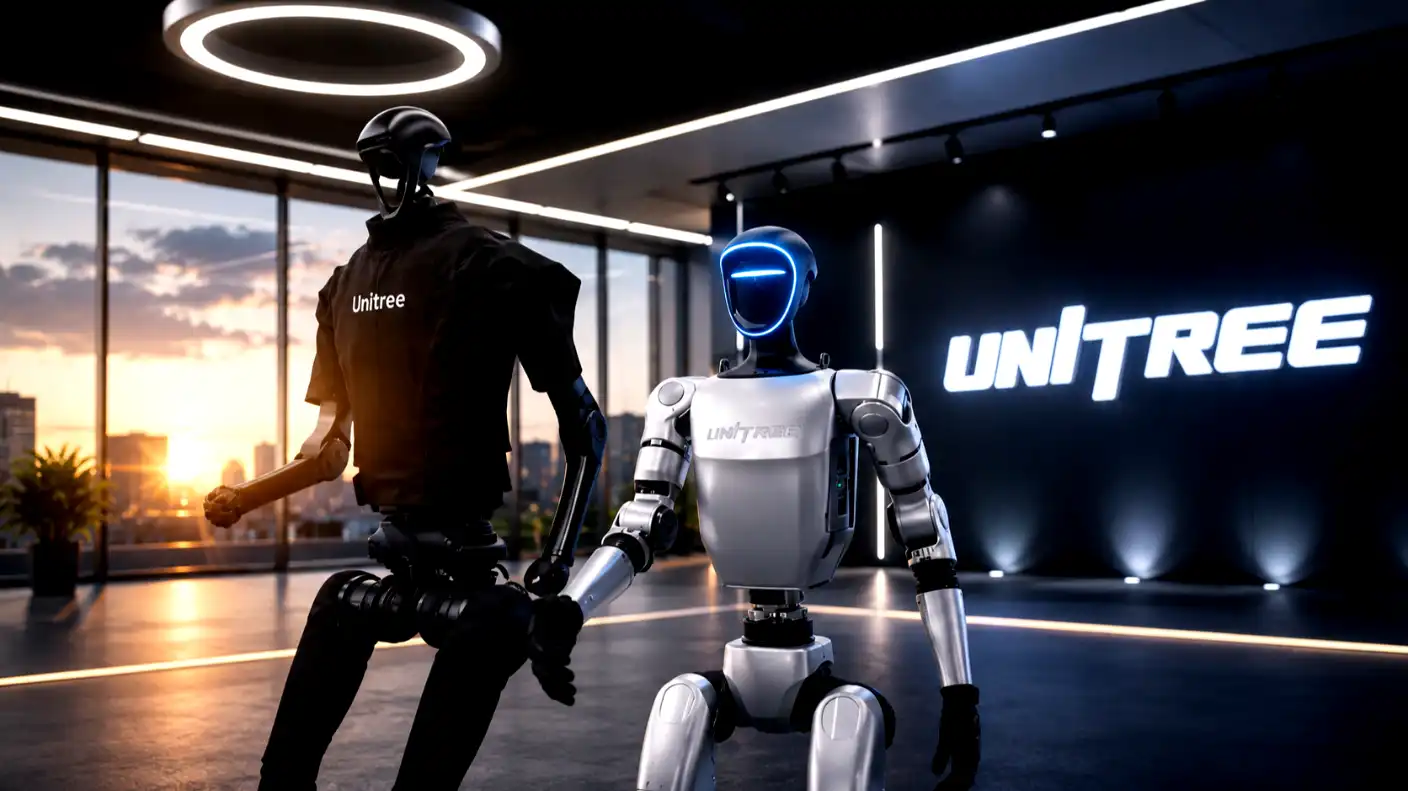
The highly anticipated “ChatGPT moment” for physical machines remains years away, as the robotics industry struggles to bridge the massive gap between laboratory demonstrations and real-world industrial deployment. During a prominent international technology summit in Tokyo, Irving Chen, who leads Asia-Pacific operations for Chinese robotics pioneer Unitree Robotics, warned that the humanoid robotics sector is still two to five years away from a breakthrough. While advanced software models perform exceptionally well in digital environments, translating those cognitive capabilities into physical machines that can navigate unpredictable real-world conditions continues to present massive engineering and technical hurdles.
The primary obstacle preventing a rapid breakthrough is the sheer unpredictability of the physical world. While a large language model operates within the structured, digital rules of text and code, a humanoid robot must constantly perceive and respond to an infinite variety of physical variables, such as shifting terrain, uneven lighting, changing friction, and moving obstacles. This means that a software model capable of generating elegant computer code or writing complex essays is still fundamentally incapable of reliably controlling a mechanical body tasked with a seemingly simple, everyday chore like clearing a cluttered table or fetching a bottle of water in an unfamiliar room.
This technical limitation is directly reflected in the industry’s current sales and distribution metrics. While global excitement over humanoid robots has reached an all-time high, the commercial deployment of these machines in active factories remains extremely limited. Disclosed financial data reveals that a staggering 74% of the company’s humanoid robot revenue during the first nine months of the previous year originated strictly from academic research institutions and educational laboratories. In contrast, active industrial applications accounted for a minor 9% of total sales, proving that the technology remains firmly in its pre-commercial development phase.
This massive commercial gap highlights a critical distinction between what robots can do on a controlled stage and what they can reliably accomplish in a factory. At major international technology exhibitions, bipedal and quadruped robots routinely dazzle audiences by performing complex gymnastic routines, martial arts flips, and coordinated dances. However, these spectacular public performances rely almost entirely on pre-programmed scripts, highly structured environments, and continuous remote-operator guidance. A robot that can repeat a highly rehearsed, difficult routine is still completely different from a robot that can solve a simple, but entirely unpredictable, real-world task.
Despite these near-term operational limitations, Chinese manufacturers are aggressively driving down the cost of physical hardware to accelerate developer adoption. The industry leader has recently implemented massive price cuts, launching its highly compact G1 humanoid robot with a starting price of 99,000 yuan ($13,780) and its lightweight R1 consumer-facing model at just 39,900 yuan ($5,500). By lowering the retail price of these advanced mechanical bodies by more than 90%, the manufacturer is attempting to make humanoid hardware accessible to thousands of independent software developers and university laboratories, hoping to crowdsource the necessary algorithmic breakthroughs.
The ultimate solution to the physical AI bottleneck will rely on the development of highly sophisticated “world models” rather than traditional, brute-force reinforcement learning. A world model acts as a highly realistic, physics-grounded digital twin of the environment, allowing an AI agent to simulate, predict, and practice millions of potential physical actions in virtual space before executing them in the real world. By building these deep, intuitive understandings of physical laws—such as gravity, momentum, and material resistance—directly into the robot’s brain, developers can successfully train machines to react safely to unexpected, real-world scenarios.
These capital-intensive technological pursuits require massive, ongoing cash reserves, prompting the industry’s leading players to launch ambitious public listings. The Hangzhou-based robotics pioneer has initiated formal preparations for a massive domestic initial public offering (IPO) on Shanghai’s STAR Market, aiming to raise 4.2 billion yuan (approximately $619.4 million) to fund its advanced R&D. Simultaneously, its fastest-growing domestic competitor, AgiBot, has hired major investment banks to coordinate a high-profile IPO on the Hong Kong Stock Exchange, proving that the sector is rapidly transitioning from venture-backed startups to institutional, publicly traded corporations.
This rapid, state-backed capital and manufacturing expansion has triggered deep economic and national security anxieties in Western capitals. Backed by extensive government subsidies and a highly integrated, domestic supply chain, Chinese manufacturers currently dominate the global humanoid market, accounting for nearly 90% of all international shipments. This massive industrial dominance allows Chinese firms to scale up production and lower costs at a pace that Western startups find impossible to match, raising concerns that the United States and Europe risk losing control over the vital hardware foundations of the future robotics economy.
While general-purpose humanoid robots remain several years away from their definitive “GPT moment,” immediate commercial opportunities are emerging in highly specialized, structured industrial environments. Fixed robotic arms, automated guided vehicles, and specialized legged robots have benefited from decades of operational refinement. These systems are already delivering measurable improvements in safety and efficiency by replacing human workers in dangerous, highly repetitive, and predictable environments, such as high-voltage power-grid inspections, underground mining operations, and hazardous chemical manufacturing.
Ultimately, the sober projections from the industry’s leading executives demonstrate that the transition to embodied artificial intelligence will require a highly disciplined, multi-year engineering commitment. While the rapid reduction in hardware costs and the launch of massive public listings prove that the physical robotics sector is maturing quickly, the software brains required to navigate the unpredictable real world remain inadequate. As developers work to compile hundreds of millions of hours of real-world training data and refine their world models over the next two to five years, the global robotics revolution will continue to advance, eventually bringing the power of autonomous machines directly into daily human life.