Key Points:
- Chinese AI pioneer Z.ai completed a massive 1-gigawatt data center running entirely on domestic silicon with no Nvidia chips inside.
- The project marks a historic milestone in Beijing’s multi-billion-dollar effort to replace U.S.-restricted semiconductor hardware.
- Z.ai is on track to hit $1 billion in annualized recurring revenue, making it the first Chinese AI developer to reach this milestone.
- The milestone coincides with China’s broader plan to invest 2 trillion yuan ($295 billion) over five years in nationwide computing networks.
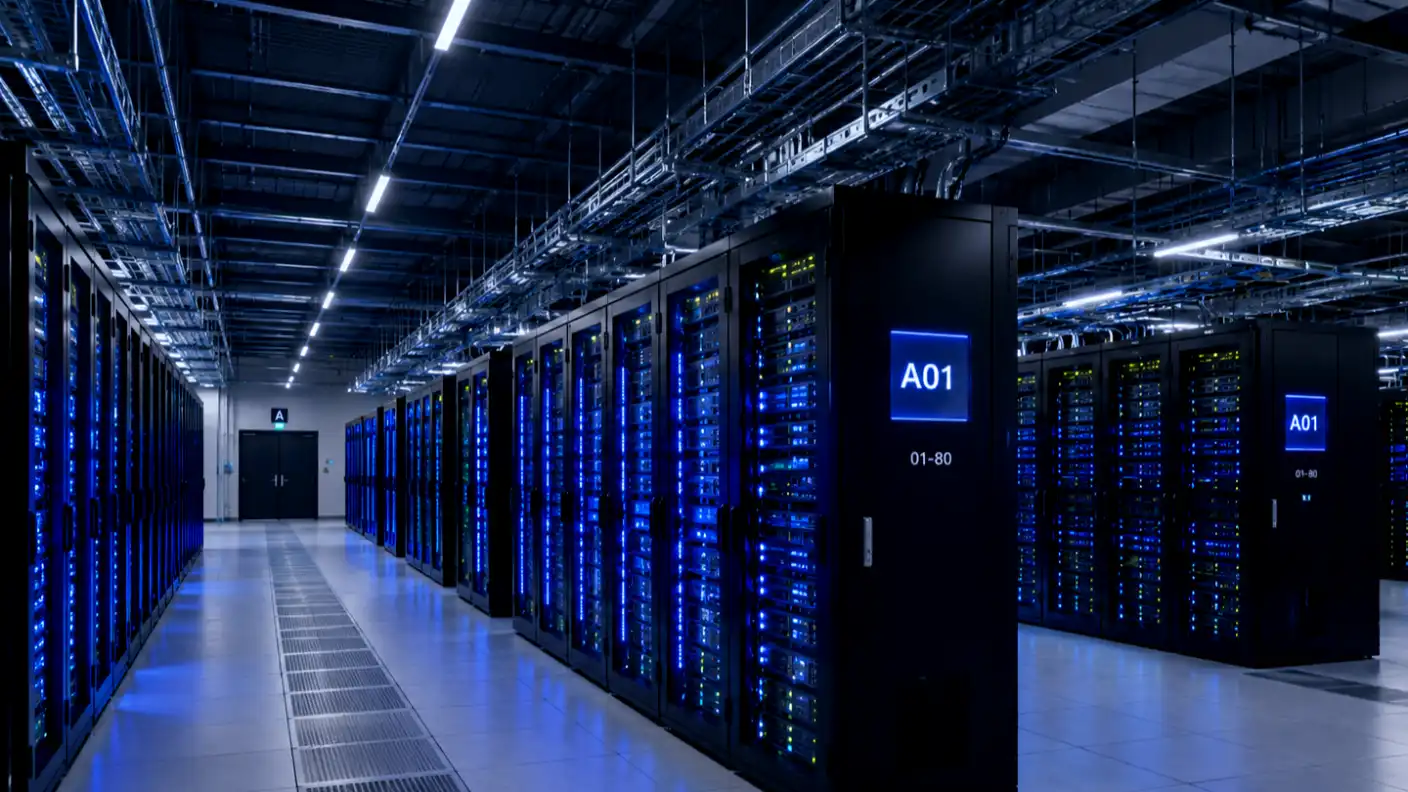
A major technological breakthrough has reshaped the global artificial intelligence landscape as a prominent Chinese AI lab successfully bypassed Western semiconductor restrictions. The Beijing-based artificial intelligence firm Z.ai has completed construction of a massive, 1-gigawatt (1GW) data center running entirely on Chinese-made silicon. This Z.ai Chinese Chip Data Center milestone proves for the first time that homegrown hardware can support large-scale foundation model training without relying on restricted Nvidia processors, signaling a decisive shift toward technological self-sufficiency in East Asia.
The completion of this gigawatt-scale computing facility marks a major victory in Beijing’s aggressive, multi-billion-dollar campaign to replace foreign high-tech hardware. For several years, strict U.S. export controls have blocked Chinese laboratories and cloud providers from purchasing Nvidia’s most advanced graphics processing units (GPUs). This hardware blockade initially raised doubts over whether the country’s domestic developers could stay competitive in the global AI race. By building a massive supercluster completely free of Western chips, the startup has proved that domestic semiconductor architectures are ready to handle the most demanding training workloads.
While the company has kept the exact suppliers of the computer chips confidential, local semiconductor designers have made rapid strides to close the technological gap with Nvidia. Huawei Technologies stands as the country’s leading developer of advanced AI accelerators, alongside local competitors such as Cambricon and Alibaba’s T-Head semiconductor division. These domestic firms have aggressively optimized their hardware and software compilation layers, allowing massive server clusters to execute complex deep-learning computations with high efficiency, even when running on older-generation manufacturing nodes.
The newly completed 1GW data center will serve as the primary computational engine to train the company’s proprietary “GLM” (General Language Model) family of open-source large language models. The startup, which spun out of Beijing’s Tsinghua University in 2019, has committed significant resources to developing models specialized in coding, complex logical reasoning, and autonomous agent workloads. Having direct access to a dedicated, high-capacity domestic supercluster ensures that the engineering team can continuously train and update its flagship models at a rapid pace without facing external hardware constraints.
This technological breakthrough coincides with an extraordinary commercial expansion that has catapulted the company to the forefront of the global software industry. The startup is officially on track to become the first independent artificial intelligence developer in China to generate more than $1 billion in annual recurring revenue. This milestone highlights the massive domestic demand for enterprise-focused cloud services, custom data center deployments, and automated coding assistants, establishing the firm as a highly viable commercial rival to Western giants like OpenAI and Anthropic.
The speed at which the company scaled its operations has completely shattered previous industry expectations. The firm’s annual recurring revenue increased approximately 15-fold in just five months, moving from a $100 million annualized run rate to the $1 billion threshold. By comparison, prominent U.S. startup Anthropic required roughly 15 months to complete the same financial progression. This rapid commercial scaling was further supported by a highly successful public listing and a subsequent follow-on share sale on the Hong Kong Stock Exchange, which caused the company’s shares to surge by nearly 20% in a single day.
The startup’s rapid technological and commercial rise is backed by a highly influential coalition of domestic technology giants and venture capital firms. During its early funding rounds, the company raised 2.5 billion yuan (approximately $350 million) from a strategic investment syndicate that included Alibaba Group, Tencent Holdings, Meituan, Xiaomi, Ant Group, and HongShan. This geopolitical corporate backing has provided the startup with both the massive capital reserves and the strategic market partnerships needed to deploy its conversational and coding models across the country’s largest digital ecosystems.
The completion of this massive 1GW facility aligns directly with a broader, state-led plan to build a highly resilient national computing network. The Chinese government is preparing to spend approximately 2 trillion yuan (about $295 billion) over five years to construct and interconnect high-power data centers across the country. Under these state directives, local operators must source at least 80% of their critical technology, including processors and network switches, from domestic suppliers to insulate the national economy from future Western sanctions.
To maximize the efficiency of these domestic chip clusters, Chinese hardware developers are also pioneering advanced networking technologies that bypass traditional processing bottlenecks. Companies like Biren Technology recently unveiled high-speed optical interconnect architectures capable of linking up to 1,024 AI accelerators into a single, high-velocity computing cluster. By utilizing optical data transmission and positioning photonic components in close proximity to the processing silicon, these advanced architectures drastically reduce latency and power consumption, allowing domestic clusters to perform closer to Western standards.
Ultimately, the successful completion of the 1GW data center built entirely on domestic silicon represents a major milestone in the global artificial intelligence arms race. By proving that a company can successfully train frontier large language models and reach a $1 billion revenue run rate without utilizing restricted Nvidia GPUs, the Beijing-based startup has shattered the Western assumption of technology dominance. As the country moves forward with its 2 trillion yuan nationwide infrastructure plan, the success of this independent, domestic computing model will likely redefine how nations secure their digital sovereignty in the age of superintelligence.