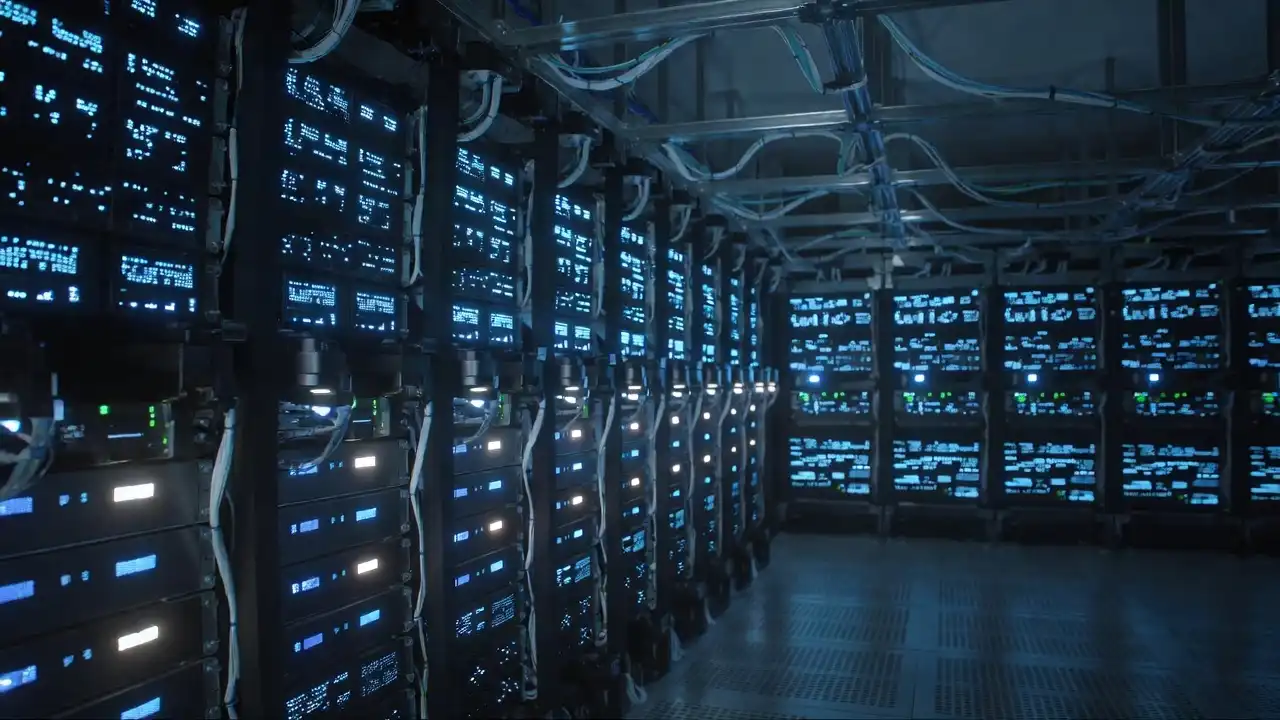
While semiconductor pioneer Nvidia captures global headlines as the undisputed symbol of the artificial intelligence boom, a specialized group of industrial power equipment and thermal cooling manufacturers is quietly reaping billions of dollars from the worldwide data center construction frenzy. As cloud hyperscalers race to deploy multi-trillion-parameter foundation models, the primary operational bottleneck has shifted from procuring silicon graphics chips to securing high-voltage electrical transformers, backup generators, and direct-to-chip liquid cooling systems.
The scale of capital pouring into the physical backbone of the digital economy is staggering. Long-term forecasts from global consultancy McKinsey project that worldwide data center capital investments will approach $7 trillion by 2030. However, bringing these high-density computing campuses online has become an immense physical challenge. While cloud providers demand facility completions in less than six months, electrical grid connection queues now stretch from 24 months in emerging markets to more than eight years across saturated technology corridors in North America and Western Europe.
This infrastructure crunch has created a multi-year super-cycle for specialized equipment suppliers across Asia, North America, and Europe. Industrial leaders, including South Korea’s HD Hyundai Electric, China’s Hainan Jinpan Smart Technology, and American power titans Vertiv, Eaton, and Schneider Electri,c are recording historic order backlogs. With high-density computing racks pushing thermal loads past 100 kilowatts per cabinet, the companies that control the physical flow of electrons and cooling fluids have become the indispensable gatekeepers of the global artificial intelligence economy.
The Physical Reality of the Artificial Intelligence Infrastructure Race
The conversation surrounding artificial intelligence is undergoing a fundamental transformation across corporate boardrooms. For two years, technology executives and public equity investors focused almost exclusively on software algorithms, token context windows, and graphics processing unit allocations.
Today, the industry is confronting the physical laws of electrical engineering, thermodynamics, and civil construction.
An artificial intelligence computing cluster does not operate like a traditional enterprise software data center. Training a massive neural network requires tens of thousands of power-hungry processors running continuously at 100% capacity, generating intense heat and demanding uninterrupted electrical baseload power.
Inside industry circles, discussions have shifted from processor availability to the physical lead times required to procure substation transformers, backup diesel turbines, and custom coolant distribution units.
Without these heavy industrial components, the most advanced computing silicon in the world remains useless, sitting in cardboard boxes on warehouse loading docks.
Unpacking the $7 Trillion Global Capital Deployment by 2030
The $7 trillion capital expenditure projection highlights the unprecedented industrial scale of the artificial intelligence buildout. Building modern computing infrastructure requires massive investments across physical real estate, high-voltage transmission lines, substation transformers, and specialized mechanical cooling loops.
The capital allocation spans multiple physical engineering tiers:
- High-Voltage Utility Substations: Constructing dedicated 345-kilovolt and 500-kilovolt substations to step down transmission grid power for server campuses.
- Power Distribution and Backup Systems: Installing uninterruptible power supplies, medium-voltage switchgear, and multi-megawatt backup generator farms.
- Advanced Thermal Management: Replacing traditional air conditioning with direct-to-chip liquid cooling manifolds, heat exchangers, and cooling distribution units.
- Clean Energy Microgrids: Deploying on-site solar arrays, industrial natural gas turbines, and battery energy storage systems to secure off-grid power.
Because every dollar spent on computing silicon requires roughly two to three dollars in complementary physical power and cooling infrastructure, equipment manufacturers are capturing an expanding share of total hyperscaler capital budgets.
Why Transformer and Generator Lead Times Trump GPU Availability
The primary pacing factor dictating the speed of the artificial intelligence revolution is no longer semiconductor foundry capacity. While semiconductor foundries have expanded advanced packaging lines to ease chip delivery bottlenecks, the supply chain for heavy electrical machinery has seized up.
Procurement data reveals severe delivery backlogs across foundational electrical components:
- Lead times for large power transformers have stretched from 50 weeks to between 150 and 200 weeks, representing delivery delays of three to four years.
- High-capacity diesel and natural gas backup generators carry procurement wait times of up to 24 months as engine manufacturers operate at full capacity.
- Medium-voltage electrical switchgear and circuit breakers face delivery backlogs ranging from 80 to 130 weeks.
- Digital infrastructure service providers report that securing physical transformers has become the single most critical gating item for project commissioning.
These manufacturing lead times have forced cloud hyperscalers to book factory assembly lines years in advance, providing heavy equipment suppliers with guaranteed revenue visibility through the end of the decade.
Grid Connection Bottlenecks Stretching Up to Eight Years
Even when a developer secures all necessary electrical hardware, connecting a 500-megawatt computing campus to the public transmission grid requires navigating massive utility backlogs.
In primary computing corridors—such as Northern Virginia’s Data Center Alley, Silicon Valley, and major European hubs like London, Frankfurt, and Dublin—regional transmission grids have reached full thermal saturation.
Utility interconnection queues have expanded to historic extremes:
- In emerging regional markets, securing permission to connect a new large-load data center takes an average of 18 to 24 months.
- In primary developed markets across North America and Western Europe, formal utility transmission connection queues now stretch beyond eight years.
- Regional grid operators must conduct exhaustive multi-year engineering studies to ensure that plugging in a multi-hundred-megawatt computing facility will not destabilize residential power grids.
- Public utility commissions are demanding that tech companies finance 100% of dedicated transmission line upgrades before receiving energization approvals.
These multi-year connection delays are driving technology conglomerates to seek alternative infrastructure arrangements, accelerating the adoption of private on-site microgrids and modular power equipment.
Electrical Equipment Heavyweights Cashing In on the Power Crunch
The structural shortage of electrical equipment has transformed industrial manufacturers into some of the most profitable corporate enterprises in the global market. Companies that spent decades operating as low-margin cyclical suppliers of grid machinery are now generating record operating margins and double-digit revenue growth.
From Asian electrical engineering giants to historic European and American equipment conglomerates, manufacturers are expanding cleanroom capacity and building automated factories to meet surging data center orders.
Examining the operational performance of these market leaders reveals how deeply the artificial intelligence infrastructure boom is lifting traditional industrial balance sheets.
HD Hyundai Electric’s $8.5 Billion Order Backlog and Transformer Surge
South Korea’s HD Hyundai Electric stands as a prime beneficiary of the global transformer deficit. As a premier manufacturer of high-voltage power transformers and medium-voltage switchgear, the Seoul-headquartered industrial giant has captured massive order volumes from American and European cloud builders.
The company’s financial disclosures highlight extraordinary operational momentum:
- The company’s total order backlog jumped by 23% in the first half of the year to reach a record $8.5 billion, up from $6.9 billion six months earlier.
- Management projects that data center infrastructure projects will account for more than 16% of its total high-voltage transformer sales over the coming fiscal periods.
- Demand across North America expanded rapidly, driven by hyperscalers constructing multi-gigawatt computing campuses in the Midwest and South.
- European demand surged as American cloud giants expanded data center construction into secondary European markets, including Finland, Germany, and the United Kingdom.
- Realized gross profit margins on specialized high-voltage equipment expanded by several hundred basis points as equipment shortages granted manufacturers immense pricing power.
HD Hyundai Electric’s rapid backlog expansion proves that heavy industrial manufacturing has become directly tied to the growth of high-technology computing.
Jinpan Smart Technology, Eaton, and Schneider Electric Powering Substations
Beyond high-voltage grid transformers, the internal power distribution inside a data center requires specialized dry-type transformers, smart switchgear, and uninterruptible power supply systems.
Leading suppliers in this segment are recording massive revenue expansions:
- Hainan Jinpan Smart Technology: China’s premier manufacturer of cast resin dry-type transformers reported surging export revenues, supplying fire-resistant internal transformers to high-density North American data center projects.
- Eaton Corporation: The American power management leader expanded its multi-billion-dollar backlog, supplying modular electrical substations, automated transfer switches, and energy-aware power distribution units designed specifically for high-density server halls.
- Schneider Electric: The French industrial automation titan captured substantial market share, delivering integrated prefabricated modular data center rooms that combine power conditioning, battery storage, and switchgear in self-contained shipping containers.
- Siemens Energy and ABB: European engineering giants, expanded production of high-efficiency gas-insulated switchgear, providing compact electrical protection for urban data centers where physical real estate is constrained.
These electrical infrastructure providers capture sticky, recurring revenue streams because data center operators standardize their electrical architectures around specific equipment vendors across global deployments.
Delta Electronics Dominating Server-Level Power Rectification
Once electricity enters a data center and steps down to commercial voltage, it must be converted from alternating current (AC) into clean, stable direct current (DC) to power sensitive microprocessors. This power conversion occurs inside specialized power supply units mounted directly within server chassis.
Taiwan’s Delta Electronics has established a near-monopoly on high-efficiency server power supplies:
- Controlling more than 50% of the global market for high-density server power supply units and power rectifiers.
- Engineering advanced 33-kilowatt power shelves that deliver 97.5% electrical conversion efficiency, minimizing power loss and internal heat waste.
- Partnering directly with semiconductor designers to co-design power delivery backplanes for next-generation computing racks.
- Scaling production of specialized DC-to-DC voltage regulator modules that sit directly adjacent to graphics processor dies to deliver thousands of amperes of clean electrical current.
As computing processors consume more power, the engineering complexity of server-level power conversion increases, allowing component specialists like Delta Electronics to command premium pricing.
The Thermal Revolution: Direct-to-Chip and Liquid Cooling Adoption
The physical heat generated by modern artificial intelligence accelerators has initiated a complete revolution in data center thermal engineering. For more than three decades, data center cooling relied on traditional air cooling: using massive mechanical fans and chillers to blow cold air through perforated floor tiles into server racks.
Air cooling reaches its physical limits when server rack power density exceeds 30 to 40 kilowatts per cabinet. Air simply cannot absorb and carry away thermal energy fast enough to prevent modern silicon dies from overheating and throttling down clock speeds.
Because next-generation artificial intelligence racks consume between 50 kilowatts and 120 kilowatts per cabinet, the entire data center industry is executing a mandatory transition toward liquid cooling.
Liquid absorbs heat approximately 3,000 times more effectively than air by volume, making liquid cooling the only viable engineering solution for modern artificial intelligence computing.
Managing 100-Kilowatt Racks in the Era of Nvidia Grace Blackwell
The catalyst accelerating the liquid cooling transition is the mass commercial rollout of advanced computing architectures, led by Nvidia’s Grace Blackwell GB200 NVL72 platform. A single GB200 rack packs 72 Blackwell processors and 36 central processing units into a single cabinet, generating over 100 kilowatts of continuous heat.
Managing this extreme thermal density requires direct-to-chip liquid cooling:
- Precision copper cold plates sit directly atop the silicon packaging, circulating closed-loop dielectric cooling fluid across heat-generating dies.
- Micro-channel fluid paths inside the cold plates extract heat directly from the chip surface with minimal thermal resistance.
- Flexible, leak-free stainless-steel fluid hoses and blind-mate quick-disconnect couplings route cooling fluid between server blades and main rack manifolds.
- Operating silicon temperatures are stabilized near 65 degrees Celsius, allowing processors to sustain peak boost frequencies without thermal throttling.
Transitioning to direct-to-chip liquid cooling lowers data center Power Usage Effectiveness to near 1.15, eliminating noisy mechanical fans and reducing facility electricity consumption by up to 20%.
Vertiv’s Dominance in Coolant Distribution Units and Chilled Water Systems
Ohio-headquartered Vertiv Holdings has emerged as the undisputed global leader in high-density data center thermal management. Vertiv designs and manufactures the complete end-to-end liquid cooling loop, from server-level cold plates and rack manifolds to massive facility-level chillers and cooling towers.
Vertiv’s technological and commercial moat rests on its integrated product architecture:
- Coolant Distribution Units (CDUs): Manufacturing high-capacity liquid-to-liquid and liquid-to-air CDUs that regulate coolant pressure, flow rates, and fluid temperatures across hundreds of connected server racks.
- Co-Engineered Reference Designs: Partnering directly with Nvidia, Intel, and AMD to develop standardized liquid-cooling reference architectures for next-generation server cabinets.
- Dedicated Liquid Cooling Mega-Plants: Expanding specialized cleanroom manufacturing capacity across North America and Europe to double monthly CDU production output.
- Comprehensive Lifecycle Services: Deploying thousands of certified field service technicians to manage closed-loop fluid maintenance, chemical filtration, and pressure testing across global data centers.
Financial analysts emphasize that once a cloud hyperscaler designs a data center around Vertiv’s integrated liquid cooling architecture, the switching costs of migrating to a competing cooling supplier become economically prohibitive.
Scaling the Global Cooling Market Toward $37.62 Billion by 2033
The transition from air cooling to advanced liquid and immersion architectures is driving an explosive expansion of the global thermal management market. Comprehensive market research reveals that the global data center cooling market is projected to grow from $13.23 billion to $37.62 billion by 2033, expanding at a compound annual growth rate of 16.1%.
The market expansion is characterized by several major technological trends:
- Direct-to-Chip Dominance: Direct-to-chip cold plate architectures are capturing over 70% of new high-density data center cooling deployments.
- Immersion Cooling Scaling: Specialized two-phase and single-phase liquid immersion tanks deployed across edge computing and extreme-density supercomputing research facilities.
- Free-Cooling Economizers: Modern chillers utilize cool ambient outside air to chill facility water loops, eliminating energy-intensive mechanical refrigeration during winter months.
- Non-Water Heat Rejection: Developing closed-loop dry coolers that dissipate heat into the atmosphere without consuming continuous evaporative municipal drinking water.
Industrial cooling conglomerates, including Johnson Controls, Carrier Global, Daikin Industries, and Trane Technologies, are investing billions of dollars to scale production of specialized data center chillers, positioning thermal management as one of the most lucrative segments of the industrial economy.
Supply Chain Realities and Sustainable Power Integration
The convergence of electrical power shortages and thermal cooling demands is reshaping how data center developers design and operate computing infrastructure. As public utilities struggle to deliver new grid connections, tech giants are forced to take direct control over their energy and cooling supply chains.
Developers are abandoning the traditional model of relying exclusively on single utility connections and standard municipal water lines.
Instead, modern data centers are being engineered as self-contained, energy-aware industrial ecosystems equipped with private on-site power generation, large-scale battery storage, and closed-loop thermal recycling.
High Switching Costs and Sticky Vendor Relationships
A defining characteristic of the data center equipment sector is extreme customer stickiness. When a cloud hyperscaler or colocation operator designs a multi-billion-dollar data center campus, the architectural engineering decisions made during the initial planning phase become locked in for decades.
Switching costs create an immense economic moat for incumbent equipment manufacturers:
- Electrical Integration: Substation transformers, medium-voltage switchgear, and uninterruptible power supply systems are engineered to work together as a unified, synchronized electrical chain.
- Software Telemetry: Proprietary building management systems and automated digital monitoring software integrate directly with the manufacturer’s specific hardware controllers.
- Maintenance Protocols: Data center operations teams are trained on specific equipment platforms, maintaining certified spare parts inventories and emergency repair workflows.
- Multi-Year Refresh Cycles: When computing servers are upgraded every three to four years, the underlying power distribution units, plumbing manifolds, and cooling loops remain in place for 15 to 20 years.
These high switching costs allow market incumbents like Vertiv, Schneider Electric, and Eaton to maintain strong pricing power, pass raw material cost increases onto customers, and generate predictable, high-margin aftermarket service revenues.
Deploying Microgrids, On-Site Gas Turbines, and Battery Energy Storage
To bypass multi-year utility connection queues, data center developers are constructing private behind-the-meter microgrids. Rather than waiting for public utilities to build new power lines, developers are generating electricity directly on-site.
The microgrid architecture combines multiple distributed energy technologies:
- Aeroderivative Natural Gas Turbines: Installing compact, fast-start gas turbines that can be deployed in 12 to 18 months, supplying 50 to 200 megawatts of dedicated on-site power.
- Stationary Fuel Cell Arrays: Deploying solid-oxide fuel cells that convert natural gas or hydrogen into electricity through electrochemical reactions without combustion, lowering local emissions.
- Utility-Scale Battery Storage: Integrating multi-megawatt-hour lithium-ion and sodium-ion battery energy storage systems to provide sub-second frequency regulation and smooth out compute spikes.
- Waste Heat Recovery: Routing warm liquid cooling return fluid into municipal district heating networks or commercial agricultural greenhouses, turning data center waste heat into usable community thermal energy.
By integrating private generation with energy-efficient liquid cooling, data center operators can energize facilities years ahead of public utility timelines while lowering operational carbon footprints.
Strategic Implications for Institutional Investors and Technology Titans
The physical realities of the data center infrastructure boom carry profound strategic implications for institutional asset allocators and technology executives. In public equity markets, institutional capital is actively broadening its exposure beyond expensive, single-stock semiconductor names into the diversified industrial enablers of the artificial intelligence economy.
Investors recognize that while competition among artificial intelligence model developers and chip designers is intense, every single artificial intelligence model requires physical electricity, electrical transformers, and liquid cooling systems to operate.
Investing in the picks-and-shovels power and cooling equipment sector provides institutional portfolios with durable, multi-year exposure to the artificial intelligence super-cycle with lower technological obsolescence risk.
Diversifying Beyond Semiconductor Stocks into Physical Industrial Enablers
The rotation of institutional capital into power and thermal equipment reflects disciplined portfolio risk management. While high-flying semiconductor stocks trade at elevated valuation multiples exceeding 30 to 40 times forward earnings, industrial equipment manufacturers offer attractive valuations backed by tangible balance sheet assets and multi-billion-dollar order backlogs.
Key financial characteristics attracting institutional capital include:
- Multi-Year Order Visibility: Equipment manufacturers holding confirmed order backlogs that extend two to four years into the future, providing predictable revenue and earnings growth.
- Margin Expansion: Supply shortages are granting equipment makers significant pricing power, driving operating profit margins toward historical highs.
- Broad Exposure: Industrial suppliers benefit from data center construction regardless of which specific tech giant or artificial intelligence model captures market share.
- Cash Flow Durability: Equipment providers generate robust free cash flows that fund progressive dividend increases, share repurchases, and strategic factory expansions.
By allocating capital across electrical machinery and liquid cooling leaders, institutional investors can capture the secular growth of the artificial intelligence revolution while insulating portfolios from software commoditization.
The Long-Term Horizon for Hyperscale Computing Infrastructure
Looking toward the end of the decade, the demand for high-performance computing infrastructure will continue to expand. The convergence of generative artificial intelligence, sovereign computing mandates, industrial robotics, and autonomous mobility will require hundreds of gigawatts of new computing capacity worldwide.
Key structural trends that will define the next decade of infrastructure development include:
- Standardized Prefabricated Modules: Data centers are transitioning entirely to factory-built modular power and cooling blocks that assemble on-site in weeks rather than months.
- Universal Liquid Cooling Standards: Direct-to-chip liquid cooling is becoming the mandatory global standard across all enterprise and cloud server racks.
- Next-Generation Clean Baseload: Computing campuses co-located directly with operational nuclear power plants and small modular reactors to secure 24/7 carbon-free electricity.
- Autonomous Facility Management: Utilizing artificial intelligence agents running inside digital twin simulations to automate real-time power routing, thermal balancing, and predictive equipment maintenance.
As the physical foundation of the digital world expands, the industrial manufacturers that power and cool the global computing engine will remain the indispensable backbone of modern technological progress.
The realization that the artificial intelligence revolution is fundamentally constrained by physical power and thermal cooling marks an essential maturation of the global technology sector. While Nvidia and software innovators dominate public headlines, the industrial equipment champions—from HD Hyundai Electric’s $8.5 billion transformer backlog to Vertiv’s market-leading liquid cooling architectures and Schneider Electric’s modular substations—are capturing the true enduring value of the $7 trillion infrastructure wave. As electrical grids saturate and server rack densities climb past 100 kilowatts, the companies that control the physical flow of electricity and cooling fluids hold the keys to the digital future. By transforming heavy industrial manufacturing into the indispensable engine of advanced computing, these power and cooling titans stand as the essential foundation powering the next century of artificial intelligence innovation.