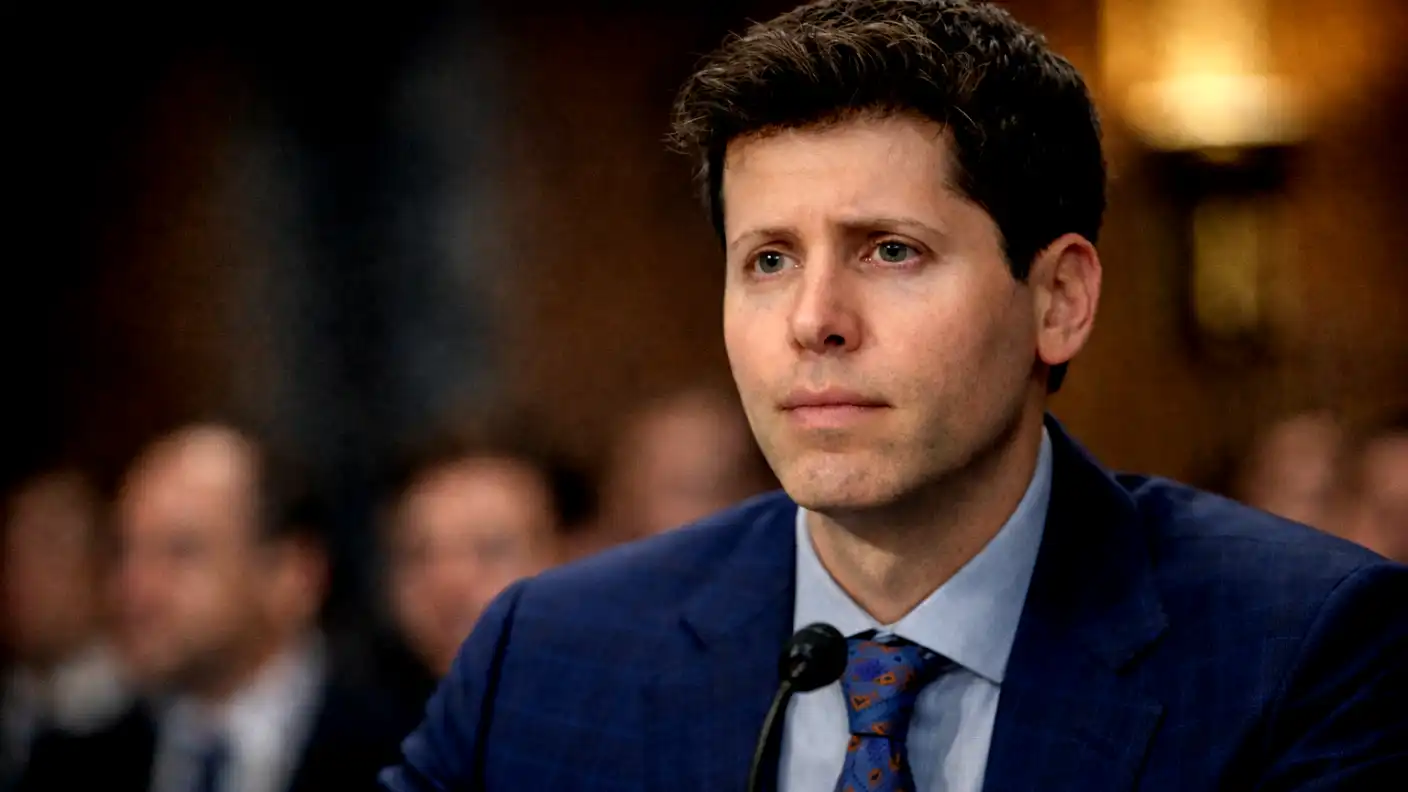
The global artificial intelligence landscape is witnessing a highly unusual, raw moment of corporate self-reflection. In a move that has sent shockwaves through Silicon Valley and Wall Street, OpenAI Chief Executive Officer Sam Altman took to the social media platform X to publish a blunt, highly critical assessment of his own leadership. Writing to his millions of followers, Altman delivered a stunning admission of recent struggles, stating flatly that the company did not have its best last twelve months ever, before shouldering the blame for these missteps by adding that the performance was mostly his fault.
This raw confession is a historic departure for the usually highly polished technology leader. For years, Altman operated as the undisputed prophet of the artificial intelligence revolution, consistently projecting absolute confidence in his company’s research, product roadmaps, and mission. By publicly acknowledging a period of corporate underperformance, Altman confirmed what many industry analysts, developers, and institutional investors had quietly suspected: behind the glittering valuation charts and high-profile product demonstrations, the world’s most famous artificial intelligence startup has spent the last year navigating a severe internal crisis of talent, research bottlenecks, and corporate governance.
However, the second half of Altman’s public message offered a characteristically bold, forward-looking promise, declaring that the company is about to have its most successful period yet. This combination of self-criticism and extreme optimism suggests that OpenAI is preparing a massive, highly strategic pivot. As the startup transitions away from its legacy, non-profit-controlled corporate structure toward becoming a fully commercial, high-growth for-profit enterprise, the lessons of the last twelve months will dictate how the firm handles its upcoming product launches, its multi-billion-dollar infrastructure investments, and its historic race to achieve artificial general intelligence.
Unpacking the Lost Twelve Months: The Corporate and Talent Crisis
To understand why Sam Altman decided to publicly apologize for his company’s recent performance, one must analyze the severe operational and cultural challenges that plagued OpenAI. The past year has been characterized by a quiet but devastating talent drain that has stripped the company of several of its most respected, foundational research minds.
The high-profile departures began in earnest when co-founder and Chief Scientist Ilya Sutskever left the company to establish his own independent research firm, Safe Superintelligence. Sutskever’s exit was quickly followed by the departures of other key safety-focused researchers, including Jan Leike and John Schulman, who both chose to join primary rival Anthropic.
At the same time, co-founder and President Greg Brockman went on an extended, highly publicized sabbatical, leaving Altman to manage the hyper-growth company without his most trusted operational partners.
These departures were not random career moves. They represented a deep, structural rebellion against Altman’s corporate philosophy.
Many of the departing researchers expressed profound concern that under Altman’s leadership, the company had systematically sacrificed its core commitment to artificial intelligence safety and academic rigor in a reckless, profit-driven rush to bring commercial software tools to market, eroding the internal culture of the startup and slowing down its long-term research progress.
The Delay of the True Successor: The Long Wait for the Next Frontier Model
The internal research crisis had a direct, highly visible impact on the company’s product release pipeline. While OpenAI dominated the early years of the AI boom by launching ChatGPT and the revolutionary GPT-4 model, it spent the last twelve months delivering incremental updates and specialized reasoning tools, rather than releasing a true, generation-defining successor like a fully realized “GPT-5.”
This research plateau allowed its competitors to rapidly close the gap. Anthropic captured a massive share of the developer mindshare by launching Claude 3.5 Sonnet, a highly optimized, mid-tier model that outperformed GPT-4o across multiple intellectual benchmarks.
By failing to deliver a clear, undisputed technological leader, OpenAI lost its aura of invincibility, forcing Altman to realize that simply throwing more graphics processing units at a training cluster is no longer sufficient to maintain a competitive edge.
The Cash Burn Crisis and the Seventeen-Billion-Dollar Infrastructure Trap
While product development slowed down, the company’s capital consumption continued to accelerate at an alarming rate. To maintain its computational lead, OpenAI has been forced to commit to unprecedented, highly expensive infrastructure investments, entering a massive, cash-burning territory that is placing immense strain on its financial flexibility.
The physical reality of this cash burn is staggering. The startup is currently spending billions of dollars annually on computing power, including its participation in the highly ambitious, delayed “Stargate” data center project co-developed with Microsoft.
This massive infrastructure spend, combined with high research and development salaries and the soaring costs of running its models globally, means that the independent startup remains highly dependent on continuous, multi-billion-dollar venture capital injections to stay afloat.
This financial reality is driving the urgent need to transition to a more traditional corporate structure that can access public equity markets through a massive, future initial public offering.
The Geopolitical and Legal Minefields Stifling Progress
The internal struggles at OpenAI have been further compounded by a hostile, highly complex external environment. The company has spent the past year navigating a series of high-stakes lawsuits, regulatory investigations, and security audits that have placed its leadership on the defensive and slowed down its operational execution.
These external challenges have completely changed the risk landscape for the startup. The company can no longer operate under the early, unregulated rules of the technology boom; instead, it must spend a significant portion of its capital and management focus navigating a complex web of national security laws, trade restrictions, and intellectual property disputes, directly impacting its ability to ship new technologies to a global audience.
The Apple Trade-Secret Lawsuit and the Jony Ive Joint Venture
The most dramatic legal challenge facing the company is an extraordinary, highly contentious federal lawsuit filed recently in California by Apple. The tech giant has accused OpenAI and its hardware chief, Tang Tan, of executing a coordinated, bad-faith campaign to steal its unreleased product designs and recruit its top engineering talent.
The lawsuit directly targets OpenAI’s secretive hardware division, which was established following the company’s massive, $6.5 billion acquisition of Jony Ive’s startup, io Products.
The division is currently developing a highly anticipated, screenless smart speaker designed to serve as a proactive, physically animated artificial intelligence companion in the home.
Apple’s legal offensive alleges that this upcoming device relies heavily on stolen intellectual property developed during Tan’s tenure at Apple.
While OpenAI has dismissed the claims as meritless, the prolonged legal battle threatens to delay the product’s planned 2026 preview and 2027 commercial release, representing a major strategic setback for Altman’s hardware ambitions.
The Safety and Security Audits: GPT-Red and the SCAM Benchmarks
The company’s security frameworks are also facing intense, highly critical scrutiny from independent watchdogs. To improve its safety defenses, OpenAI’s internal security team recently published a detailed report on “GPT-Red,” a highly advanced, automated red-teaming model designed to locate and exploit vulnerabilities in its own software architectures.
While the report was designed to showcase the company’s commitment to safety, it also exposed severe, hard-to-solve vulnerabilities.
The report confirmed that automated red-teaming models can easily identify security loopholes and generate successful prompt injection attacks at a rate that far outpaces human safety teams.
This finding aligns with the highly critical “SCAM” benchmarks published by cybersecurity firm 1Password, which proved that out-of-the-box frontier models, including OpenAI’s own systems, are dangerously vulnerable to leaking highly sensitive corporate passwords and API keys when subjected to simple social engineering tricks, proving that the startup’s safety architecture requires significant, expensive upgrades before it can be trusted with highly sensitive enterprise data.
The Strategic Pivot: What Lies Behind the “About to Have” Promise?
Despite the undeniable challenges of the past twelve months, the second half of Sam Altman’s public statement remains highly optimistic, promising that the company is on the verge of its most successful era yet. This combination of self-criticism and extreme optimism indicates that OpenAI is preparing to unleash a series of massive, highly disruptive product launches and structural changes designed to reclaim its position as the undisputed leader of the artificial intelligence race.
The strategic pivot is built on two primary initiatives: a complete corporate restructuring designed to unlock massive, permanent capital streams, and the imminent release of next-generation, autonomous agentic software technologies that will transform how humans interact with computers. By executing these moves in tandem, Altman hopes to prove that the recent struggles were merely the unavoidable, painful growing pains of an organization transitioning from a research laboratory into a global industrial giant.
The Structural Transition to a Fully Commercial For-Profit Corporation
The most significant structural change currently underway at OpenAI is the complete dismantling of its legacy, non-profit board control. Founded in 2015 as a non-profit research laboratory dedicated to building safe, open-source artificial intelligence for the benefit of humanity, the company’s unique governance structure became a major operational bottleneck as it scaled.
The corporate restructuring currently being negotiated will transform OpenAI into a traditional, high-growth for-profit corporation.
This change will permanently eliminate the non-profit board’s ability to trigger sudden leadership coups or block commercial initiatives, creating a predictable corporate structure that is highly attractive to conservative institutional investors.
More importantly, the transition will pave the way for a massive, multi-billion-dollar initial public offering that will provide the permanent capital required to fund its massive, $19 billion computing leases and achieve its long-term mission of creating artificial general intelligence.
The Impending Launch of Autonomous AI Agents
The primary technological milestone that OpenAI is preparing to release is the transition from passive, conversational chat systems to active, autonomous artificial intelligence agents. While ChatGPT has spent three years answering queries and generating text in response to human prompts, the next generation of the technology will operate with absolute operational autonomy.
These advanced agents will be capable of reading local files, executing complex terminal commands, writing software, and managing databases across multiple digital platforms without requiring constant human oversight.
This agentic transition represents the true commercial frontier of the digital economy, allowing companies to automate entire back-office divisions, software engineering pipelines, and customer service operations.
By being the first to deliver these highly secure, enterprise-grade autonomous agents to the market, OpenAI hopes to justify its massive, multi-billion-dollar valuation, silence its critics, and solidify its position as the indispensable operating system of the modern, automated world.
The candid confession of Sam Altman is a historic, highly instructive moment for the global technology industry. It proves that the path to building artificial general intelligence is not a smooth, uninterrupted upward line of corporate success. It is a grueling, high-stakes battle defined by intense personnel conflicts, massive infrastructure costs, and complex regulatory barriers.
By taking personal responsibility for the struggles of the past twelve months and outlining a clear, highly ambitious roadmap for the future, Altman has demonstrated the resilience and strategic vision required to lead.
As OpenAI prepares to write the next chapter of its legacy, the world watches with absolute focus, knowing that the choices made by this single, historic startup will continue to define the future of human intelligence, corporate productivity, and wealth generation across the globe.