Key Points:
- Four European technology companies pledged a combined $165 million in foreign direct investment to South Korea.
- South Korea and the European Union signed a landmark Digital Trade Agreement to streamline digital commerce.
- The agreements cover critical futuristic sectors, including quantum computing, semiconductors, and advanced displays.
- Leaders also established a high-level economic dialogue and an energy-focused vice-ministerial forum.
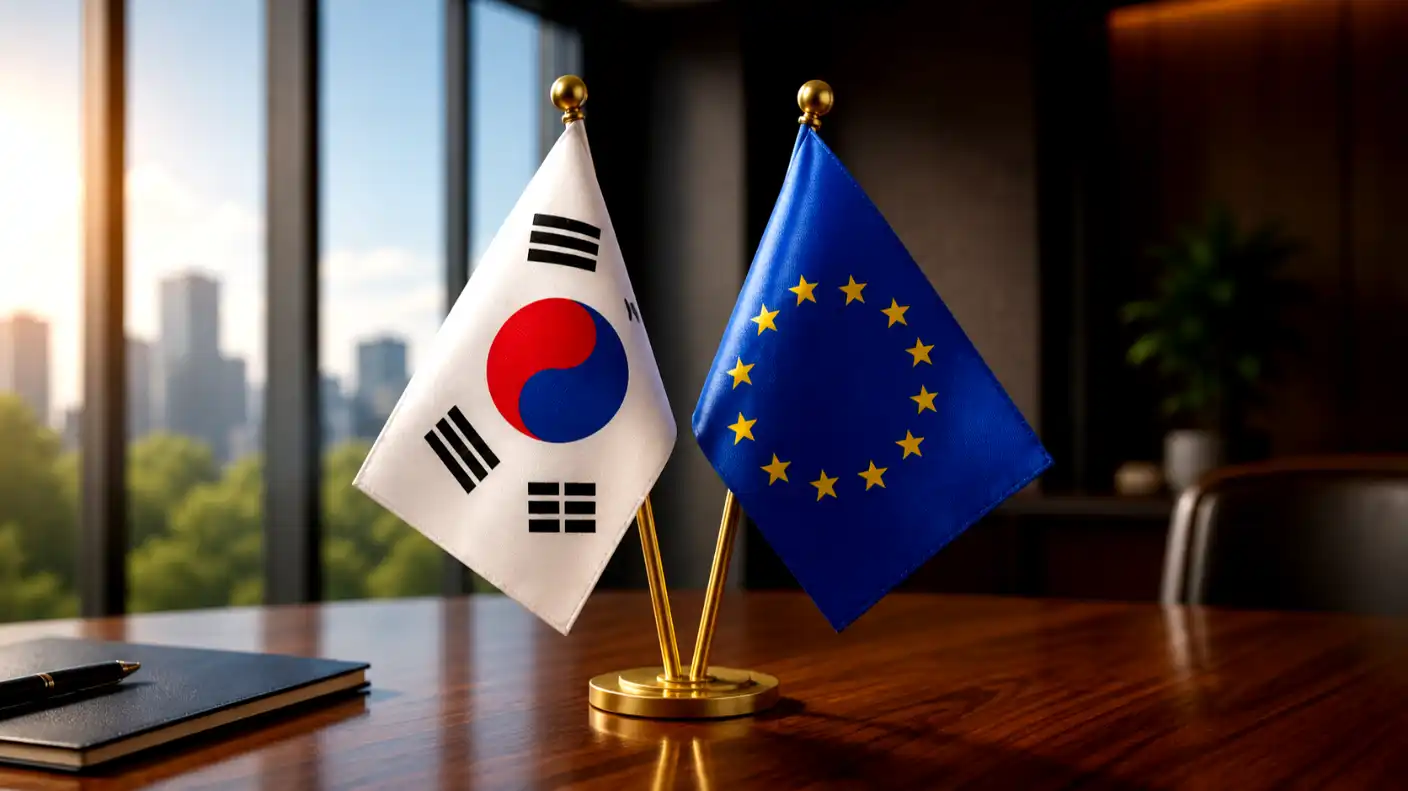
South Korea has successfully secured $165 million in foreign direct investment from four major European technology companies while simultaneously signing a landmark digital trade agreement with the European Union. These dual developments signal a significant deepening of economic and technological cooperation between Seoul and Brussels. The agreements materialized during the recent EU-South Korea Summit in Brussels, marking the first formal summit between the two strategic partners in three years. In an era of heightened geopolitical risks, global trade protectionism, and rapid technological shifts, both economies have prioritized building resilient supply chains and cutting digital red tape to foster mutual growth.
The $165 million in foreign direct investment targets key futuristic industries, emphasizing South Korea’s growing role as a global hub for advanced technology. Four companies from Germany, France, the Netherlands, and Sweden officially committed the funds during a specialized investment ceremony co-hosted by South Korea’s Ministry of Trade, Industry and Energy and the Korea Trade-Investment Promotion Agency. The capital injection, equivalent to roughly 250 billion won, will support local research and manufacturing operations in the semiconductor, quantum computing, advanced materials, and display sectors.
Each of the four European companies plans to use South Korea as a strategic launchpad for regional expansion. Germany’s advanced materials company Orafol intends to expand production facilities at a local reflective film manufacturer it acquired last year, aiming to establish South Korea as its primary export hub for the Asia-Pacific market. Meanwhile, French quantum computing pioneer Quandela will build out its local research, development, and manufacturing capacity. This investment aims to position South Korea as a key manufacturing base for quantum technology while fostering collaborative academic and industrial research programs.
The other two investors will directly support South Korea’s world-leading semiconductor and display industries. Prodrive Technologies, based in the Netherlands, plans to establish a local subsidiary focused on producing high-precision equipment modules for semiconductors and other advanced manufacturing sectors. Depending on the subsidiary’s market performance, the Dutch firm will consider building dedicated local research and manufacturing hubs. Additionally, Sweden’s Mycronic will scale up its operations to turn South Korea into a primary research and development hub for laser equipment used in display and semiconductor photomask production.
Beyond the physical capital investments, the signing of the digital trade agreement represents a massive leap forward for cross-border e-commerce. The new agreement supplements the existing EU-Korea Free Trade Agreement, which has governed bilateral trade since it entered into force in 2011. This pact marks only the second digital trade agreement South Korea has signed with an international partner, following a similar digital partnership with Singapore. The deal seeks to modernize bilateral transactions, reduce operating costs for small and medium-sized businesses, and establish uniform rules of the road for the rapidly expanding digital economy.
The agreement introduces binding, high-standard rules that recognize the legal validity of electronic contracts and facilitate the widespread use of digital signatures. To protect corporate intellectual property, the treaty explicitly prohibits governments from forcing companies to hand over their source code as a condition for market entry. It also removes unjustified barriers to cross-border data flows, making it far easier for multinational firms to coordinate operations. Crucially, the agreement achieves these updates while fully preserving the robust personal data protection and consumer privacy regulations established under European and South Korean laws.
To ensure these agreements deliver long-term benefits, both sides agreed to build new institutional frameworks for constant communication. South Korea and the EU will establish a high-level economic dialogue focused on economic security, trade policies, and supply chain resilience. This dialogue will help both partners coordinate their positions on emerging industrial challenges, such as the EU’s Carbon Border Adjustment Mechanism and ongoing tariff disputes. Simultaneously, the climate ministries of both regions agreed to launch a vice-ministerial dialogue to negotiate clean energy and climate transition initiatives.
The economic and technological announcements coincided with high-level geopolitical discussions among South Korean President Lee Jae-myung, European Council President António Costa, and European Commission President Ursula von der Leyen. The leaders noted that economic security and defense security have become completely inseparable in the modern geopolitical landscape. To address these overlapping threats, the partners also agreed to launch negotiations on a new Security of Information Agreement. This upcoming defense pact will enable Brussels and Seoul to safely share classified intelligence, creating a robust shield against global instability and supply chain disruptions.