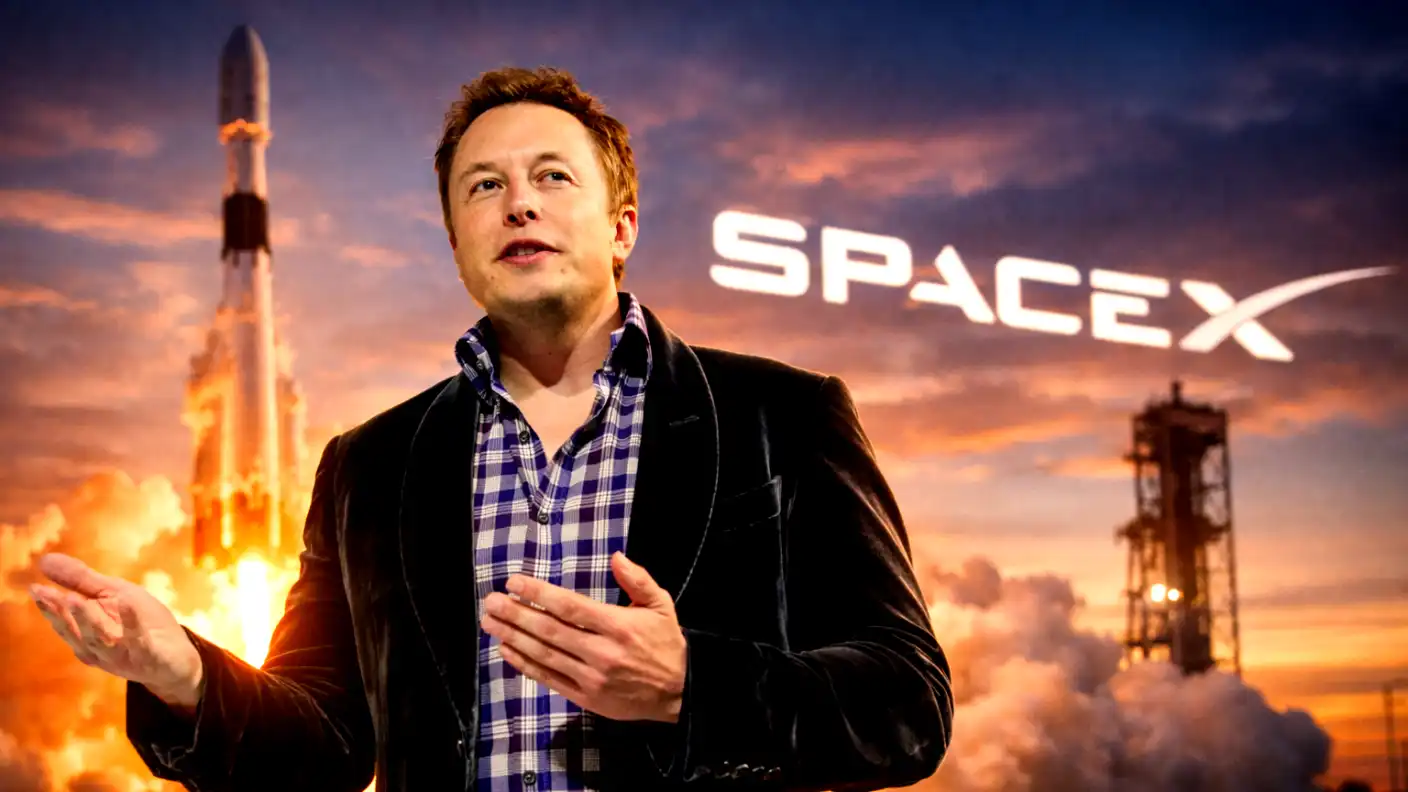
The initial public offering of Elon Musk’s rocket and satellite giant, SpaceX, has rapidly transitioned from a historic celebration into a stark lesson in market volatility. As United States equity markets reopened on Monday morning following a holiday weekend, SpaceX shares faced immediate pressure, falling as much as 4.6% in active premarket trading. The early-morning decline put the stock on track for its third consecutive session of losses, signaling that the initial post-IPO euphoria is fading. Investors are now shifting their focus toward the company’s complex financial realities and highly aggressive expansion strategies.
The premarket slide follows a volatile ending to the stock’s first week on the public exchange. After launching on the Nasdaq under the ticker symbol SPCX, the company experienced a spectacular three-day rally that defied typical market gravity. However, the momentum reversed sharply during the final two trading sessions of the shortened week, with shares sliding 5% on Wednesday and dropping another 6.4% on Thursday to close at $179.62 per share. Despite these consecutive drops, the stock still trades more than 30% above its initial public offering price of $135. However, this early pullback has highlighted deep concerns among institutional analysts regarding the company’s multi-trillion-dollar valuation, its high cash burn rate, and its massive debt obligations.
The Mechanics of the Historic Public Debut and the Sudden Pullback
The market launch of SpaceX was highly anticipated by investors, marking the largest initial public offering in United States history by capital raised. Underwriters originally priced the offering at $135 per share, valuing the company at roughly $1.75 trillion to $1.80 trillion. The IPO raised an initial $75 billion, a figure that climbed to $85.7 billion after financial institutions exercised their overallotment “greenshoe” options. Demand for the shares was incredibly high, with reports indicating that the order book was more than four times oversubscribed before the stock even began trading on the public market.
During its first day of trading, the stock opened at $150 per share, representing an immediate 11% premium over the listing price, before closing the day at $160.95. This early momentum grew over the next two sessions, pushing the stock to an all-time intraday high of $225.64. At its peak, the total market capitalization of SpaceX ballooned to a staggering $2.65 trillion. This massive valuation allowed the company to briefly surpass Amazon and approach Microsoft, making it the fourth-largest publicly traded corporation in the world. However, this valuation proved unsustainable in the short term, and the stock quickly began shedding value as the market closed out the week.
The Transition From Euphoria to Profit-Taking
The turning point for the stock occurred on June 16, when exchanges officially listed options contracts for SpaceX. The introduction of these derivative contracts gave institutional traders and retail investors the ability to establish short positions or purchase protective put options to hedge their gains. This immediate increase in hedging tools coincided with a wave of profit-taking from early buyers who wanted to secure their rapid gains from the opening sessions.
The shift in investor behavior is clearly reflected in the retail purchasing data. According to financial tracking firm Vanda Research, individual retail investors aggressively bought up SpaceX shares during its first three days of public trading, executing net purchases worth more than $300 million. However, this retail buying pressure dried up rapidly toward the end of the week. Net retail purchases fell to just $9.1 million during Thursday’s trading session, leaving the stock vulnerable to institutional selling and short-selling pressure as market participants reassessed the company’s steep valuation multiples.
Broad Pressures Across the Space Sector
The downward pressure on SpaceX shares has had a noticeable ripple effect across the entire aerospace and space technology sector. On the final trading days of the previous week, several other prominent publicly traded space companies also experienced significant declines. Rocket Lab and Planet Labs saw their share prices drop by approximately 3%, while satellite connectivity provider AST SpaceMobile fell by nearly 7%. Similarly, lunar lander developer Intuitive Machines recorded a 3% decline.
This sector-wide pullback suggests that the cooling enthusiasm for SpaceX is prompting investors to take a more conservative approach toward the entire space economy. During the run-up to the SpaceX IPO, speculative capital flowed into smaller space equities, driven by the belief that a blockbuster debut would raise valuations across the industry. Now that the market leader is undergoing a reality check, portfolio managers are scaling back their exposure to high-beta, capital-intensive aerospace companies, choosing instead to wait for stable price floors to be established.
Assessing the Fundamentals: The High Cost of the SpaceX Empire
As the excitement surrounding the stock market listing cools, financial analysts are examining SpaceX’s underlying balance sheet, which was made public through its S-1 registration filings with the Securities and Exchange Commission. The financial disclosures reveal a business of massive scale, but one that also carries substantial structural losses and immense capital requirements to sustain its multi-pronged business model.
Currently, SpaceX operates as a three-engine conglomerate. It combines its dominant satellite launch infrastructure, its global Starlink satellite broadband network, and its newly consolidated artificial intelligence operations. While each division boasts strong growth potential, they each require massive capital investments. This reality has raised questions about whether the company can achieve sustainable profitability in the near term.
The Revenue Gap and Massive Net Losses
SpaceX’s core financial performance highlights the steep premium that public investors are currently paying for the stock. In its full-year 2025 financial disclosures, the company reported a total revenue of $18.67 billion, which represents a solid 33% increase compared to the previous year. However, this revenue growth did not translate into profitability. The company posted a deep net loss of $4.94 billion for the full year, driven by the immense costs of constructing its next-generation Starship launch vehicles and expanding its low-Earth-orbit satellite fleet.
The financial strain became even more visible in the first quarter of 2026. During those first three months, SpaceX recorded a net loss of $4.28 billion, nearly matching its entire loss from the previous year. At its peak stock price of $225.64, the company was trading at an estimated 67 times its trailing sales. This valuation multiple is roughly three times higher than the revenue multiple of semiconductor giant Nvidia, which is historically considered highly valued. Independent analysts at Morningstar had warned investors before the IPO that the stock was significantly overvalued, placing the company’s actual fair value closer to $780 billion—less than half of its listing valuation.
The Dilution Risk of the $60 Billion Anysphere Acquisition
Adding to the valuation debate is SpaceX’s sudden announcement of a massive corporate acquisition just days after going public. The company confirmed that it will acquire Anysphere, the software startup behind the popular artificial intelligence coding assistant Cursor, for $60 billion. The strategic goal of the acquisition is to merge Anysphere’s AI software capabilities with SpaceX’s massive Starlink telecommunications network and the operations of xAI, an artificial intelligence startup that Musk previously folded into the SpaceX corporate umbrella.
While the acquisition aligns with Musk’s vision of building a vertically integrated technology powerhouse, the financial structure of the deal has raised red flags on Wall Street. The $60 billion transaction will be funded entirely through an all-stock swap. To pay for the acquisition, SpaceX must issue a massive volume of new Class A common shares. This substantial issuance of new equity will dilute the ownership stakes of the public shareholders who just purchased stock at the IPO, increasing the total supply of shares on the market and putting immediate downward pressure on the stock price.
Debt Restructuring and Governance Realities
Aside from equity dilution, SpaceX is also preparing to navigate a major transition in its corporate debt structure. Financial institutions working with the company are preparing to approach institutional fixed-income investors to market a massive, dollar-denominated bond offering. This capital raise represents another major step in the company’s financial evolution.
The planned debt issuance highlights the complex balance sheet that SpaceX must manage. While the company has successfully unlocked the public equity markets to fund its long-term strategic projects, it must still service a heavy load of short-term and long-term liabilities that require constant refinancing.
The Upcoming $20 Billion Investment-Grade Bond Sale
The proposed bond offering is expected to raise at least $20 billion, marking SpaceX’s first-ever entry into the investment-grade corporate debt market. Investment bankers are scheduled to begin formal calls with prospective debt buyers to gauge market interest and determine pricing. The primary purpose of this massive bond sale is to raise the necessary funds to refinance a temporary $20 billion bridge loan facility.
This bridge loan represents a significant portion of the company’s outstanding liabilities. According to the SEC filings, the bridge facility accounts for the vast majority of the $29.1 billion in long-term debt that SpaceX carried on its balance sheet as of March 31. The bridge loan is scheduled to mature in September 2027. By converting this short-term bridge facility into long-term, fixed-rate investment-grade bonds, SpaceX hopes to lock in stable interest payments and extend its debt maturity profile. However, issuing $20 billion in new debt so soon after a record-breaking IPO could weigh heavily on investor sentiment, as fixed-income investors will demand strict financial covenants and a clear path toward positive cash flow.
Total Control and the Governance Bottleneck
Another critical factor that public investors must accept when buying SpaceX shares is the absolute concentration of voting power in the hands of its founder. Elon Musk maintains near-total control over the company’s strategic direction. He currently controls approximately 42% of the outstanding equity but holds a dominant 85% of the total voting power. This structure means that public shareholders have virtually no ability to influence corporate policy, elect board members, or push back against major strategic decisions like the $60 billion Anysphere acquisition.
To address corporate governance concerns, SpaceX recently appointed veteran venture capitalist Roelof Botha to its board of directors as an independent director and a member of its audit committee. Botha, a managing partner at Sequoia Capital, has a long history of working with Musk, having served as the chief financial officer of PayPal during its early years. While Botha’s appointment brings deep corporate oversight and financial experience to the board, the reality remains that SpaceX operates under a dual-class share structure that shields Musk from any pressure from activist investors or public shareholders.
What Lies Ahead for Investors as the Market Stabilizes
The rapid rise and subsequent fall of SpaceX shares during its first two weeks of trading illustrate the immense speculative forces at play in the modern market. For many retail investors, buying SPCX shares is less about near-term cash flows and more about participating in a historic technological narrative. Under Musk’s leadership, the company has achieved unprecedented engineering milestones, including the successful landing and reuse of orbital-class rocket boosters and the rapid deployment of a global satellite internet constellation that now serves millions of customers worldwide.
However, institutional portfolio managers must focus on the numbers. At a valuation of over $2.5 trillion, SpaceX must show that its satellite internet business can generate high-margin recurring revenues that are large enough to offset the massive capital expenditures required to build and launch its Starship rockets. Additionally, the company must prove that its expensive push into artificial intelligence will yield commercial software tools that can justify the multi-billion-dollar acquisition costs.
In the coming weeks, the stock’s performance will likely depend heavily on the outcome of the $20 billion bond offering and the upcoming U.S. inflation data. If credit markets show strong demand for SpaceX’s investment-grade bonds, it will reassure equity investors that the company has secure, long-term access to capital. Conversely, if bond buyers demand high interest rates to hold the company’s debt, it could trigger further profit-taking in the stock, dragging shares down toward their initial offering price. As the market enters this critical phase of price discovery, investors should expect continued volatility as Wall Street works to find a realistic valuation for the world’s most valuable aerospace company.